Equipment
The Handley Page Hampden
A narrow twin-engined bomber, the "flying suitcase": for three years it took bombs and mines to Germany, then ended as a torpedo bomber, in Soviet hands too.
- Role:
- medium bomber
- State:
- United Kingdom
- Maker:
- Handley Page
- First flight:
- 21 June 1936
- Built:
- about 1,430
- Author:
- Łukasz
- Updated:
- 1 November 2026
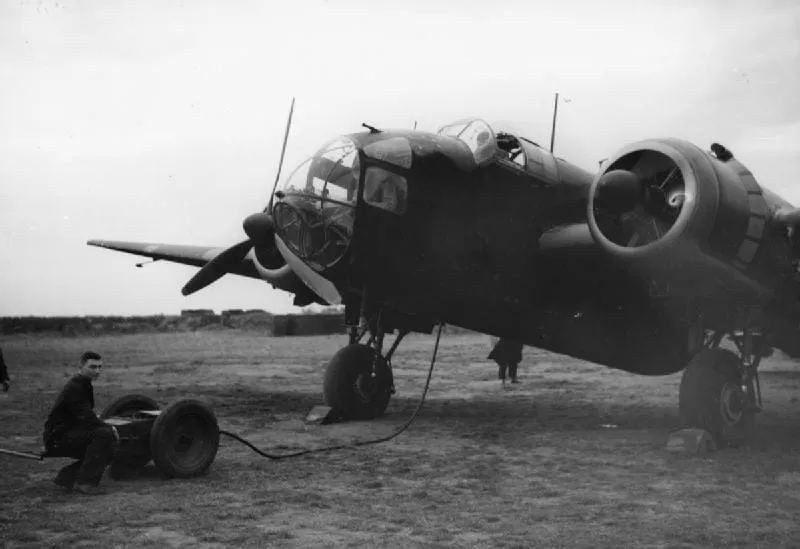
The Handley Page Hampden was the least known of the three twin-engined bombers which in 1939–1941 carried the whole British air offensive against Germany on their wings. Beside the Wellington and the Whitley it stood out for its shape: a deep, very narrow fuselage ran into a thin tail boom, and its airmen, squeezed inside with no way of changing places, called it the “flying suitcase”. It was fast and manoeuvrable but lightly armed, so after the first daylight raids it moved to night operations. With it the RAF began mining German waters on a large scale, and its crews won two of the bomber force’s first Victoria Crosses.
Narrow and fast
The Hampden answered the same Air Ministry requirement of 1932 as the Wellington. The Handley Page team, in which the German-born engineer Gustav Lachmann played a key role, aimed for low drag: the fuselage was only about a metre wide, the pilot sat high as in a fighter, and the gunners worked single hand-held machine guns instead of turrets. The prototype flew at Radlett on 21 June 1936, in August the ministry ordered 180 aircraft, and in the second half of 1938 No. 49 Squadron received the first of them. Hampdens were also built by English Electric and by factories in Canada, and in Belfast a Hereford version was made with Napier engines so unreliable that most of these aircraft were converted into Hampdens.
The daylight lessons of 1939
In September 1939 Arthur Harris took command of No. 5 Group, made up of the Hampden squadrons in Lincolnshire. As early as 4 September, the day of the first RAF raids, eighteen Hampdens searched the sea for German warships. On 29 September eleven aircraft of No. 144 Squadron attacked destroyers near Heligoland and fighters shot down five of them. Hand-held guns could not hold off the Messerschmitts. Harris pushed through twin guns at the gun positions, and the aircraft received extra armour, but after the December defeat of the Wellingtons over the Heligoland Bight the Hampdens, like the whole heavy part of Bomber Command, moved to night operations.
The nights of 1940
On the night of 19–20 March 1940 twenty Hampdens and thirty Whitleys attacked the seaplane base at Hörnum on the island of Sylt in retaliation for the raid on Scapa Flow. It was the first British attack on a target on German soil, and the reports of damage turned out to be greatly exaggerated. From April No. 5 Group began dropping mines in the shipping lanes off Germany and Denmark; the airmen called it “gardening”, and according to some accounts the Hampdens laid more mines in the first half of the war than any other type, at small cost. On the night of 15–16 May, 36 Hampdens flew in the first raid on the Ruhr.
In the summer of 1940 Hampdens repeatedly attacked the aqueduct of the Dortmund-Ems Canal, along which barges sailed from the Ruhr towards the coast. On the night of 12–13 August Flight Lieutenant Roderick Learoyd of No. 49 Squadron went down very low over it under anti-aircraft fire and received the Victoria Cross. Two weeks later Hampdens flew in the first raid on Berlin, from which several, their tanks empty, ditched on the way home. In September they bombed the barges gathered for the invasion of England, and over Antwerp eighteen-year-old Sergeant John Hannah fought the fire in a burning Hampden of No. 83 Squadron, for which he received the Victoria Cross. The losses inflicted on the barges in the ports were one of the reasons why Hitler postponed the invasion.
The last years in Bomber Command
In 1941 the Hampdens, with the Wellingtons and Whitleys, remained the core of the night raids over Germany, and they also supported landings such as the Vågsøy raid in December 1941, where they dropped smoke bombs. In 1942 No. 5 Group was re-equipping with Manchesters and Lancasters, but 79 Hampdens still took part in the thousand-bomber raid on Cologne. They flew with Bomber Command for the last time on the night of 14–15 September 1942, when the Canadian No. 408 Squadron bombed Wilhelmshaven.
Torpedo bomber and the flight to Russia
From the spring of 1942 Hampdens with a torpedo under the fuselage flew with Coastal Command in British, Australian, Canadian and New Zealand squadrons, attacking shipping off Norway. In September 1942 No. 144 Squadron and the Australian No. 455 flew from Shetland to the airfield at Vaenga near Murmansk, to defend convoy PQ 18 should German warships sail. Of 32 aircraft, eight or nine crashed or were lost on the way. No attack came, and in October the remaining Hampdens were handed over to the air arm of the Soviet Northern Fleet, which flew them until mid-1943. In Coastal Command the last squadron gave them up in December 1943.
About 1,430 Hampdens were built: 500 by Handley Page, 770 by English Electric and 160 in Canada, where they served in an operational training unit on Vancouver Island. One of those Canadian aircraft, which sank in Saanich Inlet in November 1942, was raised in 1985 and rebuilt, and today stands in the aviation museum at Langley; the RAF Museum has recreated the fuselage of a second one.
Sources
In the chronicle
(23)1940
- 16 March 1940The Scapa Flow raid and the first civilian death
- 15 May 1940The RAF begins bombing the Ruhr
- 12 July 1940Air raids on Wales and Scotland
- 25 August 1940The first RAF raid on Berlin
- 17 September 1940Hitler postpones Operation Sea Lion
- 24 September 1940A major RAF raid on Berlin
- 25 October 1940RAF raids on Berlin and Hamburg
- 16 December 1940The raid on Mannheim
1941
1942
- 13 March 1942Gee raids on the Ruhr
- 28 March 1942The bombing of Lübeck
- 5 April 1942RAF raids on Cologne and Hamburg
- 30 May 1942The thousand-bomber raid on Cologne
- 2 June 1942The thousand-bomber raid on Essen
- 25 June 1942The thousand-bomber raid on Bremen
- 27 July 1942The RAF raid on Hamburg of 26/27 July
- 10 September 1942The raid on Düsseldorf
- 14 September 1942Convoys PQ 18 and ON 127