United Kingdom
Arthur Harris
Commander of No. 5 Bomber Group RAF (1939–1940), Deputy Chief of the Air Staff (1940–1941), Commander-in-Chief of RAF Bomber Command (1942–1945), Marshal of the RAF (1946)
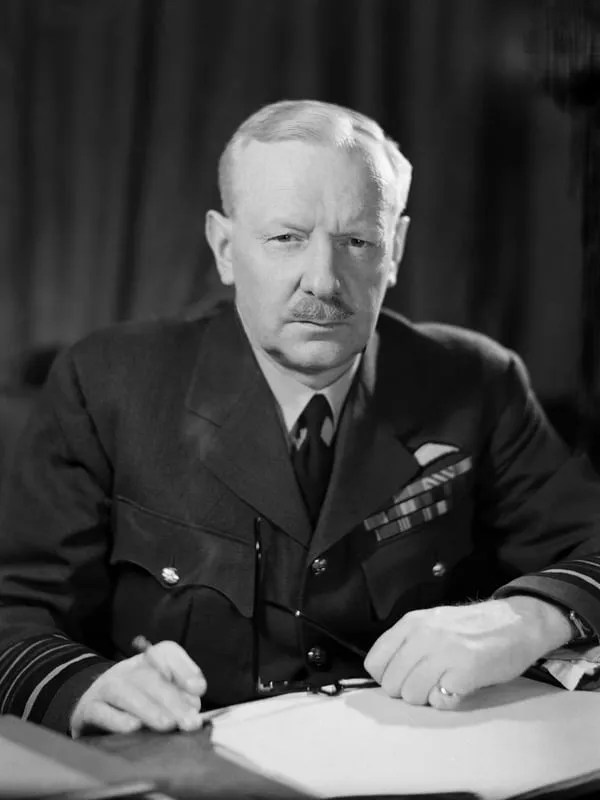
- Born:
- 13 April 1892, Cheltenham (England)
- Died:
- 5 April 1984, Goring-on-Thames (England)
- Author:
- Łukasz
- Photo:
- Fg Off Stannus, Royal Air Force official photographer, domena publiczna, Wikimedia Commons

For more than three years, from February 1942 to the end of the war in Europe, Arthur Travers Harris commanded Britain’s bomber force, RAF Bomber Command. The press called him “Bomber Harris”, and his airmen, with a mixture of respect and irreverence, “Butcher” or “Butch”. He did not invent the night bombing of whole urban areas – that course had been set by an Air Ministry directive issued a week before he took command – but it was he who turned it into a methodical campaign and defended it with unshakeable conviction for the rest of his life. Under his command Bomber Command burned Lübeck, sent a thousand bombers over Cologne, destroyed Hamburg and shared in the destruction of Dresden. To some he was the commander who, during the years when there was no land front in western Europe, alone carried the war into the heart of Germany. To others he was the symbol of a policy that made the civilian population a target.
Rhodesia and the First World War
He was born on 13 April 1892 in Cheltenham, Gloucestershire, where his parents were on leave. His father was an engineer in government service in India, so the boy grew up largely away from his parents, partly in a clergyman’s family in Kent. He was educated at Allhallows School in Devon. In 1910, aged seventeen, and against the wishes of his father, who saw him in the army or the civil service, he left for Southern Rhodesia. There he worked in a mine, drove a stagecoach and ran a farm. According to his biographer Henry Probert, from then on he regarded himself first and foremost as a Rhodesian. Some accounts give 1908 as the year of his departure, but his biographies point to early 1910.
When war broke out in August 1914 Harris was in the bush and learned of it only nearly a month later. He enlisted in the 1st Rhodesia Regiment as a bugler, since that was the only place left, and in 1915 went through the campaign in German South West Africa with it. He remembered the long marches across the desert for the rest of his life, later writing that from then on he never walked a step if he could ride. After the regiment was disbanded he sailed for England in 1915 and on 6 November became a second lieutenant in the Royal Flying Corps. He learned to fly at Brooklands. In 1917 he fought in France with No. 45 Squadron, flying the Sopwith 1½ Strutter and the Sopwith Camel, and was credited with five enemy aircraft. He ended the war as a major commanding a home defence squadron, decorated with the Air Force Cross. In 1916 he married Barbara Money, with whom he had three children.
An airman of the Empire
Harris stayed on in the newly formed Royal Air Force. In the early 1920s he served in India on the North-West Frontier, and in 1922–1924 in Mesopotamia, where air power policed the British mandate in Iraq. There he commanded a squadron of Vickers Vernon transport biplanes, which his men converted into bombers by cutting a hole in the nose and fitting their own bomb racks. They were also used to bomb the villages of rebellious tribes at night. From those years come his remark that within 45 minutes a village could be practically wiped out and a third of its inhabitants killed or injured, as well as statements about Arabs who understood only “the heavy hand”. Harris saw bombing as a means of putting pressure on a whole community, not only on its fighters, and he took this conviction with him to Europe.
After returning to England he took over the first post-war heavy bomber squadron in 1925 and, together with his former superior from Iraq, John Salmond, later Chief of the Air Staff, developed training for night flying. In 1927–1929 he attended the Army Staff College at Camberley. There he mocked soldiers who kept two hundred horses for officers’ hunting and who, he said, would accept the tank only if it ate hay. Of the few army officers he took to, he remembered Bernard Montgomery. He later commanded a flying-boat squadron, and in 1934–1937 he was Deputy Director of Plans at the Air Ministry, where together with other officers he pressed for the construction of large strategic bombers capable of flying from England to Germany. These requirements gave birth to the four-engined Stirling and Halifax and to the twin-engined Manchester, later redesigned as the Lancaster. In 1936 he proposed to suppress the Arab revolt in Palestine by dropping one bomb on every “recalcitrant” village.
In 1935 he divorced his first wife, and in 1938 he married Thérèse (“Jill”) Hearne, with whom he had a daughter. Promoted to air commodore in 1937, he then commanded No. 4 Bomber Group for a time. In 1938 he headed a purchasing mission to the United States, which ordered, among other things, Lockheed Hudson aircraft for Coastal Command. He then commanded the RAF in Palestine and Transjordan, and on 1 July 1939 he was promoted to air vice-marshal.
From No. 5 Group to Washington
In September 1939 Harris returned to England and took over No. 5 Bomber Group, equipped with twin-engined Hampdens. In the first months of the war the bomber force suffered heavy losses in daylight attacks on warships and then switched to night raids and leaflet drops, few of which, as it turned out, landed where they were meant to. In November 1940 Harris became deputy to the Chief of the Air Staff, Charles Portal. On the night of 29–30 December 1940, during the Second Great Fire of London, he watched the City burning from the roof of the Air Ministry and is said to have remarked that the Germans were “sowing the wind”. In 1942, in a newsreel, he completed the proverb: they would reap the whirlwind.
From mid-1941, as acting air marshal, he headed the RAF delegation in Washington, which sought American aircraft and equipment. There he made contacts that later eased his cooperation with Henry Arnold and the commanders of the American bomber force. Meanwhile in London the Butt Report of August 1941 showed that only one crew in three was dropping its bombs within five miles of the target. After heavy losses on the night of 7–8 November 1941 Bomber Command was ordered to conserve its strength, and its commander, Richard Peirse, departed.
At the head of Bomber Command
On 14 February 1942 the Air Ministry issued Bomber Command a new directive naming the morale of the civilian population, especially industrial workers, as the primary objective. On 22 February Harris took command at the headquarters near High Wycombe, the same day on which the first American air headquarters was established there. He then had a few hundred serviceable bombers, most of them twin-engined. His first raids – on the Renault works near Paris, and with the new Gee navigation system on Essen and the Ruhr – brought mixed results. The first real success was the raid on Lübeck on the night of 28–29 March 1942, followed in April by Rostock: two easily found, weakly defended old towns, burned out with incendiaries. In retaliation the Luftwaffe began raids on historic English cities.
Harris understood that he needed a result that would persuade the government to expand his force. On the night of 30–31 May 1942, in Operation Millennium, he gathered every aircraft he could, training units included, and sent more than a thousand bombers over Cologne. For the first time the aircraft flew in a concentrated “stream”, so as to pass through the German night defences in the shortest possible time. On 11 June 1942 he was knighted. He opposed the creation of an elite target-marking formation, the Pathfinder Force, believing that the best crews should raise standards within their own groups, but in August 1942 he had to accept it. Bomber Command was receiving more and more Lancasters and Halifaxes, new navigational aids and airborne radar.
The height of the offensive
In 1943 Harris fought a series of “battles”: from March to July the Battle of the Ruhr, and at the end of July the Battle of Hamburg. In Operation Gomorrah the firestorm created by the raids killed an estimated 34,000 people. Harris assured Portal that by April 1944 he would bring Germany to a state in which surrender would be inevitable. He also set aside one squadron for the attack on the Ruhr dams, Operation Chastise in May 1943, although he was sceptical of the idea itself. In October 1943 he demanded that the government openly admit that the aim of the offensive was to destroy German cities, kill German workers and bring about “the disruption of civilised life” in Germany, not merely to hit factories. The government preferred to speak publicly of industrial and military targets.
From November 1943 to March 1944 Bomber Command fought the Battle of Berlin. Harris hoped to repeat Hamburg there, but the sprawling, well-defended city did not burn, and losses were very high: more than a thousand bombers, according to figures cited by his biographers. The raid on Nuremberg on the night of 30–31 March 1944 cost some 95 aircraft, the heaviest loss in a single night of the entire war.
In the spring of 1944, despite Harris’s objections, Bomber Command was placed under Dwight Eisenhower and directed against the French railways ahead of Operation Overlord. It carried out this task with greater precision than Harris himself had expected. After the liberation of France control of the strategic air forces returned to Portal and the American command. In the autumn of 1944 the two men clashed in a sharp exchange of letters: Portal wanted Bomber Command to concentrate on refineries and synthetic fuel plants, while Harris called such “panaceas” a distraction from the destruction of cities and offered his resignation. Portal did not accept it. According to some historians, among them Frederick Taylor, Harris did not know the source of some of the intelligence and was unaware how much decrypted German signals revealed about the effects of the oil raids.
On the night of 13–14 February 1945 Bomber Command, followed by the American air force, bombed Dresden. According to the findings of a commission of historians appointed by the city authorities, up to 25,000 people were killed. At the end of March Winston Churchill, in a memorandum to the Chiefs of Staff, questioned the continued bombing of cities “simply for the sake of increasing the terror”. Harris replied that attacks on cities were justified as long as they shortened the war and spared the lives of Allied soldiers, adding that he did not regard all the remaining cities of Germany as worth the bones of a single British grenadier. His airmen flew their last great strategic raids at the end of April 1945.
After the war
Victory brought Harris disappointment. Churchill passed over Bomber Command in his victory broadcast, and the airmen received no separate campaign medal. Although promoted to Marshal of the Royal Air Force on 1 January 1946, Harris in protest refused a peerage, the only one of the commanders-in-chief to do so. In September 1946 he retired. In 1947 he published his memoirs, Bomber Offensive, in which he defended the campaign; of Dresden he wrote that the attack had at the time been considered necessary by people much more important than himself. He received many foreign decorations, including the Soviet Order of Suvorov 1st Class (1944), American and French awards, and the Grand Cross of the Order of Polonia Restituta (1945). Polish bomber squadrons fought in Bomber Command, among them No. 300 “Land of Masovia” Squadron.
He dreamed of returning to Rhodesia as its governor, but nothing came of it. He went to the Union of South Africa, where until 1953 he ran the shipping company South African Marine Corporation. In 1953, at the urging of Churchill, once again Prime Minister, he accepted a baronetcy. He returned to England and settled at Goring-on-Thames, where he died on 5 April 1984, a week before his 92nd birthday. Some accounts give Henley-on-Thames as his place of death, and name Queen Elizabeth II as the person who unveiled his statue in 1992. In fact he died at his home in Goring, and the statue was unveiled by Queen Elizabeth the Queen Mother.
Significance
Harris still divides historians. His supporters point out that in 1942–1944 Bomber Command was the only instrument with which Britain could strike Germany directly. The raids forced the Reich to devote thousands of anti-aircraft guns, hundreds of thousands of men and most of its fighters to home air defence, and Albert Speer admitted that the guns firing at bombers over Germany could have been fighting tanks on the Eastern Front. Critics argue that Harris clung stubbornly to the bombing of cities when precision attacks on oil and transport were achieving more, that hundreds of thousands of civilians fell victim to it (estimates of the deaths caused by Allied bombing in Germany range from about 300,000 to more than 600,000), and that priceless monuments were destroyed. The British official history reproached him for seeing only one side of any question and then exaggerating it. Harris never changed his mind, but he stressed that he had been carrying out the government’s policy, not his own.
He paid for his war with the lives of his men: more than 55,000 airmen of Bomber Command were killed, almost one in two of those who flew with it. Loyalty to them was an enduring trait of his character, and they repaid it in kind. When in 1992 the veterans’ association erected a statue of him outside St Clement Danes, the RAF church in London, some Britons and Germans protested, and for many months the statue had to be guarded against vandalism.
Sources
Mentioned in battles
(01)Often appears with
People who appear in the same events.
On the timeline
(66)The 40 most important of 66 events. All tagged “Arthur Harris” (32) →