Poland
Tadeusz Boy-Żeleński
Translator, theatre and literary critic, columnist; head of the chair of French literature at Lwów University (1939–1941)
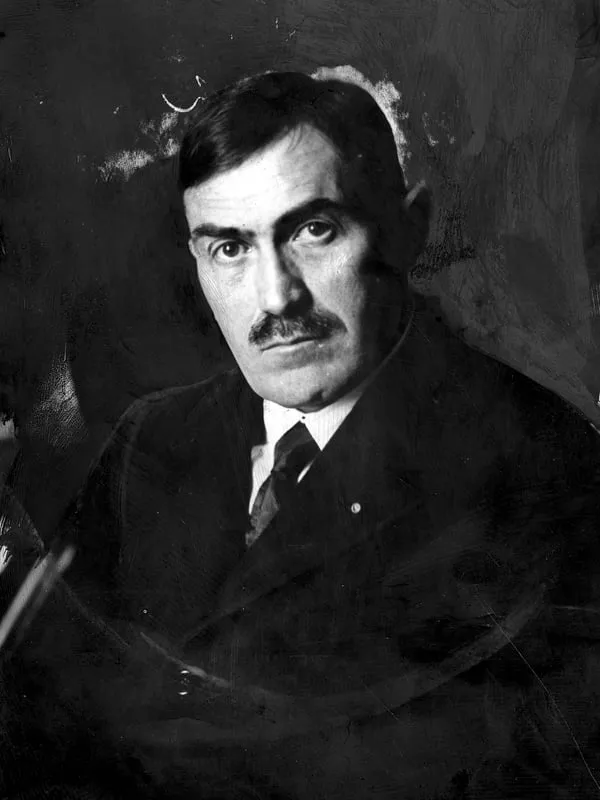
- Born:
- 21 December 1874, Warsaw (Russian Empire)
- Died:
- 4 July 1941, Lwów
- Author:
- Łukasz
- Photo:
- autor nieznany, domena publiczna, Wikimedia Commons

Tadeusz Żeleński, known by his cabaret pen name Boy, was a physician by training and a translator, critic and columnist by choice. He translated more than a hundred volumes of French literature into Polish, from the Song of Roland and Villon to Balzac and Proust, and his satirical Słówka (“Little Words”) passed into everyday speech. In the interwar years he was the best-known and most bitterly opposed Polish columnist: he campaigned for planned parenthood and civil marriage law, against the influence of the clergy in public life, and against the “bronzers” who turned great writers into monuments. His place in the history of the war is owed to the last chapter of his life. In September 1939 he found himself in Lwów (Lviv), where under Soviet occupation he took up the chair of French literature, a decision that remains controversial to this day. Four days after the Germans entered the city, on the night of 3–4 July 1941, he was arrested in his brother-in-law’s flat and shot together with a group of Lwów professors on the Wulka Hills (Wzgórza Wuleckie).
Family and youth
He was born in Warsaw on 21 December 1874, the son of the composer Władysław Żeleński and the writer and translator Wanda née Grabowska (PL). His parents’ home was open to artists; among its visitors were the ethnographer Oskar Kolberg and the young Ignacy Paderewski. Tadeusz’s cousin was the poet Kazimierz Przerwa-Tetmajer. In 1881 the family moved to Kraków, the city with which Tadeusz would be bound up for the next forty years. He attended St Anne’s Gymnasium and in 1892–1900 studied medicine at the Jagiellonian University.
Years later he recalled that he had ended up studying medicine for no very clear reason and that, in his spiritual turmoil, he “mostly played cards”. Gambling cost him a year of his studies, but he completed them. In 1898 Stanisław Przybyszewski, the leader of the artistic bohemia, arrived in Kraków from Berlin, and the young Żeleński became his constant companion – and fell in love with the writer’s Norwegian wife, Dagny Juel. The Kraków of Young Poland, with its cafés, salons and quarrels, later became the main subject of his memoirs and sketches.
Doctor and cabaret artist
After graduating he worked at the paediatric clinic and St Louis’s Hospital in Kraków. In 1902–1906 he published more than a dozen scientific papers on paediatrics, including on the pasteurisation of milk for infants, and founded the Drop of Milk society, which supplied poor mothers with clean milk and taught them how to care for their babies. His study trips abroad, especially to Paris, brought him a different love, however – French literature. In 1904 he married Zofia Pareńska (PL), the daughter of a professor of medicine and the model for Zosia in The Wedding by Stanisław Wyspiański; in 1905 their son Stanisław (PL), later an actor, was born. Zofia’s sister Maria married the physician Jan Grek – and it was in their flat in Lwów that Boy would meet his death.
From 1906 he was one of the creators of the Green Balloon cabaret in Michalik’s Den. Under the pen name Boy he wrote songs, satires and texts for its famous political puppet shows, mocking Kraków’s bourgeoisie, the conservatives and the very pose of Young Poland itself. Collected in the volume Słówka (1913), they made him famous, and many of their punchlines live on in Polish to this day. At the same time he began translating: in 1909 a Kraków theatre staged two comedies by Molière in his translation, and by 1912 he had translated all of Molière’s plays, for which in 1914 he received the French Palmes Académiques. In these years he worked as a railway doctor, and during the First World War he served as a doctor in the Austro-Hungarian army. It was there that the idea of “Boy’s Library” was born, a numbered series of translations that grew to more than a hundred volumes.
Translator and critic in independent Poland
In 1919 he gave up medicine and became theatre critic of the Kraków daily Czas (PL). In 1922 he moved to Warsaw, where he was literary director of the Polish Theatre and then, until 1939, theatre critic of the Kurier Poranny. His reviews, collected in successive volumes of Flirt z Melpomeną (“Flirting with Melpomene”), were essays about life rather than reports from the stage. At that time, together with Karol Irzykowski, he defended the experiments of Stanisław Ignacy Witkiewicz, whose theatre most critics did not understand.
Boy’s most lasting work remained his translations. Among others he translated Rabelais, Villon, the Essays of Montaigne, Descartes and Pascal, Voltaire, Diderot and Rousseau, the cycle of The Human Comedy by Balzac, Stendhal and successive volumes of In Search of Lost Time by Proust. The critic Wacław Borowy (PL) wrote as early as 1922 that Boy had created a Polish language of classicism in order to render French classicism, and Jan Błoński later called him “the Shakespeare of translation”. France awarded him successive grades of the Legion of Honour, up to Commander in 1934. In 1933 he was elected to the Polish Academy of Literature.
As a literary historian he wanted to show writers as “living people” rather than statues. His sketches on Mickiewicz and his entanglement in Towianism, collected in the volume Brązownicy (“The Bronzers”, 1930), and Obrachunki fredrowskie (“Settling Accounts with Fredro”), in which he challenged the image of Fredro as a bard of the gentry’s virtues, caused a storm. Opponents such as Stanisław Pigoń accused him of gossip-mongering and “desecrating what is sacred”, while supporters valued his break with schoolroom hagiography. He also wrote biographies, including Marysieńka Sobieska (1937).
“The Hell of Women” and the fight against obscurantism
From the end of the 1920s Boy waged campaigns on social mores in the pages of Wiadomości Literackie (PL) and the Kurier Poranny that made him the most controversial columnist in the country. In Dziewice konsystorskie (“Consistory Virgins”) he criticised Church marriage law and the practice of annulments and demanded civil marriage and divorce. In Piekło kobiet (“The Hell of Women”) and Jak skończyć z piekłem kobiet? (“How to End the Hell of Women?”) he wrote about the poverty of large families and the victims of illegal abortions, and called for planned parenthood, contraception and the legalisation of abortion. Together with the writer and feminist Irena Krzywicka, with whom he was in a relationship, he opened Poland’s first planned-parenthood clinic in Warsaw in 1931; in the following year it saw more than four thousand women. His collection of columns Nasi okupanci (PL) (“Our Occupiers”, 1932) took aim at the influence of the clergy on the state and on public morals.
The response was fierce. The Catholic and nationalist press called him a corrupter and an “erotomaniac”, and the papers of the nationalist youth ran a campaign to “liquidate Boy”. From other positions he was criticised by Witkacy, who accused him of making thought shallow, and by Irzykowski in his book Beniaminek. Boy nevertheless kept a loyal readership, and his disputes over the place of the Church, women’s rights and the secular character of the state were among the loudest debates of the Second Polish Republic. After 1935 his journalism lost much of its force; his last pre-war work was an anthology of Young Poland poetry that in 1939 never reached the bookshops.
Lwów under Soviet occupation
In September 1939, as the Germans approached Warsaw, Boy, like many of the capital’s inhabitants, left for the east and reached Lwów, where he lived with his brother-in-law, Professor Jan Grek. After the Soviet invasion of Poland the city came under Soviet rule, and in November it was incorporated into the USSR together with the rest of the eastern lands. The new authorities, courting the Polish intelligentsia, offered the well-known writer the chair of the history of French literature at Lwów University, renamed the Ivan Franko University and turned into a Ukrainian institution. Boy accepted and held the chair until June 1941.
His conduct in these years remains the most disputed chapter of his biography. In November 1939, together with a dozen or so other writers, he signed a text published in the Soviet press welcoming the “reunification” of Western Ukraine with the Ukrainian SSR. He was active in the Lwów writers’ union, published in the Polish-language daily Czerwony Sztandar (“Red Banner”), in 1940 joined the team of authors of a Soviet textbook on the history of Polish literature, and in 1941 the editorial board of the journal Nowe Widnokręgi. In August 1940 he travelled to Moscow with a group of Lwów scholars at the invitation of the Soviet education authorities and afterwards published an enthusiastic account of the trip. Critics, especially in the emigration, considered this collaboration and support for propaganda that presented the fall of Poland as the end of “the Poland of the gentry”. His defenders and biographers point out that Boy, a long-standing left-leaning anticlerical, may have believed in some of the new regime’s slogans, but also that in a city occupied by the NKVD refusal carried the risk of the arrest and deportation that befell tens of thousands of the city’s inhabitants. He also used his position to intercede with the authorities on behalf of deported acquaintances. His writings from these years, though loyal to the regime, lacked their former sharpness.
Two weeks before his death he submitted to a Lwów publishing house the typescript of a book of memoirs and criticism, W perspektywie czasu (“In the Perspective of Time”). Found years later, it was not published until 2006.
Death
On 22 June 1941 Germany attacked the USSR, and on 30 June the Germans entered Lwów. On 2 July a special-purpose unit of the German Security Police under SS-Oberführer Eberhard Schöngarth arrived in the city with a list of Polish professors drawn up with the help of Ukrainian nationalists. On the night of 3–4 July Gestapo men came for Professor Grek. They took him, his wife Maria and Boy, who was not on the list – he simply happened to be in the flat. After a night of interrogations in the Abrahamowicz dormitory, the detainees were led at dawn on 4 July to the Wulka Hills and shot. Some 40 people died there, among them twenty-odd professors and lecturers of Lwów’s universities with their families and members of their households. Boy was 66. The circumstances of the crime, its perpetrators and its further victims are part of the story of the murder of the Lwów professors.
In October 1943 the Germans ordered Jewish prisoners from a unit tasked with erasing the traces of the crimes to dig up the grave and burn the bodies. Boy has no grave. On the Żeleński family tomb in Kraków’s Rakowicki Cemetery a plaque was placed “in memory of the writer murdered by the Nazis in July 1941 in Lwów and buried there in a mass grave”. His wife Zofia survived the war and died in 1956. His nephew, the lawyer Władysław Żeleński, spent decades in exile in France collecting documents on the crime and demanding that the perpetrators be punished.
Memory
His death at the hands of the Germans turned Boy into a monumental figure in post-war Poland – something he would probably have mocked. The authorities of the Polish People’s Republic were keen to recall the anticlerical, “progressive” writer, while omitting the Lwów years or presenting them one-sidedly. Between 1955 and 1992 the State Publishing Institute (PIW) issued his Writings in 29 volumes, edited by Henryk Markiewicz. Since 1957 the Polish section of the International Association of Theatre Critics has awarded a prize in his name, Kraków’s Bagatela Theatre has borne his name since 1972, and his bust stands in Kraków’s Planty park. Streets named after Boy-Żeleński exist in dozens of Polish towns.
Opinions of Boy are still divided. For some he was an Enlightenment rationalist who modernised Polish social mores and gave Poles the French classics in translations that are still read today. For others he was a blasphemer and a corrupter of morals and, because of the years 1939–1941, also an example of submission to the Soviet occupier. In the history of the Second World War, however, his death carries a significance that goes beyond the disputes over his work: he was the best-known victim of the German policy of exterminating the Polish intelligentsia, which, from Sonderaktion Krakau in 1939 to the executions in Lwów, was meant to deprive the Poles of their leadership class.