Soviet invasion of Poland
- Dates:
- 17 September – 6 October 1939
- Front:
- Poland
- Location:
- The eastern provinces of the Second Polish Republic, from the Wilno and Grodno regions through Polesie and Volhynia to Eastern Galicia, and towards the end of the fighting also the Lublin regionOn the battle map →
- Sides:
- Soviet UnionMikhail Kovalyov, Semyon TimoshenkoPolandEdward Rydz-Śmigły, Wilhelm Orlik-Rückemann, Władysław Langner
- Result:
- Soviet victory. The Red Army occupied more than half of Poland's territory and took some 230,000–250,000 soldiers prisoner, and these lands were incorporated into the Ukrainian and Byelorussian SSRs.
- Author:
- Natalia
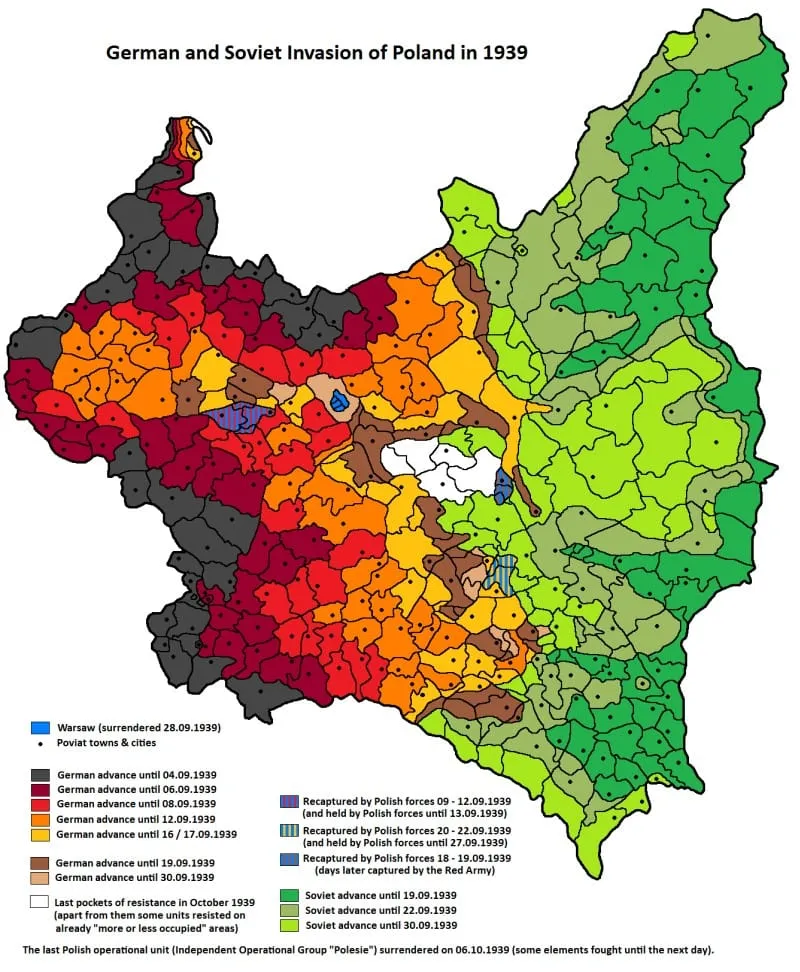
The Soviet invasion of Poland was the second, eastern front of the September Campaign. At dawn on 17 September 1939 two Red Army fronts crossed the Polish–Soviet border along its entire length, carrying out the secret protocol of the Molotov–Ribbentrop Pact. Polish forces in the east were few, and the Commander-in-Chief ordered them to avoid fighting the Soviets unless attacked or unless the Soviets tried to disarm Polish units. Even so, resistance was put up by the watchtowers and battalions of the Border Protection Corps (KOP), the garrisons of Wilno (Vilnius), Grodno and Lwów (Lviv), improvised cavalry brigades, the sailors of the Pinsk Flotilla, and the KOP group of Brigadier General Wilhelm Orlik-Rückemann. In less than three weeks the Red Army occupied more than half the territory of the Polish Republic and took several hundred thousand soldiers prisoner, among them the officers whom the NKVD murdered in the spring of 1940.
Name and dates
Polish historians speak of the “Soviet aggression against Poland”, the “Soviet aggression” or the “Soviet invasion”. An inscription on the Tomb of the Unknown Soldier in Warsaw, added after 1990, commemorates it as the “Defence of the Eastern Border of the Republic, 17 IX – 1 X 1939”. Soviet propaganda and historiography spoke of the Red Army’s “liberation campaign” into Western Ukraine and Western Belorussia. In present-day Russia it is usually called the “Polish campaign of the Red Army”. In terms of international law it was an act of aggression without a declaration of war, in breach of the treaties then in force.
The invasion began on 17 September 1939, when Soviet troops crossed the border. Its end date is a matter of convention. The last major clash with the Red Army, the Battle of Wytyczno, was fought on 1 October, and that is the date commemorated on the Tomb of the Unknown Soldier. Smaller skirmishes with scattered units went on for several more days, however, and the remnants of the KOP group fought on as part of Independent Operational Group Polesie, which capitulated to the Germans at Kock on 6 October. That date, which ended the regular operations of the Polish Army in the campaign, may be regarded as the end of the fighting in the east. Soviet troop movements went on for longer still: in the first half of October the Red Army withdrew from the Lublin region behind the Bug, to the line agreed with the Germans on 28 September.
Background
The Polish–Soviet border had been drawn by the Treaty of Riga of 1921, concluded after the Polish–Soviet War. In 1932 the two states signed a non-aggression pact, extended in 1934 until the end of 1945, and in 1933 a convention defining aggression. For years Polish defence strategy assumed that the main threat would come from the east, but in 1939 all attention was focused on Germany. The plan “West” rested on the assumption that the USSR would remain neutral in a Polish–German war, and might even agree to supplies passing through its territory.
On 23 August 1939 in Moscow, Ribbentrop and Molotov signed a non-aggression pact with a secret protocol that divided Poland into spheres of interest along the Narew, Vistula and San rivers. After Germany attacked Poland on 1 September, Berlin repeatedly pressed Moscow to occupy its zone. Joseph Stalin delayed. A covert mobilisation was carried out in the western military districts, and two fronts were formed from the Belorussian and Kiev Special Military Districts. The attack was originally planned for the night of 12–13 September, but the concentration of forces fell behind schedule. In the Far East the war with Japan at Khalkhin Gol was still going on; it ended in a truce agreed on 15 September and in force from the 16th. By the middle of the month Warsaw was encircled, and the Polish Army was falling back into the Lublin region and towards the Romanian bridgehead. Moscow concluded that it could move in without risking either a long war or the Germans seizing part of its share of the spoils.
Forces
The Belorussian Front (PL) of Komandarm 2nd Rank Mikhail Kovalyov had four armies (the 3rd, 4th, 10th and 11th) and the cavalry-mechanised group of Komkor Ivan Boldin. It advanced on Wilno, Lida and Grodno, on Wołkowysk and Białystok, and through Polesie on Brest. The 4th Army was commanded by Komdiv Vasily Chuikov, later the defender of Stalingrad. The Ukrainian Front of Komandarm 1st Rank Semyon Timoshenko had the 5th, 6th and 12th Armies (the 13th Army did not go directly into action) and headed for Równe, Łuck and Włodzimierz Wołyński, for Tarnopol and Lwów, and for Stanisławów and Kołomyja, towards the Romanian and Hungarian borders. The 6th Army was commanded by Komkor Filipp Golikov, the 12th Army by Komandarm Ivan Tyulenev.
According to Polish studies, the first echelon comprised 21 rifle divisions, 13 cavalry divisions, 16 tank brigades and 2 motorised brigades – some 620,000 men in all, nearly 4,700 tanks and around 3,300 aircraft. Russian historians, among them Mikhail Meltyukhov, give a figure of some 470,000 men for 17 September. In the following days the forces in Poland grew steadily, and for the peak period some estimates speak of more than 800,000 soldiers. Behind the troops came NKVD operational groups, which took over offices, banks, archives and prisons and arrested people from lists prepared in advance.
On the Polish side there was no continuous front in the east. The border was guarded by the Border Protection Corps, whose best battalions had left for the field armies in August. What remained were weaker sub-units, newly formed battalions and watchtowers – by various calculations anything from over ten thousand to more than twenty thousand men. From 31 August they were commanded by Brigadier General Orlik-Rückemann. In the towns of the eastern borderlands there were depot centres, guard units, police and volunteers from Military Training (Przysposobienie Wojskowe), and transports of troops bound for the Romanian bridgehead were passing through Polesie and Volhynia. Larger formations were still fighting the Germans: the Northern Front of Major General Stefan Dąb-Biernacki and the Lublin Army in the Lublin region, the Southern Front of Major General Kazimierz Sosnkowski near Lwów, and Independent Operational Group Polesie under Brigadier General Franciszek Kleeberg.
Course: crossing the border (17–19 September)
At around 3 a.m. Moscow time the Deputy People’s Commissar for Foreign Affairs, Vladimir Potemkin, read to Ambassador Wacław Grzybowski a note stating that the Polish state had ceased to exist and that the USSR was taking the Ukrainians and Belorussians under its protection. Grzybowski refused to accept it. At dawn Soviet units attacked the KOP watchtowers. Many of them, taken by surprise, held out to the last man; others were overrun within the hour. In Volhynia and Podolia the leading armoured units advanced very quickly: on 17 September itself the Soviets took Tarnopol and Równe.
The Commander-in-Chief, Marshal Edward Rydz-Śmigły, was at Kołomyja and Kuty, close to the Romanian border. After some hesitation he issued a general directive on 17 September: “Do not fight the Bolsheviks, unless they attack or attempt to disarm our units.” The troops were to withdraw to Romania and Hungary, and towns approached by the Soviets were to negotiate the departure of their garrisons abroad. The order reached some commanders and never reached others at all. On the night of 17–18 September the President, the government and the Commander-in-Chief crossed into Romania. From then on there was no unified direction of the fighting in the east. Decisions were taken by local commanders, who often did not know whether the Red Army was coming as an enemy or as an ally against the Germans – which was, indeed, what Red Army soldiers sometimes claimed to be.
The strongest resistance in the first days was put up by the KOP “Sarny” Regiment in the Sarny Fortified Area (PL). From 17 to 20 September it defended its bunkers in Polesie against the Soviet 60th Rifle Division, and the “Tynne (PL)” sector held out for several days more. The Navy’s River Flotilla at Pinsk scuttled its vessels, and the sailors set off overland and fought on as infantry. The remaining KOP units from Polesie and Volhynia fell back westwards, towards the Bug.
Course: Wilno, Grodno, Lwów (18–22 September)
Before the war Wilno had been one of the strongest garrisons in the country, but its units had left for the German front. Some 14,000 soldiers and volunteers remained in the city, of whom only about 6,500 were armed. The district commander, Brigadier General Józef Olszyna-Wilczyński, ordered that no defence be attempted and that the troops withdraw to Lithuania. When tanks of the Soviet 36th Cavalry Division approached the city on the afternoon of 18 September, Colonel Jarosław Okulicz-Kozaryn (PL) gave the order to retreat, but some units and volunteers fought on until the morning of 19 September. The defence of Wilno ended with the occupation of the city, and most of its defenders crossed into Lithuania and were interned.
The defence of Grodno was fiercer. The best units had left the city to help Lwów, and the district commander and the civil authorities left Grodno on 18 September. The defence was organised by the deputy mayor, Roman Sawicki, and Major Benedykt Serafin, and command was later taken over by Brigadier General Wacław Przeździecki. Earlier, an armed rising by local communists had been suppressed in the city. From 20 to 22 September some 2,000–2,500 soldiers, policemen, volunteers, scouts and schoolboys, supported from 21 September by the Wołkowysk Reserve Cavalry Brigade (PL), fought the Soviet tank brigades and rifle divisions of Boldin’s group. The defenders destroyed tanks with petrol bombs and a handful of light guns. Polish accounts speak of several dozen tanks destroyed, Soviet documents of more than ten. On the evening of 21 September the defenders began to withdraw, and on 22 September the city was taken. Some of the defenders made for the Lithuanian border. On the night of 21–22 September, at Kodziowce (PL), the 101st Uhlan Regiment beat off an attack by a Soviet armoured detachment, destroying, according to Polish accounts, more than ten tanks. On 22 September, near Sopoćkinie, Red Army soldiers stopped and shot General Olszyna-Wilczyński and his aide-de-camp.
Lwów had been defending itself against the Germans since 12 September under Major General Władysław Langner. News of the invasion reached the city on the morning of 17 September, and on the night of 18–19 September the first Soviet unit tried to burst into the city by surprise from the Łyczaków side. The Poles repulsed it, and from 19 September talks were held at Winniki with representatives of the 6th Army, who insisted that they had come to fight the Germans. Attempts by General Sosnkowski’s Southern Front to break through to the city failed. The Germans called on the defenders to surrender by the morning of 21 September, but on orders from above they withdrew from Lwów, which lay in the Soviet zone. General Langner, surrounded by the Red Army, judged further defence hopeless and on the morning of 22 September signed a protocol at Winniki handing over the city. It guaranteed the soldiers and policemen free departure from the city, and the officers personal freedom and the right to go abroad. The Red Army entered Lwów in the afternoon. The agreement was not kept: the officers were detained and taken to the camp at Starobilsk, and some of the policemen were shot on the spot.
Course: meeting the Wehrmacht
Soviet and German troops came into contact in the very first days. In many places the Wehrmacht had crossed the line agreed in August and now had to withdraw behind the Narew, the Vistula and the San, handing over the ground it had taken to the Red Army: Białystok, Brest, the area around Lwów and the Borysław–Drohobycz oilfield. There were misunderstandings and a few clashes between units of the two armies, among others near Lwów, but they were quickly cleared up. On 22 September, in Brest-on-the-Bug, whose fortress Brigadier General Konstanty Plisowski had defended against Guderian’s corps until 17 September, General Heinz Guderian and Kombrig Semyon Krivoshein took a joint parade at the handover of the city. For several more days Polish military transports kept arriving at Brest station, and their soldiers stepped down straight into Soviet captivity.
The Soviets reached the Romanian and Hungarian borders within a few days, closing the shortest escape routes. Some Polish units managed to cross into Romania and Hungary, but many were cut off. Brigadier General Władysław Anders, who was trying to break through to Hungary with the remnants of the Nowogródek Cavalry Brigade, fought both the Germans and the Red Army at the end of September, was wounded and fell into Soviet captivity. On 28 September in Moscow Germany and the USSR signed the Boundary and Friendship Treaty, which moved the dividing line to the Bug. The Red Army, which had already occupied part of the Lublin region, had to withdraw from it.
Course: Szack and Wytyczno (28 September – 1 October)
General Orlik-Rückemann’s KOP group fought the longest. Made up mainly of the KOP “Sarny” and “Polesie” Regiments, with cavalry squadrons and an artillery battery, it numbered several thousand men. From 20 September it fought its way westwards out of Polesie towards the Bug, avoiding combat wherever possible, as ordered. On 28 September, at Szack, the group, by then some 4,000 strong, clashed with the Soviet 52nd Rifle Division under Colonel Ivan Russiyanov. The Poles routed a tank battalion that had got stuck on a causeway beside a lake, destroyed several tanks and then took Szack in a bayonet charge. The Soviet divisional commander was wounded. According to Russian sources, Soviet losses amounted to more than 80 killed and nearly 190 wounded; Polish losses were about 500 killed and wounded. On 29 September the group crossed the Bug near Grabowo.
In the Lublin region the group sought to join Brigadier General Kleeberg’s Independent Operational Group Polesie. On 1 October at Wytyczno, on the road from Włodawa to Lublin, it was attacked by the 253rd Rifle Regiment of the Soviet 45th Rifle Division, reinforced with tanks and artillery. After a day-long battle, in which the “Rokitno” Battalion suffered heavy losses and some of the soldiers of the “Polesie” Battalion refused to fight on and surrendered, General Orlik-Rückemann disbanded the group. The soldiers made their way in small parties into the forests or to Independent Operational Group Polesie, as the “Bereźne” Battalion did. The general himself escaped through Lithuania to Sweden, and from there, at the end of October, to Britain. Independent Operational Group Polesie, which in the last days of September had won skirmishes against Soviet units at Jabłoń and Milanów, fought the Germans at Kock from 2 to 5 October and capitulated on 6 October.
Losses
Estimates of losses are uncertain and inconsistent. According to various Polish calculations, between 3,000 and 7,000 Polish soldiers were killed in the fighting against the Red Army, and from several thousand to more than ten thousand were wounded. Some 230,000–250,000 soldiers fell into Soviet captivity, most of them without a fight. Soviet documents gave a higher figure of over 450,000, probably including civilians and policemen. Some of the rank and file from the territories occupied by the USSR were released to their homes, and some of those from the German-held lands were handed over to the Germans. Officers, policemen, gendarmes and prison-service officers were placed by the NKVD in camps at Kozelsk, Starobilsk and Ostashkov.
On 31 October Molotov announced to the Supreme Soviet of the USSR that the Red Army had lost 737 killed and 1,862 wounded. More recent Russian research, including Meltyukhov’s, speaks of about 1,500 killed and missing and about 2,000 wounded. Polish historians used to give higher figures, up to 3,000 killed and 8,000–10,000 wounded. According to various sources, the Red Army also lost several dozen tanks destroyed, and many more were damaged or immobilised for lack of fuel.
Crimes
From the first day the invasion was accompanied by crimes (PL). Soviet propaganda portrayed Polish officers as “lords” and class enemies, and units that put up resistance were called “officers’ bands”. Soldiers of the Red Army and the NKVD shot prisoners after the fighting, most often officers and NCOs. After the capture of Grodno, according to the findings of Polish historians, some 300 defenders and inhabitants were shot. Prisoners were killed at Rohatyn and around Sarny, where soldiers from the “Tynne” sector died; at Mielniki near Szack, where 18 KOP officers and soldiers were shot; at Grabowiec, where the wounded and the staff of a military hospital were killed; and in many other places. In Lwów, in breach of the agreement, a group of policemen was shot. According to estimates cited by the Institute of National Remembrance (IPN), some 2,500 soldiers and policemen and several hundred civilians fell victim to these crimes. The more cautious calculations of Czesław Grzelak speak of around 1,500 killed. The Soviet entry was also exploited by communist and Ukrainian nationalist armed bands, which attacked retreating soldiers, policemen, officials and settlers.
Significance
The Soviet invasion sealed the outcome of the September Campaign. From mid-September Polish strategy had rested on holding the Romanian bridgehead, through which supplies from the Allies were to flow. The Red Army’s entry into the rear of this area and the closing of the borders with Romania and Hungary wrecked that plan, and the troops still fighting the Germans found themselves caught in a pincer. The government and the Commander-in-Chief left the country, and for the rest of the war Poland carried on the struggle from exile. Britain and France did not declare war on the USSR. On 18 December 1939 the Polish government-in-exile declared that a de facto state of war existed between Poland and the Soviet Union, but no war was formally declared.
The lands occupied by the Red Army – some 200,000 square kilometres with more than 13 million inhabitants – were incorporated into the Ukrainian and Byelorussian SSRs at the beginning of November 1939, after rigged elections in October. The USSR handed Wilno over to Lithuania, only to occupy the whole of that country in 1940. In the eastern borderlands occupation began: arrests, nationalisation, the closing of churches and, in 1940–1941, mass deportations into the interior of the USSR. In the spring of 1940, in the Katyn massacre, the NKVD murdered nearly 22,000 prisoners of war and prisoners, including officers captured in September. The border drawn by Hitler and Stalin, which in its central section was close to the Curzon Line, became, with minor changes, Poland’s eastern border after 1945.