Battle of Westerplatte
- Dates:
- 1–7 September 1939
- Front:
- Poland
- Location:
- The Military Transit Depot on the Westerplatte peninsula, at the entrance to the harbour canal of the Free City of DanzigOn the battle map →
- Sides:
- PolandHenryk Sucharski, Franciszek DąbrowskiNazi Germany and the Free City of DanzigGustav Kleikamp, Friedrich-Georg Eberhardt
- Result:
- The Polish garrison capitulated on 7 September 1939 after almost seven days of fighting. The Germans took the depot, but the defence became one of the most important symbols of Polish resistance.
- Author:
- Natalia
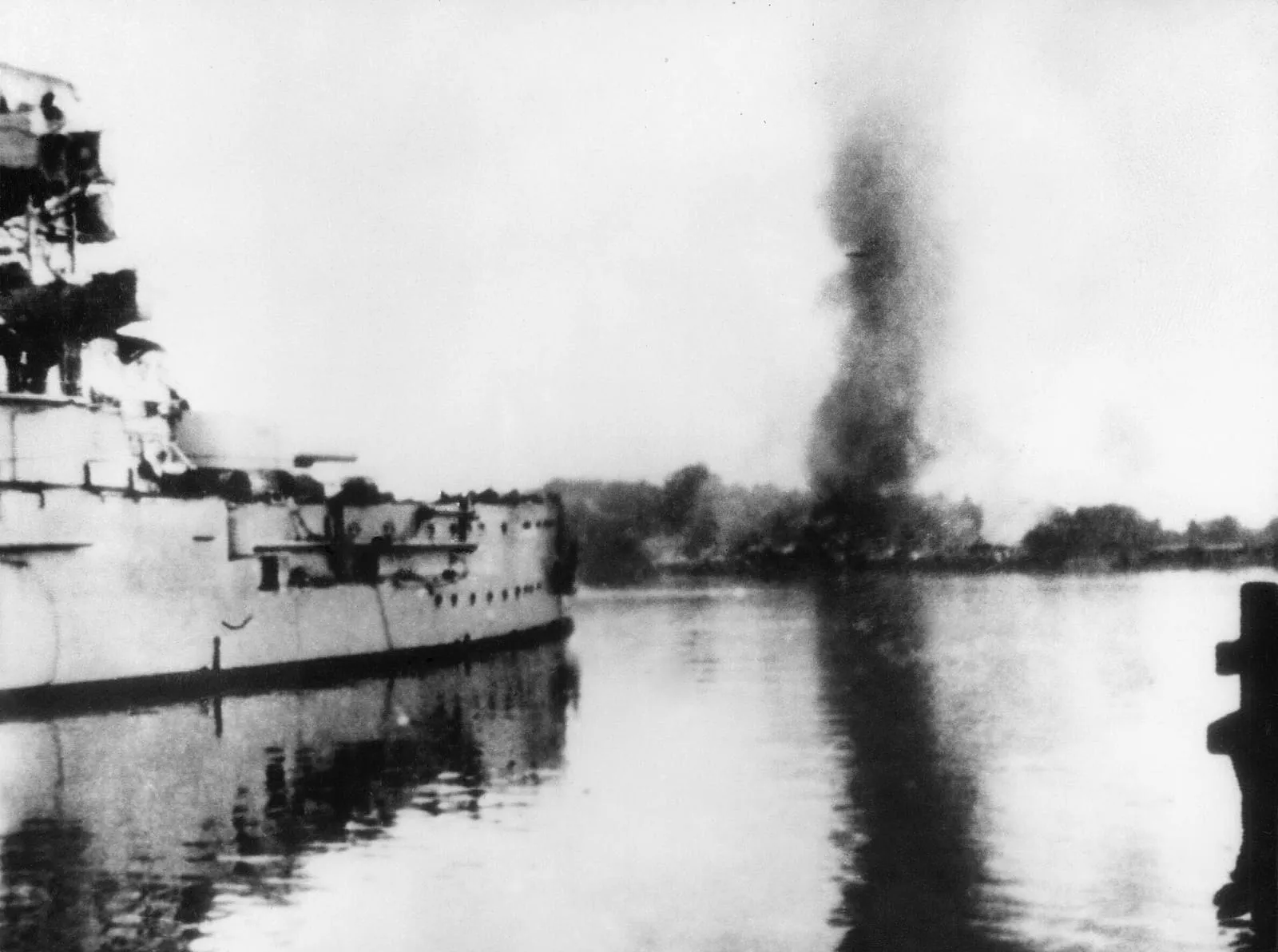
The defence of Westerplatte was the first battle of the September Campaign and one of the first engagements of the Second World War in Europe. On a small wooded peninsula at the entrance to the port of Gdańsk (Danzig), some two hundred Polish soldiers of the Military Transit Depot held out for almost a week against an enemy many times stronger: the fire of the old battleship Schleswig-Holstein, a Kriegsmarine assault company, units of the Danzig police and the SS, heavy artillery and dive-bomber raids. The outpost, which according to the plans was to hold for twelve hours, did not capitulate until the morning of 7 September. The defence had no influence on the outcome of the campaign, but it became its best-known symbol. Its history also has a second layer, long passed over in silence: the dispute over the conduct of the commandant, Major Henryk Sucharski, and over the role of his deputy, Captain Franciszek Dąbrowski.
Name and dates
In Polish literature the battle is called the defence of Westerplatte; in German, the fight for Westerplatte (Kampf um die Westerplatte). Almost all studies give the dates as 1–7 September 1939. The Schleswig-Holstein fired its first salvo on the morning of 1 September. Orders set the time at 4.45 a.m., and that is the time Sucharski gave in his report, but the sources also give 4.47 and 4.48. Most probably 4.45 was the planned time; at about 4.47 the ship’s captain gave the order to open fire, and the guns fired roughly a minute later. The salvo was not the first act of the war: a dozen or so minutes earlier German bombers had attacked Polish positions at the bridge in Tczew, and according to some studies the bombing of Wieluń began before the battleship’s salvo. The end came with the capitulation on the morning of 7 September. The Germans spotted a white flag at around 9.30–9.45 a.m., Sucharski gave the order to surrender at around 10.15 a.m., and the garrison marched out of the outpost at about 11.30 a.m.
The popular phrase “seven days” is therefore something of a simplification: the fighting lasted from dawn on the first day to the morning of the seventh, a little over six days and nights. The often repeated figure of “thirteen assaults” is a simplification too. The Germans made two genuine infantry attacks on 1 September; in the following days they mainly shelled and bombed the peninsula, launching several reconnaissance attacks and attempts to set the woods on fire.
Background
The Polish depot at Westerplatte was a child of the compromise on which the Free City of Danzig was founded. Poland had extensive rights in the port of Gdańsk, but it could not freely handle arms and ammunition there: in 1920, during the war with the Bolsheviks, the Danzig dockers had refused to unload shipments for the Polish Army. In 1924 the Council of the League of Nations granted Poland a site on Westerplatte, a former bathing resort on the peninsula at the mouth of the Vistula, for a depot for ammunition in transit. From January 1926 it was guarded by a Polish guard detachment, whose strength the League limited to 88 men; it also forbade the construction of fortifications. A brick wall separated the depot from the rest of the peninsula, and a railway siding running across the territory of the Free City connected it with Poland.
The people of Danzig regarded the Polish outpost as an affront, and relations at Westerplatte were often tense. In March 1933 Józef Piłsudski demonstratively landed a naval battalion there to show that Poland would not let itself be pushed out of Danzig. Under pressure from the League of Nations the reinforcement was withdrawn, but in the years that followed the depot was quietly rebuilt. Between 1933 and 1936 five reinforced-concrete guardhouses were built, with cellars for machine-gun positions, together with new, solid barracks that could serve as a last point of defence. After the declaration of non-aggression was concluded in 1934, tension around Gdańsk eased for several years.
That changed in the autumn of 1938, when Germany demanded the incorporation of the Free City into the Reich, and in the spring of 1939 it repeated its demands in a harsher form. In April Hitler ordered preparations for war with Poland under Case White, in which the capture of Westerplatte was assigned to the navy and the Danzig forces. Throughout the summer arms were stockpiled in Danzig itself, and military units were formed from the local police and “volunteers” from the Reich. The Poles responded by secretly reinforcing the depot’s garrison: civilians leaving it were replaced by soldiers, and in the summer field fortifications, barbed-wire entanglements and barricades of felled trees were added.
Polish forces
Exactly how many men defended Westerplatte has still not been established beyond doubt. Older studies spoke of 182 soldiers, including five officers and a doctor. More recent lists count about 205–210 people, including a dozen or so mobilised contract and civilian employees, and some researchers give as many as 220–240. The commandant of the depot from December 1938 was Major Henryk Sucharski; his deputy and commander of the guard detachment from December 1937 was Captain Franciszek Dąbrowski. The other officers included Lieutenants Leon Pająk and Stefan Grodecki (PL), Second Lieutenant Zdzisław Kręgielski (PL) and the doctor, Captain Mieczysław Słaby.
The armament was modest: one 75 mm field gun, two 37 mm Bofors anti-tank guns, four 81 mm mortars, some forty heavy and light machine guns, about 160 rifles, several dozen pistols and around a thousand grenades. There was food for several weeks. The defence was organised in three belts: forward posts (“Prom”, “Przystań”, “Łazienki”, “Wał”, “Fort” and others), five guardhouses in the middle of the peninsula, and the barracks. The garrison was to hold for twelve hours, until help arrived. But no help was going to come. It had originally been planned that units of the Pomorze Army would enter Danzig, but in the last days of August the grouping assigned to this task was moved inland. On 31 August, according to later accounts, Lieutenant Colonel Wincenty Sobociński (PL) of the Polish mission in Danzig warned Sucharski that he could not count on relief. The content of this conversation, however, is known only at second hand.
German forces
On 25 August, the day the Anglo-Polish alliance was signed, the old training battleship Schleswig-Holstein, a veteran of the Battle of Jutland armed with four 280 mm guns and numerous smaller ones, sailed into Danzig on an announced courtesy visit. She was commanded by Captain (Kapitän zur See) Gustav Kleikamp. Hidden below decks was a naval infantry assault company of about 225 men under Lieutenant Wilhelm Henningsen. The ship moored in the harbour canal opposite Westerplatte. The attack was set for dawn on 26 August, but on the evening of 25 August Hitler called off the war, and the battleship waited another six days.
On land the Danzig forces were commanded by Generalmajor Friedrich-Georg Eberhardt, a Wehrmacht officer sent to Danzig in the summer to form regular units from the local state police (the so-called Eberhardt Group). Against Westerplatte were sent units of the Danzig police, a company of the SS-Heimwehr Danzig, sappers and, in the following days, artillery, including 105 mm howitzers and 210 mm mortars. Aircraft and smaller warships provided support. Formally Kleikamp directed the whole operation against Westerplatte; in practice command was divided between the navy and the land forces, which affected coordination. The Germans knew nothing of the Polish fortifications and estimated the garrison at a hundred men at most. The Danzig police assured everyone that Westerplatte would fall within minutes; Eberhardt spoke of a few hours. Over the week, according to frequently cited estimates, more than three thousand men were involved in one way or another in the operations against the depot.
The course of the fighting
1 September: two assaults repelled
During the night of 31 August – 1 September Henningsen’s company landed near the Wisłoujście fortress and took up positions under the depot wall, while sappers laid explosive charges. At around four o’clock the battleship moved to a position better suited for shelling. At dawn she opened fire with all her guns. The shells blew out the railway gate and breached the wall, but at such short range the heavy shells often failed to arm and did not explode, and the reinforced-concrete guardhouses held. Sucharski reported to fleet command that Westerplatte was under fire.
A few minutes later the naval infantry went through the breaches and ran into the forward posts, above all “Prom”. Polish positions hidden in the woods caught the Germans in crossfire, and the entanglements and barricades slowed their movements. The Polish field gun, rolled out into position near the power station, destroyed several machine-gun nests on the warehouses across the canal, and the mortars shelled the attackers. An attempt by a small Danzig police detachment to land was also beaten off. It was then that Staff Sergeant Wojciech Najsarek, a railwayman on duty at the depot station, was killed. At around 6.20 a.m. Henningsen reported heavy losses and withdrew his company.
The second assault was preceded by a long bombardment from the battleship, which destroyed the Polish field gun. Lieutenant Pająk, commander of the “Prom” post, was severely wounded, and command passed to Warrant Officer Jan Gryczman (PL). The attack, supported by a platoon of the SS-Heimwehr Danzig, forced the defenders of the forward posts to fall back, but it came to a halt under fire from guardhouses No. 1, 2 and 5 and the mortars. At around 12.30 p.m. the Germans withdrew; Henningsen had been mortally wounded. On the Polish side four soldiers were killed that day. The Germans lost, according to various tallies, from a dozen or so to about twenty killed and over a hundred wounded. Their commanders concluded that without the destruction of the fortifications by artillery and aircraft the infantry would not take the depot.
2 September: the air raid and the crisis
Towards evening on 2 September some sixty Junkers Ju 87 dive-bombers from the groups of StG 2 “Immelmann” appeared over Westerplatte. Within a few dozen minutes they dropped more than twenty tonnes of bombs. A heavy bomb destroyed guardhouse No. 5, burying at least eight soldiers under its rubble. All the mortars, the radio station, the kitchen and part of the supplies were destroyed, the telephone lines were cut, and the whole peninsula was shrouded in smoke. The German infantry, however, did not seize the moment. No assault followed the raid, partly because of poor coordination between the navy, the police and the army.
This raid was the garrison’s hardest ordeal. Some soldiers abandoned their posts and took shelter in the barracks. According to German reports a white flag briefly appeared over the depot, although not all historians regard this as certain. In the evening Sucharski ordered the codes and secret documents to be burned. According to accounts by some of the officers, which came to light only years later, the major suffered a nervous breakdown that day and wanted to capitulate, and Captain Dąbrowski and Lieutenant Grodecki vehemently opposed him. The details of what happened are not known.
3–6 September: the siege
In the following days the Germans shelled the peninsula from the battleship, with heavy howitzers and mortars and with machine guns from across the canal, and at night they launched reconnaissance attacks. The garrison’s morale was briefly lifted by the news that on 3 September Britain and France had declared war on Germany, but no help came. On 4 September the torpedo boat T196 and the old minesweeper Von der Groeben joined the bombardment from the sea. The defenders had to abandon the “Wał” post. On 5 September Sucharski called a council of his officers and spoke in favour of capitulation, since the order to defend for twelve hours had long since been carried out. Dąbrowski was against it, and they decided to fight on. That night one of the defenders, mistaken in the darkness for a German, was killed by his comrades’ bullets.
On 6 September the Germans twice rolled burning fuel tank wagons into the depot along the railway track to set the woods on fire and smoke out the defenders. The first attempt, before dawn, failed because the engine driver uncoupled the wagons too early. The fire nevertheless consumed part of the woods that had until then concealed the Polish positions. The second attempt, in the afternoon, ended just as unluckily. That day, at another council, Sucharski was again ready to surrender. There was a shortage of medicines and dressings, many of the wounded were suffering from infections, and the news from the rest of the country was bad. There was, however, enough ammunition to last a good while longer.
7 September: capitulation
At 4.30 a.m. on 7 September the Germans began the heaviest bombardment since the fighting started, lasting until about seven o’clock. The Schleswig-Holstein took part in it. Then sappers with flamethrowers moved forward, setting the woods on fire, with the infantry behind them. Guardhouse No. 2 was destroyed and guardhouses No. 1 and 4 damaged, but the Polish machine guns stopped the attack once more. Even so, Sucharski concluded that further fighting would only mean more casualties. At around 9.30–9.45 a.m. the Germans spotted a white flag, and at around 10.15 a.m. the major gave the order to capitulate. Some of the defenders wanted to fight on, but the order stood. Sucharski went over to the German lines and surrendered the outpost to General Eberhardt. At around 11.30 a.m. the garrison marched out of the barracks, and the Germans, impressed by its conduct, rendered it military honours. Eberhardt allowed the major to keep his sabre in captivity, although it was taken from him at the first camp.
Losses
Polish losses are relatively well known. At least fifteen or sixteen defenders were killed in the fighting, and the officers’ accounts speak of about twenty dead. At least forty were wounded, a dozen or so of them severely. The fate of several soldiers remains unknown. On 8 September the Germans found on the peninsula a grave of four unidentified Polish soldiers, about which Polish accounts were silent. Some researchers believe that these were defenders shot by their own side for refusing to fight or for attempting to desert after the raid of 2 September, but this has not been conclusively proven. After the capitulation the radio operator, Sergeant Kazimierz Rasiński (PL), was taken from the transit camp for interrogation. According to some accounts he was murdered for refusing to hand over the codes; according to others he took his own life. In 2019 the remains of several of the fallen were found, and in November 2022 they were buried, together with Major Sucharski, in a new military cemetery on Westerplatte.
For decades German losses were exaggerated. The defenders estimated them at several hundred dead, and in communist Poland figures of the order of 300–400 killed were repeated. Present-day studies based on German documents usually give about 50 killed (including a dozen or so from the Kriegsmarine assault company) and about 150 wounded, and some authors give even fewer. The disproportion between the forces and the losses shows how well the defenders made use of their fortifications, but also that after 1 September the Germans no longer risked frontal attacks.
The dispute over command
For several decades after the war the defence of Westerplatte was presented as the work of the indomitable Major Sucharski. This image was fixed by the reportage of Melchior Wańkowicz, who spoke with Sucharski in Italy after the war, and by Stanisław Różewicz’s 1967 film Westerplatte. In the 1990s historians, above all Andrzej Drzycimski, drawing on accounts by participants who had been unwilling to speak of it during their lifetimes, described the crisis of 2 September: the commandant’s breakdown, his repeated proposals to capitulate and Dąbrowski’s opposition. Some authors went further, regarding Dąbrowski as the de facto commander of the defence from 2 September to the end, and even writing that Sucharski had been removed by force. Others, such as authors writing in Tygodnik Powszechny, regard such claims as exaggerated: as commander of the guard detachment Dąbrowski directed the fighting directly in any case, while Sucharski retained his authority to the end, as is shown by the fact that his order to capitulate was carried out. The dispute also concerns whether the “twelve hours” order meant permission to surrender once they had passed, or merely the minimum time for which resistance must not cease. What is certain is that there was a sharp conflict between the two officers, and that both of them, each in his own way, bore the burden of a decision on which their soldiers’ lives depended.
Significance
Militarily, the defence of Westerplatte was of little importance. For a week it tied down a capital ship that could have supported operations at Gdynia and on Hel, together with several thousand men, but the fate of the campaign was being decided elsewhere. Its moral and political importance, by contrast, was immense. In days when the front in Poland was collapsing along its entire length, news of resistance kept coming from Westerplatte, and the sentence “Westerplatte is still holding out”, repeated by Polish Radio, became one of the watchwords of September. As early as mid-month Konstanty Ildefons Gałczyński wrote the “Song of the Soldiers of Westerplatte” (PL), fixing the myth that all the defenders had fallen. In reality most of them survived the war in captivity.
Westerplatte became one of the most important sites of memory in Poland. In communist Poland the defence was at first passed over in silence as the work of the pre-war army (the garrison’s doctor, Captain Słaby, died in 1948 after being tortured under interrogation), and after 1956 it became an official symbol. In 1966 the Monument to the Defenders of the Coast was erected on the peninsula, and every year at dawn on 1 September ceremonies marking the anniversary of the outbreak of the war are held there. The disputes over Sucharski and Dąbrowski have not robbed the defence of its meaning. If anything, they have shown that the heroism of the soldiers of Westerplatte was the heroism of ordinary men – in fear, exhaustion and uncertainty – and not of figures on a monument.
Places·Gdańsk·Westerplatte