Poland
Józef Piłsudski
Commander of the 1st Brigade of the Legions (1914–1916), Chief of State (1918–1922), Marshal of Poland (from 1920), after 1926 Minister of Military Affairs and twice Prime Minister
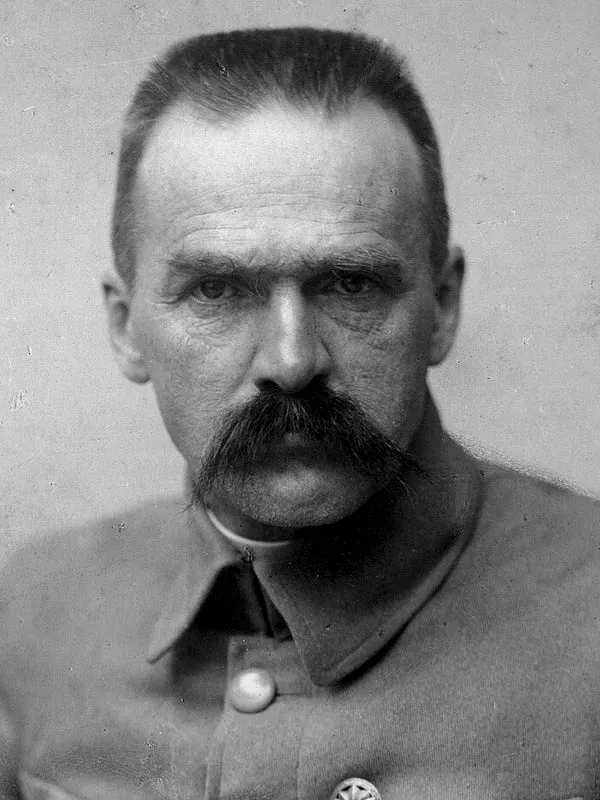
- Born:
- 5 December 1867, Zułów in the Wilno region (Russian Empire)
- Died:
- 12 May 1935, Warsaw
- Author:
- Natalia
- Photo:
- autor nieznany, domena publiczna, Wikimedia Commons

Józef Piłsudski was the most important figure in Polish politics in the first half of the twentieth century. He began as a socialist and conspirator fighting tsarist Russia; during the Great War he created the Legions, and in November 1918, freed from a German prison, he took charge of the reborn state. As Chief of State and Commander-in-Chief he led Poland through its wars over its borders, above all the war with Soviet Russia, in which victory in 1920 halted the westward march of revolution. In 1926 he returned to power through a coup d’état and until his death in 1935 was the country’s de facto leader. It was he and his associates who shaped the state, the army and the foreign policy with which Poland entered 1939, so the dispute over his legacy is also a dispute over the causes of the September defeat.
Youth and Siberia
He was born on 5 December 1867 at Zułów near Wilno (Vilnius), into an impoverished gentry family raised in the cult of the January Uprising. His father had been a commissioner of the insurgent National Government during the uprising, and his mother, Maria née Billewicz, taught the children Polish history and literature in defiance of the Russifying school in Wilno. In 1885 Józef began studying medicine in Kharkiv, but he soon had to return home. In 1887 he was implicated in a plot against the life of Tsar Alexander III, in which he himself played a marginal role, while his brother Bronisław was more deeply involved. Józef was exiled to Siberia for five years, first to Kirensk on the Lena and then to the village of Tunka. Among those involved in the same plot was Alexander Ulyanov, the elder brother of the future Bolshevik leader Vladimir Lenin, who was executed for his part in it.
Socialist and fighter
After his return in 1892 Piłsudski joined the Polish Socialist Party (PPS) and quickly became one of its leaders. He edited the illegal newspaper Robotnik (“The Worker”), printed on clandestine presses in Lithuania and later in Łódź. For him socialism was above all a road to independence. Arrested in Łódź in 1900 and held in the Warsaw Citadel, he feigned mental illness, and in 1901 he escaped from a lunatic asylum in St Petersburg.
When the Russo-Japanese War broke out in 1904, he concluded that Russia’s defeat was an opportunity for the Poles. In the summer he travelled to Tokyo to seek Japanese help for a Polish rising and to urge the Japanese to form a legion from Polish prisoners of war. There he met his chief political rival, Roman Dmowski, who was telling the Japanese that an uprising would be a disaster for the Poles. Japan confined itself to modest financial help. During the revolution of 1905–1907 Piłsudski created the Combat Organisation of the PPS, which attacked Russian officials, policemen and shipments of money. Its most famous action was the raid on a mail train at Bezdany on 26 September 1908, in which he took part in person.
The Riflemen and the Legions
From then on he was less and less a socialist and more and more a soldier. He believed that war between the partitioning powers was inevitable and that the Poles must then have an army of their own. He staked everything on Austria-Hungary against Russia, which he regarded as the main enemy. In 1908 the clandestine Union of Active Struggle was founded in Lwów (Lviv) on his initiative, and on its basis the open Riflemen’s associations in Galicia, of which he became commandant. The Austrian authorities tolerated them because they might prove useful against Russia, and historians have shown that Piłsudski’s men passed information on the Russian army to Austrian intelligence.
On 6 August 1914 his First Cadre Company crossed the border into the Kingdom of Poland. The hope of an uprising in the Russian partition came to nothing, but his riflemen formed the core of the 1st Brigade of the Polish Legions, which he commanded through two years of fighting on the Eastern Front. At the same time he built up the clandestine Polish Military Organisation. After the Battle of Kostiuchnówka in July 1916 he asked to be released from service in protest against the treatment of the Legions as auxiliary troops. After the Act of 5 November he joined the Provisional Council of State, but the February Revolution in Russia changed his calculations. Once tsarism had fallen, he came to see Germany as the main obstacle. In July 1917, at his call, the legionaries refused to swear an oath of “brotherhood in arms” with the Central Powers, and he himself was sent to a German prison, ending up in the fortress of Magdeburg. Imprisonment did more for his legend than two years of fighting: from an ally of Austria he became a symbol of the struggle against all the partitioning powers.
November 1918
The revolution in Germany opened his way to power. On 8 November 1918 the Germans released him, and on the morning of 10 November he arrived in Warsaw. The next day, the day of the Armistice of Compiègne, the Regency Council handed him command of the army, and three days later all power. The German garrison in Warsaw, after talks in which he took part, laid down its arms in exchange for safe passage home. On 22 November Piłsudski proclaimed himself Provisional Chief of State. The Entente powers regarded him with suspicion, since they recognised Dmowski’s Polish National Committee in Paris. A compromise came in January 1919, when Ignacy Jan Paderewski became prime minister. In February the Legislative Sejm entrusted Piłsudski with continuing in the office of Chief of State.
Towards the Greater Poland Uprising he remained cautious. He believed that the fate of the Prussian partition would be decided by the peace conference, and Greater Poland, with its National Democratic Supreme People’s Council, did not trust him. He sent no troops there, but he agreed that General Józef Dowbor-Muśnicki should take command, although he had little regard for former tsarist officers. He himself concentrated on the east, where nobody but the Poles themselves could draw the border.
The war with the Bolsheviks
Piłsudski dreamed of an Eastern Europe in which Russia would be separated from Poland by a belt of independent states – Lithuania, Belarus and Ukraine – linked to Poland by federation or alliance. In April 1919 his troops took Wilno. On 19 March 1920 Piłsudski received the title of First Marshal of Poland. In April he concluded an alliance with the Ukrainian ataman Symon Petliura and marched on Kiev, which was taken on 7 May. The Red Army’s counter-offensive, however, drove the Poles back to the gates of Warsaw. Lenin’s Council of People’s Commissars hoped that the revolution would reach Germany through a defeated Poland. In mid-August 1920 a counter-attack from the Wieprz river, planned and led by Piłsudski, routed Tukhachevsky’s forces in the Battle of Warsaw. According to many historians, a dispute within the Soviet command also contributed to the Soviet defeat: the South-Western Front, whose political commissar was Joseph Stalin, stubbornly attacked Lwów instead of supporting the advance on Warsaw. The Treaty of Riga of March 1921 divided Belarus and Ukraine between Poland and Soviet Russia and buried Piłsudski’s federal plans.
The war had long-lasting consequences. The eastern border drawn at Riga was as hard for the Soviet Union to accept as the western border drawn at Versailles was for Germany. In 1939 both these borders were threatened simultaneously by Berlin and Moscow.
Sulejówek and the May Coup
The March Constitution of 1921, adopted by a Sejm dominated by his opponents, gave the president such modest powers that Piłsudski did not stand. In December 1922 he handed over power to the first president, Gabriel Narutowicz, who only two days later was killed by a right-wing fanatic. Shaken, in 1923 he withdrew from public life to Sulejówek, from where he criticised the rule of the parties and the Sejm. In May 1926, during a political crisis, he led troops loyal to him on Warsaw. Several hundred people, soldiers and civilians, were killed in the May Coup of 12–14 May. The National Assembly elected Piłsudski president, but he declined, and the office went to his candidate, Ignacy Mościcki.
The Sanation regime
Until the end of his life Piłsudski was Minister of Military Affairs and Inspector General of the Armed Forces, and twice, in 1926–1928 and in 1930, also prime minister. His camp, known as Sanation (sanacja), promised to “heal” the state, but in practice it increasingly restricted democracy. In 1930 opposition leaders were arrested, imprisoned in the Brest fortress and convicted in the Brest trial. In 1934, after the assassination of the interior minister Bronisław Pieracki, an isolation camp was set up at Bereza Kartuska, where political opponents were locked up without trial. The April Constitution, adopted in 1935, a few weeks before his death, gave the president almost unlimited power.
In foreign policy Piłsudski, and from 1932 his trusted minister Józef Beck, pursued a policy of “equilibrium” between Germany and the Soviet Union, while maintaining alliances with France and Romania. In July 1932 Poland signed a non-aggression pact with the USSR, and after Hitler came to power, in January 1934, a declaration of non-aggression with Germany. The Weimar Republic, whose president from 1925 was Paul von Hindenburg, had been unwilling to conclude any agreement with Poland that recognised the border. Whether Piłsudski really proposed a preventive war against Hitler to France in 1933 remains disputed by historians, as there are no conclusive documents. The declaration of 1934 gave Poland a few years of peace in the west, but Hitler treated it as a tool: he repudiated it in April 1939, when Poland rejected his demands concerning Gdańsk.
Death and legacy
Piłsudski died of liver cancer on 12 May 1935 at the Belweder Palace. He was buried in the crypt of Wawel Cathedral, alongside the kings, and in 1936 his heart was placed in his mother’s grave in the Rossa cemetery in Wilno. In Berlin, Hitler attended a requiem mass for the Marshal. After his death power passed to his former subordinates: President Mościcki, Foreign Minister Beck and the new Inspector General, from 1936 Marshal Edward Rydz-Śmigły. It was they who, ruling in the name of his political testament, led Poland in 1938–1939, rejected Hitler’s demands and in September 1939 faced Germany and the Soviet Union at the same time.
Piłsudski was a contested figure in his own lifetime and remains so today. To some he was the founder of independence and the victor of 1920; to others a dictator who destroyed a young democracy and left his successors an authoritarian state at odds with its national minorities and unprepared for war with two powerful neighbours. Historians nonetheless grant that in 1918 no one else could have concentrated power in Warsaw so quickly, or defended the state against the Soviet invasion in 1920. His cult, built up after 1926 by the Sanation camp, survived the war in exile; in communist Poland he was passed over in silence, and after 1989 Piłsudski once again became one of the chief symbols of Polish independence.
Sources
Commanded in battles
(01)Mentioned in battles
(04)Often appears with
People who appear in the same events.