Poland
Henryk Sucharski
Commandant of the Military Transit Depot at Westerplatte (1938–1939), major in the Polish Army
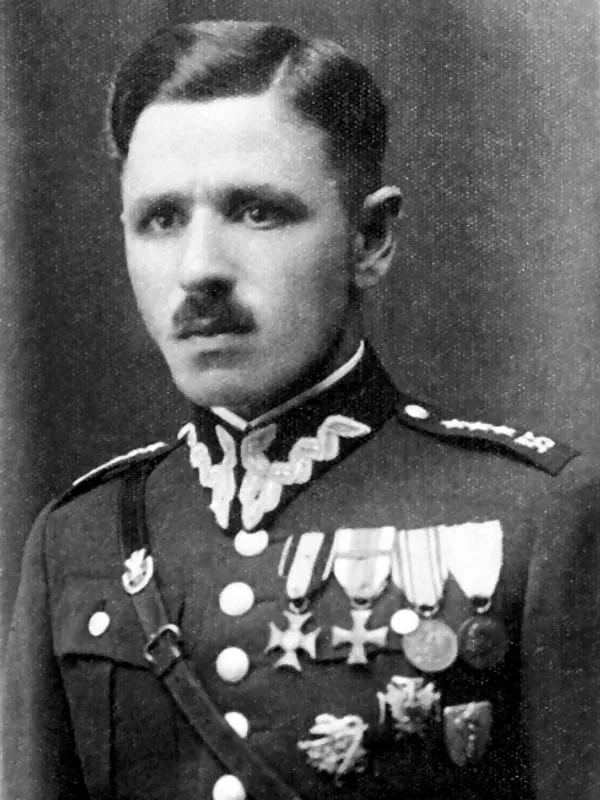
- Born:
- 12 November 1898, Gręboszów (Galicia, Austria-Hungary)
- Died:
- 30 August 1946, Naples (Italy)
- Author:
- Łukasz
- Photo:
- autor nieznany, domena publiczna, Wikimedia Commons

Henryk Sucharski was a professional infantry officer who in December 1938 took command of the small Polish outpost at Westerplatte in the Free City of Danzig. On 1 September 1939 his garrison was among the first to face the German onslaught, and it held out until 7 September, far longer than its orders required. For decades Sucharski was, in Poland, the very symbol of the unbroken soldier of September 1939. Since the 1990s, however, historians have argued over his conduct during the defence: according to many accounts he suffered a breakdown after the air raid of 2 September and several times proposed surrender, while his deputy, Captain Franciszek Dąbrowski, largely took over the direction of the fighting. The dispute does not diminish the importance of the defence, but it shows how complicated the stories of those who became monuments really were.
Childhood and youth
He was born on 12 November 1898 in the village of Gręboszów near Dąbrowa Tarnowska, in western Galicia, then part of Austria-Hungary. He was the fourth child of Stanisław, a village shoemaker, and Agnieszka, née Bojko. His mother’s family was related to Jakub Bojko (PL), one of the leaders of the Galician peasant movement. He finished primary school in nearby Otfinów, where the local parish priest took him under his wing, and from 1909 to 1917 attended a grammar school in Tarnów. The son of a poor peasant family with many children, he owed his path to an officer’s career to education and to the war.
In February 1917 he was called up into the Austrian Landwehr and posted to the reserve battalion of the 32nd Rifle Regiment in Bochnia. That autumn he passed the so-called wartime school-leaving examination, and in 1918 he completed the reserve officers’ school in Opava. As an officer cadet he fought in the last months of the war on the Italian front.
In the Polish Army
After the collapse of the Habsburg monarchy he returned home and in February 1919 joined the Polish Army, serving in the 16th Infantry Regiment in Tarnów. In the spring of 1919 he served on the disputed border with Czechoslovakia near Cieszyn, and in the autumn of 1919 he was transferred to the Lithuanian–Belarusian front of the Polish–Soviet War. At the beginning of 1920 he became a second lieutenant and a company commander in the assault battalion of the 6th Infantry Division. For bravery in the fighting of August 1920 he received the Silver Cross of the Virtuti Militari, presented to him in 1922, and the Cross of Valour.
After the war he remained in the army as a professional officer and followed the ordinary, far from brilliant career of an infantry officer. In the 1920s he served in the 20th Infantry Regiment in Kraków; in 1928 he was promoted to captain and became an instructor at the Infantry Cadet School (PL) in Ostrów Mazowiecka. In 1930 he was transferred to the 55th Infantry Regiment in Leszno, and in 1932 to the 35th Infantry Regiment in Brześć nad Bugiem (Brest). He was promoted to major with seniority from March 1938.
Commandant of Westerplatte
On 3 December 1938 Sucharski was appointed commandant of the Military Transit Depot (PL) at Westerplatte. It was an unusual post: a Polish ammunition depot on the territory of the Free City of Danzig, with a guard detachment whose strength was limited by the League of Nations. Sucharski took it over just as Germany had demanded the incorporation of Gdańsk (Danzig) into the Reich, and in the spring of 1939, after Hitler’s new demands, Westerplatte found itself in the front line of the coming conflict. The commandant oversaw the covert reinforcement of the garrison and the construction of field fortifications. Training and the defence itself were directed by his deputy and commander of the guard detachment, Captain Franciszek Dąbrowski.
According to later accounts, on 31 August Lieutenant Colonel Wincenty Sobociński (PL) warned Sucharski that the garrison could not count on relief, although the content of that conversation is known only at second hand. On the morning of 1 September the battleship Schleswig-Holstein, moored in the harbour channel, opened fire on the depot, and Sucharski reported to naval command that Westerplatte was under fire. On the first day the garrison beat off two assaults by German marines and Danzig units.
The turning point came with a dive-bomber raid towards evening on 2 September, which destroyed guardhouse no. 5, the mortars and the radio station. Several soldiers were killed, among them the commandant’s orderly. According to officers’ accounts that came to light years later, Sucharski then suffered a nervous breakdown, wanted to surrender and ordered the cipher material burned, and Captain Dąbrowski and Lieutenant Stefan Grodecki vehemently opposed him. At the councils of war on 5 and 6 September the commandant again argued for capitulation, pointing out that the order to hold for twelve hours had long since been fulfilled and that no relief would come. Each time the view that they should fight on prevailed. On the morning of 7 September, after the heaviest bombardment since the fighting began and an attack with flamethrowers, Sucharski gave the order to surrender. He justified it by the plight of the wounded, who lacked medicines and dressings, the exhaustion of his men and the enemy’s superiority. According to tradition he told his soldiers that they would yet be of use to Poland. He surrendered the outpost to General Friedrich-Georg Eberhardt, who, in recognition of the garrison’s conduct, allowed him to keep his sabre. So ended the defence of Westerplatte, which had lasted almost a week instead of the planned twelve hours.
Captivity and final years
After the surrender Sucharski was taken prisoner. He passed through a series of prisoner-of-war camps in East Prussia and the Reich, including Oflag IV-A Hohnstein, Oflag II-B Arnswalde (PL) and Oflag II-D Gross-Born. As the commandant of Westerplatte he was a well-known and respected figure among his fellow prisoners. In March 1945, during the evacuation of the camps ahead of the advancing Red Army, he was injured in an accident and ended up in hospital in Mecklenburg.
After liberation he did not return to a country ruled by the communists. In the summer of 1945 he reached General Władysław Anders’s Polish II Corps in Italy, and in January 1946 he took command of the 6th Carpathian Rifle Battalion. In Italy he met Melchior Wańkowicz, whose reportage on Westerplatte, published in Wrzesień żagwiący (“Flaming September”) and in Poland in 1959, cemented the image of Sucharski as an unbending commander. The major did not tell the writer about the crisis of 2 September. In August 1946 he was admitted to a British military hospital in Naples, where he died of peritonitis on 30 August 1946, aged 47. He was buried on 1 September 1946, the seventh anniversary of the outbreak of war, at the Polish War Cemetery in Casamassima.
Memory and controversy
In the Polish People’s Republic, after an initial silence about a defence led by pre-war officers, Westerplatte became an official symbol from the second half of the 1950s, and Sucharski its hero. In Stanisław Różewicz’s 1967 film “Westerplatte” he was played by Zygmunt Hübner. In 1971 his ashes were brought back from Italy and laid to rest at Westerplatte, and he was posthumously awarded the Commander’s Cross of the Virtuti Militari. He was thus a three-time recipient of the order: for the war of 1920, for Westerplatte and posthumously. Numerous schools and streets bore, and still bear, his name. In 2021 his remains were exhumed again, and on 4 November 2022 they were buried, together with several fallen defenders, in the new military cemetery at Westerplatte.
From the early 1990s, when Andrzej Drzycimski and other researchers published the accounts of participants, the picture of Sucharski grew more complicated. Some authors concluded that Dąbrowski had been the real commander of the defence from 2 September, and some even wrote that the commandant had been removed by force. There was also a theory that communist Poland chose as its hero the shoemaker’s son rather than the nobleman Dąbrowski – though it is contradicted by the fact that Sucharski was a Catholic, a veteran of the war against the Bolsheviks and an officer of the army in exile, while Dąbrowski served after the war in the communist-controlled Polish People’s Army. Other historians regard the claims that command was taken over as exaggerated: as commander of the guard detachment Dąbrowski directed the fighting in any case, and the fact that the surrender order of 7 September was carried out shows that the commandant had kept his authority. They also defend Sucharski’s decision: he surrendered the outpost when its significance had become purely symbolic, and further resistance would have meant the death of the wounded and of more soldiers.
Significance
Henryk Sucharski was neither a great commander nor a politician. He was an ordinary infantry officer whom fate placed at the spot where the Second World War began. The garrison under his command held out for almost a week against a battleship, aircraft and several thousand soldiers, which made Westerplatte one of the most enduring symbols of Polish resistance in 1939. At the same time his life shows how, for decades, the myth of the hero displaced the human truth about fear, exhaustion and hard decisions – and how historians are now trying to restore it without denying the defenders of Westerplatte the respect they are due.