Austria-Hungary
István Tisza
Prime Minister of the Kingdom of Hungary (1903–1905, 1913–1917), leader of the National Party of Work
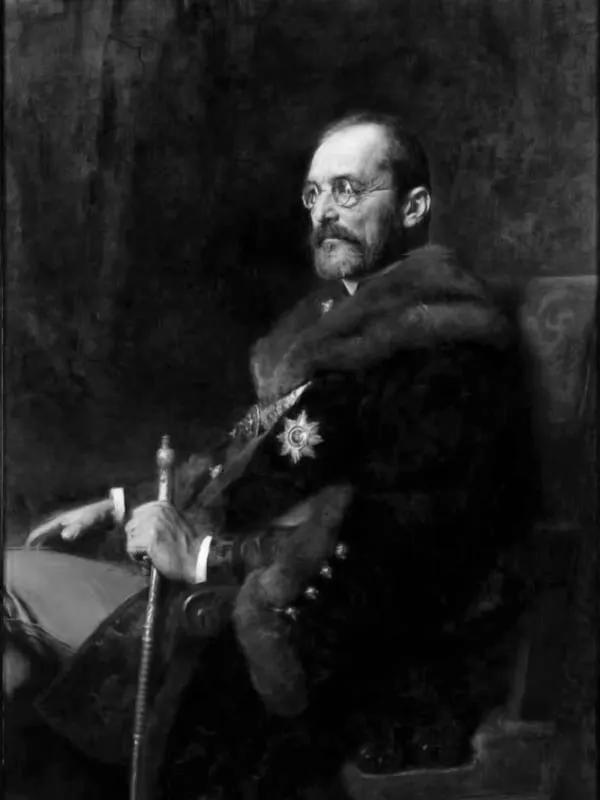
- Born:
- 22 April 1861, Pest, now Budapest (Hungary)
- Died:
- 31 October 1918, Budapest
- Author:
- Natalia
- Photo:
- Gyula Benczúr, domena publiczna, Wikimedia Commons

Count István Tisza was the strongest politician in the Hungarian half of the Habsburg monarchy in the last years of its existence. He defended dualism – Hungary’s equal standing with Austria – together with the rule of the Hungarian nobility over the Kingdom’s other nationalities and a narrow franchise. In July 1914 he was the only one of the monarchy’s leaders who, for nearly two weeks, opposed war with Serbia, foreseeing that it would turn into a world war. Once he gave way, however, he waged it with iron consistency, first as prime minister and then as leader of the majority in the Budapest parliament. To the Slovaks, Romanians and Serbs, and to the Hungarian left, he became the symbol of the old order and of the war. He was killed by soldiers on 31 October 1918, on the last day of the Aster Revolution. After his death he became a martyr of the Hungarian right, and in the interwar period his legend served a regime that blamed the revolution and the democrats for the catastrophe of 1918.
The son of a prime minister
He was born on 22 April 1861 in Pest, the son of Kálmán Tisza, who was Prime Minister of Hungary from 1875 to 1890 and the architect of the Liberals’ long dominance. Some accounts give his birthplace as the family estate at Geszt, where he spent his childhood. The family came from the Calvinist nobility of eastern Hungary, and the title of count was conferred on his uncle in 1883. The young Tisza studied law and political science in Budapest, Berlin and Heidelberg, and from 1886 sat in parliament for his father’s party. An economist by training, he admired English parliamentarism and Bismarck; he was a stern, stubborn Calvinist and a keen fencer who did not shy away from duels.
First government and the fight against obstruction
He was prime minister for the first time from 1903 to 1905. The Hungarian opposition, which demanded among other things that Hungarian be the language of command in the army, was at that time paralysing parliament with obstruction. Tisza tried to break it by changing the standing orders, which he forced through amid scandal, and he lost the election of 1905, in which the opposition won for the first time in decades. For several years he withdrew into the background. He returned with a new National Party of Work, which won an absolute majority in 1910. In 1912, as Speaker of the House of Representatives, he pushed through the army bills, having the police remove protesting deputies from the chamber. On 7 June 1912 one of them, Gyula Kovács, fired at him in the chamber but missed. The court acquitted him on grounds of temporary insanity.
In January 1913 Tisza fought a sabre duel with his fiercest opponent, Count Mihály Károlyi. It lasted about an hour and ended when Tisza wounded Károlyi in the arm. On 10 June 1913 he became head of the government for the second time. He believed that Hungary could survive only as an equal partner in a strong Danubian great power and, at the same time, as a state ruled by Hungarians, even though they made up only about half of the Kingdom’s inhabitants. Fewer than ten per cent of the population could vote. The heir to the throne, Archduke Franz Ferdinand, who wanted to reshape the monarchy at the expense of the Hungarian nobility, saw him as his chief adversary.
July 1914
After the assassination in Sarajevo on 28 June 1914, Tisza was the only one of the monarchy’s leading politicians who did not want immediate war. As early as 1 July he warned Emperor Franz Joseph that an attack on Serbia would be a “fatal mistake”. At the joint Council of Ministers on 7 July he argued that a strike against Serbia would draw Russia into the war and lead to a world war, and that Romania, instead of helping, might attack Transylvania. He demanded that Serbia first be presented with harsh but acceptable terms. He also feared that a victorious war would bring the annexation of Serbia and that new Slav subjects would undermine Hungary’s position in the monarchy.
The foreign minister, Leopold Berchtold, and the chief of staff, Franz Conrad von Hötzendorf, spent a week trying to persuade him. What tipped the balance were German assurances that Berlin would back the monarchy and restrain Romania, and the argument that delay would undermine the ally’s confidence. On 14 July Tisza gave way, and at his insistence the Council of Ministers undertook not to annex any substantial Serbian territory. Once the decision had been taken, he defended it without hesitation and wrote that he was convinced the war was necessary. The public knew nothing of his earlier opposition, which four years later sealed his fate.
Wartime prime minister
In the first years of the war Tisza wielded an influence within the monarchy that no Hungarian politician before him had enjoyed. When the Russians crossed the Carpathians into Hungary in the autumn of 1914, he pressed for them to be driven out of the Kingdom at any cost. In January 1915 he had Berchtold replaced by his confidant István Burián. Both rejected territorial concessions to Italy, fearing that they would set a precedent for Romania’s claims to Transylvania. Tisza opposed plans to incorporate the whole of Serbia into the monarchy and to place Croatia under military rule, while firmly suppressing the political ambitions of the Kingdom’s Romanians and Slovaks.
His position was shaken in August 1916, when Romania entered the war and invaded Transylvania, which only German troops managed to defend. In November 1916 Franz Joseph died. Tisza still had time to persuade the new ruler, Charles I, to be crowned quickly in Budapest. On 30 December 1916, standing in for the vacant office of palatine, he and the Primate of Hungary placed the Holy Crown of St Stephen on Charles’s head. The coronation oath bound Charles to the Hungarian constitution and to the integrity of the lands of the crown, which closed the door to any reshaping of the monarchy that involved the Slavs of its Hungarian half.
Charles, however, wanted reform, and after the February Revolution in Russia the extension of the franchise became urgent. Tisza would accept at most minor changes and refused to give the vote to all front-line soldiers. On 23 May 1917, at the king’s demand, he resigned.
Hussar colonel and parliamentary leader
His resignation did not deprive him of power. The National Party of Work held a majority in parliament, and Tisza had no difficulty blocking the electoral reforms of successive governments. He himself did something remarkable: in the summer of 1917 the 56-year-old former prime minister went to the Italian front as a colonel and took command of the 2nd Honvéd Hussar Regiment from Debrecen. According to accounts, he was tough with his superiors and solicitous towards his men, giving them his tobacco ration and paying towards their food.
In 1918 he returned to Budapest and once again called the shots in parliament. In September the king sent him to Bosnia and Croatia to gauge the mood of the South Slavs. In Sarajevo he received delegations demanding union with Serbia and sent them away curtly, rejecting the very right of nations to self-determination. A few weeks later reality caught up with him as well. On 16 October a young would-be assassin, János Lékai, tried to shoot him outside parliament, but the pistol misfired and Tisza disarmed him. The next day he admitted in parliament: “We have lost this war.”
Death
In the last days of October 1918 revolution broke out in Budapest. On 28 October the police fired on demonstrators on the Chain Bridge; on the night of 30–31 October soldiers and workers took control of the city, and in the morning Károlyi became prime minister. Tisza did not flee and would not let himself be hidden. Towards evening on 31 October – at around 5.45 p.m., according to most accounts – a group of armed soldiers broke through the garden into the villa on Hermina Street where he lived. The attackers disarmed the gendarmes and accused him of being the reason the war had dragged on for years. Tisza came out to them with a revolver in his hand, accompanied by his wife and a relative, Countess Denise Almásy. When he put the weapon down, shots were fired. He died on the spot, and a bullet wounded the countess in the face. The last words attributed to him were: “It is over for me. It had to be so.” He was buried in the family crypt at Geszt, beside his father.
The investigation stalled under Károlyi’s government and under the Hungarian Soviet Republic. After the fall of the communists the trial dragged on and ended in October 1921. The court found guilty several soldiers and left-wing activists from the circle of the National Council, including the journalist Pál Kéri and József Pogány, later a Comintern activist, who were by then already abroad. Only some of those convicted served their sentences. Historians still disagree about who was really behind the killing and how far the verdict was political.
Legend
In the interwar period, under the regency of Miklós Horthy, Tisza became a hero of the Hungarian right, a martyr of the “revolution” that was blamed for the dismemberment of the country by the Treaty of Trianon. For that camp his death proved that defeat had been brought about not by the leaders who had waged the war but by the democrats, socialists and communists who had disarmed and betrayed the nation at the decisive moment. Like the German stab-in-the-back legend, this story nourished the revisionism and hostility to democracy that in the 1930s drew Hungary closer to Hitler’s Germany. On 22 April 1934, the 73rd anniversary of his birth, a monument to him was unveiled in front of the Budapest parliament. In the spring of 1945 unknown persons pulled it down, and in the communist era Tisza was portrayed as a reactionary and warmonger. A reconstructed monument was put back in its original place in 2014.
Assessment
Tisza remains a contested figure, in Hungary too. His defenders, among them his American biographer Gabor Vermes, stress that he was the only leader of the monarchy who in July 1914 clearly foresaw that a war with Serbia would turn into a world war, and that during the war he opposed annexations and military rule. They also point to his personal courage, his integrity and his loyalty to the monarch, which not even his dismissal changed.
His critics point out that his opposition in July 1914 sprang above all from concern for the position of the Hungarians in the dualist monarchy, not from pacifism, and that he gave way after two weeks. Austrian and German historians reproach him for having blocked, through his stubborn defence of Hungarian supremacy over the other nationalities, a narrow franchise and the integrity of the lands of the crown, every reform that might have given the monarchy a chance of survival. It was precisely those nationalities that broke away from Hungary in 1918, and Trianon sealed their departure. Most historians see Tisza as a tragic figure: a politician who judged the dangers soberly but was incapable of the change that might have averted them.