Hungary
Mihály Károlyi
Chairman of the Hungarian National Council (1918), Prime Minister (1918–1919) and President of the Hungarian People's Republic (1919), envoy in Paris (1947–1949)
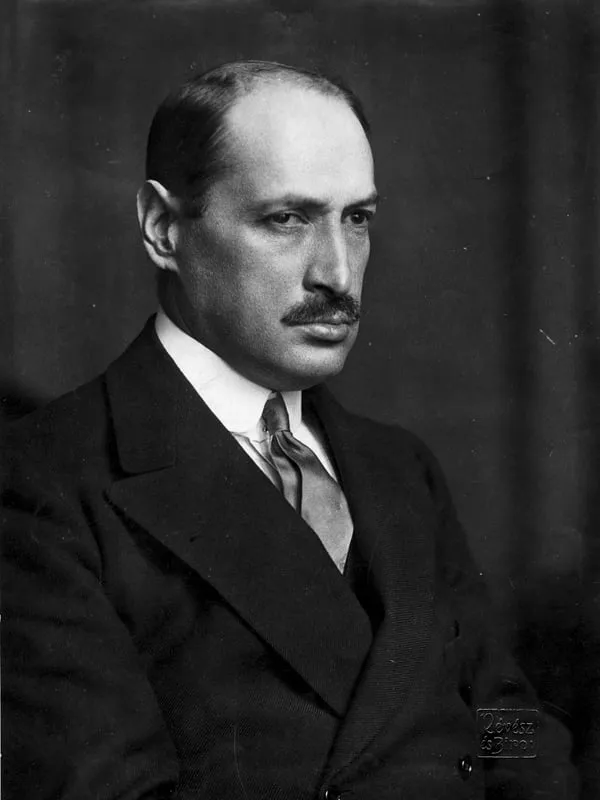
- Born:
- 4 March 1875, Budapest (Austria-Hungary)
- Died:
- 19 March 1955, Vence (France)
- Author:
- Natalia
- Photo:
- Révész és Bíró, domena publiczna, Wikimedia Commons

Count Mihály Károlyi, one of the richest men in Hungary, was during the First World War the best-known Hungarian opponent of the war and of the alliance with Germany. In the autumn of 1918 the Aster Revolution carried him to power. As Prime Minister and then President, he severed the tie with Austria, took Hungary out of the war and stood at the head of the first, democratic Hungarian republic. He hoped that the victors would deal leniently with a Hungary that had broken with the old order. He was disappointed, and after less than five months in office he gave up power, and his name became forever linked with its seizure by the communists. To the interwar right he was the “traitor” who had disarmed the country and opened the way to the Treaty of Trianon, and the memory of this “treason” was one of the foundations of the regime that in the 1930s bound Hungary to Hitler’s Germany. Károlyi himself spent more than a quarter of a century in exile, and to this day he remains one of the most contested figures in his country’s history.
A magnate’s youth
He was born on 4 March 1875 in Budapest, in the Károlyi Palace in Pest. Some sources give his birthplace as Fót, near Budapest, where he grew up. He came from an old magnate family with great estates in eastern Hungary. His parents, Gyula and Georgina, were cousins. He was born with a cleft lip and palate, which left him almost unable to speak as a child. He lost his mother early and was brought up in the care of relatives. Only an operation in Vienna, performed when he was fourteen, allowed him to learn to speak normally.
He studied law in Budapest and then for years led the life of a wealthy idler: he travelled, played cards and lost fortunes at them, raced motor cars and had several accidents. His opponents would often reproach him for this later. Family tradition taught him to dislike the Habsburgs and the Germans, while he knew France and England well and admired their political culture.
From conservative to radical
He entered politics as a conservative. In 1905 he became a member of parliament and soon joined the opposition Party of Independence, which appealed to the tradition of 1848 and demanded greater autonomy for Hungary in relation to Vienna. In 1909–1912 he presided over the influential Hungarian National Agricultural Society, an organisation of the great landowners. Over time, however, he moved to the left. His chief adversary was Count István Tisza, who ruled parliament with a firm hand and blocked any extension of the franchise. The quarrel was so personal that in January 1913 the two counts fought a sabre duel. It lasted about an hour and ended when Tisza wounded Károlyi in the arm.
In the spring and summer of 1914 Károlyi, by then one of the leaders of the opposition, toured the United States giving lectures and raising money among the Hungarians there. It was there that he received the news of the assassination in Sarajevo and then of the ultimatum to Serbia. In dispatches for the Budapest press he warned that the monarchy, having bound itself to Germany, had manoeuvred itself into a hopeless position. On his way back to Europe in August 1914 he was detained by the French at Le Havre as an enemy national and spent several weeks in internment. He was released after giving his word that he would not fight against France, and he returned home in the autumn by way of Spain and Italy. On 7 November 1914 he married Countess Katinka (Katalin) Andrássy, the stepdaughter of Gyula Andrássy, one of the leading figures of Hungarian politics. His wife shared his views and in time became even more radical than he was.
Leader of the peace camp
In the first years of the war Károlyi did not swim against the tide. His party, like the whole Hungarian opposition, declared a “political truce” and supported the government, and he himself volunteered for the hussars and, according to his memoirs, served for a time as an officer. The turning point came in July 1916. When the Party of Independence decided to continue backing Tisza’s war policy, Károlyi left it with a group of some twenty deputies and founded a party of his own, known as the Károlyi Party. It called for a peace without annexations, a break with the German alliance, looser ties with Austria, universal and secret suffrage, and land reform. Károlyi also spoke of equal rights for Hungary’s nationalities, although he assumed that the state would remain intact.
After the death of Franz Joseph the young King Charles IV sought an understanding with the opposition. Károlyi supported his efforts towards peace and electoral reform, which in May 1917 led to Tisza’s dismissal. He headed the Electoral Bloc, an alliance of his party with the Social Democrats and Oszkár Jászi’s Radicals. The reform, however, stalled in parliament, where the majority still belonged to Tisza’s men. In January 1918 Károlyi publicly declared his support for President Woodrow Wilson’s Fourteen Points. From then on he was all but a traitor to the right, and a hope to the war-weary workers, peasants and soldiers.
The Aster Revolution
In the autumn of 1918, as the monarchy was losing the war and breaking up into nation states, Károlyi became the man of the moment. On 16 October he declared in parliament that the war was lost, and the next day Tisza himself conceded that he was right. On the night of 24–25 October his party, the Radicals and the Social Democrats formed the Hungarian National Council in his palace; it elected him chairman and held its sessions in the Hotel Astoria. The Council demanded immediate peace, a break with the German alliance, full independence and democratic elections. The King spoke with Károlyi and, according to some accounts, was inclined to entrust him with the government, but changed his mind. His plenipotentiary, Archduke Joseph August, instead charged a conservative, Count János Hadik, with forming a cabinet. On 28 October police and gendarmes opened fire on the Chain Bridge on a crowd marching on the castle in Buda to demand that Károlyi be made Prime Minister. On the night of 30–31 October mutinous soldiers and workers took control of Budapest, Hadik stepped down, and in the morning Károlyi was appointed Prime Minister.
That same evening soldiers shot Tisza dead in his villa. Because the killers had links with the circle around the National Council, the right accused Károlyi for years of sharing responsibility. Several of his associates were later convicted in absentia, but neither judges nor historians have found evidence that Károlyi himself was involved. Károlyi condemned the murder and sent a wreath for his old opponent’s coffin.
Prime Minister and President
Károlyi’s government declared the union with Austria at an end and called on soldiers to go home. The Minister of War, Béla Linder, announced that he did “not want to see any more soldiers”. The army, which still numbered hundreds of thousands of men, dispersed, and Hungary was left almost without troops. Károlyi refused to accept that he was bound by the Armistice of Villa Giusti, signed on 3 November still in the name of the Emperor and King. On 7 November he travelled to Belgrade for talks with General Louis Franchet d’Espèrey, counting on his anti-war past to secure lenient treatment for the new Hungary. The Frenchman, however, treated the delegation as representatives of a defeated state. The military convention signed in Belgrade on 13 November drew a demarcation line beyond which lay the south of the country and a large part of Transylvania.
On 13 November Charles renounced any part in Hungarian affairs, and on 16 November the Hungarian People’s Republic was proclaimed. Károlyi was its Prime Minister and provisional head of state, and on 11 January 1919 the National Council elected him President. His government brought in laws on freedom of the press and of assembly, an electoral law giving women the vote, and a land reform act. On 23 February 1919 he himself began distributing land from his estate at Kápolna to the peasants. His minister Jászi offered the Slovaks, Romanians and Serbs broad autonomy in an “Eastern Switzerland”, but Hungary’s nationalities no longer wanted such a state. On 1 December 1918 the Romanians of Transylvania proclaimed union with Romania at Alba Iulia, while Czechoslovak, Serbian and Romanian troops, backed by France, occupied more and more territory, often beyond the Belgrade line.
The republic was also weakening from within. Béla Kun’s communists agitated in the streets, prisoners of war returning from Russia dreamt of a revolution on the Bolshevik model, and the right could not forgive Károlyi for disarming the army. On 20 March 1919 the Entente’s representative in Budapest, the French Lieutenant Colonel Fernand Vix, delivered a demand for a further withdrawal of Hungarian troops into the interior. The government would not accept it and resigned. The next day the Social Democrats merged with the communists and proclaimed the Hungarian Soviet Republic. This was announced in a proclamation bearing Károlyi’s name, though he later maintained that he had not signed it. Whether he handed over power voluntarily or merely yielded to a fait accompli remains disputed.
The “Red Count” in exile
He was powerless against the new regime, and on 4 July 1919 he left the country, not to return for a long time. After the fall of the Soviet Republic, power in Hungary passed to the camp of Admiral Miklós Horthy, for whom Károlyi embodied everything that had led to defeat. In the first half of the 1920s a court convicted him in absentia of high treason, and his enormous fortune was confiscated. Károlyi lived in Austria, Czechoslovakia and Yugoslavia, and from the mid-1920s mainly in London and Paris. He often lived modestly, on his writing and lectures. In 1925 he published his memoirs, Egy egész világ ellen (“Against the Whole World”). He drew close to the communists, which earned him the nickname “the Red Count”, although he never became a party member. In the mid-1920s the United States refused him a visa.
In the 1930s he warned against fascism and against the course that was leading Hungary towards Germany. He criticised the Hungarian anti-Jewish laws and the revisionism which, at the price of the lands regained through the Vienna Awards, made the country dependent on Hitler. His son Ádám was killed in an air crash in 1939. During the Second World War Károlyi was in Britain, where he led the émigré movement of Hungarians opposed to Horthy and to the alliance with Germany. According to some sources, in August 1944, as chairman of the Hungarian Council in Great Britain, he protested against the deportation of Hungarian Jews to Auschwitz.
Return and final exile
On 9 May 1946, after almost 27 years, Károlyi returned to Hungary. The new authorities welcomed him ceremonially as a patriot and democrat. In 1947–1949 he was the Hungarian envoy in Paris. When the communists took full power and staged the show trial of László Rajk, he resigned in protest in June 1949 and remained in France. He spent his last years at Vence on the Riviera, writing his memoirs, published in English as Faith Without Illusion. He died there on 19 March 1955. In 1962 his ashes were brought back to Budapest and buried in the Fiumei Road (Kerepesi) Cemetery.
Assessment
Few Hungarian politicians provoke such conflicting judgements. To the right of the Horthy era, and in part still today, Károlyi was the man who disarmed the country at the moment of greatest danger, surrendered it to its neighbours without a fight and opened the way to the communists, and so shares responsibility for Trianon. In the interwar period this view served the Horthy regime as a justification: if defeat had been brought about by the “treason” of the democrats and revolutionaries, then only a firm hand and a revision of the borders could reverse it – a revision Hungary ultimately achieved at Germany’s side. The communist authorities, with whom he had broken in 1949, restored his reputation after his death as a progressive patriot. In 2012 his statue, which had stood beside the Budapest Parliament since 1975, was moved to Siófok, and two years later a reconstructed monument to his greatest adversary, Tisza, was erected on the same spot. There could hardly be better proof of how much alive the dispute over the two men still is.
Liberal and left-wing historians see him above all as the first Hungarian democrat, who during the war had the courage to swim against the tide and who believed in Wilson’s principles. Yet even sympathetic authors concede that he lacked political experience and resolve. Many scholars point out that Hungary’s fate in 1918–1919 was decided above all by the defeat of the monarchy, the collapse of the army, the stance of the nationalities and French policy, not by the weakness of one man. Recent Hungarian research questions whether the exhausted army, returning from the front and in large part non-Hungarian, could have been used at that time to defend the old borders at all.
Sources
Mentioned in battles
(01)Often appears with
People who appear in the same events.