Hungary
Miklós Horthy
Last commander of the Austro-Hungarian fleet (1918), commander-in-chief of the National Army (1919), Regent of the Kingdom of Hungary (1920–1944)
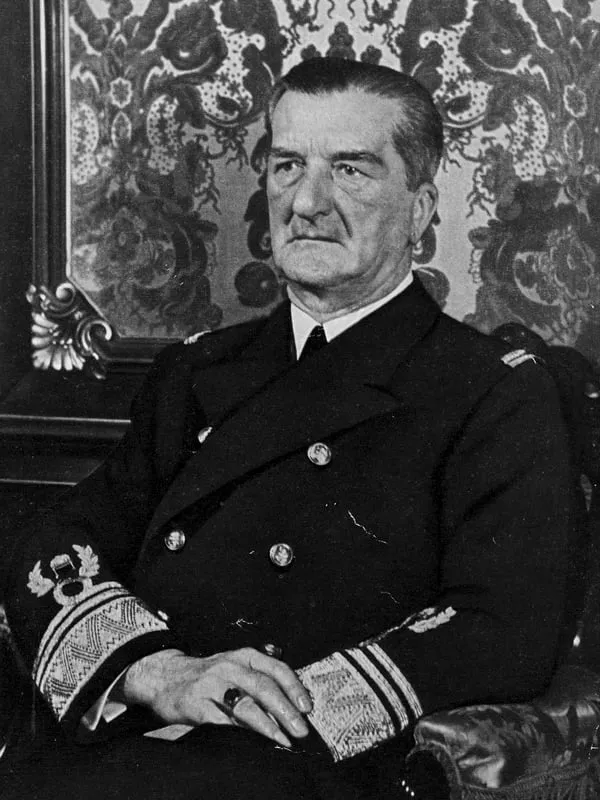
- Born:
- 18 June 1868, Kenderes (Kingdom of Hungary)
- Died:
- 9 February 1957, Estoril (Portugal)
- Author:
- Natalia
- Photo:
- autor nieznany, domena publiczna, Wikimedia Commons

Miklós Horthy ruled Hungary longer than anyone else in the 20th century before the communists. Until 1918 he was a naval officer, aide-de-camp to Emperor Franz Joseph and the last commander of the Austro-Hungarian fleet. In 1919, when the Hungarian Soviet Republic lost the war with Romania, he placed himself at the head of the counter-revolutionary National Army, and in March 1920 parliament elected him regent of a kingdom without a king. For a quarter of a century his state lived for a single aim: the revision of the Treaty of Trianon, which had taken two-thirds of Hungary’s territory. That aim drew Horthy towards Mussolini and Hitler, thanks to whom he regained part of the lost lands in 1938–1941, and led Hungary into the war against the USSR. Under his rule anti-Jewish laws were passed, and in 1944, already under German occupation, the Hungarian authorities sent more than 430,000 Jews to their deaths. Horthy halted the deportations in July, and in October he tried to take the country out of the war. The Germans overthrew and interned him. He died in exile in Portugal.
Sailor and imperial aide-de-camp
He was born on 18 June 1868 in Kenderes on the Great Hungarian Plain, into a Calvinist family of the middle gentry. His father, István Horthy, was a landowner. At the age of fourteen Miklós entered the Naval Academy at Fiume, where teaching was in German. He became an officer of the Imperial and Royal Navy, sailed the Mediterranean and far beyond, and during the Bosnian crisis of 1908 commanded the embassy station ship at Constantinople. In 1901 he married Magdolna Purgly, with whom he had four children. In 1909–1914 he was one of the aides-de-camp of Emperor Franz Joseph I. For a Hungarian and a Protestant in a milieu dominated by Catholic army officers this was a remarkable advancement. At court he won the trust of the old emperor, as well as the goodwill of his eventual successor, Charles.
The First World War
At the start of the war he commanded the old battleship Habsburg, and from the end of 1914 the new, fast cruiser Novara. The Austro-Hungarian fleet, weaker than the Italian, French and British fleets, spent most of the war in port, but Horthy was one of its most enterprising officers. He led raids on the Italian and Albanian coasts and on the barrage that the Allies had built across the Strait of Otranto to stop submarines leaving the Adriatic. On the night of 14–15 May 1917 three cruisers under his command sank more than a dozen armed drifters guarding the barrage. On the way back they fought British and Italian warships; Horthy was badly wounded, and the damaged Novara had to be taken in tow. The Austrians lost no ships, and the wounded commander became a hero in a country that had little good news at the time.
After the sailors’ mutiny in the Bay of Kotor in February 1918, Emperor Charles passed over many more senior admirals and on 27 February appointed him rear admiral and commander of the fleet. In June Horthy led it out for a great attack on the Otranto barrage, but when an Italian torpedo boat sank the dreadnought Szent István on 10 June, he called off the operation. On 31 October 1918, on the emperor’s orders, he handed the fleet over at Pola to representatives of the new Yugoslav state and left for Kenderes. In those same days the Aster Revolution gave power in Budapest to Mihály Károlyi.
Commander of the National Army
When Béla Kun’s communists seized power in Hungary on 21 March 1919, opponents of the new regime began to gather at Szeged, in the zone occupied by the French. A counter-revolutionary government was formed there under Count Gyula Károlyi, a relative of the former prime minister. At the turn of May and June Horthy, the famous “hero of the Novara” and the highest-ranking officer in the country, became its minister of war, and soon commander-in-chief of the National Army being raised there. At first it numbered a few thousand men, many of them officers. When in August the Romanians routed the Red Army and occupied Budapest, Horthy moved with his troops into territory they had not occupied, with his headquarters at Siófok on Lake Balaton.
Units of his army, especially the officer companies of Pál Prónay, Iván Héjjas and Antal Ostenburg, unleashed the so-called White Terror. Its victims were real and alleged communists, social democrats, peasants suspected of sympathising with the Soviet Republic and, above all, Jews, whom counter-revolutionary propaganda identified with Bolshevism. The number killed is usually estimated at more than a thousand, and in some studies at several thousand. Historians disagree about how far Horthy directed these units, but he tolerated their activities and shielded their commanders. He himself later wrote that such times called for an “iron broom”.
On 14 November 1919, under Allied pressure, the Romanians left Budapest, and on 16 November Horthy rode into the capital on a white horse at the head of the National Army. In a speech he called Budapest a “sinful city” that had renounced its past and embraced revolution. The Allies, who were looking for a force in Hungary capable of keeping order, accepted him as the guarantor of stability. Under their supervision the government of Károly Huszár was formed and elections were held.
Regent
On 1 March 1920 parliament, with soldiers of the National Army standing inside the building, elected Horthy regent. Hungary remained a kingdom, but without a king, and the regent – an admiral of a landlocked state – was to rule in the monarch’s stead. On 4 June 1920 Hungary signed the Treaty of Trianon. It lost more than two-thirds of its territory to Romania, Czechoslovakia, the Kingdom of Serbs, Croats and Slovenes and Austria, and more than three million Hungarians found themselves beyond its borders. The slogan “Nem, nem, soha!” – “No, no, never!” – became the foundation of Hungarian policy for the next twenty years.
In 1921 King Charles IV – as Emperor of Austria, Charles I – twice tried to regain the Hungarian throne: in March, at Easter, and in October, when he reached the outskirts of Budapest with a group of supporters. Horthy, who had earlier assured him of his loyalty, each time refused to hand over power, in October by force of arms as well, in a skirmish at Budaörs. He argued that a Habsburg restoration would provoke intervention by the neighbouring states. Parliament dethroned the Habsburgs in November 1921. The regent remained head of state with no limit on his term, and his powers were extended over time.
Horthy’s Hungary was a conservative and authoritarian state, but not a totalitarian one. Parliament functioned with a limited opposition; the social democrats were legal, the communists banned. From 1921 to 1931 the country was governed by the adroit prime minister István Bethlen, who stabilised it and in 1927 concluded a treaty of friendship with the Italy of Benito Mussolini, the first breach in Hungary’s isolation. As early as 1920 parliament had passed the numerus clausus law limiting the number of Jews at universities. Bethlen’s successor Gyula Gömbös, prime minister in 1932–1936, brought the country closer to Germany after Adolf Hitler came to power.
Revision at Hitler’s hands
After the Munich Agreement, in the First Vienna Award of 2 November 1938, Germany and Italy gave Hungary a strip of southern Slovakia, and in March 1939, as Hitler was breaking up Czechoslovakia, Hungarian troops occupied Carpathian Ruthenia. Hungary thereby gained a common border with Poland, with which it was bound by a traditional friendship. In the same years parliament passed two anti-Jewish laws, of 1938 and 1939, and a third, of 1941, banned marriages between Jews and non-Jews. Horthy himself wrote in a letter to his prime minister that he had been an antisemite all his life, although he also despised Nazi radicalism.
In September 1939 the government of Pál Teleki refused to let German troops marching on Poland pass through Hungary, and after the September defeat the country took in more than a hundred thousand Polish refugees and soldiers, many of whom managed to make their way to France. For this stance Horthy is remembered with gratitude in Poland. At the same time he was courting Hitler for further gains. On 30 August 1940, in the Second Vienna Award, Hungary received northern Transylvania, over which it had fought Romania twenty years earlier. In November it joined the Tripartite Pact. In April 1941, when Hungary joined the German attack on Yugoslavia in breach of a treaty of friendship with that country signed only a few months earlier, Teleki committed suicide. The Hungarians occupied, among other areas, the Bačka.
The war and 1944
On 26 June 1941 unidentified aircraft bombed Kassa (Košice), and the next day Hungary declared war on the USSR. Hungarian divisions went east, and in August 1941 the authorities expelled thousands of Jews without Hungarian citizenship to occupied Ukraine, where most of them were murdered near Kamianets-Podilskyi. In January 1942 Hungarian troops and gendarmerie massacred several thousand Serbs and Jews in and around Novi Sad. In August that year the regent’s elder son, István, whom his father had made his deputy, was killed in an air crash on the Eastern Front. In January 1943, on the Don, the Soviet army smashed the Hungarian 2nd Army, which lost more than a hundred thousand men. The government of Miklós Kállay began secretly seeking contact with the Allies, while Horthy refused to agree to the deportations of Jews that the Germans were demanding.
Hitler responded with occupation. On 19 March 1944, while Horthy was at Klessheim Castle near Salzburg at the Führer’s summons, German troops marched into Hungary. The regent stayed in office and appointed the pro-German government of Döme Sztójay. From mid-May to the beginning of July the Hungarian gendarmerie, working with the unit of Adolf Eichmann, deported more than 430,000 Jews from the provinces, the vast majority to Auschwitz-Birkenau, where most were murdered immediately on arrival. Horthy did not oppose the deportations when they began. Only at the beginning of July, influenced by protests from the Pope, the King of Sweden and the President of the United States, by news of the fate of the deportees and by an Allied bombing raid on Budapest, did he order them stopped. As a result most of the capital’s Jews survived.
At the end of August 1944, after Romania had changed sides to the Allies, Horthy dismissed the Sztójay government, and in the autumn he sent a delegation to Moscow, which signed preliminary armistice terms. On 15 October he announced on the radio that Hungary was asking for an armistice. The Germans were ready for this. That same day a commando unit under Otto Skorzeny kidnapped his younger son, Miklós, and German troops surrounded the Royal Palace in Buda. The next day, to save his son, Horthy signed his resignation and handed power to the leader of the Arrow Cross, Ferenc Szálasi. The Germans took him to Bavaria. The rule of the Arrow Cross brought fresh murders and death marches of Budapest’s Jews.
Exile
In May 1945 Horthy fell into American hands. He was questioned as a witness before the tribunal at Nuremberg but was never brought to trial, and the Americans did not hand him over to Yugoslavia, which demanded his extradition. Until the end of the 1940s he lived with his family in Bavaria, then moved to Portugal. He settled in Estoril, where he lived modestly, largely on help from old friends and Hungarian émigrés. In 1953 he published his memoirs. He died in Estoril on 9 February 1957. In accordance with his wishes, his remains returned to Hungary only after the fall of communism. On 4 September 1993 he was buried in Kenderes, at a ceremony attended by tens of thousands of people and by members of the government.
Assessment
Horthy is one of the most contested figures in Hungarian history. To his supporters he was a patriot who rebuilt the state after defeat, revolution and Trianon, resisted the far right for years, took in Polish refugees in 1939, saved the Jews of Budapest in July 1944 and tried to take the country out of the war. To his critics, including most historians, he was an authoritarian leader who came to power on the wave of the White Terror, put his name to anti-Jewish laws, bound Hungary to Hitler in exchange for territorial gains, dragged it into the war against the USSR and shares responsibility for the deportations of 1944.
For the road to the Second World War his rule is of particular significance. Hungary was a state that Trianon gave no peace, and it was therefore the natural partner of anyone who wanted to overturn the Versailles order. Horthy was not a Nazi and did not trust Hitler, but it was from Hitler that he received what he wanted most: the return of part of the lands lost in 1920. For those gains Hungary paid with its part in a war in which it lost hundreds of thousands of soldiers and civilians, as well as more than half a million of its citizens of Jewish origin. After the war all the gains were lost and the Trianon borders returned.
Sources
Mentioned in battles
(06)Often appears with
People who appear in the same events.