Austria-Hungary
Charles I of Austria
Emperor of Austria and, as Charles IV, King of Hungary (1916–1918), supreme commander of the Austro-Hungarian army (1916–1918)
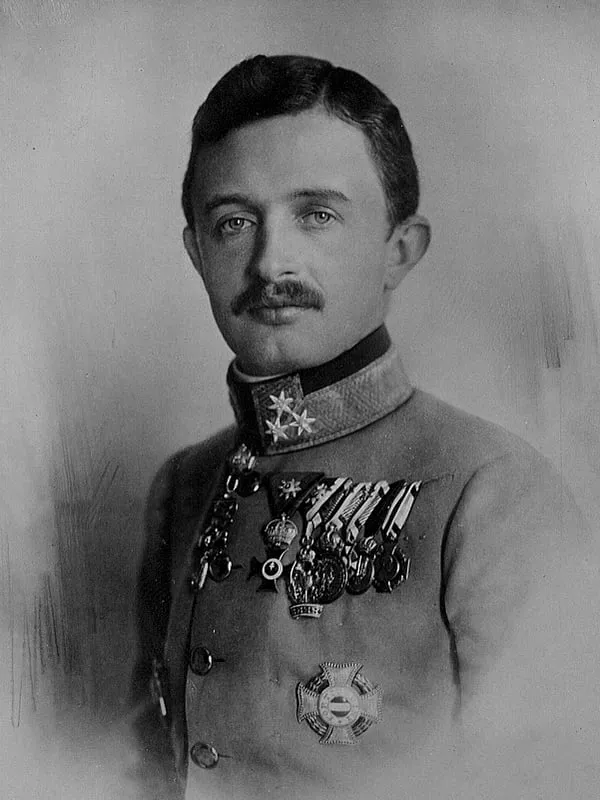
- Born:
- 17 August 1887, Persenbeug on the Danube (Austria)
- Died:
- 1 April 1922, Funchal, Madeira (Portugal)
- Author:
- Łukasz
- Photo:
- autor nieznany, domena publiczna, Wikimedia Commons

Charles I (Emperor Karl) was the last ruler of the Habsburg dynasty. He came to the throne in November 1916, in the middle of the First World War, at the age of 29, after the almost 68-year reign of his great-uncle Franz Joseph I. From his first days he was convinced that a prolonged war would destroy the monarchy, and he secretly sought a separate peace. He managed neither to conclude one nor to reshape the state before it broke apart into nation states in the autumn of 1918. In Budapest, where he reigned as Charles IV, the Aster Revolution forced him to hand power to opponents of the war. He never formally abdicated. In 1921 he twice tried to regain the Hungarian crown, and both attempts ended in failure; for years afterwards the opposition of Hungary’s neighbours and the Allies to a Habsburg return remained one of the threads of Central European politics. He died in exile at the age of 34. To some he was a man of goodwill, the only monarch of the warring states who genuinely wanted peace; to others a weak and inconsistent ruler whose ideas came too late.
Youth
He was born on 17 August 1887 at Persenbeug Castle on the Danube, in Lower Austria. He was the elder son of Archduke Otto and Princess Maria Josepha of Saxony, and a grandson of Archduke Karl Ludwig, the Emperor’s younger brother. For a long time no one saw him as a future monarch. The heir to the throne was his uncle Franz Ferdinand, but because he had made a morganatic marriage with Countess Sophie Chotek, his children could not inherit. After his father’s death in 1906, Charles was therefore second in line to the throne. He was taught mainly by private tutors, for a time attended the Benedictine-run Schottengymnasium in Vienna – a rarity in the imperial family – and later attended lectures in law and economics in Prague. From 1905 he served in the cavalry and then in the infantry.
On 21 October 1911 he married Princess Zita of Bourbon-Parma, daughter of the last Duke of Parma. The marriage was happy and exceptionally close, and the Empress later accompanied her husband on his travels and at many conferences, a fact his opponents were eager to exploit. In 1912 their first son, Otto, later the pretender to the throne, was born. The couple had eight children. Zita’s brothers Sixtus and Xavier regarded themselves as French and in 1914 joined the Belgian army.
Heir to the throne
After the assassination in Sarajevo on 28 June 1914 Charles became heir to the throne. He took no part in the decisions of the July Crisis. After the outbreak of war he was attached to the Supreme Command at Teschen (Cieszyn), where the Chief of the General Staff, Franz Conrad von Hötzendorf, kept him away from operational planning. The Archduke visited the front, took parades and handed out decorations. In the spring of 1916 he received his first real command, a corps in the Tyrol, which in May went on the offensive against Italy. In the summer he took over an army group on the Eastern Front defending Eastern Galicia and the Carpathians and, after Romania entered the war, Transylvania as well. In practice operations were directed by his German chief of staff, General Hans von Seeckt.
Emperor and king
On 21 November 1916 Franz Joseph died and Charles became emperor. That same day, in the manifesto “To My Peoples!”, he announced that he would do everything to end the war as quickly as possible. On 2 December he personally assumed supreme command of the army. On 30 December he was crowned King of Hungary as Charles IV in the Matthias Church in Budapest. The crown was placed on his head by the Primate of Hungary and by Prime Minister István Tisza, who stood in for the vacant office of Palatine. The haste that Tisza had urged on him came at a price: the coronation oath bound him to defend the integrity of the lands of the Hungarian crown, which closed the way to a restructuring of the monarchy that would include the Slavs of its Hungarian half.
Within a few months the new ruler replaced almost all of his predecessor’s men. The new foreign minister was Count Ottokar Czernin, who shared the Emperor’s conviction that peace was urgent. On 1 March 1917 Charles dismissed Conrad. In May he demanded the resignation of Tisza, who opposed extending the franchise in Hungary. On 30 May the Austrian parliament met after a break of more than three years, and in July the Emperor declared an amnesty for those convicted of political offences, which covered, among others, the Czech leader Karel Kramář. Some historians see these steps as a harbinger of reform; others point out that they were gestures rather than a considered programme, and that they aroused suspicion in Germany and among the Austrian Germans.
The search for peace and the Sixtus affair
Charles knew from the start that the monarchy would not survive a long war. Through his wife’s family he established secret contacts with France. On 24 March 1917, at Laxenburg, he handed Prince Sixtus a letter in his own hand in which he promised to support France’s “just claims” to Alsace-Lorraine. Paris and London received the offer with interest, but the talks foundered on Italy, to which the Entente had promised large parts of the monarchy’s territory, while Charles would not hear of concessions to Rome. After the October Revolution and peace with Russia, the war bound the monarchy ever more tightly to Germany.
In April 1918 the French Prime Minister, Georges Clemenceau, made the Emperor’s letter public. Charles called it a forgery and assured Emperor Wilhelm II of his loyalty, but no one believed him any longer. In May he had to travel to German headquarters at Spa and agree to a closer military and economic union with Germany. From then on, in the eyes of German nationalists, he and the “Italian woman” Zita were traitors, while in the eyes of the Allies the monarchy had ceased to be a partner for a separate peace. At the beginning of September 1918 the United States recognised the Czechoslovak National Council, a sign that the victors had already decided on the break-up of the monarchy.
Autumn 1918: the collapse of the monarchy
In June the Austro-Hungarian army attacked for the last time, on the Piave, and was defeated. On 16 October 1918 the Emperor issued a manifesto announcing the transformation of Austria into a federal state of nations, but it left out Hungary. The national councils whose formation it called for took power in their own name. On 26 October Charles informed Wilhelm II that he would ask for a separate peace, and the following day Vienna asked President Wilson for an armistice. He appointed Archduke Joseph August as his plenipotentiary in Hungary, hoping that a Habsburg popular in the country would calm the situation. He hesitated over whether to entrust the government to the opposition leader, Count Mihály Károlyi, and in the end decided against it. On 28 October police in Budapest fired on demonstrators demanding a Károlyi government, and on the night of 30–31 October the Aster Revolution forced the King to confirm Károlyi’s appointment by telephone.
On the night of 2–3 November, hesitating to the last, Charles accepted the terms of the Armistice of Villa Giusti, and in the morning he gave up supreme command. The order to cease fighting reached the troops more than a day before the armistice came into force, and by then the Italians had taken prisoner hundreds of thousands of soldiers who believed the war was already over. On 9 November the Hohenzollern monarchy fell in Berlin. On 11 November, the day of the Armistice of Compiègne, Charles signed at Schönbrunn a declaration renouncing “all participation in affairs of state” in Austria, and on 13 November, at Eckartsau Castle, a similar one for Hungary. He carefully avoided the word “abdication” and later wrote that he did not feel bound by a signature extorted from him like a cheque by a bandit. Republics were proclaimed in Vienna on 12 November and in Budapest on 16 November.
Exile and attempts to return
He spent the winter with his family at Eckartsau under the protection of British officers. On 24 March 1919 he left for Switzerland, and on the way, at Feldkirch, he signed a manifesto declaring all the decisions of the new authorities null and void. The Austrian parliament responded with the law of 3 April 1919, which stripped the Habsburgs of their rights to the throne, confiscated their property and banned the former Emperor from returning to the country.
In Hungary the situation was different. After the fall of the Hungarian Soviet Republic and the war with Romania, the country formally became a kingdom again – only without a king. In March 1920 parliament elected as regent Admiral Miklós Horthy, the former commander of the fleet, who had sworn loyalty to Charles. Charles hoped that Horthy would hand power over to him. On Holy Saturday, 26 March 1921, he arrived unexpectedly in Hungary, and the next day he appeared at the castle in Budapest and demanded to be given the reins of government. Horthy refused, citing the threat of intervention by Hungary’s neighbours, and Charles had to return to Switzerland. In October he flew with Zita to the area around Sopron and set off by train for the capital with units of volunteers loyal to him. On 23 October there was a clash with government troops at Budaörs. Czechoslovakia and Yugoslavia announced mobilisation, and Charles, unwilling to start a civil war, surrendered. The Allies exiled him to Portuguese Madeira, which he reached on 19 November. On 6 November 1921, under pressure from the Great Powers and the neighbouring states, the Hungarian parliament passed a law dethroning the Habsburgs.
The family lived on Madeira in difficult conditions. In March 1922 Charles caught influenza, which developed into pneumonia, and he died on 1 April in a villa on the hill of Monte above Funchal. He was buried in the local Church of Our Lady. Zita outlived him by 67 years.
A long shadow
Charles’s death did not close the Habsburg question. Czechoslovakia, Romania and Yugoslavia, bound together in the Little Entente – formed partly against a Habsburg restoration and Hungarian revisionism – regarded the dynasty’s return as a cause for war throughout the interwar period. In Hungary the legitimists never stopped regarding Charles’s son Otto as the rightful king, and in Austria in the 1930s, under Kurt Schuschnigg, monarchists saw him as a bulwark against the country’s absorption by Germany. Hitler, who hated the Habsburgs, took this possibility seriously. In a directive of the German war minister of June 1937, armed entry into Austria in the event of a restoration of the monarchy was named “Sonderfall Otto” (Special Case Otto), and it was under the code name “Unternehmen Otto” that the Wehrmacht marched into Austria in March 1938, carrying out the Anschluss. Historians disagree on whether the name referred to Charles’s son or to the medieval emperor Otto I. During the Second World War Otto von Habsburg worked against the Nazis in exile, and he later became a member of the European Parliament.
On 3 October 2004 Pope John Paul II beatified Charles, which sparked a lively debate in Austria.
Assessment
Judgements of Charles vary widely today. Sympathetic biographers, such as the British historian Gordon Brook-Shepherd and the Austrian historian Elisabeth Kovács, stress that he was the only leader of the warring states who consistently sought peace, that he restored constitutional life in Austria and that he tried to save the monarchy by reforming it before it was too late. Frequently quoted are words attributed to the French writer Anatole France, who is said to have called him the only decent man to have stood at the head of a state during the war.
Critics point to his inexperience, his vacillation and his tendency to act on his own. The Austrian historian Helmut Rumpler called him a dilettante, too weak for the challenges he faced. The letter to Sixtus promised other people’s land, and his later denials destroyed the Emperor’s credibility in Berlin, Paris and London. The coronation in Budapest tied his hands on the nationalities question, and his attempts to return in 1921, undertaken without a grasp of the situation, merely strengthened Horthy’s hold on power in Hungary. Most scholars agree that by 1916 no ruler could have led the monarchy out of the war on his own, and that Charles, as is often said, inherited a game that was already lost. The dispute concerns mainly whether his decisions hastened its end or whether he simply failed to avert it.
Sources
Often appears with
People who appear in the same events.