- Category:
- Crimes and repression
- Date:
- 8 October 1895
- Author:
- Natalia
- Tags:
- Korea, Japan, Japanese imperialism, Queen Min
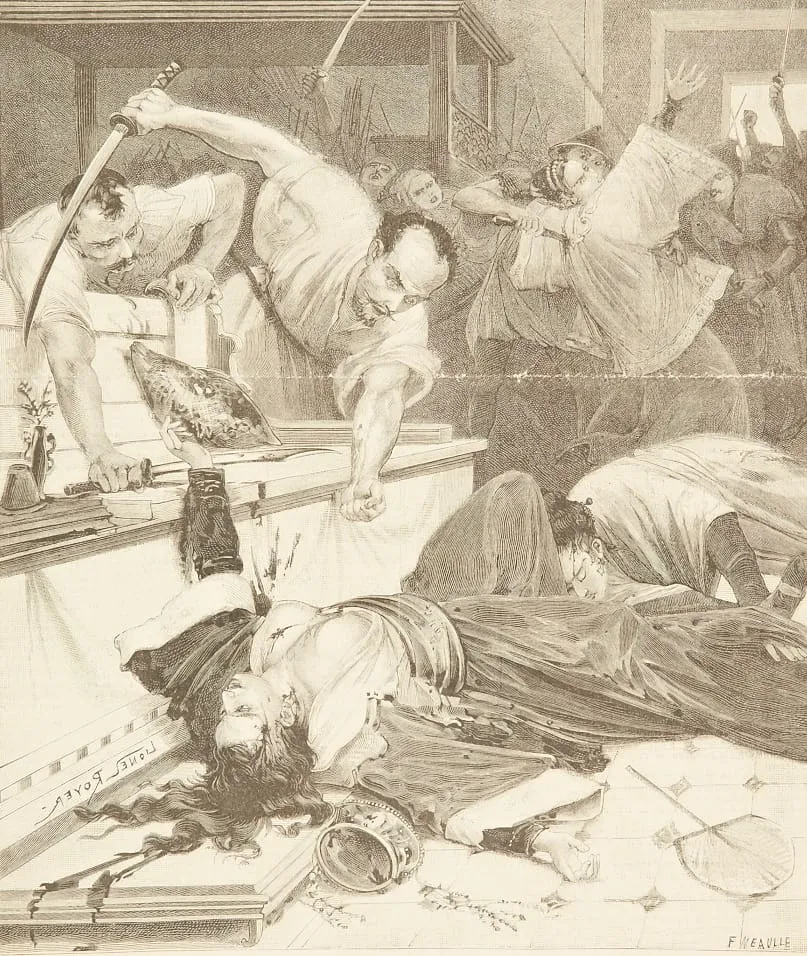
Before dawn on 8 October 1895 a group of armed Japanese, most of them civilians, backed by Japanese soldiers and policemen and by Korean troops trained by the Japanese, forced their way into the Gyeongbokgung palace in Seoul. The attackers searched the women’s quarters, beating court ladies and throwing them out of the windows, and finally killed Queen Min (posthumously Empress Myeongseong), the wife of King Gojong and for more than twenty years the most influential figure at the Korean court. Her body was carried to a nearby grove, doused with kerosene and burned. The attack had been prepared by Japan’s minister in Korea, the retired lieutenant general Gorō Miura. By the lunar calendar, still in official use in Korea at the time, it was the twentieth day of the eighth month of the year eulmi, which is why Koreans call the assassination the Eulmi incident (을미사변, Eulmi sabyeon).
Korea between China, Japan and Russia
The kingdom of Joseon, ruled by the Yi dynasty since the end of the 14th century, had for centuries acknowledged the suzerainty of the Chinese emperors and shut itself off from the rest of the world. In 1876 Japan, which since the Meiji Restoration had been rapidly adopting Western technology and Western methods of statecraft, forced Korea to sign the unequal Treaty of Ganghwa. It opened Korean ports to Japanese merchants and granted the Japanese extraterritorial rights. Treaties with China, the United States, Britain, Germany, Russia and France followed. For the next two decades Korea was an arena of rivalry between the powers, and its court a battlefield of factions that sought foreign backing.
The main line of this struggle ran through the royal family itself. Gojong had come to the throne in 1864 as an eleven-year-old boy, and his father Yi Ha-eung, known as the Heungseon Daewongun and an advocate of strict isolation, ruled in his name. It was he who chose his son’s wife: a girl from the Min clan of Yeoheung, an orphan without influential relatives, who was meant to be an obedient daughter-in-law. He was mistaken. The queen quickly built a faction of her own, helped to remove her father-in-law from power in 1873 and filled the most important offices with relatives from the Min clan. From then on she and the Daewongun waged a merciless war in which both looked for allies abroad. During the military mutiny of 1882 the Daewongun briefly regained power and announced that the queen was dead, though she had in fact gone into hiding in the provinces. She was restored to Seoul by Chinese troops, who arrested the Daewongun and took him off to China. In December 1884 reformist conspirators backed by the Japanese legation staged the Gapsin Coup. It was crushed by the Chinese garrison under Yuan Shikai, and the queen, who saw the Japanese behind the plotters, never trusted Tokyo again.
The Sino-Japanese War and the Triple Intervention
In 1894 the Donghak peasant rebellion broke out in southern Korea. The Korean government asked China for help, but Japanese troops entered Korea as well. On 23 July 1894 the Japanese seized Gyeongbokgung, took the king under their control and raised the Daewongun to power, using him to form a government compliant towards Japan. A few days later the Sino-Japanese War began; it was formally declared on 1 August. Japan won it on land and at sea. Under Japanese supervision the government of Kim Hong-jip carried out the so-called Gabo reforms: the civil service examinations and slavery were abolished, and the administration and the army were reorganised. Units known as the hullyeondae were formed in Seoul from forces trained by Japanese instructors. The Daewongun soon proved too independent for the Japanese, and in the autumn of 1894 the new Japanese minister, Kaoru Inoue, pushed him out of state affairs.
The Treaty of Shimonoseki, signed on 17 April 1895, forced China to recognise Korea’s full independence, which in practice meant severing its ties with Beijing and opening the way to Japanese influence. China also ceded Taiwan and the Liaodong peninsula, with Port Arthur, to Japan. Six days later Russia, France and Germany, in what became known as the Triple Intervention, “advised” Japan to return Liaodong. Tokyo, exhausted by the war, gave way. For Seoul this was a sign that Japan was not all-powerful and that there was a power capable of holding it in check: Russia.
Queen Min drew the lesson faster than anyone. In the summer of 1895 her faction began removing men associated with Japan, and one of the most important of them, the Home Minister Pak Yeong-hyo, accused of plotting against the queen, fled to Japan in July. The court sought support ever more openly from the Russian chargé d’affaires, Karl Weber. Japanese observers concluded that the queen was undoing everything Japan had won in the war and that, as long as she dominated the court, Japanese influence in Korea would keep waning.
A minister who did not want to be a diplomat
Inoue, an experienced politician, tried to win over the king and queen with promises of financial aid and assurances that Japan would protect their safety. In the summer of 1895, however, Tokyo decided to replace him. His successor was Gorō Miura, a soldier from the former Chōshū domain, a veteran of the Boshin War and of the suppression of the Satsuma Rebellion, who had been at odds with the army leadership for years and had no diplomatic experience whatsoever. According to his later memoirs, he turned the post down three times. He arrived in Seoul at the beginning of September 1895.
Miura soon concluded that the only way to reverse the course of events was to remove the queen. Around 19 September, as Kenzō Adachi, owner of the Seoul newspaper Kanjō Shinpō, later testified, the minister asked him whether he knew any young men ready for a “fox hunt”. Adachi recruited journalists from his paper and other Japanese adventurers, the so-called sōshi, who had been active in Korea for years, sheltering behind extraterritoriality. According to the findings of the court in Hiroshima, the plan was approved on 3 October at the legation, at a meeting between Miura, the legation secretary Fukashi Sugimura and Ryūnosuke Okamoto, a former officer serving as an adviser to the Korean court. The military attaché, Lieutenant Colonel Yukihiko Kusunose, also took part in the preparations. The conspirators intended to draw the Daewongun into the operation, so that the attack would look like an internal Korean coup, and to present the Korean soldiers of the hullyeondae as its perpetrators.
The operation was planned for mid-October, but events brought it forward. The court decided to disband the hullyeondae, which it regarded as a tool of Japan. On 7 October the Korean Minister of War came to Miura with news of the king’s decision. The minister decided that he could wait no longer and set the attack for dawn the next day.
The night of 7–8 October
At around 2 a.m. Okamoto, with a group of Japanese in civilian clothes that included consular policemen, arrived at the Daewongun’s suburban residence in Gongdeok-ri. What happened there remains disputed. According to Japanese sources, after several hours of talks the old prince agreed to lead the “uprising”, demanding only a guarantee that no harm would come to the king and the crown prince. Some Korean historians believe he was simply abducted and taken to the palace against his will. The palanquin carrying the Daewongun set off towards Gyeongbokgung, and along the way it was joined by further groups: sōshi, Japanese policemen and soldiers of the garrison, and Korean hullyeondae troops under their own Korean battalion commanders.
At around 5 a.m., as day was breaking, Japanese policemen climbed the palace walls on ladders and opened the gates from inside, while other attackers entered through the main gate, Gwanghwamun. After a brief exchange of fire most of the palace guard scattered. The American general William McEntyre Dye, an instructor of the Korean army, tried in vain to rally the soldiers to defend the palace. Among the dead was Hong Gye-hun, commander of a hullyeondae regiment and loyal to the queen, who had saved her life during the mutiny of 1882. Accounts differ as to whether he was shot by the Japanese or by the soldiers he commanded.
The attackers headed for the Geoncheonggung complex in the northern part of the palace, where the royal couple lived. Several of them burst into the king’s room, manhandled the crown prince, Yi Cheok, the future Emperor Sunjong, and threw his wife down the stairs. In the queen’s wing the sōshi dragged court ladies by their hair, beat them and threw them from windows and verandas, demanding that they point out the queen. The difficulty was that hardly any of them knew what she looked like. The queen did not allow herself to be photographed and received even foreign envoys from behind a screen. At least two court ladies mistaken for her were killed. The Minister of the Royal Household, Yi Gyeong-jik, who tried to block the way to the queen’s chambers, was shot or cut down.
Some of these scenes were witnessed by the Russian architect and engineer Afanasy Seredin-Sabatin, who was employed at the court. He later described a courtyard full of Japanese in strange robes, armed with swords, and one of them who asked him in English: “Where is the queen? Point out the queen to us!” Sabatin did not point her out and escaped with his life.
The death of the queen
It is not known for certain who killed the queen, and it will probably never be established. Several of the attackers claimed the killing. The most frequently named are the sōshi Yasukichi Terasaki (who also went by the name Genji Takahashi) and a Japanese second lieutenant from the garrison. According to the crown prince’s testimony, the killer knocked the queen to the ground, jumped on her chest and slashed her with a sword. This happened in the queen’s chambers at around 6 a.m. Because the attackers were not sure whom they had killed, they brought in court ladies to look at the body. When the women began to weep, they took this as confirmation. The body was carried to a nearby grove, doused with kerosene and burned. According to Korean accounts, only some remains survived, and these were buried in secret. The queen was 43 years old.
The assassins went on looting the palace and then gradually left through Gwanghwamun. By around 7 a.m. foreign diplomats had already seen them. Later that morning Miura arrived at the palace and, together with the Daewongun, went to an audience with the distraught king. The Daewongun took over the government in his son’s name, and a new pro-Japanese government was formed the same day. On 10 October an edict was published in the official gazette in the king’s name which blamed the queen for the country’s misfortunes, claimed that she had fled and reduced her to the status of a commoner. According to accounts gathered by historians, Gojong declared that he would rather have his fingers cut off than sign it. The edict appeared without his consent, and most of the foreign representatives in Seoul refused to recognise it. It was revoked at the end of November.
The cover-up and the Hiroshima trial
From the very first hours Miura denied any Japanese involvement. To the Russian chargé d’affaires Weber, who said that Japanese swords had been seen in the palace, he replied that they might have been Koreans dressed as Japanese. In his telegrams to Tokyo he wrote of a brawl between Korean units and said that the queen’s fate was unknown. The eyewitnesses Dye and Sabatin, however, told the foreign community in Seoul everything, and despite obstacles the news reached the foreign press. The Japanese consul Sadatsuchi Uchida conducted an investigation on his own initiative, and the diplomat Jutarō Komura was sent from Tokyo. Both established that the attack had been organised by Miura and his men and recommended that they be punished.
The Japanese government under Prime Minister Hirobumi Itō, anxious to avoid accusations that it was behind the crime, recalled Miura and several dozen participants in the attack to Japan. When they left Korea in the second half of October, Japanese settlers saw them off as heroes. On landing at Hiroshima they were arrested and charged with murder and conspiracy. On 14 January 1896 the court martial of the 5th Division acquitted eight officers on the grounds that they had been following orders and had not known of the plan to kill the queen. On 20 January the examining judge of the Hiroshima district court dropped the case against 48 civilians, Miura among them, for lack of sufficient evidence. The ruling nevertheless stated that some of the accused had resolved to kill the queen and had broken into her chambers for that purpose, though it did not say who had dealt the fatal blow. There was no public trial, and the foreign witnesses were never questioned. Historians still debate whether the outcome was influenced by the government in Tokyo or was the judge’s own decision.
In Korea, meanwhile, the pro-Japanese government needed culprits. That same winter a Korean court sentenced three Koreans to death, and they were hanged: the former Vice-Minister of War Yi Ju-hoe, Pak Seon and the officer Yun Seok-u. The last two were almost certainly innocent. According to some accounts, Yun Seok-u drew suspicion upon himself by gathering and burying the queen’s remains. The assassins’ real Korean accomplices, among them the hullyeondae battalion commander U Beom-seon, escaped punishment at the time.
The king’s flight to the Russian legation
The assassination, which was meant to restore Japan’s ascendancy in Korea, had the opposite effect. Gojong, a prisoner in his own palace, feared being poisoned and would accept only food sent in locked boxes from the Western legations. At the end of November 1895 his supporters tried to smuggle him out of the palace through the Chunsaengmun gate, but the plot was betrayed. On 30 December the government issued a decree ordering men to cut off their traditional topknots, regarded as a mark of Korean identity. Outrage at the queen’s murder and at the hair decree sparked the first anti-Japanese uprisings of the so-called righteous armies (uibyeong) in the provinces.
On 11 February 1896 Gojong and the crown prince – hidden, according to tradition, in court ladies’ palanquins – slipped out of the palace and took refuge in the Russian legation. From there the king dismissed Kim Hong-jip’s government, and the prime minister was killed by a mob the same day. For a year Korea was governed from a Russian diplomatic mission, and Russian influence on the Korean peninsula reached its height. Japan lost everything it had gained in 1894 and had to conclude agreements with Russia on a balance of influence in Korea. In February 1897 Gojong moved to the Gyeongun Palace next to the legations, and in October 1897 he proclaimed himself emperor and transformed Joseon into the Korean Empire. He granted his late wife the title of Empress Myeongseong and in November gave her a state funeral.
Miura, too, suffered no consequences. He returned to public life, joined the Privy Council in 1910 and in the 1920s was an influential go-between among the political parties. In 1903 U Beom-seon, who had spent years hiding in Japan as a fugitive, was murdered there.
Significance
In the assassination of Queen Min, the official representative of a foreign state organised the murder of a queen in her own palace, and the courts of his country let the perpetrators go free. Japan lost out in the short term, but it drew from the affair the conclusion that Korea would be decided not by intrigue but by war with Russia. It fought that war in 1904–1905. After its victory it forced Korea to accept a protectorate, compelled Gojong to abdicate in 1907 and annexed the country in 1910. In Korea the murdered queen became a symbol of resistance and of injustice suffered. When An Jung-geun shot Hirobumi Itō in Harbin in October 1909, the queen’s murder headed his list of charges against him.
For Japan, Korea became not only a colony but also a bridge to the continent. Through Korea ran the road to Manchuria, where after 1905 Japan acquired railways and the lease of the Kwantung territory, and it was from Korea, where the Japanese Korean Army was stationed, that reinforcements set out in 1931 for the Kwantung Army after the Mukden Incident: on 21 September the Korean Army’s commander, General Senjūrō Hayashi, moved his troops across the Yalu border river without the government’s consent. The conquest of Manchuria and the creation of the state of Manchukuo opened the way to war with China in 1937 and to the Pacific War. The assassination of Queen Min was one of the first steps on that road. It showed that Japanese soldiers and nationalists operating abroad could break the law and act on their own initiative without fear of punishment. The same pattern – unauthorised action by the military, presented as the work of locals, followed by leniency from the authorities in Tokyo – was repeated in Manchuria in 1928 and 1931.