Korea
Sunjong
Emperor of Korea (1907–1910), after the annexation “King Yi of Changdeok Palace” (1910–1926)
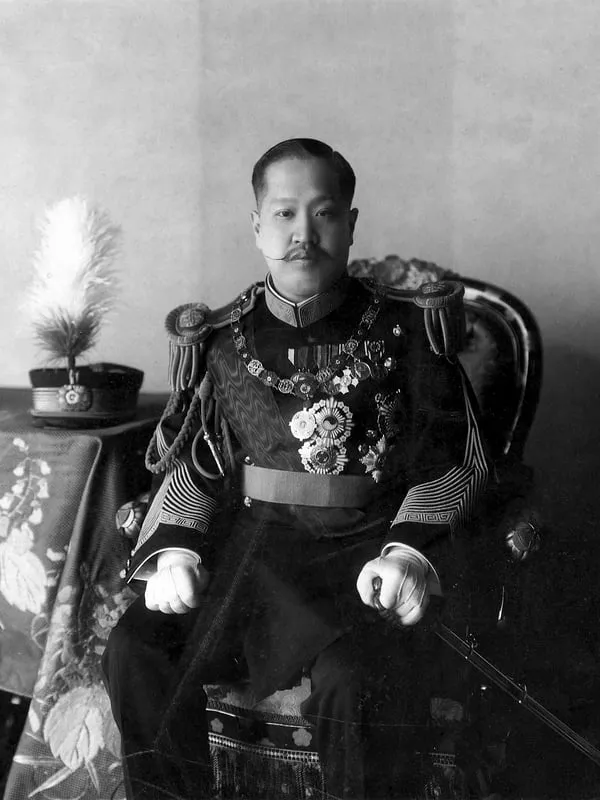
- Born:
- 25 March 1874, Seoul, Changdeokgung Palace (Joseon)
- Died:
- 25 April 1926, Seoul, Changdeokgung Palace
- Author:
- Natalia
- Photo:
- Photography by 岩田鼎, domena publiczna, Wikimedia Commons

Sunjong was the last monarch of Korea and the last ruler of the Joseon dynasty, which had ruled the country since 1392. He was placed on the throne in 1907 by the Japanese, after they had forced his father, Emperor Gojong, to step down. He reigned for three years but never governed: from the very first days everything was decided by the Japanese Resident-General, and in 1910 the state was abolished in his name. After the annexation he lived for another sixteen years in his palace in Seoul as “King Yi”, a vassal of the Emperor of Japan. His funeral in 1926 became the occasion for one of the great protests against Japanese rule. Sunjong’s fate shows how Japan absorbed Korea without a war, preserving the appearance of legality and of the throne, and in this way built its first great colony on the mainland, from which it moved further in the 1930s.
Crown prince
He was born on 25 March 1874 in Changdeokgung Palace in Seoul as Yi Cheok, the son of King Gojong and Queen Min (Empress Myeongseong). He was the only one of her children to reach adulthood and the only legitimate son of the king to survive childhood. His mother, who was locked in a power struggle with her father-in-law, the regent Heungseon Daewongun, had him proclaimed crown prince in 1875 and obtained the consent to this decision of the Emperor of China, then Korea’s suzerain. In 1882 he married a young woman of the Min clan, a relative of his mother.
His childhood and youth fell in the years when China, Japan and Russia were fighting over Korea. On 8 October 1895, when Japanese assassins burst into Gyeongbokgung Palace and murdered Queen Min, the twenty-one-year-old crown prince was beaten and his wife was thrown down the stairs. In February 1896 he fled with his father to the Russian legation, and when in October 1897 Gojong proclaimed the Korean Empire, Yi Cheok became imperial crown prince.
On 11 September 1898, on the orders of Kim Hong-ryuk, an interpreter who had been dismissed from the court and was seeking revenge, opium was slipped into the coffee served to the emperor and the crown prince. Gojong noticed a strange taste and spat the drink out, but his son drank a good deal of it. He survived, but lost his teeth and suffered from stomach and kidney ailments for the rest of his life. Some contemporaries, including foreigners who frequented the court, described him as physically and mentally weak. He had no children. His first wife died in 1904, and at the turn of 1906 and 1907 he married the young Yun Jeung-sun, the future Empress Sunjeong.
Emperor at the Resident-General’s pleasure
After its victorious war with Russia, Japan imposed a protectorate on Korea in November 1905 and installed a Resident-General in Seoul, a post filled by Hirobumi Itō. When in June 1907 Gojong sent secret envoys to the peace conference at The Hague, Itō and the government of Prime Minister Yi Wan-yong forced the emperor to step down. On 19 July 1907 Gojong announced that his son would exercise power on his behalf, and the Japanese treated this as an abdication. The next day a ceremony of handing over the throne was held, attended by neither father nor son. Sources therefore give either 19 or 20 July as the start of Sunjong’s reign. The formal enthronement took place on 27 August in Deoksugung Palace, and the new emperor adopted the era name Yunghui (“Abundant Prosperity”).
The first days of his reign sealed the fate of the state. On 24 July 1907 the government signed an agreement with Itō that placed legislation and the appointment of officials under the Resident-General, and on 1 August the Korean army was disbanded. In November Sunjong moved to Changdeokgung Palace, away from his father, and in December his half-brother and the new crown prince, the ten-year-old Yi Un, was taken to Japan “to study”, in the care of Itō himself. A guerrilla war by the “righteous armies” was raging in the country and was bloodily suppressed by the Japanese army. In January and February 1909 Itō took the emperor on tours of the provinces to show the population that the monarch supported the new order. In July 1909 Korea handed over its judiciary to the Japanese.
The end of the Empire
After Itō’s assassination in Harbin in October 1909, Japan decided to settle the matter. The new Resident-General, General Masatake Terauchi, presented a draft treaty to Yi Wan-yong’s government in August 1910. On 22 August a council was held in Changdeokgung Palace in the emperor’s presence, after which Sunjong issued the prime minister with full powers to conclude the agreement. On the same day Yi Wan-yong and Terauchi signed the treaty annexing Korea, which was announced on 29 August. Sunjong’s rescript published at that time, calling on his subjects to remain calm and obey the new authorities, bears the imperial seal but not his personal signature. Korean historians see this as proof that the monarch did not give his consent. The full powers of 22 August, on the other hand, are signed, which supporters of the view that the treaty is invalid attribute to coercion. In 1926 the Korean émigré press in the United States published what were said to be his last words, in which he supposedly declared that he had never agreed to the annexation. The authenticity of this text is uncertain.
“King Yi”
Under the treaty the former emperor received the title “King Yi of Changdeok Palace”, and his father that of “Elder King Yi”. The family of the former rulers became a princely house within the Japanese empire, maintained from the budget and supervised by a special office. Sunjong continued to live in Changdeokgung, surrounded by Japanese and Korean officials. Japanese accounts describe him as a punctilious man who rose and ate to the minute, played billiards in the afternoons and listened to the gramophone in the evenings. In June 1917 he had to travel to Japan and pay a visit to Emperor Yoshihito. While there he visited his half-brother, who in 1920 married a Japanese princess.
In January 1919 Gojong died. A rumour that he had been poisoned spread quickly in Seoul, and his funeral became the occasion for the outbreak of the March First Movement, nationwide peaceful demonstrations for independence, which the Japanese army and police suppressed, killing many of the participants. In April that year independence activists set up the Provisional Government of the Republic of Korea in Shanghai, which did not recognise the annexation.
Death and funeral
Sunjong died on 25 April 1926 in Changdeokgung Palace at the age of 52 (some sources give 24 April). For the funeral the Japanese authorities conferred on him the rank of field marshal of the Japanese army and organised a state funeral according to the ceremonial of the former court, hoping to avoid a repeat of 1919. On 10 June 1926 school pupils and students along the route of the funeral procession threw leaflets and shouted slogans for independence. The police arrested more than a hundred people, but the June Tenth Movement did not reach the scale of the protests of seven years earlier. Sunjong was buried in the Yureung tomb at Namyangju near Seoul, beside both his wives. The second of them, Empress Sunjeong, outlived him by forty years and lived to see the end of Japanese rule.
Significance
Sunjong was not an actor in events but their instrument. Japan needed him so that the annexation would look like a voluntary transfer of power by a legitimate monarch rather than a conquest. Preserving the throne, albeit without power, made it easier to take over the country without a war and allowed Japan to present it to the powers as an agreement between two emperors. Japan applied the same pattern – an obedient monarch from an old dynasty on the throne, with the Japanese army and advisers behind him – in Manchuria in 1932, when it installed the last Emperor of China, Puyi, at the head of the puppet state of Manchukuo. In Korea Sunjong remained a symbol of lost statehood, and the dispute over whether he truly surrendered power is still part of the dispute over the validity of the 1910 treaty.
Sources
Often appears with
People who appear in the same events.