Korea
Gojong
King of Joseon (1864–1897), Emperor of Korea (1897–1907)
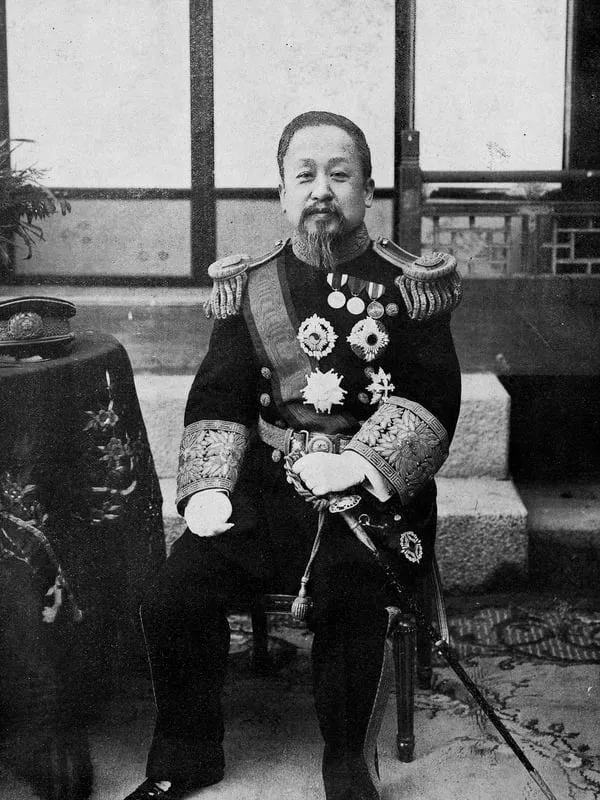
- Born:
- 8 September 1852, Seoul (Joseon)
- Died:
- 21 January 1919, Seoul, Deoksugung Palace
- Author:
- Łukasz
- Photo:
- This photo was taken in 1907, domena publiczna, Wikimedia Commons

Gojong, the penultimate monarch of the Yi dynasty, reigned over Korea for 43 years, first as King of Joseon and then as the first Emperor of the Korean Empire. He came to the throne as a child in a state that for centuries had shut itself off from the world and acknowledged the suzerainty of China. He abdicated under duress in 1907 as ruler of a country that had lost its independence to Japan. All his life he tried to save Korea, seeking support now from China, now from Russia, now from the United States, but he had neither an army, nor money, nor allies willing to fight for Korea. His reign is the story of how Japan won Korea – its first great acquisition on the continent and its springboard to Manchuria – and his death in 1919 gave the impetus for the greatest uprising against Japanese rule.
A boy on the throne
He was born in Seoul on 8 September 1852 as Yi Myeong-bok, the second son of Yi Ha-eung, a distant relative of the royal family. In January 1864 King Cheoljong died without issue. The senior royal widow, Queen Dowager Jo, adopted the eleven-year-old boy as the son of her late husband and placed him on the throne. He took the name Yi Hui; the name Gojong, by which he is known as a ruler, was given to him only after his death, in keeping with Korean custom. Real power was assumed by his father, who received the title of Daewongun, the Grand Prince Father of the King. The Heungseon Daewongun ruled with a firm hand: he rebuilt the ruined Gyeongbokgung Palace, broke the power of the aristocratic clans, persecuted Catholics and fought off French and American expeditions that tried to open Korea.
In 1866 Gojong married a young woman of the Min clan chosen by his father, known as Queen Min (later Empress Myeongseong). She was intelligent, ambitious and ruthless, and soon grew into the most important figure at court. In 1873, at the age of 21, Gojong announced that he would rule in person and removed his father from power. In practice this meant rule by the Queen’s faction and her relatives. A feud flared up between the Queen and the Daewongun that divided the court for the next two decades and opened the way to foreign powers. Gojong, indecisive by nature, often gave way to those stronger than himself and relied on his wife’s judgement in affairs of state.
The opening of Korea
In 1876 Japan, exploiting an incident involving the gunboat Un’yō off Ganghwa Island, forced Korea to sign an unequal treaty that opened the ports of Busan, Wonsan and Incheon and gave the Japanese extraterritorial rights. Gojong and his court went further than Japan wished: to counterbalance its influence, between 1882 and 1886 they concluded treaties with the United States, Britain, Germany, Italy, Russia and France. The King sent study missions to Japan, China and America, brought in American military instructors and advisers, and founded schools and the first Western hospital.
The opening, however, caused upheavals. In 1882 soldiers of the old units mutinied and the Daewongun briefly seized power. Order was restored by Chinese troops, who carried the Daewongun off to China. In 1884 young reformers backed by the Japanese legation staged the Gapsin Coup and for three days held the King under their control, until they were crushed by the Chinese garrison under Yuan Shikai. For the next ten years China held the upper hand in Seoul, and Yuan behaved like a viceroy.
The Sino-Japanese War and the Queen’s death
In 1894 the Donghak peasant uprising broke out. The court called on China for help, and Japan sent troops of its own. On 23 July 1894 Japanese soldiers occupied the royal palace, took Gojong under their control and installed the Daewongun in power. The Sino-Japanese War broke out, and Japan drove China out of Korea. Under Japanese pressure the Korean government carried out the Gabo reforms, which among other things abolished slavery and the traditional civil service examinations. The Treaty of Shimonoseki of April 1895 ended Korea’s dependence on China.
When Russia, France and Germany forced victorious Japan to return the Liaodong Peninsula to China, the King and Queen turned towards Russia. The response was the attack of 8 October 1895, prepared by the Japanese minister Gorō Miura. Japanese assassins broke into Gyeongbokgung Palace and killed the Queen, then burned her body. Gojong, intimidated and held in the palace under guard, had to watch as an edict degrading his dead wife was issued in his name. According to accounts, he refused to sign it. For months afterwards he feared poisoning and ate only what the Western legations sent him.
In the Russian legation
On 11 February 1896 Gojong and the Crown Prince slipped out of the palace and took refuge in the Russian legation. The escape was arranged by courtiers linked to Russia and America, among them Yi Wan-yong, who more than a decade later would sign the treaty annexing Korea. From the legation the King dismissed the pro-Japanese government and declared four of its members guilty of the Queen’s death. Prime Minister Kim Hong-jip was killed by a mob that same day. For a year Korea was governed from the Russian mission, and the Russians obtained timber and mining concessions as well as influence over the army. In 1896 Gojong sent Min Yeong-hwan, a relative of the late Queen, to Moscow for the coronation of Tsar Nicholas II.
The Gwangmu Emperor
In February 1897 Gojong moved to Gyeongun Palace, which stood next to the foreign legations. On 12 October 1897, at the newly built Hwangudan altar, he crowned himself emperor, and the state was renamed the Great Korean Empire (Daehan Jeguk). He gave his reign the era name Gwangmu, which is why he is also called the Gwangmu Emperor. The imperial title was meant to show that Korea was nobody’s vassal and stood on an equal footing with China and Japan. Gojong raised his late wife to the rank of Empress Myeongseong and gave her a solemn funeral.
The first years of the empire were a time of reforms known as the Gwangmu reforms: trams, a railway and the telegraph were built, schools and factories founded, a land survey carried out and the army expanded. Gojong, however, had no wish to share power. When the Independence Club, founded by Philip Jaisohn, began to call for political reform and a representative council, the Emperor had it dissolved in 1898. The constitution of 17 August 1899 gave him absolute power.
Between Russia and Japan
The Korean Empire survived only because Russia and Japan balanced each other’s influence. Gojong tried to proclaim Korea’s neutrality, but no power recognised it. In 1902 Britain concluded an alliance with Japan, and in February 1904 the Russo-Japanese War broke out. Japanese troops occupied Seoul, and on 23 February 1904 the Korean government had to sign a protocol allowing Japan to use Korean territory for military purposes. In August Korea accepted Japanese financial and diplomatic advisers.
After the Treaty of Portsmouth, in which Russia recognised Japan’s paramount position in Korea, Tokyo set about the final subjugation of the country. On 17 November 1905 Hirobumi Itō, having surrounded the palace with troops, forced the ministers to sign a treaty that handed control of Korea’s foreign policy to Japan and established a Japanese Resident-General in Seoul. Gojong did not sign the treaty and regarded it as void to the end. Through the American missionary Homer Hulbert he tried to deliver a letter asking for help to President Theodore Roosevelt, but Washington had already accepted Japan’s predominance in Korea.
The Hague and abdication
In 1907 Gojong made one last appeal to the world. He secretly sent three envoys – Yi Sang-seol, Yi Jun and Yi Wi-jong – to the Second Peace Conference at The Hague to persuade the powers that the 1905 treaty had been extorted. They were not admitted to the proceedings, since Korea no longer had the right to its own foreign policy. Yi Jun died at The Hague in July. For Itō this was the chance to be rid of a troublesome monarch. The pro-Japanese government of Yi Wan-yong demanded the Emperor’s abdication. Gojong refused for a long time, but on 19 July 1907 he agreed to hand the government over to his son. The abdication was proclaimed on 20 July without either monarch taking part. The new emperor was Sunjong, the son of Gojong and Queen Min. A few days later Korea signed a new agreement that gave the Resident-General control over the government, and on 1 August the Korean army was disbanded. Many of its soldiers joined the guerrillas, who fought the Japanese for several years.
Prisoner of Deoksugung
Gojong lived in Gyeongun Palace, renamed Deoksugung, under discreet Japanese surveillance. After the annexation of Korea in 1910 he was given the title “King Yi of Deoksugung”, and the former ruling family was granted a status in Japan equal to that of members of the imperial family, without any power. According to accounts by Korean independence activists, on several occasions – among them in 1910 and 1918 – he considered fleeing abroad and forming a government-in-exile, but it never came to that. His youngest son, Crown Prince Yi Un, was taken by the Japanese to Tokyo to be educated and was married to a Japanese princess.
On 21 January 1919 Gojong died suddenly at Deoksugung. The official cause was a stroke, but a rumour that the Japanese had poisoned him spread through Korea at once. The former monarch’s death coincided with President Wilson’s proclamation of the principle of national self-determination. On 1 March 1919, two days before the funeral, Korean religious and civic leaders proclaimed a declaration of independence in Seoul. The March 1st Movement spread across the whole country. Hundreds of thousands of people took part in demonstrations, and the Japanese police and army killed, according to various estimates, anywhere from several hundred to more than 7,000 people. In April 1919 the Provisional Government of the Republic of Korea was formed in Shanghai. Gojong was buried beside the Queen in the Hongneung tomb at Namyangju.
Assessment
In Korea Gojong is often judged harshly, as a weak and vacillating ruler who placed the state in the hands of one protector after another and failed to reform it in time. In recent decades, however, many Korean historians have stressed that in a hopeless position he fought for his country’s independence with the means he had: diplomacy, reform and the refusal to recognise the treaty of 1905. His reign was the period in which Japan learned that it could seize territory by force and by faits accomplis, and that the Western powers would accept this as long as their own interests were not harmed. The Korea that Gojong lost became Japan’s base for the conquest of Manchuria in 1931 and for expansion in China, and later a source of support during the Pacific War, supplying rice, coal, labourers and soldiers. Japanese rule in Korea ended only on 15 August 1945.
Sources
Mentioned in battles
(01)Often appears with
People who appear in the same events.