Japan
Hirobumi Itō
Prime Minister of Japan (1885–1888, 1892–1896, 1898, 1900–1901), Resident-General in Korea (1906–1909), genrō
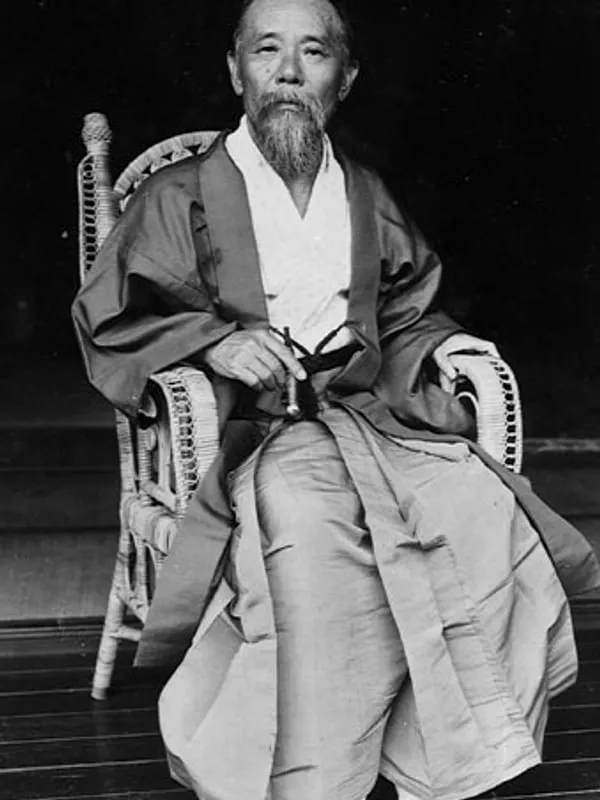
- Born:
- 16 October 1841, Tsukari, Suō Province (today Hikari, Yamaguchi Prefecture, Japan)
- Died:
- 26 October 1909, Harbin (Manchuria, China)
- Author:
- Natalia
- Photo:
- autor nieznany, domena publiczna, Wikimedia Commons

Hirobumi Itō was the chief architect of the modern Japanese state. The son of a peasant from the Chōshū Domain, who in his youth took part in attacks on foreigners, he became Japan’s first prime minister, headed the government four times and was the principal author of the Meiji Constitution, which remained in force with few changes until 1947. For the history of Japanese expansion, however, he matters above all for another reason: it was he who in 1905 forced a protectorate on Korea, governed it for three years as the first Japanese Resident-General, and in the end agreed to its annexation. He was regarded as a moderate and an advocate of cooperation with the great powers, but he built an empire that after his death passed into the hands of far less cautious men. In Japan he is remembered as the father of the constitution, in Korea as a symbol of conquest, and his assassin, An Jung-geun, is a national hero there.
Youth in Chōshū
He was born on 16 October 1841 in the village of Tsukari in Suō Province, in the Chōshū Domain at the western tip of the island of Honshu, as Risuke Hayashi, the son of a poor peasant, Jūzō Hayashi. His father moved to the domain capital, Hagi, and he and his family were adopted by a samurai of the lowest rank, Naoemon Itō. As a result the boy acquired the surname Itō and samurai status. He took the given name Hirobumi, “broad learning”, only around 1868.
In 1857 he entered the private school of Shōin Yoshida, a teacher whose circle produced many leaders of the Meiji Restoration, including Aritomo Yamagata, Itō’s future rival. After Shōin’s execution in 1859, Itō joined the radical “revere the Emperor, expel the barbarians” movement. In 1862 he took part in setting fire to the British legation under construction in Edo and in the murder of the scholar Tadatomi Hanawa, who had been falsely suspected of searching the old chronicles for precedents for deposing an emperor. A year later, defying the ban on travel abroad, he set out secretly with four other young men from Chōshū for London to study at University College London. His time in England transformed his views. When in 1864 he learned from the newspapers that the fleets of the powers intended to bombard Shimonoseki, he returned home with Kaoru Inoue to convince the domain authorities that expelling the foreigners was impossible. He then took part in the peace negotiations with the powers. His knowledge of English and of the West opened the way to his career.
Builder of the Meiji state
After the Meiji Restoration of 1868, Itō became the first governor of Hyōgo Prefecture, which included the port of Kobe, and in 1870–1871 he studied the currency and banking system in the United States. He was one of the four vice-ambassadors of the mission of Tomomi Iwakura, which toured the United States and Europe in 1871–1873. On his return he backed Toshimichi Ōkubo and Takayoshi Kido in the dispute over an expedition to Korea: they believed that Japan must first grow strong and only then think of conquest. He became a councillor of state and Minister of Public Works, and after Ōkubo’s assassination in 1878, Home Minister and one of the two most powerful men in the government.
In 1881 he engineered the removal from the government of Shigenobu Ōkuma, who wanted to introduce a British-style parliament quickly, and was given the task of preparing a constitution. In 1882–1883 he studied the political systems of Europe – in Berlin under Rudolf von Gneist and in Vienna under Lorenz von Stein – and chose the Prussian model: a strong monarch, a government responsible to the Emperor and a parliament with limited powers. On 22 December 1885 he replaced the old Grand Council of State with a cabinet of ministers and became Japan’s first prime minister. In 1888 he became president of the Privy Council, which approved the draft of the fundamental law, and on 11 February 1889 he presented the text of the constitution to Emperor Meiji (Mutsuhito). In his commentary on it he described the imperial house as “the axis of the state”. The constitution gave Japan a parliament but left the army the right of direct access to the Emperor, which in the 1930s allowed the military to slip out of the government’s control.
The war with China and Korea
Itō was prime minister for the second time in 1892–1896, when Japan declared war on China over influence in Korea. After victory in the Sino-Japanese War, he negotiated with Li Hongzhang at Shimonoseki together with the Foreign Minister, Munemitsu Mutsu. In the Treaty of Shimonoseki, signed on 17 April 1895, China recognised Korea’s independence, ceded Taiwan and the Liaodong Peninsula to Japan and paid an enormous indemnity. A few days later Russia, Germany and France forced Tokyo to return the Liaodong Peninsula, and Itō’s government had to give way. It was during his premiership, in October 1895, that the minister in Seoul, Gorō Miura, organised the murder of Queen Min (posthumously Empress Myeongseong). The cabinet recalled Miura and put him on trial in Hiroshima, where in the end nobody was convicted.
In 1898 Itō briefly headed the government for the third time, and in 1900, although he had previously opposed party government, he founded the Rikken Seiyūkai, which for decades afterwards was one of the two main forces in the Japanese parliament. His fourth cabinet fell in 1901. As one of the genrō, the “elder statesmen” who advised the Emperor, he continued to influence the most important decisions. In policy towards Russia he advocated an understanding: Japan would recognise Russian influence in Manchuria, and Russia Japanese predominance in Korea. In the autumn of 1901 he travelled to St Petersburg on this matter, but the government of Prime Minister Tarō Katsura chose the alliance with Great Britain, concluded in January 1902. When Russia refused to withdraw from Manchuria, Itō reconciled himself to war, which broke out in February 1904. The course of the Russo-Japanese War and the Treaty of Portsmouth gave Japan a free hand in Korea.
Resident-General in Seoul
In November 1905 Itō went to Seoul as the Emperor’s envoy extraordinary, carrying a draft treaty that would strip Korea of the right to its own foreign policy. When Emperor Gojong refused, on 17 November, in a palace surrounded by troops, Itō personally questioned the Korean ministers one by one and declared the treaty adopted when five of the eight present, among them Yi Wan-yong, gave their consent. Korea became a protectorate, and in March 1906 Itō arrived in Seoul as the first Resident-General.
He claimed that he did not want to “swallow” Korea but to modernise it through the Koreans themselves under Japanese supervision. He reformed schools and courts and built roads and hospitals, while curtailing the independence of the court and the army. Although a civilian, he obtained the right to command the Japanese troops in Korea and tried to keep the generals in check. He lived in open enmity with Gojong. When it emerged in 1907 that the Emperor had sent secret emissaries to the peace conference at The Hague, Itō regarded it as tantamount to a declaration of war on Japan. Yi Wan-yong’s government forced Gojong to abdicate in favour of his son, Sunjong, and on 24 July 1907 Itō signed an agreement with Yi Wan-yong that gave the Resident-General control over the entire administration of Korea. In August the Korean army was disbanded. That same year Itō was made a prince, and in December he took the ten-year-old heir to the throne, Yi Un, to be educated in Japan, as though he were a hostage.
The disbanding of the army sparked an uprising of the “righteous armies” that engulfed the whole country. Itō supported its brutal suppression by the army, while admitting that the methods used were “too harsh”. In the spring of 1909 he accepted that the policy of “tutelage in self-government” had failed and approved the annexation plan put to him by Prime Minister Katsura and Foreign Minister Jutarō Komura. According to his notes, however, he envisaged an annexed Korea as a country with its own parliament and government under a Japanese viceroy. In June 1909 he stepped down from office and once again became president of the Privy Council.
Death in Harbin
In the autumn of 1909 Itō travelled to Manchuria to meet the Russian Finance Minister, Vladimir Kokovtsov, and discuss relations between the two powers in East Asia. On the morning of 26 October 1909 he stepped off the train at the station in Harbin, then a Russian town on the Chinese Eastern Railway. As he walked past the ranks of a Russian guard of honour, shots rang out from the crowd. An Jung-geun, a former commander of a “righteous army” unit, fired several times. Three bullets hit Itō; others wounded several members of his entourage. Itō died less than half an hour later in a railway carriage, at the age of 68. During the investigation and before the court in Lüshun, An set out fifteen charges against him, from the murder of Queen Min to the enslavement of Korea, and maintained that he had acted as a soldier in order to restore peace in East Asia. He was executed on 26 March 1910.
Japan gave Itō a state funeral in Tokyo on 4 November 1909. His death did not halt the annexation; it hastened it. The man who had enough authority in Tokyo to restrain the army and its patron Yamagata was gone, and the assassination was taken as proof that Korea could not be held by half-measures. In May 1910 the Army Minister, Masatake Terauchi, became Resident-General, and in August he carried out the annexation of Korea.
Memory
Itō remains a contested figure. Japanese historians, especially his biographer Kazuhiro Takii, portray him as a statesman who built a constitutional state, believed in gradual reform and economic development rather than conquest, and opposed Yamagata’s militarism. From 1963 until the mid-1980s his portrait appeared on the 1,000-yen banknote. For Koreans he is the creator of the protectorate that deprived them of their state, and the man under whose government the queen was murdered. In 1932 the Japanese colonial authorities built a Buddhist temple named after him in Seoul, the Hakubunji. After 1945 the temple ceased to exist. Itō’s assassin, An Jung-geun, is a national hero in both Korean states, and in 2014 a memorial hall dedicated to him was opened at Harbin station, drawing a protest from Tokyo.
From the perspective of the road to the Second World War, Itō’s legacy is ambiguous. The institutions he built – the Emperor as “the axis of the state”, the Privy Council and the separate standing of the military – became in the 1930s the instruments by which the militarists brought the state under their control. Korea, won under his direction, became a bridge to Manchuria, and its conquest a model for further conquests.
Sources
Mentioned in battles
(01)Often appears with
People who appear in the same events.