- Category:
- Military operations
- Front:
- Pacific
- Date:
- 2 March 1943
- Author:
- Natalia
- Tags:
- Japan, Australia, United States, Douglas MacArthur
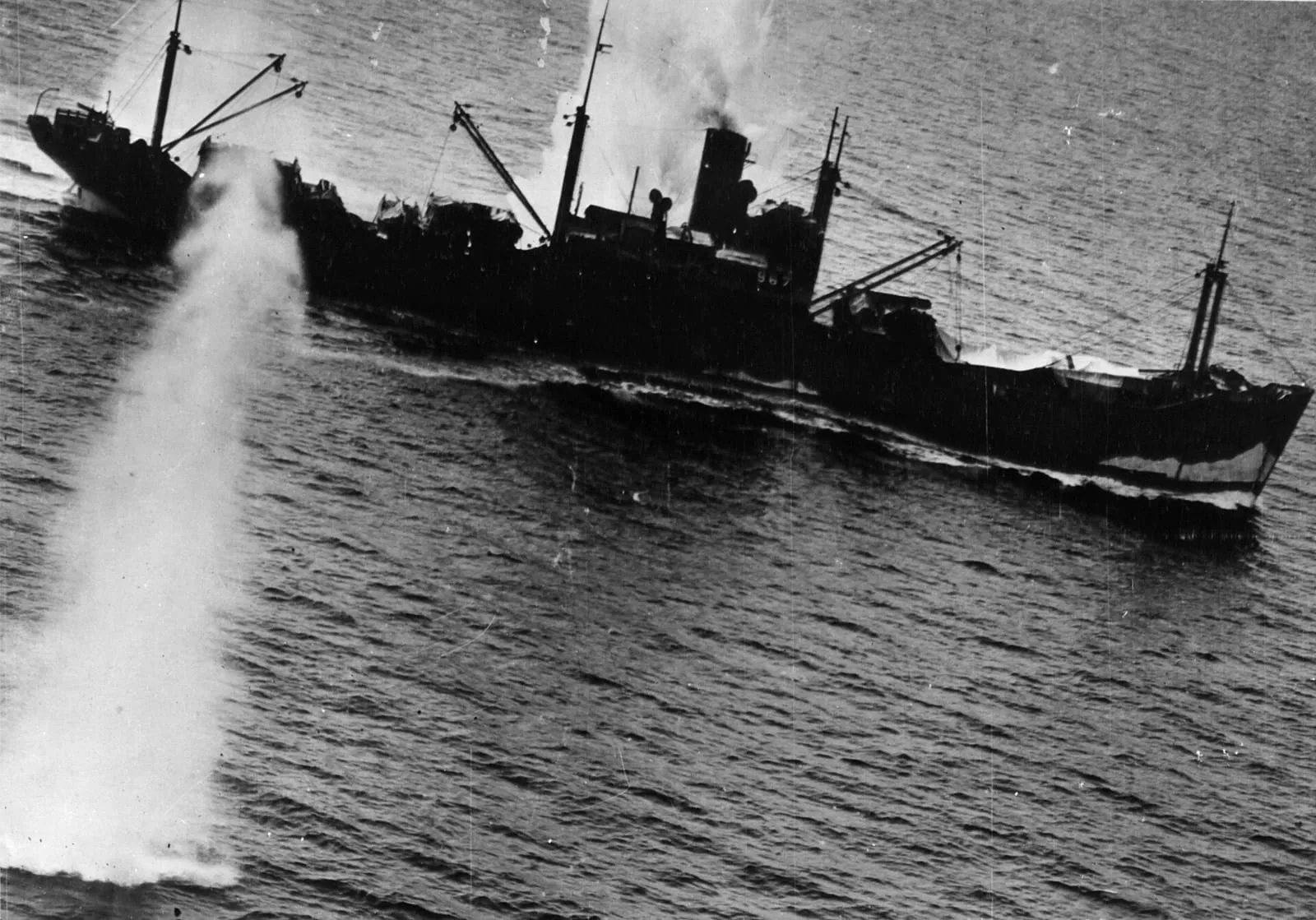
On 2 March 1943 Allied aircraft attacked a Japanese convoy at sea north of New Britain that was carrying the main body of the 51st Division from Rabaul to Lae in New Guinea. Over three days they sank all eight transports and four of the eight destroyers escorting them. Nearly 3,000 Japanese soldiers and sailors were killed, and only a small part of the force reached its destination. The Battle of the Bismarck Sea was one of Japan’s most one-sided defeats of the entire Pacific War, and it settled the fact that the Japanese could no longer supply the northern coast of New Guinea by convoy.
Popular chronologies state that the eight transports were sunk over three days by “American and Australian naval forces”. This is inaccurate. The convoy was destroyed above all by air power: the US Fifth Air Force and the Royal Australian Air Force (RAAF). American PT boats appeared only in the final phase – they finished off one burning transport and attacked survivors. The surface warships of neither navy took part in the battle itself.
A convoy for Lae
After the loss of Papua and Guadalcanal, Japan’s Imperial General Headquarters decided to defend Rabaul along a line running through the northern coast of New Guinea and the central Solomon Islands. The key points were Lae and Salamaua, from which the Japanese could threaten the Allied airfields and the base at Port Moresby. In January a convoy carrying Major General Tōru Okabe’s detachment had reached Lae, but it failed to capture the airfield at Wau. Now the commander of the Eighth Area Army at Rabaul, Lieutenant General Hitoshi Imamura, and the commander of the South-East Area Fleet, Vice Admiral Gun’ichi Mikawa, decided to move the headquarters of the Eighteenth Army and the main body of the 51st Division – some 6,900 men – to Lae.
The planners were aware of the risk. War games held by the Eighteenth Army staff predicted the loss of four of the ten transports and 30–40 aircraft, and the chances of success were rated at roughly fifty-fifty. The alternative, however, was to land the troops further west, at Madang, from where they would have had to march more than 200 kilometres to Lae through swamps, mountains and roadless jungle. The sea route was therefore chosen, but this time along the northern coast of New Britain, in the hope that the Allies would take Madang to be the convoy’s destination. The operation was designated Operation 81.
On 28 February eight transports and eight destroyers left Simpson Harbour at Rabaul. The escort was commanded by Rear Admiral Masatomi Kimura of Destroyer Squadron 3, aboard Shirayuki. The commander of the Eighteenth Army, Lieutenant General Hatazō Adachi, sailed in the destroyer Tokitsukaze, and the commander of the 51st Division, Lieutenant General Hidemitsu Nakano, in Yukikaze. The transports carried nearly 6,000 soldiers, together with guns, ammunition and fuel; some 950 men were embarked on the destroyers. The convoy, steaming at a mere seven knots, had an air umbrella of about 100 army and navy fighters.
The Allies lie in wait
The Allies knew of the preparations. From mid-February air reconnaissance had been recording dozens of ships in Rabaul harbour, and codebreakers in Melbourne and Washington had read signals showing that the convoy was due to reach Lae at the beginning of March. On 25 February the commander of Allied air forces in the South West Pacific, Lieutenant General George Kenney, studied these reports at the headquarters of General Douglas MacArthur. MacArthur, who after the end of the fighting at Sanananda was preparing an advance on Lae and Salamaua, regarded the new convoy as a serious threat. Kenney ordered his deputy in New Guinea, Brigadier General Ennis Whitehead, to concentrate aircraft at the forward airfields and attack the convoy in the Vitiaz Strait, where it would have to pass within range of every Allied aircraft.
Kenney had a new weapon in hand. The January attacks on the convoy to Lae had been a disappointment: more than 400 combat sorties had sunk just two ships. Heavy bombers dropping their bombs from high altitude rarely hit manoeuvring ships. From the autumn of 1942, therefore, the airmen had been practising very low-level attacks: skip bombing, in which a bomb with a delayed-action fuse, released a dozen or so metres above the water, skipped across the surface like a stone and struck the ship’s side; and masthead-height bombing. For aircraft to survive such an attack, the ships’ anti-aircraft guns first had to be silenced. To this end Major Paul “Pappy” Gunn and the mechanics of the Townsville workshops modified North American B-25 Mitchell bombers, mounting batteries of heavy machine guns in their noses and turning them into strafers. A similar role could be played by No. 30 Squadron RAAF, equipped with Bristol Beaufighter heavy fighters armed with four cannon. At the end of February the crews rehearsed a coordinated attack from several directions and altitudes simultaneously on a wreck off Port Moresby.
2 March: the first strike
For the first days the convoy was shielded by two tropical storms. Only on the afternoon of 1 March did the crew of a patrolling B-24 Liberator spot the ships, but the bombers sent out failed to find them. At dawn on 2 March Australian Boston bombers attacked the airfield at Lae to weaken the Japanese fighter cover. At around 10 a.m. another Liberator again located the convoy as it sailed across the Bismarck Sea. B-17 Flying Fortresses took off: bombing from about one and a half kilometres, they sank the transport Kyokusei Maru with some 1,200 soldiers on board and damaged two other ships. The destroyers Yukikaze and Asagumo picked up about 950 survivors and went ahead with them to Lae, then returned to the convoy. An evening raid caused only minor damage. During the night the convoy was shadowed by Australian Catalina flying boats.
3 March: the destruction of the convoy
On the morning of 3 March the convoy was rounding the Huon Peninsula and coming within range of every Allied airfield. Some 90 aircraft took off from Port Moresby, and Australian Bostons again bombed the airfield at Lae. At around 10 a.m. B-17s appeared over the convoy and dropped their bombs from medium altitude. There were few hits, but the ships scattered as they took evasive action, and the Japanese fighters and anti-aircraft guns concentrated on the high-flying bombers. One B-17 was shot down in the air battle. Some of its crew baled out, and Japanese pilots machine-gunned the airmen in the air and in the water; news of this quickly reached the Allied bases.
Then the Beaufighters came in low over the water. Their approach resembled that of torpedo bombers, so the ships, following procedure, turned their bows towards them – and exposed themselves to their fire. The Beaufighters’ cannon and machine guns swept away gun crews, bridges and decks. Aboard one of them the Australian cameraman Damien Parer filmed the attack; his footage went into a newsreel about the destruction of the convoy. Right behind the Beaufighters came the B-25s: some dropped bombs from medium altitude, while the modified aircraft of the 38th Bombardment Group strafed the ships with their nose guns and attacked at masthead height. Within a quarter of an hour or so almost every ship had been hit.
The first to sink was the flagship Shirayuki: after her magazine exploded her stern broke off, and the wounded Kimura transferred to Shikinami. A bomb in the engine room disabled Tokitsukaze, and the stricken Arashio collided with the transport Nojima. In the afternoon further waves of B-25s, American A-20s and Australian Bostons arrived, along with B-17s. All seven remaining transports were burning or sinking some 100 kilometres south-east of Finschhafen. The four destroyers that survived – Shikinami, Yukikaze, Uranami and Asagumo – took on as many survivors as they could and withdrew to Rabaul.
4 March and the strafing of survivors
During the night of 3–4 March ten American PT boats under Lieutenant Commander Barry Atkins put out from their base in New Guinea. Two turned back after being damaged by floating debris; the rest found the burning transport Oigawa Maru towards dawn and finished her off with torpedoes. On the morning of 4 March a bomb from a B-17 sank the destroyer Asashio, which was rescuing survivors from Arashio. By the end of the day not a single transport was still afloat, and all that remained of the escort were the four destroyers that had earlier left for Rabaul.
Many men, however, were still in the water – about a thousand survivors, according to American figures, on rafts, in boats and clinging to wreckage. From the evening of 3 March until 5 March PT boats and aircraft attacked Japanese rescue vessels, boats and rafts, as well as soldiers swimming in the sea. Some accounts state that this was done on Kenney’s orders. It was later justified on the grounds that the rescued soldiers would quickly have been put ashore and returned to the fight; for many airmen the attacks were also revenge for the machine-gunning of the downed B-17’s crew. Some Allied airmen regarded them as a military necessity, while others were revolted by them. Passed over in silence in the communiqués of the time, this episode is among the most controversial in the history of the Pacific War, in which the killing of defenceless opponents occurred on both sides.
Some of the survivors were saved. On 6 March the Japanese submarines I-17 and I-26 picked up about 170 men, and two days later I-26 landed several dozen more at Lae. Hundreds of survivors swam or drifted to nearby islands, where they usually fell into the hands of Australian patrols. On Goodenough Island, between 8 and 14 March, soldiers of the Australian 47th Battalion killed or captured more than a hundred Japanese. In one of their boats a Japanese army list of officers and their unit assignments was found in a sealed tin. For Allied intelligence this was an invaluable prize – it made it possible to reconstruct the order of battle of the entire Japanese army.
Losses and propaganda
According to the Australian War Memorial and most studies, about 2,890 Japanese soldiers and sailors were killed. Warships rescued some 2,700 men and took them back to Rabaul. Depending on the source, between about 800 and about 1,200 soldiers reached Lae – most of them without their heavy weapons and equipment, which went to the bottom. The Japanese also lost some 15 aircraft. Allied losses were negligible: 13 airmen killed (three of them in an accident), one B-17 and three P-38s shot down in combat, and two aircraft wrecked in accidents.
The victory was grossly exaggerated. MacArthur’s communiqué of 7 March spoke of 22 vessels sunk, including 12 transports, three cruisers and seven destroyers, and of 12,792 soldiers killed; the American press even wrote of 15,000 dead. When air force headquarters in Washington established in mid-1943 that the convoy had consisted of only 16 warships and merchant ships, MacArthur’s staff stood by the original version. The battle itself, however, was proof of a genuine change: the new low-level tactics produced several times as many hits as high-altitude bombing, and simultaneous attacks from several directions broke the ships’ anti-aircraft defences.
Place in the history of the war
For the Japanese the battle was a shock. Imamura’s chief of staff flew to Tokyo to report on the defeat, and Imperial General Headquarters decided to send no more troop convoys to Lae. Masatake Okumiya, a staff officer at Rabaul, wrote after the war that Japan had not suffered so grievous a blow in any of the clashes over Guadalcanal, and that from then on neither cargo ships nor even fast destroyers could be sent to the northern coast of New Guinea east of Wewak. The transfer of the 20th Division, which had been planned for Madang, was moved further west, to Hansa Bay. The remnants of the 51st Division reached Lae only in May, by night, in landing barges creeping along the coast; supplies were also brought in by submarine. This way of supplying the front consumed enormous resources and was never sufficient; the Japanese later estimated that they had lost some 20,000 soldiers in all during transfers from Rabaul to New Guinea.
On 25 March the army and navy agreed in Tokyo that New Guinea would henceforth take priority over the Solomon Islands. In April Admiral Isoroku Yamamoto threw naval aviation into Operation I-Go – an air offensive against Allied bases in New Guinea and the Solomons, which was meant to reverse the effects of the March defeat but proved inconclusive. A few days later Yamamoto himself was killed, shot down over Bougainville. The Allies, meanwhile, set about implementing Operation Cartwheel, the gradual encirclement of Rabaul. In September 1943 the Australians, supported by American paratroopers and an amphibious landing, took Lae and Salamaua – the garrison, which could not be reinforced in March, was unable to hold them.
The Battle of the Bismarck Sea showed how much the Pacific War had changed since a year earlier, when Japanese convoys had freely carried troops to New Guinea and the Dutch East Indies. Command of the air over the sea had passed to the Allies, and ships without effective fighter cover had become easy targets. From then on Kenney and Whitehead used the same low-level tactics against Japanese shipping and airfields until the end of the New Guinea campaign, and strafers with cannon and machine guns in their noses became one of the symbols of American air power in the South West Pacific.
Sources
Meanwhile
(04)Elsewhere, within a week.
- 28 February 1943 · ScandinaviaOperation GunnersideDuring the night of 27–28 February 1943 Norwegian SOE commandos blew up the heavy water plant at Vemork. Not a shot was fired, and all evaded pursuit.
- 5 March 1943 · Eastern FrontManstein's counter-offensiveIn early March 1943 Manstein’s counter-stroke shattered the armies of the South-Western Front and the 3rd Tank Army. The SS Panzer Corps advanced on Kharkiv.
- 5 March 1943 · Western FrontThe Battle of the Ruhr beginsDuring the night of 5–6 March 1943 the RAF bombed Essen, opening the Battle of the Ruhr. On 8–9 and 9–10 March bombers struck Nuremberg and Munich.
- 6 March 1943 · MediterraneanThe Battle of MedenineOn 6 March 1943 three German panzer divisions attacked the Eighth Army at Medenine and lost dozens of tanks in a single day. Rommel’s last battle in Africa.
Related events
(04)The same battle, people or subject.
- 7 January 1943 · PacificJapanese reinforcements at LaeOn 7 January 1943 a convoy from Rabaul landed some 4,000 men of the Okabe Detachment at Lae. Losing Papua, Japan resolved to defend northern New Guinea.
- 9 February 1943 · PacificThe end of the fighting on GuadalcanalOn the nights of 1–8 February 1943 Japanese destroyers took some 10,600 soldiers off Guadalcanal. On 9 February the Americans declared the island secured.
- 22 January 1943 · PacificThe end of the fighting at SananandaOn 22 January 1943 organised Japanese resistance at Sanananda ceased, ending the six-month Papuan campaign – a costly Allied victory.
- 2 January 1943 · PacificThe capture of BunaOn 2 January 1943 Americans and Australians took Buna Government Station – the last Japanese stronghold on the eastern flank of the beachheads in Papua.