United States
Douglas MacArthur
Chief of Staff of the US Army (1930–1935), commander of USAFFE (1941–1942) and of the South West Pacific Area (1942–1945), Supreme Commander in Japan (1945–1951), General of the Army
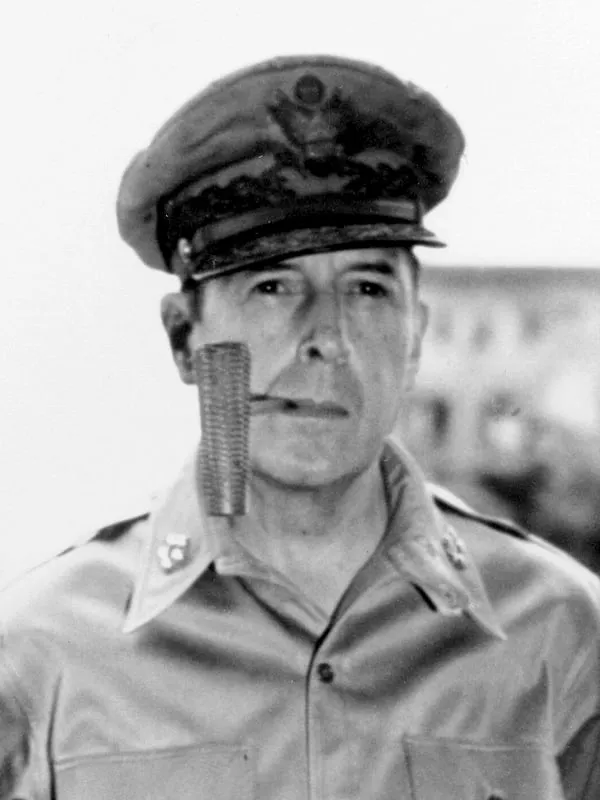
- Born:
- 26 January 1880, Little Rock, Arkansas (United States)
- Died:
- 5 April 1964, Washington, D.C.
- Author:
- Łukasz
- Photo:
- autor nieznany, domena publiczna, Wikimedia Commons

Douglas MacArthur was the best-known and most controversial American commander of his era. The son of a general, top of his class at West Point and the youngest American general in France in 1918, he served as Chief of Staff during the Great Depression, at the head of an army that had money for nothing. From 1935 he built up the army of the Philippines, and in December 1941 it was he who commanded on the archipelago when Japan opened the war in the Pacific. Within the first few hours he lost half his air force on the ground, and five months later his troops went into captivity. Even so, he became a hero in the United States, a symbol of resistance and of the promise to return. He kept that promise in 1944, accepted Japan’s surrender and for almost six years ruled the country as supreme commander of the occupation forces. In 1950 he led United Nations forces in Korea, and in 1951 President Truman relieved him of command. He was exceptionally able and brave, but also vain, given to self-promotion and convinced of his own infallibility. To this day some see him as a brilliant strategist, others as a commander whose greatest talent was propaganda.
A general’s son
He was born on 26 January 1880 in the barracks at Little Rock, Arkansas, the youngest of three sons of Captain Arthur MacArthur Jr. and Mary Pinkney Hardy of Norfolk, Virginia. His father, a Union hero of the Civil War who had won the Medal of Honor for the assault on Missionary Ridge, rose to the rank of lieutenant general and in 1900–1901 was military governor of the Philippines during the Philippine–American War. Douglas spent his childhood in forts on the Wild West frontier. His mother, ambitious and domineering, instilled in him the conviction that he was destined for greatness. When he entered the military academy at West Point in 1899, she took up residence in a hotel overlooking the academy.
On 11 June 1903 he graduated from West Point first in his class, with one of the best records in its history. As a second lieutenant of engineers he was posted to the Philippines, where he formed friendships that would last for decades, among them with a young lawyer, Manuel Quezon. In 1905–1906, as aide to his father, who had been sent to observe the Russo-Japanese War, he toured Japan, China, India and South-East Asia, and came away convinced that America’s future would be decided in Asia. For a time afterwards he was one of the aides to President Theodore Roosevelt.
In 1914, during the American occupation of Veracruz ordered by President Woodrow Wilson, he carried out on his own initiative a risky reconnaissance behind Mexican lines in search of locomotives. He was recommended for the Medal of Honor, but the board refused, ruling that he had acted without his commander’s knowledge. A year later, as a major in the War Department, he became the army’s first press officer, which sharpened his feel for public opinion.
The Rainbow Division
When the United States entered the First World War, MacArthur proposed forming a division from National Guard units of many states, one that would “stretch over the whole country like a rainbow”. Thus was born the 42nd Infantry Division, known as the Rainbow Division, and MacArthur, promoted to colonel, became its chief of staff. In France, from February 1918, he made his name through sheer daring: he went on night raids in the front line without helmet or gas mask, carrying a cane. He was gassed twice and received two Distinguished Service Crosses and seven Silver Stars. In June 1918, at the age of 38, he was promoted to brigadier general, and in August he took over the 84th Infantry Brigade, which he led at Saint-Mihiel and in the Meuse-Argonne Offensive. In the last days of the war he briefly commanded the entire division. He won a reputation as one of the bravest officers in the army, but also as a man who could not abide authority, above all that of General John Pershing’s staff.
Between the wars
As superintendent of West Point in 1919–1922 he modernised the academy’s curriculum, introducing more general subjects and more sport. In 1922 he married a wealthy divorcee, Louise Cromwell Brooks, and was almost immediately sent to the Philippines, which rumour attributed to Pershing’s jealousy. The marriage broke down in 1929. In 1925, as the youngest major general, he sat on the court martial that convicted the aviation pioneer Billy Mitchell; he later claimed to have voted for acquittal. In 1928 he led the United States team at the Amsterdam Olympics, and from 1928 to 1930 he commanded the Philippine Department.
On 21 November 1930 President Herbert Hoover appointed him Chief of Staff of the Army, with the temporary rank of full general. Through five years of the Depression he defended against cuts an army of little more than 130,000 men, supported the development of tanks and heavy bombers, and from 1933 assigned officers to organise the camps of the Civilian Conservation Corps, one of the programmes of the New Deal.
What did him the most damage, however, was July 1932. Thousands of veterans demanding early payment of their wartime service bonus, the so-called Bonus Army, were camped in Washington, and when two of them were killed in a clash with the police on 28 July, Hoover ordered the army to clear the area. Against the advice of his aide, Major Dwight Eisenhower, MacArthur personally accompanied the troops, who drove the veterans out with bayonets, tear gas and tanks. Then, although by some accounts the President had ordered them to halt, they crossed the bridge over the Anacostia River and broke up the veterans’ main camp, which went up in flames. MacArthur announced that he had saved the country from revolution. The images of armed soldiers driving out veterans contributed to Hoover’s defeat at the polls.
In September 1932, during a tour of Europe, he visited Poland. He watched Polish Army manoeuvres in Volhynia and, according to Polish sources, was received at the Belweder Palace by Marshal Józef Piłsudski.
Field Marshal of the Philippines
When his term as Chief of Staff ended in 1935, MacArthur accepted an offer from his friend Manuel Quezon, president of the new Commonwealth of the Philippines, and with the consent of Franklin Delano Roosevelt became military adviser to the Philippine government. Within ten years, by the time of the promised independence, he was to build an army capable of defending the archipelago. He based it on short-term conscript service and ten reserve divisions, but money, weapons and instructors were always lacking. On 24 August 1936, at Malacañang Palace, Quezon conferred on him the title of field marshal of the Philippine Army. Eisenhower, who had gone with him to Manila as his chief of staff, thought the title ridiculous and claimed that MacArthur had invented it himself; relations between the two deteriorated badly over time.
His mother died in Manila in 1935. On 30 April 1937 he married Jean Faircloth, and in February 1938 their only son, Arthur, was born. On 31 December 1937 he retired from the US Army but remained in the Philippines as Quezon’s adviser.
On 26 July 1941, after the freezing of Japanese assets, Roosevelt recalled him to active duty as commander of the new United States Army Forces in the Far East (USAFFE); the next day he promoted him to lieutenant general, and in December to full general. MacArthur persuaded Washington that, instead of withdrawing to Bataan as earlier plans had foreseen, he could defend the entire archipelago with the help of B-17 bombers and the mobilised Philippine Army.
Defeat in the Philippines
When news of the attack on Pearl Harbor arrived on the morning of 8 December 1941, Manila time, MacArthur withheld for several hours his permission for a raid on the Japanese airfields on Taiwan. At midday Japanese bombers destroyed half his air force at Clark Field and Iba. Who was to blame for the delay – MacArthur, his chief of staff Richard Sutherland or his air commander Lewis Brereton – remains disputed. Unlike Admiral Kimmel and General Short in Hawaii, MacArthur was never held to account for this disaster.
After the Japanese landings in Lingayen Gulf on 22 December he abandoned the plan to defend the beaches and on 24 December ordered a retreat to the Bataan peninsula, while he himself moved with Quezon to the Malinta Tunnel on the island of Corregidor. The retreat succeeded, but the food stockpiled near the beaches was left behind on the plain, and the defenders of Bataan went hungry from the start. For three months MacArthur promised them in his proclamations that relief was coming soon, relief that Washington could not and did not intend to send. He visited Bataan only once, which earned him the soldiers’ nickname “Dugout Doug”. In January 1942, under a decree of the Philippine government, he accepted 500,000 dollars from Quezon as payment for his pre-war service. The payment was legal, but when the historian Carol Petillo revealed it in 1979, it did serious damage to his reputation.
“I shall return”
In February 1942 Roosevelt, fearing that America’s best-known general would be taken prisoner, ordered him to move to Australia. On the evening of 11 March MacArthur, with his wife, his son and part of his staff, left Corregidor in Lieutenant John Bulkeley’s torpedo boats, reached Mindanao and from there flew to Australia in a B-17 bomber. On 20 March, on his way to Melbourne, he made his promise: “I came through and I shall return.” He handed command in the Philippines to General Jonathan Wainwright, who in April and May was forced to surrender on Bataan and Corregidor, bringing the Philippines campaign to an end. To counter Japanese propaganda about a commander who had run away from his men, General Marshall had MacArthur awarded the Medal of Honor. Arthur and Douglas MacArthur became the first father and son to receive it.
In April 1942 MacArthur became Supreme Commander of the South West Pacific Area, which covered Australia, New Guinea, the Dutch East Indies and the Philippines. The central Pacific went to Admiral Chester Nimitz, and the rivalry between the army and the navy over resources and the direction of the main thrust lasted until the end of the war. In 1942–1944 American and Australian troops under his command fought in New Guinea, from Buna to Hollandia, bypassing strong Japanese garrisons such as Rabaul and cutting them off from supplies. MacArthur stubbornly insisted that the next objective should be the Philippines, not Taiwan, and in July 1944 he put his case to Roosevelt at a conference in Hawaii. The President took no decision there; the strikes on Leyte and Luzon were settled by the Joint Chiefs of Staff in the autumn of 1944.
On 20 October 1944 American troops landed on the island of Leyte. MacArthur waded ashore through the surf and announced over the radio: “People of the Philippines, I have returned.” A few days later the Battle of Leyte Gulf destroyed the Japanese fleet. On 18 December 1944 he became one of four American five-star Generals of the Army. In January 1945 his troops landed in the same Lingayen Gulf where Homma’s army had come ashore three years earlier. The Battle of Manila in February and March 1945 destroyed the city and cost the lives of some 100,000 civilians, killed by the Japanese, in the crossfire and by American artillery. Thousands of prisoners of war and internees were freed from camps around Manila, among them the surviving defenders of Bataan.
On 2 September 1945, aboard the battleship USS Missouri in Tokyo Bay, MacArthur as Supreme Commander for the Allied Powers accepted the surrender of Japan. Behind him stood Wainwright and the British general Arthur Percival, the defender of Singapore, both newly freed from captivity in Manchuria.
Ruler of occupied Japan
As Supreme Commander for the Allied Powers (SCAP), MacArthur wielded in occupied Japan for almost six years greater power than any American before him had held in a foreign country. He disbanded the army and navy, freed political prisoners, carried out land reform, gave women the vote, broke up the great conglomerates and purged thousands of officials and politicians from public life. His staff drafted the constitution that came into force in May 1947 and, in Article 9, renounced war as a sovereign right of the nation. From 1947, as the Cold War intensified, the occupation changed course: economic recovery and the fight against communism became more important than reform.
He confirmed the death sentences on Generals Tomoyuki Yamashita and Masaharu Homma, condemned by American tribunals in Manila. These trials, conducted in haste, were criticised then and are criticised now, and the Yamashita case established the principle of a commander’s responsibility for the crimes of his subordinates. MacArthur also set up the International Military Tribunal for the Far East, which sentenced Hideki Tōjō and others to death. At the same time he judged Emperor Hirohito indispensable to keeping order in the country and ensured that he was not indicted. Historians still argue over whether this was sensible policy or the protection of a man who shared responsibility for the war.
Korea and dismissal
When North Korea attacked the South on 25 June 1950, MacArthur took command of American forces and then of United Nations forces. On 15 September 1950 he carried out a bold landing at Inchon, far behind enemy lines, which sealed the defeat of the North Korean army. He assured President Harry Truman that China would not enter the war and pressed the advance towards the border on the Yalu river. At the end of November 1950 a Chinese offensive drove the UN forces far to the south. MacArthur demanded the bombing of China, a blockade of its coast and the use of troops from Taiwan, publicly criticising the government’s policy. On 11 April 1951 Truman stripped him of all his posts for insubordination.
Last years
He returned in triumph to the United States, which he had not seen since 1937. On 19 April 1951 he addressed a joint session of Congress, closing with the words of an old soldiers’ ballad: “Old soldiers never die; they just fade away.” He hoped for the Republican nomination in the 1952 election, but the party chose his former aide Eisenhower. He became chairman of the board of Remington Rand and settled with his wife in the Waldorf-Astoria hotel in New York. He died on 5 April 1964 at Walter Reed Army Hospital in Washington. He was buried in Norfolk, his mother’s home town.
Significance
MacArthur was a figure equal to his legend, which he had built with great care himself. His greatest successes – the retreat to Bataan, the New Guinea campaign, the recapture of the Philippines, the Inchon landing and the remaking of Japan – stand alongside great mistakes: the destruction of his air force on the ground on 8 December 1941, the unrealistic plan to defend the whole of the Philippines, which condemned the defenders of Bataan to starvation, and his disregard of the warnings about China in 1950. The Australian official historian Gavin Long called the defeat in the Philippines the greatest in the history of America’s foreign wars, and yet it was from that very defeat that MacArthur emerged a national hero, because in the first months of the war America needed a hero. To Filipinos he became a symbol of liberation, to the Japanese the creator of their post-war state, and to Americans an example of where a general’s authority ends and a president’s begins.
Sources
Commanded in battles
(11)- 8 December 1941 – 8 May 1942Philippines campaign (1941–1942)Pacific
- 16 November 1942 – 22 January 1943Battle of Buna–GonaPacific
- 4–16 September 1943Capture of LaePacific
- 15 December 1943 – 21 August 1945New Britain campaignPacific
- 29 February – 18 May 1944Admiralty Islands campaignPacific
- 22 April – 6 June 1944Landings at Hollandia and AitapePacific
- 27 May – 17 August 1944Battle of BiakPacific
- 17 October – 31 December 1944Battle of LeytePacific
- 9 January – 15 August 1945Battle of LuzonPacific
- 3 February – 3 March 1945Battle of ManilaPacific
- 1 May – 15 August 1945The Borneo campaignPacific
Mentioned in battles
(13)Often appears with
People who appear in the same events.
On the timeline
(108)The 40 most important of 108 events. All tagged “Douglas MacArthur” (44) →
1932
1937
1940
1941
1942
January
February
March
April
- 09
- Key eventThe fall of BataanOn 9 April 1942 General Edward King surrendered the forces on Bataan against orders. Some 75,000 men went into captivity; only Corregidor still held out.
- The Bataan Death MarchAfter Bataan fell on 9 April 1942 the Japanese drove some 76,000 prisoners north on foot to Camp O'Donnell. Thousands of men died on the way.