Japan
Isoroku Yamamoto
Navy Vice-Minister (1936–1939), Commander-in-Chief of the Combined Fleet (1939–1943), admiral, posthumously Marshal Admiral
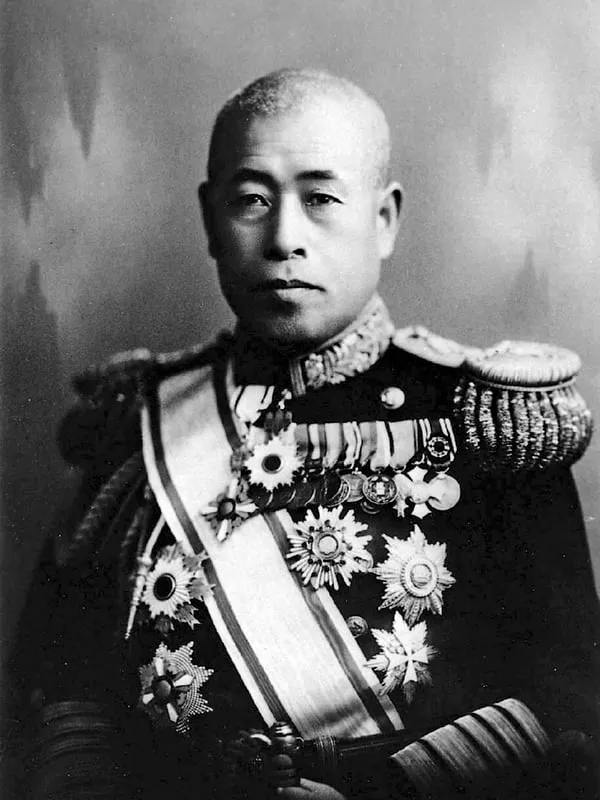
- Born:
- 4 April 1884, Nagaoka, Niigata Prefecture (Japan)
- Died:
- 18 April 1943, Over Bougainville Island, Solomon Islands
- Author:
- Łukasz
- Photo:
- autor nieznany, domena publiczna, Wikimedia Commons

Isoroku Yamamoto was the best-known Japanese commander of the Second World War and one of its most paradoxical figures. He knew the United States better than almost anyone in the Japanese high command – he had studied at Harvard and served twice in Washington – and in the 1930s he belonged to the part of the navy that opposed an alliance with Germany and a war with the English-speaking powers. Yet it was he who, as commander of the Combined Fleet, planned the blow that opened the Pacific War: the carrier attack on the American fleet at Pearl Harbor on 7 December 1941. He was one of the first admirals in the world to grasp that command of the sea would be decided by aircraft rather than battleships. Six months after Pearl Harbor his plan ended in defeat at Midway, and in April 1943 he was killed when his aircraft was shot down by the Americans, who had read a signal giving the details of his journey.
A samurai’s son from Nagaoka
He was born Isoroku Takano on 4 April 1884 in Nagaoka in Echigo Province, in today’s Niigata Prefecture. His father, Sadayoshi Takano, was a former middle-ranking samurai of the Nagaoka domain, which had fought against the supporters of the emperor in the civil war of 1868 and been defeated. The name Isoroku, meaning “fifty-six”, recorded his father’s age at the time of his birth. He was the sixth son of a family that lived modestly after the domain’s defeat.
In 1901 he entered the Naval Academy at Etajima and graduated in November 1904, eleventh out of 192, during the Russo-Japanese War. As a midshipman he served on the armoured cruiser Nisshin and took part in the Battle of Tsushima on 27 May 1905, in which Admiral Heihachirō Tōgō’s fleet destroyed the Russian squadron. An explosion in the ship’s forward turret blew off the index and middle fingers of his left hand and badly wounded him in the thigh. Officially the cause was a Russian shell, but some former naval officers believed that one of Nisshin’s own guns had burst. According to a well-known anecdote, geishas later jokingly called him “Eighty Sen”, because a manicure cost ten sen a finger.
In the years that followed he served on various ships, completed gunnery and torpedo courses and, in 1914–1916, the Naval War College. In 1916 he was adopted into the Yamamoto family, an old line of senior officials of the Nagaoka domain that had no male heir, and took its name – a common custom in Japan. In 1918 he married Reiko Mihashi, with whom he had two sons and two daughters.
America and aviation
In 1919 the navy sent him to the United States. Until 1921 he studied at Harvard University, learnt English and travelled widely. What impressed him most were the oilfields of Texas and the car factories of Detroit. From these travels he took away a conviction that would stay with him for the rest of his life: sea power depends on oil and industry, and in both Japan could not compete with America.
On his return he taught at the Naval War College, and in 1923 he was promoted to captain. In 1924 he took the step that shaped his career: he moved from gunnery to aviation and became executive officer and director of training at the naval air school at Kasumigaura, where he learnt to fly himself. From the end of 1925 until 1928 he was naval attaché at the embassy in Washington. After returning he commanded the light cruiser Isuzu and, from December 1928, the carrier Akagi – the same ship that thirteen years later would lead the strike on Pearl Harbor.
In November 1929 he became a rear admiral and went as naval adviser to the delegation at the conference that ended in the London Naval Treaty. There he firmly upheld the Japanese demand for a cruiser fleet of 70 per cent of American strength. From December 1930 he headed the technical division of the Navy Aviation Bureau and pushed for the construction of aircraft of Japanese design. The long-range Mitsubishi G3M bomber was built on his initiative, and the requirements he set for naval aircraft also influenced the later Zero fighter. In 1933 he commanded the 1st Carrier Division.
In 1934 he led the navy delegation to the preliminary talks in London ahead of a new naval conference. His task was to present Tokyo’s position, which spelt the end of the system of limitations: Japan demanded equality with America and Britain. In November 1934 he became a vice admiral, and in December Japan renounced the Washington Treaty. The talks collapsed. Yamamoto was embittered, all the more so because his academy friend Admiral Teikichi Hori, a supporter of arms limitation, had been removed from the navy at the same time. On his way home, in January 1935, he met in Berlin with, among others, Joachim von Ribbentrop and Admiral Erich Raeder; according to Japanese researchers, his German hosts sounded out the possibility of cooperation between the two countries against the Soviet Union.
From December 1935 he was head of the Navy Aviation Bureau. He opposed the construction of the gigantic Yamato-class battleships, arguing that in a future war aircraft would sink them before they could fire a shot. He lost the argument. The same armament programme, however, also approved two large carriers, which entered service in 1941 as Shōkaku and Zuikaku.
A vice-minister against the German alliance
On 1 December 1936, a week after the conclusion of the Anti-Comintern Pact, Yamamoto became Navy Vice-Minister, and from February 1937 he worked under the minister, Admiral Mitsumasa Yonai. During the 26 February Incident of 1936, while still head of the Aviation Bureau, he had sharply sent away young naval officers who came to him in support of the rebels. In December 1937, after Japanese aircraft sank the American gunboat Panay on the Yangtze, he publicly accepted responsibility on behalf of the navy and apologised to the American ambassador, Joseph Grew.
In 1938–1939 Yonai, Yamamoto and the head of the ministry’s Naval Affairs Bureau, Rear Admiral Shigeyoshi Inoue, were the main obstacle to turning the Anti-Comintern Pact into the military alliance with Germany and Italy that the army wanted. They believed that such an alliance would drag Japan into a war with Britain and the United States that it could not win, and that Germany was too far away to give it any real help. Yamamoto received threatening letters, nationalists announced plans to assassinate him, and the Navy Ministry was put under guard. At that time the admiral wrote a testament in which he declared that the life or death of a single man was of no consequence. The alliance negotiations were cut short in August 1939 by the Molotov–Ribbentrop Pact, which Tokyo received as a betrayal, and the government of Kiichirō Hiranuma resigned.
On 30 August 1939, in the last days of Yonai’s term of office, Yamamoto was appointed commander of the Combined Fleet, the main force of the Japanese navy. According to his associates, Yonai made this choice partly because the admiral would be safer at sea than in Tokyo.
Commander of the Combined Fleet
Japan stayed out of the war in Europe, but the fall of France in 1940 and the German victories changed the mood in Tokyo. In September 1940 the navy, under a new minister, agreed to the Tripartite Pact with Germany and Italy. Yamamoto warned that it might lead to war with America. According to the memoirs of Prime Minister Fumimaro Konoe, when asked at the time about Japan’s chances in such a war, he replied that if he were told to fight he would “run wild” for the first six months or a year, but had no confidence whatever about the second and third years. On 15 November 1940 he was promoted to full admiral.
In January 1941 he wrote to the nationalist politician Ryōichi Sasakawa that in a war with America it would not be enough to take Guam and the Philippines, or even Hawaii and San Francisco: Japan would have to march into Washington and dictate peace in the White House, and he doubted whether the politicians who spoke so lightly of war were prepared for that. Japanese propaganda later circulated the letter without its last sentence, and in America it was read as a boastful announcement of conquest.
Since war nonetheless seemed ever more likely, Yamamoto resolved to begin it in a way that would give Japan any chance at all. He rejected the navy’s traditional plan, which envisaged waiting for the American fleet and fighting a decisive battleship engagement in Japanese waters. On 7 January 1941 he put to the Navy Minister the idea of a carrier strike on the Pacific Fleet in its base in Hawaii. One source of inspiration was the British attack on Taranto. The details were worked out by Rear Admiral Takijirō Ōnishi and Lieutenant Commander Minoru Genda, and in April the carriers were concentrated in Vice Admiral Chūichi Nagumo’s First Air Fleet. The Naval General Staff considered the plan too risky and gave way only in October 1941, when Yamamoto threatened to resign. After the Imperial Conference of 5 November he issued the Combined Fleet’s operational order, and on 26 November Nagumo’s carriers sailed from the Kurils for Hawaii.
Pearl Harbor and six months of victories
On 7 December 1941, Hawaiian time, aircraft from six carriers sank or damaged eight American battleships at Pearl Harbor and killed more than 2,400 Americans. Tactically it was a great success; strategically it achieved less than Yamamoto had hoped. The American carriers were not in port, and Nagumo did not renew the attack on the dockyard and the fuel tanks. Moreover, the Japanese note breaking off negotiations was delivered in Washington only after the raid had begun. According to those close to him, Yamamoto, who had pressed for the Americans to be warned before the attack, was deeply troubled that the strike went down in history as a treacherous assault, for it was precisely this that united Americans in their will to fight. The famous line about “awakening a sleeping giant”, often attributed to him, comes from the 1970 American film Tora! Tora! Tora! and has no confirmation in the sources.
Over the following months his prediction came true. On 10 December naval bombers, whose development Yamamoto had championed in the 1930s, sank the British battleship Prince of Wales and the battlecruiser Repulse off the coast of Malaya. By the spring of 1942 Japan had taken Malaya, Singapore, the Philippines, the Dutch East Indies and Burma, and Nagumo’s carriers had struck Darwin in Australia and raided the Indian Ocean. Yamamoto hoped that after such a run of defeats the Americans would agree to negotiate, but there was no sign of it.
Midway
Seeking a decision, Yamamoto pressed for a plan to seize Midway Atoll, which was meant to lure the American carriers into a decisive battle. The Naval General Staff again resisted, and the matter was settled by the Doolittle Raid: on 18 April 1942 American bombers took off from a carrier and bombed Tokyo, showing that the home islands were not safe as long as American carriers remained afloat. At the beginning of May the Battle of the Coral Sea put two carriers, Shōkaku and Zuikaku, out of action.
The Midway plan was sprawling and complicated, with forces scattered from the Aleutians to the central Pacific. The Americans, however, had broken the Japanese navy’s operational code and knew its broad outline, and the commander of the Pacific Fleet, Admiral Chester Nimitz, laid an ambush. On 4 June 1942, in the Battle of Midway, American dive bombers sank Nagumo’s four carriers: Akagi, Kaga, Sōryū and Hiryū. Yamamoto, sailing several hundred miles behind aboard the battleship Yamato, could no longer change anything and called off the operation. The Japanese public was not told the scale of the defeat, and the admiral kept his post, though he lost some of his authority. Historians still argue over how much of the blame for Midway lies with his plan and how much with the superiority of American intelligence.
Guadalcanal and death
From August 1942 the Combined Fleet was drawn into the fighting for the Solomon Islands, which began with the American landing on Guadalcanal. It was a war of attrition – precisely what Yamamoto had wanted to avoid. His ships won several night actions and fought two carrier battles, the Eastern Solomons in August and the Santa Cruz Islands in October, but they could not secure supplies for the troops on the island. Japan was losing ships, aircraft and experienced airmen it could not replace. In February 1943 Japanese forces evacuated Guadalcanal.
In April 1943 Yamamoto moved to Rabaul, from where he directed an air offensive against American bases in the Solomons and New Guinea. He then decided to visit the bases in the northern Solomons to raise morale. His itinerary was sent out in a signal that American cryptanalysts read on 14 April. Nimitz approved an attempt to shoot the admiral down. On the morning of 18 April 1943 sixteen Lockheed P-38 Lightning fighters from Guadalcanal intercepted over Bougainville the two Mitsubishi G4M bombers carrying Yamamoto and his staff, escorted by six Zero fighters. The admiral’s aircraft crashed into the jungle near Buin. The action went down in history as Operation Vengeance. The dispute over which American pilot, Thomas Lanphier or Rex Barber, shot down Yamamoto’s aircraft lasted for decades; present-day research tends to favour Barber.
A Japanese search party found the body the next day. According to the autopsy, Yamamoto had been killed by bullets while still in the air. The admiral’s ashes were taken to Japan aboard the battleship Musashi, his last flagship, and his death was announced only on 21 May. On 5 June 1943 he was given a state funeral, the first in Japan for anyone outside the imperial family and the aristocracy. He was posthumously awarded the rank of Marshal Admiral (gensui) and the empire’s highest order, and Germany conferred on him the Knight’s Cross of the Iron Cross with Oak Leaves and Swords. Part of his ashes were laid to rest in Tama Cemetery in Tokyo and part in his home town of Nagaoka. He was succeeded by Admiral Mineichi Koga.
The man
Yamamoto was short, energetic and sociable. He hardly drank at all, but he was a passionate gambler: he played shōgi, go, bridge, poker and billiards, and joked that after leaving the navy he would open a casino in Monaco. He wrote poetry and practised calligraphy. For years he had a relationship with the geisha Chiyoko Kawai, which the Japanese public learnt of only after the war, in 1954. His subordinates adored him, which in 1941 enabled him to impose his plan on the General Staff. Critics, including some within the navy itself, charged that he set too much store by gambles in strategy, dispersed his forces and realised too late at Midway that the enemy knew his intentions.
Significance
Yamamoto belonged to the generation that watched Japan grow from a backward land of samurai into a naval power, and to that part of it which understood the limits of Japanese strength. He warned against the alliance with Germany, against war with America and against overrating battleships, and yet it was he who opened the Pacific War with the boldest strike in naval history. He saw no contradiction in this: as an officer he carried out the decisions of the government, and since war was going to break out, he wanted to give Japan the only chance he could see – the swift destruction of the American fleet and negotiations from a position of strength. Pearl Harbor proved him right about the role of aircraft, and the rest of the war proved him right about America too: for six months Japan went from victory to victory, and then the industry of the United States, about which he had written in the 1920s, began to decide the war against it.
Sources
Commanded in battles
(04)Mentioned in battles
(08)Often appears with
People who appear in the same events.
On the timeline
(50)The 40 most important of 50 events. All tagged “Isoroku Yamamoto” (12) →
1922
1934
1936
1937
1940
1941
February
March
November
- 26
- Key eventThe Kidō Butai sails for HawaiiOn 26 November 1941 Vice-Admiral Chūichi Nagumo’s six carriers left Hitokappu Bay in the Kurils, sailing under radio silence to strike Pearl Harbor.
- The Hull noteOn 26 November 1941 Cordell Hull handed the Japanese a note demanding withdrawal from China and Indochina. It set no deadline, but Tokyo saw it as an ultimatum.
December
1942
January
February
March
April
May
June
- 03
- The attack on Dutch HarborOn 3 and 4 June 1942 aircraft from Ryūjō and Jun'yō bombed Dutch Harbor in the Aleutians, opening the Aleutian campaign alongside Midway.
- The Battle of Midway beginsOn 3 June 1942 a Catalina sighted Japanese transports heading for Midway. B-17s hit no ship, and Nagumo's carriers were still hidden in the fog.
- 07
- The Japanese on Attu and KiskaOn 6–7 June 1942 the Japanese took Kiska and Attu unopposed. Attu's Aleuts were deported to Japan, and the US removed Aleuts from other islands.
- The end of the Battle of MidwayOn 5–7 June 1942 Yamamoto called off the Midway attack, US planes sank the cruiser Mikuma, and a Japanese submarine finished off Yorktown, which sank on 7 June.