Equipment
de Havilland Mosquito
A wooden, unarmed bomber meant to outrun fighters that became the RAF's most versatile aircraft, from reconnaissance to night fighting.
- Role:
- multi-role aircraft
- State:
- United Kingdom
- Maker:
- de Havilland
- First flight:
- 25 November 1940
- Built:
- 7,781 (6,710 of them during the war)
- Author:
- Łukasz
- Updated:
- 1 November 2026
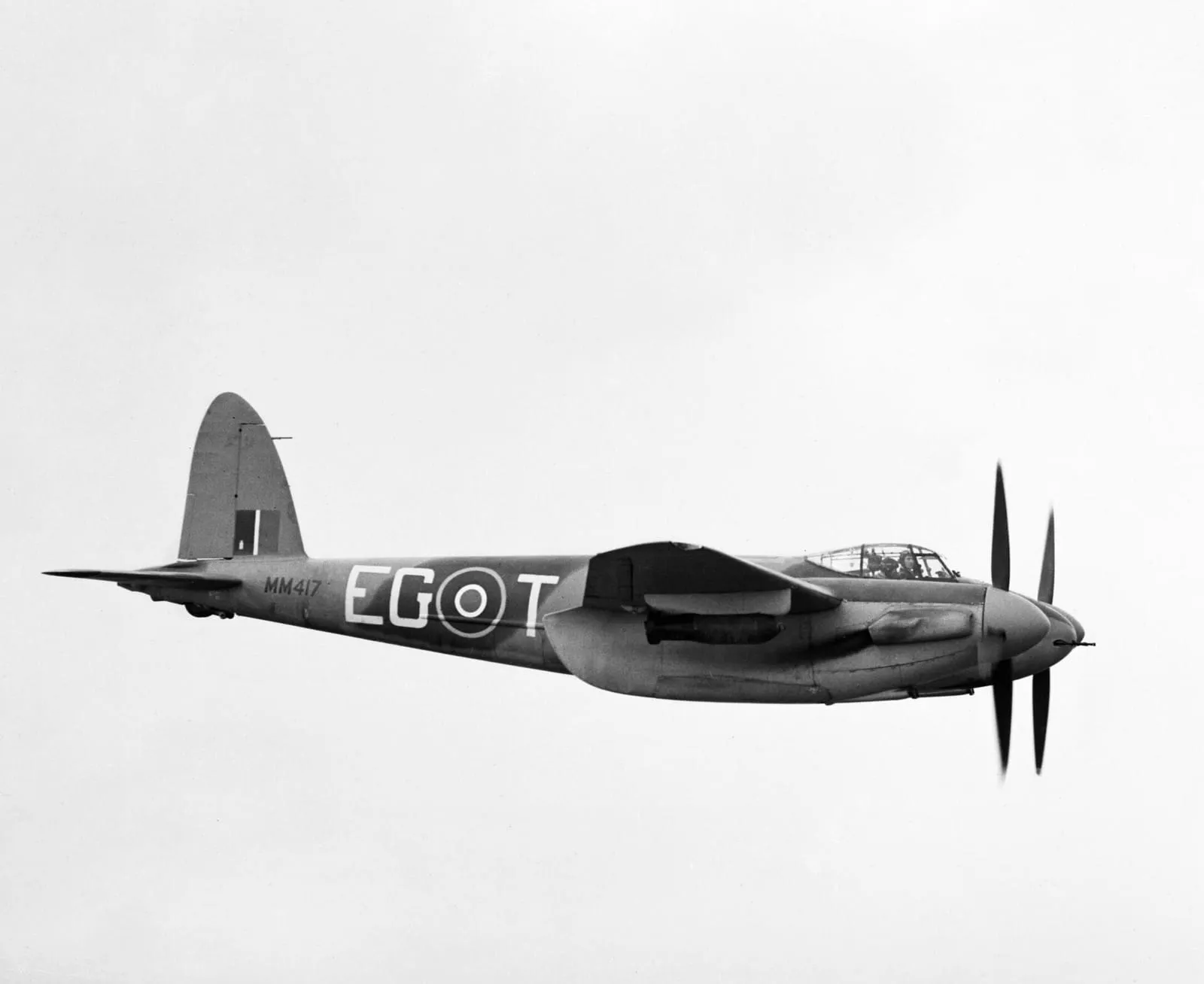
The de Havilland Mosquito was the answer to a question nobody in the British Air Ministry wanted to ask in 1939: could a bomber do without guns if it was faster than the fighters? Built almost entirely of wood by a firm that knew sporting and passenger aircraft rather than warplanes, it proved one of the fastest aircraft of the war and the RAF’s most versatile machine. It photographed the Reich, bombed Berlin in broad daylight, hunted German bombers and V-1 flying bombs by night, marked targets for the heavy bombers and destroyed single buildings in occupied cities. Its losses were the lowest in the whole of Bomber Command.
“Freeman’s Folly”
Before the war the de Havilland company of Hatfield had made its name with the fast DH.88 Comet racer and the wooden Albatross airliner. Its founder Geoffrey de Havilland (PL) argued in 1938–1939 that a small bomber with two Rolls-Royce Merlin engines, no gun turrets and a crew of two would outrun any fighter. Wood had an added advantage: it took no aluminium needed by other factories, and carpenters and furniture makers could work on it. The ministry was sceptical; the project was, however, backed by a member of the Air Council, Wilfrid Freeman, and Lord Beaverbrook is said to have called the aircraft “Freeman’s Folly”.
After the fall of France the Minister of Aircraft Production, Lord Beaverbrook, had the factories concentrate on five proven types, and work on the Mosquito stopped. It resumed in July 1940, when the firm’s management promised fifty aircraft by the end of 1941. The prototype, built in secret at the Salisbury Hall manor house, was first flown at Hatfield on 25 November 1940 by the founder’s son, Geoffrey de Havilland junior. The fuselage was a shell of two layers of birch plywood with balsa between them, glued in moulds like a boat. In trials the aircraft reached a speed that no RAF fighter then had.
Reconnaissance and daylight bombing (1941–1943)
An unarmed reconnaissance Mosquito flew the first operational sortie over western France in September 1941. From November No. 105 Squadron received bombers, and in 1942 it began attacking single targets in occupied Europe from low level. A raid on the Gestapo headquarters in Oslo on 25 September 1942 allowed the British to reveal the new aircraft to the world, and in December Mosquitoes took part in the raid on the Philips works at Eindhoven. On 30 January 1943, the tenth anniversary of the Nazi seizure of power, three Mosquitoes of No. 105 Squadron bombed Berlin just as Hermann Göring was due to speak on the radio, and delayed his speech by more than an hour. Göring later complained publicly that he turned green with envy when he saw the Mosquito, and ordered special fighter units formed to fight it. The daylight attacks, however, cost Nos. 105 and 139 Squadrons many crews.
In the service of Bomber Command (1943–1945)
From 1943 the Mosquito became part of the night offensive. Aircraft of No. 109 Squadron with the Oboe radio system marked targets in the Ruhr with flares for the heavy bombers, including in the June raid on Elberfeld. Other Mosquitoes deceived the defences by imitating great raids: in August 1943 eight of them dropped markers over Berlin while the main force flew to Peenemünde. From mid-1943 the so-called Light Night Striking Force dropped “cookie” bombs of about 1.8 tons on German cities from high altitude, and the enemy’s night fighters could hardly catch it. Mosquitoes also protected the heavy bombers as night fighters of No. 100 Group, hunting German fighters over their own airfields.
The Mosquito was also one of the RAF’s best night fighters. In summer 1944 its crews shot down the first V-1 flying bomb on the night of 14–15 June, and in the following months chased them over the Channel. The Polish No. 307 Squadron switched to night-fighter Mosquitoes in December 1942, and No. 305 Squadron used them from February 1944 as a fighter-bomber unit attacking targets in France and Germany. Only a German jet challenged the Mosquito’s speed: on 26 July 1944 a Messerschmitt Me 262 attacked a reconnaissance Mosquito over Bavaria in the first combat of a jet aircraft.
Precision strikes
Most famous were the attacks by FB.VI Mosquitoes on single buildings. On 18 February 1944, in Operation Jericho, nine aircraft breached the walls of Amiens prison; according to BAE Systems 255 prisoners escaped, but 182 were soon recaptured. On 31 October 1944 Mosquitoes destroyed the Gestapo headquarters in Aarhus. On 21 March 1945, in Operation Carthage, they bombed the Gestapo headquarters in Copenhagen: the files burned and eighteen prisoners escaped, but one aircraft struck a mast, and some of those following took the smoke from its wreck for the target and dropped their bombs on a nearby school. 86 children were killed.
Mosquitoes also fought at sea, in the Coastal Command strike wings that attacked shipping off Norway with rockets, and in Asia. In the tropics the wooden structure failed: at the end of 1944, after a series of crashes in India, an investigation found that wings had been badly glued at two factories, and damp and heat did the rest. On 2 May 1945 it was the crew of a reconnaissance Mosquito who spotted a message on the roof of Rangoon jail saying that the Japanese had gone.
The balance
7,781 Mosquitoes were built, 6,710 of them during the war, in Britain, Canada and Australia; many furniture works made their wooden parts. According to British figures the bomber Mosquitoes had the lowest losses of any Bomber Command aircraft, even though the daylight attacks of 1942 were very costly. After the war they served in many air forces, and in the RAF only the Canberra jet replaced them. The Mosquito showed that speed could take the place of guns, but only until the enemy had jet aircraft.
Sources
In the chronicle
(24)1942
1943
- 31 January 1943Paulus surrenders
- 5 March 1943The Battle of the Ruhr begins
- 29 May 1943The raid on Wuppertal
- 24 June 1943The raid on Elberfeld and the evacuation of the Ruhr
- 24 July 1943Operation Gomorrah
- 17 August 1943Operation Hydra
- 22 October 1943The raid on Kassel
- 18 November 1943The air Battle of Berlin begins
- 27 November 1943Raids on Berlin in November 1943
1944
- 20 January 1944The raid on Berlin of 20 January
- 14 March 1944The isolation of Ireland
- 22 March 1944The raids on Frankfurt
- 21 April 1944The raid on La Chapelle
- 13 June 1944The first V-1 flying bombs
- 2 July 1944Flying bombs over London
- 26 July 1944The first jets in combat
- 24 December 1944V-1s over Manchester