Germany
Hermann Göring
Commander of the SA (1923), President of the Reichstag (1932–1945), Minister-President of Prussia (1933–1945), Minister of Aviation (1933–1945) and Commander-in-Chief of the Luftwaffe (1935–1945), Plenipotentiary for the Four-Year Plan (1936–1945), Reichsmarschall (1940)
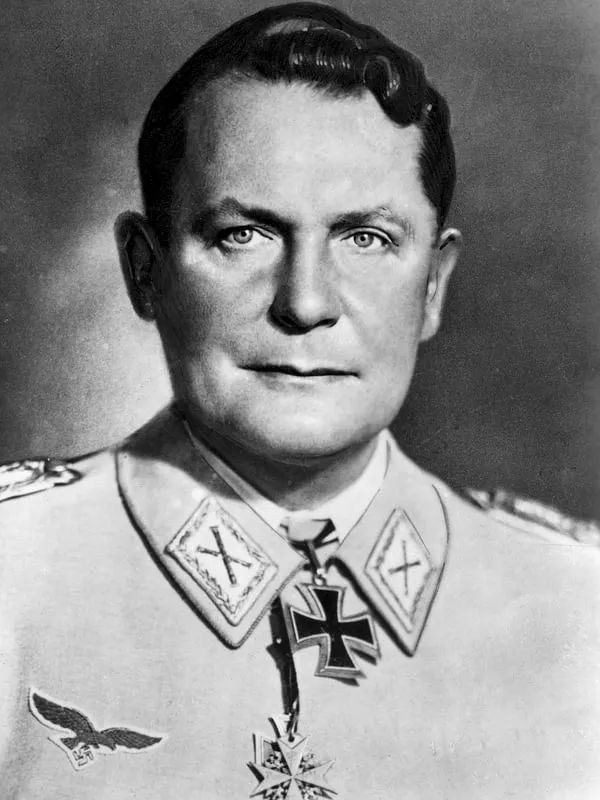
- Born:
- 12 January 1893, Rosenheim (Bavaria)
- Died:
- 15 October 1946, Nuremberg
- Author:
- Natalia
- Photo:
- Robert Röhr, domena publiczna, Wikimedia Commons

For most of the Third Reich’s existence Hermann Göring was the second man in the state and the designated successor of Adolf Hitler. A flying hero of the First World War and the last commander of Richthofen’s famous “Flying Circus”, in 1923 he commanded the SA and was wounded in the Beer Hall Putsch. After the Nazis came to power he created the Gestapo and the first concentration camps in Prussia, built the Luftwaffe and, as Plenipotentiary for the Four-Year Plan, geared the German economy to preparing for war. During the war his air force bombed Wieluń, Warsaw, Rotterdam and London, while he himself directed the plunder of occupied Europe and signed the authorisation under which Reinhard Heydrich prepared the “final solution of the Jewish question”. Extravagant, vain and addicted to morphine, he lost influence in the last years of the war. At Nuremberg he was the foremost defendant, and on the eve of his execution he took his own life.
The governor’s son
He was born on 12 January 1893 in a sanatorium in Rosenheim in Upper Bavaria. His father, Heinrich Ernst Göring, was a lawyer and diplomat, in 1885–1890 the first Reich Commissioner in German South West Africa (today’s Namibia) and later Germany’s representative in Haiti. The family later lived at the castles of Veldenstein in Franconia and Mauterndorf in Austria, which belonged to Hermann’s godfather, the physician Hermann von Epenstein, his mother’s lover. He did poorly at school, but at the cadet schools in Karlsruhe and at Lichterfelde near Berlin he was an outstanding pupil. In 1912 he joined an infantry regiment stationed at Mulhouse (Mülhausen) in Alsace as an officer cadet, and soon became a lieutenant.
Fighter ace
At the beginning of the war he fell ill with rheumatism of the joints, and in hospital in Freiburg he met the airman Bruno Loerzer, who infected him with a passion for flying. In the autumn of 1914 Göring transferred to the air service as an observer, and in 1915 he trained as a pilot. In November 1916 he was wounded and spent several months in hospitals. In May 1917 he took command of a fighter squadron, and on 2 June 1918, after more than a dozen aerial victories, he received Prussia’s highest military decoration, the Pour le Mérite. At the beginning of July 1918 he was given command of Fighter Wing 1 (Jagdgeschwader 1), previously led by Manfred von Richthofen, the “Red Baron”. He ended the war with 22 kills.
Sweden and Carin
After the Armistice Göring refused to hand his aircraft over to the Allies and led the wing back to Germany. The Treaty of Versailles forbade Germany a military air force, so Göring went to Denmark and Sweden, where he demonstrated Fokker aircraft and worked as a pilot for a Swedish airline. At the beginning of 1920, after flying the wealthy explorer Count Eric von Rosen to his estate, he met his sister-in-law, Baroness Carin von Kantzow. They fell in love. Carin left her husband and son and in 1921 went with Göring to Bavaria. They married at the beginning of 1923.
SA commander and the putsch
In the autumn of 1922 Göring heard Hitler speak in Munich against Versailles and soon joined the NSDAP. Hitler was looking for a commander with a well-known name and a heroic past who would lend prestige to the party’s fighting squads, the Storm Detachments (SA). At the beginning of 1923 Göring took command of them. He wrested them from the influence of Captain Hermann Ehrhardt and organised them on military lines into companies, battalions and regiments.
On 8 November 1923 Göring, in a steel helmet, burst with armed men into the Bürgerbräukeller beer hall, where Hitler proclaimed the “national revolution”, and kept the hall calm while in a side room Hitler put pressure on Gustav von Kahr and his companions. On the morning of 9 November he threatened that if the police killed any of the putschists, the hostages being held would die. At noon he marched in the front rank of the column beside Hitler and Erich Ludendorff. When the police opened fire at the Feldherrnhalle, he was shot in the thigh and groin. His comrades carried him into the courtyard of a nearby house, whose Jewish owner, Robert Ballin, gave him help. Years later Göring repaid the debt by getting Ballin and his wife released from the Dachau camp after Kristallnacht.
Exile and morphine
With a warrant out for his arrest, he escaped to Austria with Carin’s help. In hospital in Innsbruck he underwent an operation and was given morphine for the pain. Thus began an addiction that, with interruptions, lasted for the rest of his life. He did not stand trial alongside Hitler, who on 1 April 1924 was sentenced to five years’ fortress confinement. In the spring of 1924 the Austrian authorities ordered him to leave the country. He went to Italy, where as Hitler’s envoy he sought in vain a meeting with Benito Mussolini and money for the shattered movement. In 1925 the Görings, without means of support, moved to Sweden. His addiction became so severe that after he attacked a nurse who had refused him morphine he was committed to the Långbro psychiatric hospital near Stockholm. He returned to Germany for good in 1927, after a political amnesty.
The road to power
In Berlin Göring earned his living as a lobbyist for aircraft firms, drawing on old wartime acquaintances, and renewed his party membership. In the election of 20 May 1928 he was one of twelve NSDAP deputies elected to the Reichstag. Hitler valued him as a link to the aristocracy, big industry and the army. Göring introduced him to men such as the industrialist Fritz Thyssen and the former president of the Reichsbank, Hjalmar Schacht. After the September 1930 election, when the NSDAP became the second-largest force in parliament, he became Hitler’s political representative in the capital. On 17 October 1931 Carin died of tuberculosis. He later named his great forest estate in the Schorfheide near Berlin after her: Carinhall.
After the election of July 1932, in which the NSDAP became the largest party, the Reichstag elected Göring its president on 30 August. On 12 September, in breach of the standing orders, he refused to let Chancellor Franz von Papen speak – Papen wanted to read out the decree dissolving parliament – and held a vote of no confidence, which the government lost by a crushing majority. In the months that followed he was one of the chief intermediaries in the negotiations that led, on 30 January 1933, to Hitler’s appointment as chancellor by Paul von Hindenburg.
Builder of terror
In Hitler’s first cabinet Göring became minister without portfolio and commissioner of the Prussian interior ministry, and with it head of the police in the largest state of the Reich. On 17 February 1933 he ordered the police to use their weapons ruthlessly against “enemies of the state” and assured them that he would cover for them whatever the consequences. A few days later he enrolled men of the SA and SS as auxiliary police. After the Reichstag fire on the night of 27–28 February, thousands of communists and Social Democrats were thrown into jails and into the first concentration camps, such as Oranienburg. On 11 April Göring became Minister-President of Prussia, and on 26 April he separated from the police the Secret State Police Office, from which the Gestapo grew. Only on 20 April 1934 did he hand over its direction to Heinrich Himmler. Together with Himmler and Heydrich he prepared the reckoning with the SA. During the Night of the Long Knives, from 30 June 1934, he directed the arrests and executions in Berlin according to prepared lists. Among those killed were Ernst Röhm, the former chancellor Kurt von Schleicher and Gustav von Kahr.
The Luftwaffe and the Four-Year Plan
On 5 May 1933 Göring became Reich Minister of Aviation and began secretly building the air force forbidden by the Treaty of Versailles. In March 1935 Germany revealed the existence of the Luftwaffe, and Göring became its Commander-in-Chief. In the Spanish Civil War its Condor Legion supported General Franco and on 26 April 1937 bombed Guernica. On 10 April 1935 Göring married the actress Emmy Sonnemann, with Hitler as a witness at the wedding. In 1938 their daughter Edda was born.
On 18 October 1936 Hitler appointed Göring Plenipotentiary for the Four-Year Plan, which was to make the army and the economy ready for war within four years. Göring became the de facto dictator of the German economy, pushed Schacht aside and in 1937 founded the state-owned Reichswerke Hermann Göring, which during the war, relying on forced labour, became the largest steel concern in Europe. In February 1938, after an intrigue that forced the resignation of the war minister, Werner von Blomberg, and the commander of the army, Werner von Fritsch (the Blomberg–Fritsch affair), he was made a field marshal. On 11 March 1938, in telephone calls to Vienna, he forced the resignation of the Austrian chancellor and opened the way to the Anschluss.
Göring was also one of the chief agents of the plunder of Jewish property. After Kristallnacht he convened a conference on 12 November 1938 at which a “contribution” of one billion marks was imposed on the German Jews, they were made to pay for the damage themselves, and a decree was issued excluding them from economic life. It was then that he said: “I wish you had killed two hundred Jews instead of destroying such valuables.” In January 1939 he set up a central office in Berlin that was to force the Jews to emigrate.
He knew Poland from several visits. From 1935 he came to hunt in the Białowieża Forest and held talks with Polish leaders – in 1935 with Józef Piłsudski as well – assuring them of German friendship and urging a common policy against the Soviet Union. In March 1939 he threatened the President of Czechoslovakia, Emil Hácha, with the bombing of Prague if he did not agree to the German occupation of Bohemia and Moravia. In the summer of 1939, although he had no doubt there would be war with Poland, he held talks with the British through a Swedish intermediary, hoping that London would stay neutral. On 1 September 1939 Hitler announced in the Reichstag that if anything happened to him, his successor would be Göring, and after him Rudolf Hess.
The war
One of the first targets of the German bombers on the morning of 1 September 1939 was Wieluń, a town of no military importance. Göring’s Luftwaffe destroyed the Polish air force, paralysed communications and in September bombed Warsaw, killing thousands of civilians. In May 1940, during the campaign in the West, it bombed Rotterdam. Göring then promised Hitler that the air force alone would destroy the British army encircled at Dunkirk. He failed to keep his word: more than three hundred thousand soldiers were evacuated to England. Nevertheless, after the victory over France Hitler appointed him Reichsmarschall on 19 July 1940, a rank created especially for him, and awarded him the Grand Cross of the Iron Cross.
In the summer and autumn of 1940 the Luftwaffe lost the Battle of Britain, in which Polish airmen played an important part. The raids on London and other British cities, which Göring personally oversaw, did not break the British. After the invasion of the Soviet Union in June 1941 the Luftwaffe had to fight on several fronts at once, and the aircraft industry, run by, among others, his old comrades-in-arms such as the fighter ace Ernst Udet, could not keep up with production. When in November 1942 the Red Army encircled the Sixth Army at Stalingrad, Göring assured Hitler that the Luftwaffe would supply it from the air. Only a fraction of the supplies needed got through, and the army capitulated at the beginning of 1943. Ever heavier Allied raids on German cities ruined his authority.
Crimes
Göring was not an ideologue of the Holocaust like Himmler or Heydrich, but he was one of its organisers. On 31 July 1941 he signed a letter authorising the head of the Reich Main Security Office, Reinhard Heydrich, to prepare a “total solution of the Jewish question” in the German sphere of influence in Europe. Heydrich invoked it on 20 January 1942 at the Wannsee Conference. As head of the Four-Year Plan Göring also directed the economic exploitation of the conquered countries. Planners under his authority drew up, before the invasion of the Soviet Union, the Hunger Plan, which assumed that food would be shipped to Germany and that millions of inhabitants of the occupied territories would starve to death. In November 1941 Göring told the Italian foreign minister, Count Ciano, that twenty to thirty million people would die of hunger in Russia that year, and that perhaps this was just as well. Within his Four-Year Plan organisation there also operated the Plenipotentiary for Labour Deployment, who deported millions of forced labourers to Germany.
At the same time he enriched himself from the war like no other dignitary. He amassed more than four thousand works of art, a large part of them looted from Jews in France, the Netherlands and other countries or bought under duress. He chose them in person at the Jeu de Paume museum in Paris, where Rosenberg’s task force stored the plundered collections. He organised lavish hunts, spent fortunes on Carinhall and appeared in extravagant uniforms, for which Germans mockingly called him “Lametta-Heini” (from Lametta, Christmas-tree tinsel).
The fall
In the last years of the war Göring lost his influence over decisions. Hitler blamed him for the failures of the air force, and Himmler, Joseph Goebbels, the armaments minister Albert Speer and Hitler’s secretary Martin Bormann competed with him successfully for access to the Führer. On 20 April 1945, after Hitler’s birthday, he left besieged Berlin and went to Bavaria. On 23 April, having learned that Hitler had decided to remain in the capital, he sent him a telegram asking whether he should take over the leadership of the Reich in accordance with the decree of 1941, and announcing that if he received no reply by evening he would assume that Hitler had lost his freedom of action. Bormann presented this as treason. Hitler had Göring arrested and stripped of all his offices, and in his political testament of 29 April expelled him from the party and named Admiral Karl Dönitz as his successor. The SS men guarding Göring on the Obersalzberg were ordered to shoot him after the fall of Berlin, but did not carry out the order. Freed by Luftwaffe soldiers, he gave himself up to the Americans in Austria on 9 May 1945, convinced that he would negotiate with them as Germany’s representative.
Nuremberg
In prison the Americans weaned him off the drugs to which he was addicted. At the trial before the International Military Tribunal at Nuremberg (PL), which opened on 20 November 1945, he was the foremost of the defendants. He defended Hitler and the Third Reich, presented himself as a diplomat who had wanted peace, and denied that he had known about the extermination of the Jews. The documents, however, including the letter to Heydrich and the transcript of the conference of 12 November 1938, told a different story. On 1 October 1946 the tribunal found him guilty on all four counts of the indictment – participation in a common plan or conspiracy, crimes against peace, war crimes and crimes against humanity – and sentenced him to death by hanging. His request to be shot instead was refused. On the evening of 15 October 1946, a few hours before his execution was due, Göring took potassium cyanide in his cell. To this day it is not known for certain who helped him hide the poison.
Significance
Göring was the man who gave Nazism a face acceptable to the old elites. A war hero, at ease in the company of aristocrats, industrialists and diplomats, he persuaded many of them that it was possible to work with Hitler. Behind this façade stood a ruthless politician who was the first in the Third Reich to build an apparatus of terror and camps, and then the war machine that Germany hurled at Poland in 1939. Although he liked to present himself as a moderate, and at times genuinely feared war with the Western powers, he never stood up to Hitler, and he took a direct part in the regime’s crimes, from the plunder of Jewish property to the starvation of conquered peoples. His younger brother Albert spent the whole war rescuing the persecuted, making use of his brother’s name, which only underlines that a choice was possible. In the story of the road to the Second World War, Göring shows how the fame and ambition of one of the best-known soldiers of the Great War were placed at the service of a genocidal dictatorship.
Sources
Commanded in battles
(02)Mentioned in battles
(09)Often appears with
People who appear in the same events.
On the timeline
(158)The 40 most important of 158 events. All tagged “Hermann Göring” (22) →
1923
1933
1934
1935
1936
1938
1939
1940
1941
March
May
- 10
- Key eventRudolf Hess’s flight to ScotlandOn 10 May 1941 Hitler’s deputy Rudolf Hess flew alone to Scotland to make peace with Britain. He bailed out by parachute and was taken prisoner.
- Key eventThe last night of the BlitzOn the night of 10–11 May 1941 bombs killed 1,436 people in London and destroyed the House of Commons chamber. It was the Blitz's last great raid.