- Category:
- Military operations
- Front:
- Western Front
- Date:
- 17 August 1943
- Author:
- Łukasz
- Tags:
- RAF, Arthur Harris, Third Reich, forced labour
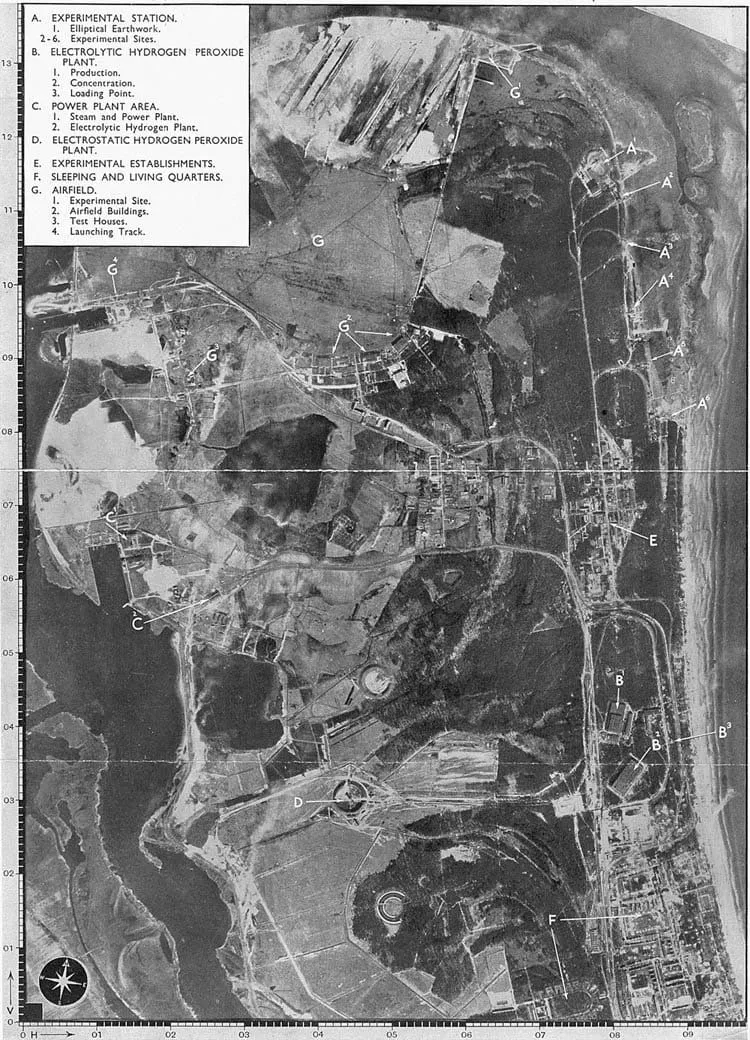
On the night of 17–18 August 1943, under a full moon, 596 heavy bombers of the British Bomber Command flew over the northern part of the island of Usedom at the mouth of the Peene. Their target was the army research centre at Peenemünde – the place where the team of General Walter Dornberger and Wernher von Braun was building the A4 ballistic missile, the future V-2, and where a neighbouring Luftwaffe establishment was testing the Fi 103 flying bomb, the future V-1. The operation was code-named Hydra. It was the Allies’ first strike against the German “vengeance weapons” programme and the beginning of the campaign that in November 1943 received the code name Crossbow.
The raid lasted less than an hour. It destroyed much of the housing estate and the works and killed two of the programme’s leading engineers, but – because of an error in marking the target – it also killed several hundred forced labourers in the camp at Trassenheide. The British lost 40 bombers. The next day the Chief of the General Staff of the Luftwaffe shot himself. Historians still argue about how far Hydra delayed the German rockets.
Rockets on the Baltic
The German army had been interested in rockets since the turn of the 1920s and 1930s. The Treaty of Versailles restricted the Reichswehr’s artillery but said nothing about rocket missiles, so in 1931 the army ordnance office took on Captain Dornberger and soon afterwards the young Wernher von Braun. In 1936 construction began of a large research centre on a remote, wooded headland of Usedom: with an engine test stand, a wind tunnel, an experimental works, a housing estate for several thousand employees and, later, halls for series production. On 3 October 1942 the fourth A4 prototype flew almost 190 kilometres, and for the first time in history a man-made object reached the edge of space. On 7 July 1943, at the Wolf’s Lair, Dornberger and von Braun showed a film of its launch to Adolf Hitler, who gave the programme the highest armaments priority. The rockets were to be produced in their thousands – at Peenemünde, Friedrichshafen and Wiener Neustadt – by the hands of forced labourers, prisoners of war and concentration camp inmates. At nearby Karlshagen and at Trassenheide stood the barracks housing thousands of workers from Poland, the USSR and other occupied countries.
What the British knew
The first signs of German rocket work had reached London as early as November 1939 in the so-called Oslo Report, an anonymous letter from a German scientist to the British attaché in Norway. For a long time they were treated as unreliable. In the spring of 1943, however, reports began to multiply. General Wilhelm von Thoma, secretly overheard in captivity, expressed surprise in a conversation with another prisoner that London was not yet under rocket fire. Reports on Peenemünde were passed on by the intelligence service of the Home Army (Armia Krajowa), which drew them among other sources from Polish forced labourers on Usedom; Luxembourgish workers employed at the centre smuggled out letters, and information also came from Denmark. From April 1943 RAF reconnaissance aircraft photographed Peenemünde in ever greater detail, and on pictures taken in June analysts spotted rockets lying on trailers.
In April 1943 the Chiefs of Staff warned the commands of the possibility of a rocket attack, and Prime Minister Winston Churchill entrusted an investigation of the matter to his son-in-law, the Parliamentary Secretary to the Ministry of Supply, Duncan Sandys. The Prime Minister’s scientific adviser, Frederick Lindemann, Lord Cherwell, considered the reports of a large liquid-fuelled rocket a hoax designed to divert attention from the real threats; a young physicist in air intelligence, Reginald V. Jones, argued that the rocket existed. The view prevailed that the risk was too great to wait. At a meeting in Downing Street on 15 July 1943 Churchill, the Chiefs of Staff and the Home Secretary, Herbert Morrison, approved the plan for a raid: it was to take place at the next favourable full moon. Churchill declared that Peenemünde must be attacked “on the heaviest possible scale”. So as not to alert the Germans, even further reconnaissance flights over Usedom were halted.
The plan
The task fell to Bomber Command under Air Chief Marshal Arthur Harris, who was usually reluctant to divert forces from the raids on German cities. This time all his heavy bomber groups took part in the operation. The target was a difficult one. Peenemünde lay about a thousand kilometres from the nearest British airfields, beyond the range of the radio navigation systems; it was extensive and protected by smoke screens. The aim here was not to burn a city but to hit a few small areas. It was therefore decided to attack under a full moon and from a height of about 2,400 metres instead of the usual 5,000–6,000, and the whole of Bomber Command carried out practice raids on similar stretches of the British coast. In the exercises the bomb scatter shrank from about 900 to about 300 metres.
Three aiming points and three waves were laid down. The first – Stirlings and Halifaxes of Nos. 3 and 4 Groups – was to strike the housing estate where the scientists and technicians slept; the order gave first priority to killing as many as possible of the people working on the new weapon. The second – Lancasters of No. 1 Group – was to hit the two large halls in which series production of the rockets was being prepared. The third – Lancasters of No. 5 Group and Halifaxes of the Canadian No. 6 Group – was to hit the experimental works, which housed the equipment, the records and the designers’ offices. The crews were not told the truth: at the briefings they were told that the Germans were developing a new radar at Peenemünde that threatened the night bombers. The operation order warned that if the raid failed it would be repeated the following night and on subsequent nights, “regardless of casualties”.
For the first time in a raid by the main force of Bomber Command, the entire attack was to be directed over the target by a “Master of Ceremonies” (master bomber) – an officer circling over the target throughout the raid and indicating by radio which markers were good and which should be ignored. The model was what the leader of Operation Chastise had done over the Ruhr dams in May. The role was given to Group Captain John Searby, commander of No. 83 Squadron of the Pathfinder Force, which marked targets with flares.
The bombers – Avro Lancasters, Halifaxes and Stirlings – were to fly over Denmark and along the Baltic coast. To draw the German fighters away from them, eight fast Mosquitoes were to drop marker flares over Berlin before midnight, as in a real raid on the capital. Meanwhile several dozen British night fighters were to patrol over German airfields and attack aircraft taking off.
The night of 17–18 August
The diversion worked. At 10.56 p.m. British time the first Mosquito was over Berlin, and the German defences – convinced that a great raid on the capital was coming – sent there most of the more than two hundred night fighters scrambled that night, including single-engined Bf 109s and Fw 190s flying “Wilde Sau” tactics over the illuminated target.
Over Usedom the first markers fell at 0.10 a.m. Cloud partly obscured the moon, and the coast of Rügen, which was to serve as a landmark, showed up poorly on the aircraft’s radar screens. The initial markers fell about three kilometres too far south – on the forced labour camp at Trassenheide. Searby soon spotted a well-placed marker over the housing estate and directed the following crews onto it, but about a third of the bombers of the first wave had already bombed the camp. The wooden barracks offered no protection against bombs. They housed the workers of the building firms working for the centre – besides Germans, Poles, Ukrainians and Czechs conscripted for forced labour, as well as Dutchmen and Italians. According to the British historian Martin Middlebrook, 23 of the 45 barracks were destroyed and at least 500, perhaps 600, workers were killed; Dornberger later spoke of 720 dead, while local German studies sometimes give much lower figures. There were also victims in the centre itself: in production hall F1, where concentration camp prisoners forced to work on the rockets had been held since the summer, prisoners were killed.
The bombs that hit the housing estate destroyed about three-quarters of its buildings, but relatively few people died there – about 170 of some 4,000 residents. The sandy soil muffled the explosions, and the shelters were well built. In one of the slit trenches, however, the chief designer of the A4 rocket engine, Dr Walter Thiel, was buried together with his family, as was the chief engineer of the planned production plant, Dr Erich Walther.
The second wave, 113 Lancasters of No. 1 Group, arrived at 0.31 a.m. The Pathfinders had to shift the marking to a new target in the middle of the raid, something never done before; some markers again fell too short or too far, but Searby warned the crews to ignore them. The bombs damaged the production halls and destroyed a store of rockets. A strong wind, however, carried the markers eastwards, and some of the loads fell into the sea.
The third wave reached Peenemünde half an hour after the start of the raid. The target was already shrouded in smoke from the fires and the German smoke screens, and fighters were arriving, having realised that Berlin was a ruse and hurried to the coast. The Canadians of No. 6 Group bombed markers, some of which had drifted east and south; the crews of No. 5 Group used their own method of timing a run from a point on Rügen, but many of them overshot. Their bombs fell several kilometres beyond the experimental works. Even so, roughly a third of the buildings were hit, including the headquarters building and the design office; the wind tunnel and the telemetry laboratory survived.
It was the third wave that paid the highest price. Within a quarter of an hour fighters shot down 28 bombers, some of them using a new armament, Schräge Musik – cannon angled obliquely upwards, with which the twin-engined Bf 110 fired into the unarmoured underside of a bomber, invisible to its gunners. That night they were used in combat for the first time.
Losses
Bomber Command lost 40 bombers – 6.7 per cent of the aircraft dispatched, most of them from the third wave – and 215 airmen. The German night-fighter force lost a dozen or so fighters. Fifteen British and Canadian airmen were buried in unmarked graves within the centre; after the war the Soviet authorities did not allow them to be exhumed, and they lie there to this day.
On the German side the total number of dead is estimated at about 700–750, the great majority of them forced labourers and prisoners rather than the German scientists and technicians whom the raid had above all been meant to eliminate. The museum at Peenemünde gives the number killed on the ground as about 700. This tragic balance is typical of raids on the armaments plants of the Third Reich, an ever larger part of whose workforce consisted of people brought there against their will.
Jeschonnek’s death
The diversion over Berlin had an unexpected consequence. Hundreds of German fighters circled over the capital, and the anti-aircraft artillery fired blindly into a sky in which there was no great raid. For the failure of the defences – after further American daylight raids, after the Hamburg catastrophe and after the helplessness against the bombers over Usedom – Hitler and Hermann Göring blamed the Luftwaffe Chief of the General Staff, Colonel General Hans Jeschonnek. On the morning of 18 August 1943, a few hours after the raid, Jeschonnek shot himself near the Luftwaffe staff headquarters in the Rominten Heath. Officially it was announced that he had died of a stomach haemorrhage.
How much time the Germans lost
After the raid the Germans simulated more damage than had actually been done, to convince British reconnaissance that the centre was destroyed and need not be bombed again: they blew up lightly damaged buildings, dug fake craters in the sand and painted black and white stripes on roofs to imitate charred beams. For several days work was also hampered by delayed-action bombs and duds lodged in the sandy soil.
The raid hastened decisions that were already being taken. Hitler and Heinrich Himmler, who was just then drawing the SS into the rocket programme, decided to move production to a place safe from bombs. At the end of August 1943 the first prisoners from Buchenwald began driving tunnels into the Kohnstein hill near Nordhausen, where the underground Mittelwerk factory was built, and next to it the Mittelbau-Dora camp. Test launches were moved to the SS Heidelager (PL) training ground near Blizna in occupied Poland, beyond the reach of British bombers. Research at Peenemünde nevertheless continued – the wind tunnel and the telemetry laboratory had not been damaged – and test launches from the island resumed as early as October.
Assessments of Hydra’s effectiveness differ sharply. The propaganda minister, Joseph Goebbels, noted in his diary that the raid would delay the programme by six to eight weeks; Dornberger spoke of four to six weeks. The United States Strategic Bombing Survey (USSBS), which after the war could not inspect Peenemünde, lying as it did in the Soviet zone, judged the raid “ineffective”. The British official historians Charles Webster and Noble Frankland considered that the attacks on Peenemünde and other sites might together have delayed the V-2 offensive by about two months, and that the deaths of Thiel and Walther and the relocation of production made it harder to eliminate the rocket’s many design faults. The British economic historian Adam Tooze judged Hydra a great success, since it forced the Germans into a Herculean effort to move rocket production to Thuringia.
The beginning of the Crossbow campaign
Hydra is sometimes presented as the start of Operation Crossbow. This is a simplification: in 1943 the investigation into German long-range weapons was conducted under the code name Bodyline, and the name Crossbow was given to the wider campaign against the V-weapons only on 15 November 1943. The raid on Peenemünde was nevertheless indeed the first major blow against the programme – although as early as June, during Operation Bellicose, Lancasters had hit the Zeppelin works at Friedrichshafen, where rocket production was being prepared. The raid also left untouched the neighbouring Luftwaffe test establishment, Peenemünde-West, where the Fi 103 flying bomb was being tested; the British were only beginning to take notice of its existence.
Ten days after Hydra, on 27 August 1943, American B-17s bombed the gigantic bunker under construction at Watten in northern France, from which rockets were to be launched. In the autumn reconnaissance detected dozens of V-1 launch sites in France, and from December Allied aircraft attacked them in their hundreds. Even so, from June 1944 V-1 flying bombs fell on London, and from September 1944 V-2 rockets, against which there was no defence at all. Much information about the V-2 was then supplied by the Home Army, which in May 1944 recovered by the River Bug the wreckage of a rocket launched from Blizna and in July sent it to Britain by air.
Place in the war
Operation Hydra was one of Bomber Command’s most accurate night raids of 1943 and proved that RAF heavy bombers, led by a master bomber and experienced Pathfinders, could hit small targets in good visibility, and not just whole cities. The methods introduced then – directing a raid from the air, shifting the marking in the course of an attack, bombing by timed runs from a landmark – became a permanent part of British air force practice. At the same time that same night revealed its weaknesses: a single marking error sent bombs onto a workers’ camp, and the fighters with Schräge Musik foreshadowed the heavy losses Bomber Command was to suffer over Berlin in the winter of 1943–1944.
The most lasting effect of the raid proved to be the move of V-2 production underground. In the tunnels of the Mittelwerk tens of thousands of prisoners of the Mittelbau-Dora camp built rockets in inhuman conditions; by some estimates more people died producing them than were killed by the rockets themselves. The weapon that Hitler regarded as a wonder weapon did not change the course of the war, but its technology – and the people of Peenemünde led by von Braun, taken over after the war by the Americans and the Russians – ushered in the era of ballistic missiles and space flight.
Sources
Meanwhile
(04)Elsewhere, within a week.
- 17 August 1943 · MediterraneanThe end of the fighting in SicilyOn the night of 16–17 August 1943 US patrols entered Messina, and Patton drove in that morning. After 38 days of fighting all of Sicily was in Allied hands.
- 16 August 1943 · PolandThe Białystok Ghetto UprisingOn 16 August 1943 the Germans began liquidating the Białystok ghetto. Several hundred poorly armed fighters resisted; their leaders died in the ghetto.
- 15 August 1943 · PacificThe landing on an empty KiskaOn 15 August 1943 more than 34,000 Americans and Canadians landed on Kiska. The Japanese had gone, but fog, mines and booby traps still killed many men.
- 15 August 1943 · PacificThe landing on Vella LavellaOn 15 August 1943 the Americans bypassed strongly held Kolombangara and landed on weakly held Vella Lavella – the first deliberate “leapfrog” in the Solomons.
Related events
(04)The same battle, people or subject.
- 24 July 1943 · Western FrontOperation GomorrahFrom 24 July to 3 August 1943 Allied bombers struck Hamburg. A firestorm on the night of 27/28 July killed about 18,000 people; in all some 34,000–40,000 died.
- 19 October 1943 · Western FrontThe order for 12,000 V-2 rocketsOn 19 October 1943 the German Army Ordnance Office ordered 12,000 A4 rockets from Mittelwerk. They were to be assembled by prisoners of the Dora camp.
- 7 July 1943 · MilitaryDornberger and von Braun meet HitlerOn 7 July 1943 at the Wolf’s Lair Dornberger and von Braun showed Hitler a film of an A4 launch. Hitler gave the programme top armaments priority.
- 27 November 1943 · Western FrontRaids on Berlin in November 1943Three great RAF night raids on 22–27 November 1943 devastated Berlin. The Memorial Church and the opera burned and several thousand people were killed.