- Category:
- Military operations
- Front:
- Eastern Front
- Date:
- 31 January 1943
- Author:
- Łukasz
- Battle:
- Battle of Stalingrad
- Tags:
- Friedrich Paulus, Wehrmacht, Red Army, Adolf Hitler
On the morning of 31 January 1943 soldiers of the Soviet 64th Army reached the basement of the ruined Univermag department store in the centre of Stalingrad. It housed the headquarters of the German Sixth Army, which had been encircled between the Don and the Volga for ten weeks. A few hours later its commander, Friedrich Paulus, promoted to field marshal the previous day, was driven away by car to a Soviet army headquarters as a prisoner. On the same day the units holding out in the southern and central parts of the pocket laid down their arms; the last group, in the factory district in the north of the city, surrendered two days later.
It was the first time in this war that a German field marshal had been taken prisoner, and at the same time the symbolic end of the Wehrmacht’s greatest defeat so far. The day before, on the tenth anniversary of the Nazi seizure of power, Third Reich propaganda had bidden farewell to the Sixth Army as to fallen heroes, although tens of thousands of its soldiers were still alive.
The last days of the pocket
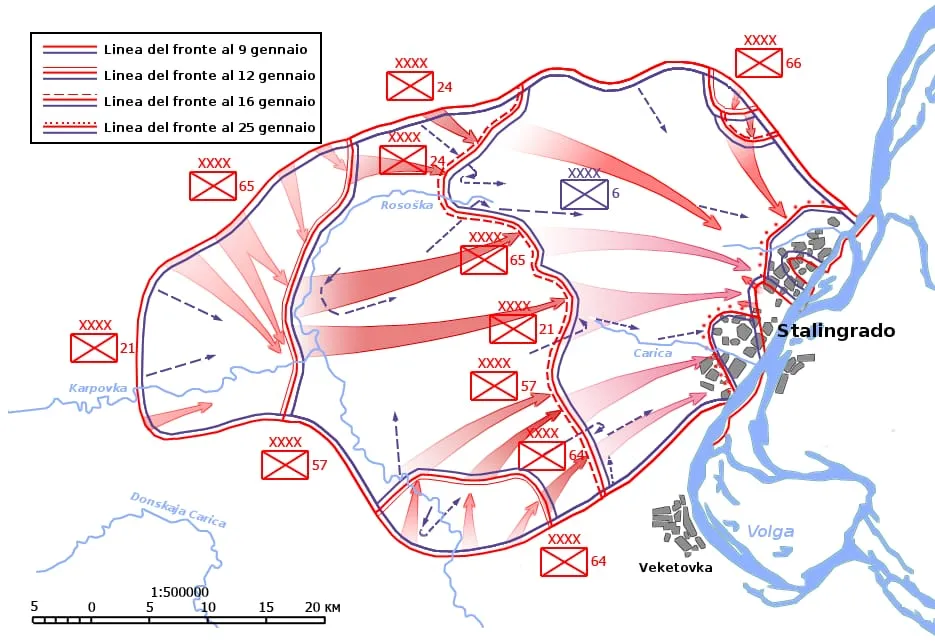
Since 10 January the troops of General Konstantin Rokossovsky’s Don Front had been conducting Operation Ring, aimed at destroying the encircled force. Paulus had earlier rejected a Soviet ultimatum, obeying the orders of Adolf Hitler, who since the encirclement of the Sixth Army in November had forbidden both a breakout and surrender. Hopes of relief had collapsed in December, and the Luftwaffe airlift that was supposed to feed the army delivered a fraction of its needs and, after the loss of the Pitomnik and Gumrak airfields, practically ceased to function – what remained were supply drops, which often landed on Soviet positions.
On 26 January units of the Soviet 21st Army, advancing from the west, linked up near Mamayev Kurgan with General Vasily Chuikov’s 62nd Army, which since the autumn had been holding out on the very bank of the Volga. The pocket broke into two parts: a northern one around the industrial plants, where General Karl Strecker commanded with XI Army Corps, and a southern one covering the ruined city centre. Over the following days a central group under General Walter Heitz also split off from the southern part. Paulus moved his command post to the basement of the Univermag department store on the Square of the Fallen Fighters, a few hundred metres from the Volga.
Conditions in the pocket in the last days were dreadful. The soldiers received a few dozen grams of bread a day or nothing, they ate horses, temperatures fell to tens of degrees below zero, and dysentery and typhus spread. Tens of thousands of wounded and sick lay in the cellars and ruins; in his reports to headquarters in the last ten days of January Paulus wrote of some 18,000 wounded without care (other estimates are higher). Some units simply stopped fighting; others resisted to the end. Several generals and many officers committed suicide or were killed seeking death in battle.
The anniversary of 30 January
30 January 1943 was the tenth anniversary of Hitler’s appointment as Chancellor. War chronologies sometimes state that Hitler gave a speech that day in which he announced Paulus’s promotion to field marshal. That is not what happened. Hitler stayed at his headquarters in East Prussia and – unlike in the three previous years of the war, when he had spoken on this anniversary at the Sportpalast – did not appear in public. His proclamation was read out there by the Propaganda Minister, Joseph Goebbels. The text referred to the “heroic struggle of our soldiers on the Volga”, which was to serve as a warning and a call to supreme effort for all Germans, but said nothing about the promotion itself.
The main speech of the day was given at the Air Ministry building by Reich Marshal Hermann Göring – the same man who in November had promised that the Luftwaffe would supply the encircled army from the air. The speech, broadcast on the radio, compared the Sixth Army to Leonidas’s Spartans at Thermopylae and to the heroes of the Nibelungenlied who fought to the last man. The Thermopylae analogy had, incidentally, been suggested a few days earlier by a military commentator on the radio. The soldiers in the pocket who listened to the broadcast on sets in their cellars heard it, according to many accounts, as a funeral oration delivered over them while they were still alive.
The British disrupted both Berlin events. In the morning three de Havilland Mosquitoes of No. 105 Squadron RAF bombed Berlin just as Göring was due to speak, delaying the broadcast by more than an hour. In the afternoon, at the time of Goebbels’s address, aircraft of No. 139 Squadron appeared over the city; this time the anti-aircraft defences were ready, and one Mosquito was shot down and both its crew killed. It was the RAF’s first daylight raid on the capital of the Reich and a painful blow to the prestige of Göring, who had considered such an attack impossible.
Promotion to field marshal
That same day Paulus sent headquarters a signal of congratulations on the anniversary in which – according to the widely quoted text – he gave assurances that the swastika flag was still flying over Stalingrad. He also reported that the collapse of the defence was a matter of hours. Hitler responded with a wave of promotions conferred by radio on officers of the encircled army. Paulus, a colonel general since the end of November, was made a field marshal.
The meaning of this promotion was plain to everyone. Hitler stressed to those around him that he knew of no case of a Prussian or German field marshal being taken prisoner. The appointment was thus meant to induce Paulus to fight to the end and, in the event of defeat, to take his own life. Historians agree about this intention, though it was not stated explicitly in any order. The claim about German field marshals’ clean record was not accurate either: in October 1806, after Prussia’s defeat at Jena and Auerstedt, the aged Field Marshal Wichard von Möllendorf was among the officers who capitulated at Erfurt.
The news of the promotion reached the headquarters in the Univermag late in the evening or during the night. According to the diary of Colonel Wilhelm Adam, Paulus’s adjutant, the signal was handed to him only in the early hours of 31 January. Paulus is said to have remarked that it was an invitation to commit suicide, but that he had no intention of doing anyone that favour.
Morning at the Univermag
During the night of 30/31 January units of General Mikhail Shumilov’s 64th Army, attacking from the south, closed in around the Square of the Fallen Fighters. Soldiers of Colonel Ivan Burmakov’s 38th Motorised Rifle Brigade approached the department store building. At 7.35 a.m. the Sixth Army headquarters radio sent its last messages: “The Russians are at the door. We are preparing to destroy”, and a moment later: “We are destroying.”
German emissaries came out of the basement. The first Soviet officer to speak to them was the brigade’s deputy chief of staff, Senior Lieutenant Fyodor Yelchenko (Ilchenko in some Russian sources). The Germans, however, wanted to negotiate with a representative of the army or front command. The brigade’s deputy commander for political affairs, Lieutenant Colonel Leonid Vinokur, arrived, followed by the 64th Army’s chief of staff, Major General Ivan Laskin, with several officers, authorised by the command to accept the surrender. The talks on behalf of the army were conducted by the chief of staff, General Arthur Schmidt, and the commander of the 71st Infantry Division, General Fritz Roske, to whom Paulus had earlier handed command in the southern pocket. The field marshal himself kept to one side: according to participants, he already regarded himself as a “private person” and left the negotiations to his subordinates.
Laskin later described finding Paulus in a small room, in his greatcoat, pacing up and down with his hands clasped behind his back. According to his account, the field marshal announced in broken Russian that he was surrendering to the Red Army. At about noon Paulus, Schmidt and his adjutant Adam were driven to the 64th Army’s headquarters at Beketovka on the southern outskirts of Stalingrad, where Shumilov received them. The prisoners were questioned for the first time that same day and then taken to Don Front headquarters, where during the night of 31 January/1 February Rokossovsky and the Stavka representative, Marshal of Artillery Nikolai Voronov, spoke with Paulus.
Paulus consistently maintained that he had not capitulated but had been taken prisoner by surprise. He declared that he no longer commanded the fighting part of the army and refused to order General Strecker to lay down his arms. This attitude – the wish to save face before Hitler and the officer corps while at the same time refusing to fight on – shaped his image for many years.
The end of the southern pocket
The surrender of the headquarters sealed the fate of the southern part of the encirclement. On 31 January the units in the city centre laid down their arms, as did the central group of General Heitz, newly promoted to colonel general, who according to accounts had only recently threatened to have anyone who tried to surrender shot. Exhausted, frostbitten and sick soldiers emerged from the cellars amid the ruins, many of them unable to march. That day most of the more than twenty generals captured at Stalingrad went into captivity, among them Paulus, Schmidt, Heitz and Roske.
Strecker’s northern pocket still held out. The Soviet command turned heavy artillery fire and an attack by several armies against it. Strecker surrendered on 2 February, and the last signal sent from Stalingrad ended with the cry “Long live Germany!” – without the customary salute to Hitler. That day the Battle of Stalingrad came to an end.
The first field marshal in captivity
War chronologies stress that this was the first time a German field marshal had surrendered. As regards this war and the Wehrmacht that is true; in a longer perspective one must remember the case of 1806 at Erfurt. More important, however, was the political significance. Paulus had only just been appointed, and the promotion was meant to be his death sentence. Hitler treated his choice as personal betrayal.
At a conference on 1 February, when the news that Paulus was alive and in captivity was already known, Hitler flew into a rage. According to the surviving stenographic record, he said that Paulus could have freed himself from all his cares and entered eternity and national immortality, but preferred to go to Moscow. He declared that he would appoint no more field marshals – yet before the end of the war he promoted several more generals to that rank, and in 1945 further field marshals were taken prisoner. For several days German propaganda maintained the version that the Sixth Army had perished to the last man. On 3 February a special announcement proclaimed the end of the fighting, and three days of national mourning were declared in the Reich.
The prisoners
According to Soviet figures, in the last phase of the battle, from 10 January to 2 February, some 91,000 German and allied soldiers were taken prisoner, including more than twenty generals and about 2,500 officers. They were men utterly worn down by hunger, frostbite, wounds and disease. The first weeks of captivity – marches on foot in the frost to makeshift camps around Stalingrad, the lack of food, medicine and fuel, and an epidemic of typhus – brought death on a mass scale. German historians attribute it both to the state in which the prisoners came out of the pocket and to Soviet incompetence and shortages of supplies. According to estimates, roughly half of those captured did not live to see the spring of 1943, and according to some calculations considerably more.
Of the Stalingrad prisoners, between about 5,000 and 6,000, by various calculations, returned to Germany after the war, most of them only in 1955. Particularly harsh was the fate of former Soviet citizens who had served in the Sixth Army as auxiliaries (the so-called Hilfswillige); the Soviet authorities treated them as traitors. The generals and senior officers were sent to separate camps near Moscow, in far better conditions.
Paulus’s later fate
In captivity Paulus long refused to cooperate. He did not join the National Committee for a Free Germany, formed in July 1943, nor the League of German Officers founded in September by General Walther von Seydlitz-Kurzbach. He changed his mind only after the failed attempt on Hitler’s life of 20 July 1944: in August he called on Germans over the radio to break with Hitler and joined the prisoners’ movement. In the Reich his family was subjected to reprisals.
In February 1946 the Soviets unexpectedly produced him as a prosecution witness before the tribunal at Nuremberg, where he described the preparations for the attack on the USSR. He was released in 1953, after the death of Joseph Stalin; he settled in Dresden, in East Germany, and died there in 1957.
Place in the war
Paulus’s surrender closed the process begun in November 1942 with Operation Uranus. An entire German field army had been destroyed – by various estimates between about 250,000 and 300,000 German and allied soldiers and auxiliaries had been encircled, of whom some were flown out as wounded, tens of thousands died in the pocket and the rest went into captivity. Together with the defeats of the Romanian, Italian and Hungarian armies on the Don, this meant the loss to the Axis of several hundred thousand men in three months. The strategic initiative on the Eastern Front passed to the Soviet side, though not yet for good: in February and March Field Marshal Erich von Manstein managed to halt the Soviet advance with a counter-attack at Kharkiv, and the final decision came only in the summer of 1943 at Kursk.
The psychological and political significance was greater still. In Germany it proved impossible for the first time to conceal a defeat of this scale; in February Goebbels responded with his call for “total war”. The Reich’s allies – Romania, Hungary, Italy, Finland – began to look for ways out of the war, and the neutral states, led by Turkey, treated Berlin with greater caution. In the Soviet Union and in the occupied countries Stalingrad became the symbol of the turning of the tide, and for the Western Allies proof that the Red Army could defeat the Wehrmacht in a great battle.
Paulus himself became an ambiguous figure. For Hitler he was a traitor; for many soldiers he was a commander who had sacrificed his army out of obedience and then saved himself. His passivity in the last days and his refusal to order the whole army to surrender prolonged the suffering of thousands of men by two more days of fighting in the north of the city. At the same time, the fact that he did not take his own life deprived Nazi propaganda of the central element of the myth of a Sixth Army fighting to the last man.
Sources
Meanwhile
(04)Elsewhere, within a week.
- 2 February 1943 · MediterraneanRommel on the Mareth LineIn early February 1943 Rommel's army fell back from Libya behind the old French Mareth Line in Tunisia. The Eighth Army entered Tunisia on 4 February.
- 28 January 1943 · SocietyCompulsory labour in the ReichSauckel's decree of 27 January 1943 required German men aged 16–65 and women aged 17–45 to register for work in the defence of the Reich.
- 27 January 1943 · Western FrontThe first American raid on GermanyOn 27 January 1943 American bombers attacked Germany for the first time. Of 91 B-17s and B-24s dispatched, 53 bombed Wilhelmshaven and three were lost.
- 24 January 1943 · DiplomacyThe demand for unconditional surrenderOn 24 January 1943, closing the Casablanca Conference, Roosevelt announced that the Allies would demand the unconditional surrender of Germany, Italy and Japan.
Related events
(04)The same battle, people or subject.
- 10 January 1943 · Eastern FrontOperation RingOn 10 January 1943, after its ultimatum was rejected, the Don Front attacked the Stalingrad pocket. Pitomnik fell on 16 January and Gumrak on 22 January.
- 19 November 1942 · Eastern FrontOperation Uranus beginsOn 19 November 1942 the Red Army hit the Romanians on the 6th Army's flanks. In three days the front broke and the pincers were closing west of Stalingrad.
- 24 January 1943 · Eastern FrontThe Stalingrad pocket splitIn late January 1943 Hitler rejected Paulus's requests to be allowed to surrender, and on 26 January Soviet troops split the Stalingrad pocket in two.
- 12 November 1942 · Eastern FrontThe last German assault in StalingradOn 11 November 1942 the 6th Army began its last assault in Stalingrad, reaching the Volga by Barrikady and cutting off Lyudnikov, but the 62nd Army held.