Israel
Abba Kovner
Co-founder (1942) and commander (1943) of the United Partisan Organisation in the Wilno Ghetto, commander of the Avengers partisan unit (1943–1944), leader of the Nakam group (1945–1946)
- Born:
- 14 March 1918, Sevastopol (Crimea)
- Died:
- 25 September 1987, Ein HaHoresh (Israel)
- Author:
- Natalia
- Photo:
- Israel Government Press Office, domena publiczna, Wikimedia Commons

Abba Kovner was a young Zionist activist from Wilno (Vilnius) who, on the last night of 1941, read out a manifesto in the ghetto calling on the Jews not to let themselves be led “like sheep to the slaughter”. It was one of the first texts in which the victims named what was happening at Ponary for what it was: not random pogroms but the beginning of the annihilation of all the Jews of Europe. Three weeks later Kovner co-founded the United Partisan Organisation (FPO), one of the first Jewish armed organisations in occupied Europe, and in 1943 he became its commander. He failed to spark an uprising in the ghetto, but he led the fighters out to the forest and fought as a partisan until Wilno was liberated. After the war he organised the escape of survivors to Palestine and led Nakam, a group that sought to avenge the Holocaust on the Germans, and in Israel he became one of the most important poets writing in Hebrew.
Childhood and youth in Wilno
He was born on 14 March 1918 in Sevastopol in the Crimea into a Jewish family, the son of Israel Kovner and Rachel, née Taubman; some sources, including Polish and English encyclopaedias, give his birthplace as Oszmiana, where the family came from. He had two brothers, Gedalia and Michael. As a child he moved with his family to Wilno, then a Polish city and one of the most important centres of Jewish culture in Europe, known as the “Jerusalem of Lithuania”. His father ran a leather shop, but fell ill early and died.
Kovner attended a Hebrew secondary school of the Tarbut network and then studied fine art at the Stefan Batory University. While still a teenager he joined the left-wing Zionist youth movement Hashomer Hatzair and quickly became one of its leaders in Wilno. The movement prepared young people to emigrate to Palestine and live on a kibbutz. Kovner wrote poetry and, like many of his contemporaries, planned to emigrate. His cousin was Ber Kovner, later the leader of the Israeli communists, Meir Vilner.
The war put an end to these plans. After the Red Army entered Wilno in September 1939, the city was handed over to Lithuania, and in the summer of 1940 it became part of the Soviet Union together with the rest of the country. The Soviet authorities dissolved the Zionist organisations and Hashomer Hatzair went underground. Kovner was one of its clandestine leaders.
The ghetto and the manifesto
On 24 June 1941 the Germans occupied Wilno. Kovner and a dozen or so of his comrades from Hashomer Hatzair, among them Arie (Jurek) Wilner, took refuge in a convent of Dominican nuns at Kolonia Wileńska outside the city. The prioress, Mother Bertranda – Anna Borkowska – hid them, although she risked death for it, and later helped the underground to obtain weapons; after the war Yad Vashem recognised her and several of her fellow nuns as Righteous Among the Nations. Meanwhile an Einsatzkommando and its Lithuanian auxiliaries were shooting Jews at Ponary (Paneriai), and on 6 September the remaining Jews were shut in the ghetto. Before the end of 1941 Kovner moved into the ghetto.
From conversations with the few who had survived the pits at Ponary, Kovner drew a conclusion that most of the ghetto’s inhabitants refused to accept: those who had been taken away were dead, and what was happening in Wilno was part of a plan that embraced all Jews. On New Year’s Eve, 31 December 1941, after the December actions, he read out to a meeting of some 150 members of the pioneer organisations a manifesto written in Yiddish and Hebrew: “Let us not go like sheep to the slaughter! It is true that we are weak and defenceless, but the only answer to the murderer is resistance!” He wrote that Hitler intended to murder all the Jews of Europe, that the Jews of Lithuania were first in line, and that it was better to die as free fighters than to live by the grace of murderers.
On 21 January 1942, the day after the Wannsee Conference, of which nobody in the ghetto knew anything, Kovner, the communist Yitzhak Wittenberg, Josef Glazman of Betar and Nissan Reznik of Hanoar Hatzioni founded the FPO. Wittenberg became its commander, while Kovner, known in the underground by the pseudonym “Uri”, joined its staff. The organisation stockpiled weapons, trained fighters in fives and platoons, and sent couriers to other ghettos. In the summer of 1942 its members, among them Vitka Kempner, later Kovner’s wife, blew up a German military train near Wilno.
Commander of the FPO and the move to the forest
In July 1943 the Germans demanded that the head of the ghetto, Jacob Gens, hand over Wittenberg. The fighters snatched their commander back from the police, but Gens persuaded the ghetto’s inhabitants that the Germans would destroy them all if Wittenberg did not give himself up. Wittenberg surrendered on 16 July so as to prevent Jews from fighting Jews, and died in prison. Kovner became commander of the FPO.
The drama of Wittenberg showed him that the ghetto would not follow the fighters. The FPO began sending groups out to the forests. When the Germans began liquidating the ghetto on 1 September 1943, Kovner declared a mobilisation and issued a manifesto calling people to fight, but the inhabitants, convinced that they were being sent to labour camps in Estonia, did not respond. On 23 September, the day of the ghetto’s final liquidation, he led the last group of fighters through the sewers beyond the walls and on to the Rudniki Forest. His mother was killed during the liquidation of the ghetto. His younger brother Michael was later killed as a partisan.
In the Rudniki Forest Kovner commanded one of four Jewish units operating within the Lithuanian brigade of the Soviet partisan movement, known as the Avengers (Hebrew: Nokmim). His deputies and closest collaborators were Vitka Kempner and Ruzka Korczak. According to figures cited by the United States Holocaust Memorial Museum in Washington, Kovner’s unit destroyed some 290 kilometres of track, 5 bridges and 40 railway wagons, killed 212 enemy soldiers and saved at least 71 Jews; these figures come from partisan reports and are difficult to verify. The participation of partisans from the Rudniki Forest units, including Jewish ones, in the raid on the Polish village of Koniuchy on 29 January 1944, in which at least 38 inhabitants were killed, is the subject of an investigation by the Institute of National Remembrance (IPN) (the Koniuchy massacre); Kovner’s personal involvement in the action has not been established.
In July 1944 Kovner’s partisans entered Wilno during the fighting for the city. Together with the poets Abraham Sutzkever and Shmerke Kaczerginski he began retrieving books and documents that FPO members had hidden in the ruins of the ghetto and setting up a Jewish museum in Wilno. He soon realised, however, that in Soviet Wilno there was no room for Jewish memory or for Zionists.
Bricha and Nakam
At the turn of 1944 and 1945 Kovner moved with a group of Wilno survivors to Lublin, where he was one of the founders of the Bricha (Hebrew for “escape”) movement, which over the following years smuggled hundreds of thousands of Jews from Eastern Europe across borders on their way to Palestine. At the same time the idea of revenge was taking shape in his mind. In 1945, together with several dozen former partisans and survivors, he founded the secret organisation Nakam (“revenge”), also called Din (“judgement”), from the Hebrew acronym of the words “the blood of Israel avenges”. Its members believed that the Allied courts would not punish the perpetrators, and that the world would not understand what the Holocaust had been until the Germans paid a similar price.
Plan A envisaged poisoning the water supply of several German cities, above all Nuremberg, and killing millions of Germans. Members of the group took jobs at the waterworks, and in the summer of 1945 Kovner travelled to Palestine to obtain poison and money. The leaders of the Jewish Yishuv received the plan with reluctance; the origin of the poison he eventually obtained later became a matter of dispute among historians. In December 1945, on his way back to Europe aboard a British ship, Kovner was detained by the British police and threw the poison overboard before his arrest. He spent several months in prison in Egypt. Plan A collapsed. In April 1946 his men carried out the fallback plan: at a bakery supplying the internment camp for SS men at Langwasser near Nuremberg they impregnated thousands of loaves of bread with arsenic. According to reports at the time, more than two thousand prisoners fell ill and some 200 were taken to hospital, but nobody died.
In Israel
After his release from prison Kovner settled in 1946 at kibbutz Ein HaHoresh in the Sharon plain and married Vitka Kempner; they had two children. In the 1948 war he served as education and culture officer of the Givati Brigade on the Egyptian front. His “battle pages”, daily leaflets for the soldiers written in a solemn, biblical language and calling for a merciless fight against the invader, were enormously popular but also provoked opposition. Their tone of hatred towards the enemy was criticised, and a leaflet condemning the defenders of kibbutz Nitzanim for surrendering to the Egyptians started a controversy that lasted in Israel for decades.
After the war Kovner devoted himself to literature. The collection Ad lo or (“Until There Is No Light”, 1947), written partly in an Egyptian prison, was a long poem about the fighting in the ghetto and in the forest. His later books, among them the prose cycle Panim el panim (“Face to Face”) about the 1948 war and the long poem Ahoti ktana (“My Little Sister”, 1967), in which the Holocaust and the Dominican convent return, made him one of the leading Hebrew poets of his generation. In 1970 he received the Israel Prize for literature. He was associated with the left-wing Mapam party and the Hashomer Hatzair movement, but held no political office.
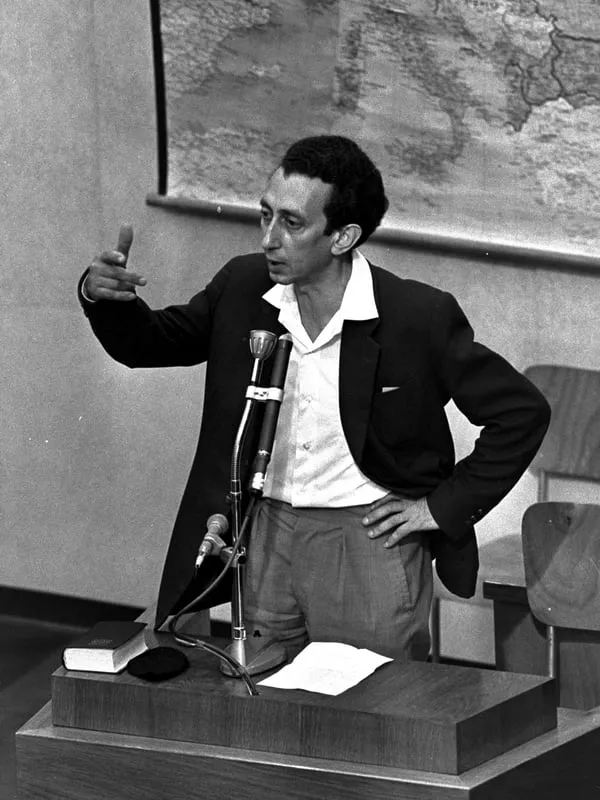
In 1961 he testified in Jerusalem at the trial of Adolf Eichmann, speaking about the Wilno Ghetto, Ponary and the Wittenberg affair. He helped to develop the concept of the museum of the Jewish diaspora, Beit Hatfutsot in Tel Aviv, which opened in 1978, and took part in creating several museums and Holocaust memorial sites. In 1986 he appeared in the American documentary film Partisans of Vilna. He died of cancer of the larynx on 25 September 1987 at his home in Ein HaHoresh.
Significance
Kovner was among the first to understand what German policy towards the Jews really was, and to say so aloud, before the plan to murder all the Jews of Europe had been coordinated at Wannsee. His manifesto, carried by couriers to other ghettos, became one of the sources of Jewish armed resistance in Warsaw and Białystok. Over time, however, the phrase about sheep led to the slaughter passed into a language that blamed the victims for not resisting, and itself became a subject of controversy; Kovner defended it as a call to fight, not an accusation against the murdered.
His life concentrates the dilemmas with which the survivors struggled: the choice between fighting and saving one’s family, the conflict with ghetto leaders who tried to save people through work, the longing for revenge after the war, and the building of a new life in Israel. The Wilno from which he came lost almost its entire Jewish community. Kovner passed on its memory in poetry and in museums, and the Wilno Ghetto, with its chroniclers, its theatre and its resistance movement, remains one of the best-documented places of the Holocaust.
Sources
Often appears with
People who appear in the same events.