Germany
Karl Jäger
Commander of Einsatzkommando 3 (1941–1943), Commander of the Security Police and SD in Lithuania (1941–1943), SS-Standartenführer
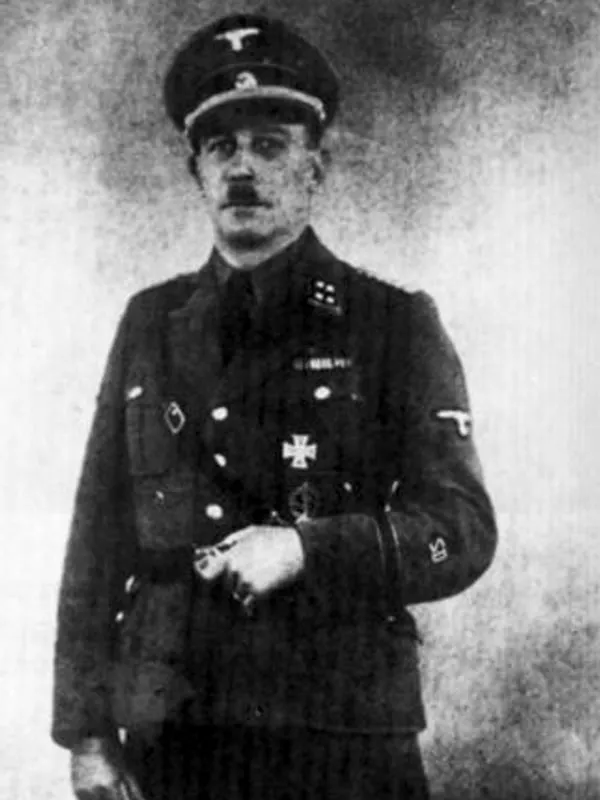
- Born:
- 20 September 1888, Schaffhausen (Switzerland)
- Died:
- 22 June 1959, Hohenasperg near Asperg (West Germany)
- Author:
- Łukasz
- Photo:
- autor nieznany, domena publiczna, Wikimedia Commons

Karl Jäger was the SS officer who in the summer and autumn of 1941 directed the murder of most of Lithuania’s Jews. As commander of Einsatzkommando 3, a unit of the German Security Police and SD, he spent five months organising, with Lithuanian auxiliaries, executions in Kaunas, Wilno and dozens of small towns, and on 1 December 1941 he summed them up in a report that listed 137,346 people killed. He was neither an ideologue nor a senior dignitary, but a solid businessman from a small Baden town, musical and pedantic, who had attached himself early to the National Socialist movement. That is precisely why historians have taken his life as an example of how “ordinary” men from a middle-class background became perpetrators of genocide. After the war he lived in West Germany under his own name for fourteen years. Arrested in 1959, he took his own life before he could be tried.
Youth in Waldkirch
He was born on 20 September 1888 in Schaffhausen in Switzerland. When he was three the family moved to Waldkirch in Baden, a small town at the foot of the Black Forest, where his father took a post as a teacher at the music school and conductor of the town band. Waldkirch was famous for making orchestrions, mechanical instruments played in taverns and at fairs. Jäger learned the trade and himself played several instruments.
In the First World War he served in the German army and received several decorations, according to most sources including the Iron Cross First Class. In 1914 he married Emma Weber, the daughter of the owner of a local orchestrion factory. After the war he became a partner and technical manager in his father-in-law’s firm. He was a respected citizen of the town, but also a man who refused to accept the lost war and the revolution.
“The Hitler of Waldkirch”
In 1923, a few months before the Munich Putsch, Jäger founded an NSDAP branch in Waldkirch and received party card number 30,988. After the party was banned and rebuilt, he joined it again in 1930. He was so zealous that, by his own account, people in the town called him “the Hitler of Waldkirch”. He belonged to the so-called Old Fighters (Alte Kämpfer), to whom the party promised priority in filling posts after 1933.
The Great Depression ruined him financially. The Weber factory went bankrupt in 1931 and Jäger was left without work. By his own account he refused to take benefits from the despised Weimar Republic and ate his way through his entire fortune. His marriage also broke down in these years, although the divorce was granted only in 1940. In 1932 he joined the SS (number 62,823) and built up a unit of about a hundred men in Waldkirch.
Career in the SS and SD
After Hitler came to power, Jäger, like many Old Fighters, tied his fate to the party. From 1936 he was a professional SS officer with the rank of Sturmbannführer, serving in Ludwigsburg and Ravensburg. Heinrich Himmler awarded him the SS death’s-head ring. On 1 May 1938 he moved to the SD Main Office in Berlin, that is, to the Sicherheitsdienst of Reinhard Heydrich, and in 1939 he took charge of the SD sector in Münster. He was a whole generation older than most of his colleagues in Heydrich’s apparatus: the commanders of the Einsatzgruppen detachments were mostly men a generation younger, often with university degrees in law, while he was over fifty and had trained as a craftsman.
After the conquest of the Netherlands in May 1940 he worked for several months at the SD office in Amsterdam. In the same year he was promoted to SS-Standartenführer, the equivalent of colonel.
Einsatzkommando 3
In June 1941, before the attack on the USSR, Jäger became commander of Einsatzkommando 3, one of the units of Franz Walter Stahlecker’s Einsatzgruppe A, which followed Army Group North. These units were formed at the police school in Pretzsch in Saxony, and their commanders were told by Heydrich and his associates that they were to kill Communist officials, Jews in party and state posts and other “radical elements”; how broadly these orders were understood from the very first days is still disputed among historians. On 2 July 1941 EK 3 took over the duties of the Security Police in Lithuania, with its headquarters in Kaunas, a few days after the bloody Kaunas pogrom.
Jäger had only a small unit at his disposal, but he knew how to make use of Lithuanian auxiliaries: the TDA battalion made up of veterans of the June uprising, the local police and local authorities, and in Wilno the Ypatingasis būrys. His key instrument was the Rollkommando Hamann, formed in July: anything from a handful to a dozen or so Germans under Joachim Hamann, with several dozen Lithuanian riflemen, who drove by lorry from town to town. In July the victims were mainly men; from mid-August women and children were also killed, and from the end of August whole communities. In Kaunas Jäger directed the executions at the Seventh and Ninth Forts of the fortress, including the shooting of 9,200 people on 29 October after a selection in the ghetto known as the Great Action. From August his remit also included Wilno (Vilnius), where by the end of the year thousands of people taken from the ghetto were killed at Ponary, among others during the yellow permit action. At the end of November EK 3 shot 4,934 Jews deported from Berlin, Munich, Frankfurt, Vienna and Breslau at the Ninth Fort, the first Jews from the Reich to be murdered immediately on arrival.
Jäger documented his work with pedantic care. A short summary of 10 September 1941 listed 76,355 people killed. On 1 December he drew up a full tally in which he declared that “the Jewish problem in Lithuania” had been solved, and that only about 34,500 Jews working in the ghettos of Kaunas, Wilno and Šiauliai remained alive. He wrote openly that he had wanted to kill them too, but that the civil administration and the Wehrmacht had forbidden it, and so he proposed sterilising the men. In February 1942, at Stahlecker’s request, he gave an updated figure of 138,272 killed, of whom 136,421 were Jews, including more than 34,000 children.
Commander in Kaunas
From December 1941 Jäger was Commander of the Security Police and SD (KdS) for the General Commissariat of Lithuania. He headed an office of about 140 Germans, supported by the Lithuanian auxiliary police. For his services Himmler gave him the SS sword of honour and Hitler the War Merit Cross with Swords. In the months that followed his men supervised the ghettos, hunted down fugitives and fought the underground.
At the beginning of August 1943 he was recalled from Kaunas. According to German studies his superiors concluded that he was coping less and less well with his duties; some authors write of a nervous breakdown and of an SS assessment that he lacked “strength of nerve”. He was succeeded by his deputy, Heinrich Schmitz. Jäger was sent to the Reichsgau Sudetenland, where in 1944 he was given the duties of police president in Reichenberg, today’s Liberec. He was never promoted to any higher post.
After the war
After Germany’s surrender Jäger did not flee abroad or change his name. He worked as a farm labourer in Wiesenbach near Heidelberg and then on a farm near Neckargemünd. In 1948 the Americans put him on a list of persons wanted for murder, but for more than ten years no one troubled him. The report of 1 December 1941 was then lying in a Soviet archive and was unknown in the West.
The situation changed at the end of the 1950s. The trial of members of the Tilsit commando at Ulm in 1958 showed that the crimes of the Einsatzgruppen in Lithuania had still not been brought to account, and led to the creation of the Central Office for the Investigation of National Socialist Crimes in Ludwigsburg. In April 1959 Jäger was identified and arrested. Under questioning by the Baden-Württemberg criminal police he presented himself as a man who had broken with his past, lived alone and seldom read the newspapers. He did not accept responsibility: he claimed that he did not feel guilty of the shooting of Jews in Lithuania. The investigation into his case led to the arrest of several other SS officers from his former circle. Jäger himself never came to trial. On 22 June 1959 he hanged himself in his cell in the prison in Hohenasperg fortress.
Memory
In 1963, four years after his death, the Soviet Union handed West German investigators a copy of the report of 1 December 1941. The document became one of the most frequently cited sources for the history of the Holocaust and was used as evidence at trials in Germany, Canada and the United States. In Waldkirch itself Jäger was long not spoken of. When in 2011 the historian Wolfram Wette, who lives in the town, published a biography of him entitled Karl Jäger. Mörder der litauischen Juden (“Karl Jäger: Murderer of the Lithuanian Jews”), some residents received it with reluctance. Wette portrayed Jäger as a perpetrator from the “middle-class centre”, cultured, musical and always correct, who within a few months had more than 137,000 people shot. At the beginning of 2017 a memorial was unveiled in Waldkirch to the victims for whose deaths Jäger was responsible: five stone stelae with plaques describing the crimes committed in Lithuania in 1941.
Jäger was not one of the architects of the policy of extermination. The decisions were taken in Berlin, by Hitler, Himmler and Heydrich. But he was a typical executor without whom it could not have been carried out: ambitious, conscientious and proud of his “results”. In Lithuania, where only a few per cent of more than 200,000 Jews survived the war, it was his unit that carried out the most important part of that work.
Sources
Often appears with
People who appear in the same events.