Germany
Adolf Eichmann
Head of the Central Office for Jewish Emigration in Vienna (1938–1939), head of the RSHA desk for Jewish affairs and evacuations (IV B 4, 1939–1945)
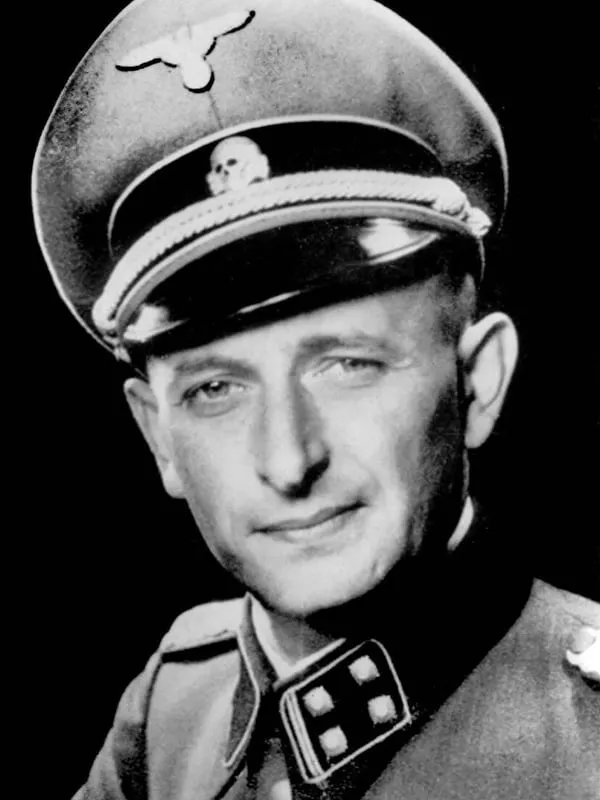
- Born:
- 19 March 1906, Solingen (German Empire)
- Died:
- 1 June 1962, Ramla (Israel)
- Author:
- Natalia
- Photo:
- autor nieznany, domena publiczna, Wikimedia Commons

Adolf Eichmann was a bureaucrat of the Holocaust. He did not belong to the inner leadership of the Third Reich and did not take the decisions about the fate of the Jews, but for seven years he carried them out with a zeal and inventiveness that made him one of the chief perpetrators of the genocide. In 1938–1939 his offices in Vienna and Prague expelled and plundered the Jews of Austria and the Protectorate. In the autumn of 1939 he organised the first wartime deportation of Jews to occupied Polish territory, and from 1941 his desk in the Reich Security Main Office planned the trains that carried Jews from all over Europe to Auschwitz, Treblinka, Sobibór and other killing sites. After the war he fled to Argentina. In 1960 he was abducted by Israeli intelligence agents, and his trial in Jerusalem, which ended in a death sentence, became one of the most important events in the post-war memory of the Holocaust.
Youth in Austria
Otto Adolf Eichmann was born on 19 March 1906 in Solingen in the Rhineland, the eldest of five children of the book-keeper Adolf Karl Eichmann. The family was Protestant. In 1913 his father took a job with a tramway and electricity company in Linz, and a year later the whole family moved there. His mother died in 1916. Adolf attended the same secondary school (Realschule) that Adolf Hitler had attended some fifteen years earlier, but he was a poor pupil. Nor did he finish technical college. He worked in his father’s mining company, then as a salesman for an electrical engineering firm, and from 1927 to 1933 as a sales representative of the American oil company Vacuum Oil in Upper Austria and Salzburg.
During this period he drifted towards the far right, first to the youth wing of a veterans’ organisation, then to the National Socialists. On the advice of a family acquaintance, Ernst Kaltenbrunner, later head of the RSHA, he joined the Austrian NSDAP on 1 April 1932, and a few months later the SS.
In the SD: the “specialist in Jewish affairs”
In 1933 Eichmann lost his job, and the NSDAP was banned in Austria. He went to Germany, was trained at the SS camp at Klosterlechfeld and served in an SS battalion whose barracks adjoined the camp at Dachau. In 1934 he moved to the Sicherheitsdienst, the SS security service headed by Reinhard Heydrich. He started on the card index of Freemasons, but Leopold von Mildenstein soon took him into the Jewish desk in Berlin. Eichmann read Zionist literature, picked up a smattering of Hebrew and Yiddish, and acquired a reputation as an expert on Jewish organisations. Nazi policy at the time aimed to push the Jews out of Germany; part of this system was the Haavara Agreement on emigration to Palestine. In 1937 Eichmann travelled with his superior to the Middle East to explore the possibility of mass emigration, but the British allowed them only a short stay in Haifa. In 1935 he married Veronika Liebl, with whom he had four sons.
Vienna and Prague: expulsion for a fee
Eichmann’s real career began after the Anschluss of Austria in March 1938. In August he set up the Central Office for Jewish Emigration in Vienna, in the confiscated Rothschild palace. All the offices needed for departure were gathered in one building, and a Jew who entered at one end with his property came out at the other with a passport and nothing else. The departure of poorer Jews was financed with money plundered from the richer ones and with foreign currency from Jewish organisations abroad. By May 1939 almost 100,000 Jews had left Austria. The model, admired by Heydrich and Hermann Göring, was extended to the whole Reich after Kristallnacht, and after the occupation of Bohemia, in the summer of 1939, to the Protectorate of Bohemia and Moravia, where Eichmann set up a similar office in Prague. The states that had refused to take in refugees at the Évian Conference confirmed the Nazis in their belief that the world would not stand up for the Jews.
Nisko and resettlement
After the invasion of Poland, policy towards the Jews shifted from forcing them abroad to deportation. In October 1939 the head of the Gestapo, Heinrich Müller, instructed Eichmann to remove Jews from Katowice and Moravská Ostrava to occupied Polish territory. On his own initiative Eichmann added Jews from Vienna, chose the village of Zarzecze near Nisko on the San as a transit camp, and on 18 October sent off the first transport. By the end of the month several thousand men had been deported, most of whom were then driven by the SS across the demarcation line into the Soviet Union. Greeting them at the station, Eichmann told them that the Führer had promised the Jews a new homeland, and that whoever built himself a house would have a roof over his head. The operation was halted by Heinrich Himmler, because the trains and space in occupied Poland were needed to settle Baltic Germans.
The failure did Eichmann no harm. In December 1939 Heydrich put him in charge of the RSHA desk for evacuations and Jewish affairs, designated IV B 4 from 1941. He first organised expulsions from the Polish territories annexed to the Reich: transports of Poles and Jews from the Warthegau and Pomerania to the General Government, in which people froze to death in unheated wagons in the winter of 1939–1940. For these expulsions the Jerusalem court later also convicted him of crimes against Poles. In August 1940 his office drew up a plan to ship four million Jews to Madagascar. The plan collapsed because Germany failed to defeat Britain and did not gain control of the sea.
Wannsee and the deportations
When the Einsatzgruppen followed the Wehrmacht east in the summer of 1941, Eichmann received their reports on the Jews they had shot. According to his later testimony, in the autumn of 1941 Heydrich told him that the Führer had ordered the physical annihilation of the Jews. Eichmann watched an execution near Minsk, the gas vans at Chełmno on the Ner and the preparations at Auschwitz. At about this time he was promoted to SS-Obersturmbannführer, the highest rank he would reach.
For 20 January 1942 he prepared the Wannsee Conference for Heydrich: he compiled the numbers of Jews in each European country, 11 million in all, supervised the stenographer and drafted the minutes. From then on his office on Kurfürstenstraße in Berlin coordinated deportations from the entire continent. It agreed with the Gestapo, the Foreign Office and the governments of allied states who was to be deported and when, booked trains with the Reich railways and saw to the seizure of the victims’ property. His men – Theodor Dannecker in France, Dieter Wisliceny in Slovakia, Greece and Hungary, Alois Brunner in Vienna, Salonika and Paris – supervised the work on the spot. Trains from France, the Netherlands, Belgium, Jozef Tiso’s Slovakia, Greece, Italy and the Reich itself went to Auschwitz-Birkenau, Sobibór, Treblinka and the Theresienstadt ghetto, which Eichmann helped to organise as a “model” ghetto and a way station on the road to death.
Hungary, 1944
Eichmann directed the destruction of Hungarian Jewry more personally than any other operation. When Germany occupied Hungary on 19 March 1944, he arrived in Budapest with his staff. The government installed by Miklós Horthy under German pressure put the Hungarian gendarmerie and railways at the Germans’ disposal. Between 15 May and the beginning of July 1944 some 437,000 Jews were deported from the provinces to Auschwitz, most of them murdered in the gas chambers immediately on arrival. Horthy halted the deportations at the beginning of July, but Eichmann still tried to send trains from the camp at Kistarcsa. He also negotiated with Joel Brand and Rezső Kasztner over the exchange of Jews for lorries and money. In the autumn, after the Arrow Cross seized power, he organised a forced march of tens of thousands of Jews from Budapest towards the Austrian border. On 24 December 1944 he fled the capital as it was being encircled.
Flight
At the end of the war Eichmann had his department’s files burned. The Americans detained him as an SS man calling himself Otto Eckmann, but he escaped from the camp before he was identified. At Nuremberg in 1946 his name came up repeatedly, among others in the testimony of the Auschwitz commandant Rudolf Höss and of Wisliceny, who recalled Eichmann’s boast of 1945 that he would leap laughing into his grave, because the knowledge that he had five million people on his conscience gave him enormous satisfaction. Eichmann hid as a forestry worker on the Lüneburg Heath. In 1950, with the help of a network in which the Austrian bishop Alois Hudal played an important role, he made his way through Italy to Argentina as Ricardo Klement. He worked in Tucumán province and then at the Mercedes-Benz plant near Buenos Aires, where he brought his family in 1952. In 1957 he gave the Dutch Nazi journalist Willem Sassen many hours of interviews, in which he showed no remorse and regretted, if anything, that the Holocaust had not been completed.
Abduction and trial
The lead came from Lothar Hermann, a German Jew living in Argentina whose daughter was seeing Eichmann’s son. The information reached the Hessian attorney general Fritz Bauer, who did not trust the West German authorities and passed it to Israel. On 11 May 1960 Mossad agents led by Isser Harel and Rafi Eitan overpowered him near a bus stop in San Fernando outside Buenos Aires. On 20 May he was flown out, drugged, on an El Al aircraft, and on 23 May Prime Minister David Ben-Gurion announced to the Knesset that Eichmann was in Israel. Argentina protested to the UN Security Council, which recognised that its sovereignty had been violated; in August the two states ended the dispute with a joint statement.
The trial before the District Court of Jerusalem opened on 11 April 1961. Eichmann sat in a glass booth. The prosecution was led by the Attorney General, Gideon Hausner, who sought to present the history of the entire Holocaust: more than a hundred witnesses testified, most of them survivors, among them the father of Herschel Grynszpan, who had been expelled to Zbąszyń in 1938. The accused argued that he had been only a cog, carrying out the orders of Müller, Heydrich, Himmler and Hitler, and that he had been responsible for transport, not for what happened to people at their destination. The court rejected this. In a judgment read out from 11 December 1961 it found him guilty of crimes against the Jewish people, crimes against humanity, war crimes and membership of criminal organisations, as well as crimes against Poles, Slovenes and Roma, and established that Eichmann had been not a will-less instrument but a convinced Nazi. On 15 December 1961 it sentenced him to death. The Supreme Court dismissed his appeal on 29 May 1962, and President Yitzhak Ben-Zvi rejected his plea for clemency. Eichmann was hanged in the prison at Ramla shortly after midnight on 1 June 1962. His body was cremated and the ashes scattered over the Mediterranean outside Israel’s territorial waters. He was the only person ever executed in Israel on the sentence of a civilian court.
Significance
The Eichmann trial, televised and reported by the press around the world, was the first great public account of the Holocaust in which the survivors had a voice. In Israel it changed attitudes towards victims and survivors; in West Germany it contributed to further trials of Nazi criminals, including the Frankfurt Auschwitz trial prepared by Bauer. Hannah Arendt, who covered the trial for the New Yorker, described him in her book Eichmann in Jerusalem as the embodiment of the “banality of evil”: a thoughtless careerist rather than a fanatic. Later research, however, especially Bettina Stangneth’s analysis of the Sassen interviews, showed that in Jerusalem Eichmann was playing a part, and that in reality he was a convinced antisemite who understood what he was doing and was proud of it.
For the history of the road to the Holocaust Eichmann matters because he links all its stages: the forced emigration of 1938–1939, the first wartime deportations in the autumn of 1939, the plans for “reservations” and Madagascar, and finally the transport of millions of people to the gas chambers. Every one of these stages was run by the same people, using the same bureaucratic methods, and each, as Nisko showed in October 1939, reckoned with the deaths of its victims from the very beginning.
Sources
Mentioned in battles
(01)Often appears with
People who appear in the same events.