Germany
Reinhard Heydrich
Head of the SD (1931–1942), head of the Gestapo (1934–1939), head of the Security Police and SD (1936–1939), head of the RSHA (1939–1942), Deputy Reich Protector of Bohemia and Moravia (1941–1942)
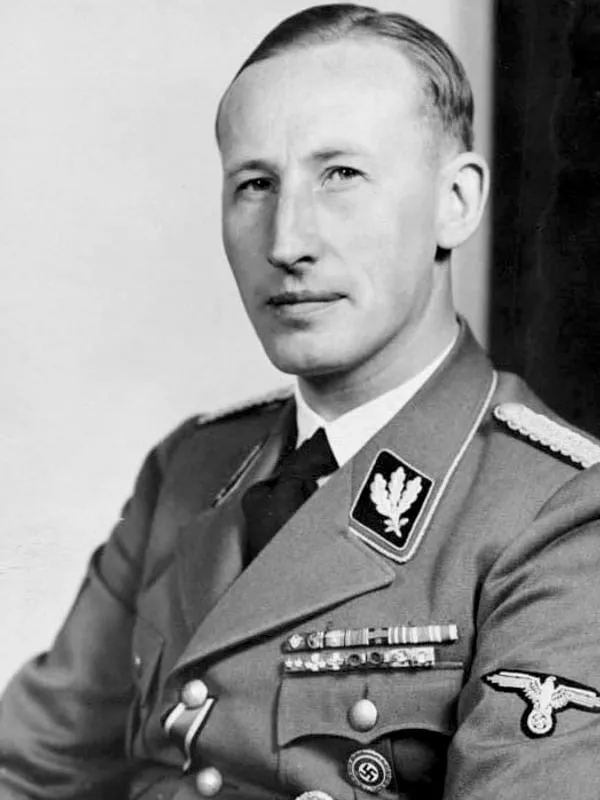
- Born:
- 7 March 1904, Halle (Saale) (German Empire)
- Died:
- 4 June 1942, Prague (Protectorate of Bohemia and Moravia)
- Author:
- Łukasz
- Photo:
- Heinrich Hoffmann, CC BY-SA 3.0 DE, Wikimedia Commons

Reinhard Heydrich was the creator and head of the Third Reich’s apparatus of terror and one of the chief organisers of the Holocaust. A naval officer dismissed for misconduct, in 1931 he presented himself to Heinrich Himmler and built for him, from nothing, the party’s intelligence service, the Sicherheitsdienst (SD). Within a few years he and Himmler had taken over the political police of the whole of Germany, and in 1939 he became head of the Reich Main Security Office (RSHA), which brought together the Gestapo, the criminal police and the SD. He staged the Gleiwitz provocation that was meant to justify the attack on Poland, directed the Einsatzgruppen that murdered the Polish intelligentsia and the Jews in the East, and in January 1942 chaired the Wannsee Conference, at which the organisation of the deportation of Europe’s Jews to their deaths was agreed. As Deputy Reich Protector he ruled occupied Bohemia and Moravia by terror. He died as a result of an attack by Czechoslovak parachutists in Prague in 1942. At his funeral Hitler called him “the man with the iron heart”.
Childhood and the navy
Reinhard Tristan Eugen Heydrich was born on 7 March 1904 in Halle on the Saale. His father, Bruno Heydrich, an opera singer and composer, ran a conservatory in the town, and his mother, Elisabeth, came from a family of musicians from Dresden. Reinhard learned the violin, did well at school and took up sport, above all fencing. The household was Catholic, prosperous and nationalist. After Germany’s defeat in 1918 and the street fighting in Halle in 1919, the teenage Heydrich came into contact with the right-wing movement: according to some biographers he was a runner for a volunteer citizens’ militia linked to General Maercker’s Freikorps, and from 1920 he belonged to the youth wing of the antisemitic Deutschvölkischer Schutz- und Trutzbund. Inflation ruined his father’s conservatory, and a rumour circulated in the town that the family had Jewish ancestors. The rumour was false, but it dogged Heydrich for years; in 1932 the party conducted an inquiry into the matter, which cleared him.
In the spring of 1922 he joined the navy of the Weimar Republic (the Reichsmarine) as a cadet. His fellow cadets disliked the tall, arrogant young man with the high-pitched voice, but his service went well. He was a signals officer, among other ships on the battleship Schleswig-Holstein; in 1928 he was promoted to Oberleutnant zur See and worked in radio intelligence. In December 1930 he met Lina von Osten at a ball – the daughter of a schoolteacher from the island of Fehmarn and an ardent supporter of the NSDAP – and soon became engaged to her. Another woman, whom he had been seeing earlier, considered herself his fiancée, and her father lodged a complaint. Before a court of honour Heydrich behaved haughtily and put the blame on the woman, which irritated the judges. The commander of the navy, Admiral Erich Raeder, dismissed him from the service at the end of April 1931 for “conduct unbecoming an officer”.
The SD and the “Bavarian Political Police”
Out of work in the middle of the Depression, and with his parents in financial difficulty, Heydrich followed his fiancée’s advice. On 1 June 1931 he joined the NSDAP, and in the summer, thanks to the good offices of a family acquaintance, he was introduced to Himmler, who was looking for someone to organise an intelligence service for the SS. Himmler was reportedly impressed by his proposal, and on 1 August 1931 Heydrich began building in Munich a service known at first as “Ic” and from 1932 as the SD. He started with a single typewriter, but within a few months he had a network of informers across Germany gathering information on opponents and on rivals within the party. On 26 December 1931 he married Lina von Osten; they had four children. He rose quickly in the SS; by July 1932 he was already a Standartenführer and head of the SD.
After Hitler came to power, Himmler became police chief in Munich in March 1933, and Heydrich took over its political department. The Bavarian Political Police arrested thousands of communists, Social Democrats and other opponents and filled the camp at Dachau with them. This was the model that Himmler and Heydrich later extended to the whole of Germany: a political police free of judicial control, linked to the SS and to the concentration camps. By the spring of 1934 they had taken over the political police in one German state after another, and in April Hermann Göring also handed over to them the Prussian Gestapo, built up by Rudolf Diels. On 22 April 1934 Heydrich became head of the Gestapo headquarters in Berlin, at Prinz-Albrecht-Straße 8.
The Night of the Long Knives and the Reich police
In the spring of 1934 the SD and the Gestapo gathered material against the leadership of the SA and its chief, Ernst Röhm, while Heydrich drew up lists of people to be arrested. During the Night of the Long Knives, from 30 June to 2 July 1934, SS men and Gestapo officers carried out most of the killings. The reward was the independence of the SS and the position of the SD as the party’s sole intelligence service.
On 17 June 1936 Hitler appointed Himmler chief of all the German police, and on 26 June Himmler gave Heydrich the newly created Security Police (Sicherheitspolizei) – the Gestapo and the criminal police – while he kept his leadership of the SD. This police no longer fought only political opponents. In the name of “prevention” it locked up in camps people deemed “asocial” and “professional criminals” (the persecution of the “asocials”), homosexuals, Jehovah’s Witnesses and, increasingly, Jews. Heydrich was convinced that the state had the right to remove from the “national community” anyone it considered harmful. At the same time he liked to pose as a sportsman and a soldier: he fenced at championship level, flew aircraft and helped organise security for the Berlin Olympic Games of 1936.
His services also engaged in foreign intelligence, despite the rivalry with the Abwehr of Admiral Wilhelm Canaris, Heydrich’s former superior in the navy. In 1936–1937 the SD prepared material intended to compromise Marshal Mikhail Tukhachevsky and passed it to Moscow through Czechoslovak channels. Most historians believe, however, that Stalin, who destroyed the leadership of the Red Army during the Great Purge, had no need of German forgeries to do so. At the beginning of 1938 the Gestapo supplied Hitler with a fabricated charge of homosexuality against the commander of the army, Werner von Fritsch, which, together with the scandal surrounding the marriage of Werner von Blomberg, allowed Hitler to take personal command of the Wehrmacht.
1938: Vienna, the Polenaktion, Kristallnacht
In March 1938, at the time of the Anschluss of Austria, Heydrich flew to Vienna with Himmler. His men, with lists ready in hand, arrested thousands of opponents, and his subordinate Adolf Eichmann set up in August the Central Office for Jewish Emigration, which within a few months drove tens of thousands of plundered Jews out of Austria. For Heydrich this was the model method: forced emigration combined with expropriation.
At the end of October 1938 his Gestapo carried out the Polenaktion, arresting at least 17,000 Jews holding Polish passports and expelling them to the border near Zbąszyń. Among them was the family of Herschel Grynszpan, who in revenge shot a German diplomat in Paris. On the night of 9–10 November, when Kristallnacht began after a speech by Joseph Goebbels, Heydrich sent a telex to police posts at 1.20 a.m.: synagogues were to be burned only where this posed no danger to neighbouring buildings, shops were not to be looted, and as many Jews, especially wealthy ones, were to be arrested as the cells could hold. Some 30,000 men were sent to camps. At a conference at Göring’s on 12 November Heydrich presented a plan to drive all the Jews out of the Reich on the Viennese model. On 24 January 1939 Göring put him in charge of the new Reich Central Office for Jewish Emigration. From then on the “Jewish question” in Germany was in the hands of Himmler and Heydrich.
The war against Poland
Heydrich also prepared the pretext for war. On 31 August 1939 his men, disguised as Polish insurgents, attacked the German radio station at Gleiwitz, now Gliwice (the Gleiwitz incident), and several other sites along the border, leaving behind the bodies of murdered prisoners as “proof” of Polish aggression. Behind the troops who marched into Poland on 1 September came the Einsatzgruppen (PL) of the Security Police and the SD. Working from proscription lists prepared in Heydrich’s office, later issued as the Sonderfahndungsbuch Polen, they murdered Polish teachers, priests, officials, landowners, national activists and Jews. In the Intelligenzaktion of 1939–1940 several tens of thousands of members of the Polish elite were killed. Heydrich told his subordinates that Poland’s leading classes were to be “rendered harmless”.
On 21 September 1939 he ordered the heads of the Einsatzgruppen to concentrate the Jews of the occupied Polish lands in larger towns near railway lines and to set up Jewish councils. This was the beginning of the ghettos. On 27 September the Security Police and the SD were merged into the RSHA under his leadership. Heydrich’s office organised the expulsion of Poles and Jews from the territories annexed to the Reich into the General Government, and in 1940, after the fall of France, considered shipping the Jews of Europe to Madagascar. In August 1940 Heydrich became president of the International Criminal Police Commission (today’s Interpol), whose headquarters were moved to Berlin. Against Himmler’s wishes he also flew combat missions as a Luftwaffe fighter pilot; on 22 July 1941 his Messerschmitt was hit over the Eastern Front, and Heydrich only just managed to get back to the German lines.
The “Final Solution”
Before the invasion of the USSR Heydrich agreed with the army high command the rules for the army’s cooperation with four Einsatzgruppen. From June 1941 his units shot communist functionaries in the occupied territories, and soon all Jews, women and children included. By the spring of 1942 the Einsatzgruppen and the formations working with them had murdered hundreds of thousands of people, and by the end of the occupation, according to historians’ estimates, more than a million, the overwhelming majority of them Jews. On 31 July 1941 Göring signed an authorisation, drafted in the RSHA, empowering Heydrich to prepare a “total solution of the Jewish question” in the German sphere of influence in Europe.
On 27 September 1941 Hitler appointed him Deputy Reich Protector in the Protectorate of Bohemia and Moravia, in practice in place of Konstantin von Neurath, who was considered too lenient. Heydrich kept his post as head of the RSHA. He immediately declared a state of emergency; summary courts sentenced hundreds of people to death, thousands were sent to concentration camps, and the prime minister of the Protectorate government, Alois Eliáš, was sentenced to death by the People’s Court (Volksgerichtshof), which was brought to Prague for the purpose. At the same time he raised workers’ food rations and benefits in order to secure calm in an armaments industry that mattered greatly to the Reich. In October 1941, at a meeting in Prague, he decided to establish the ghetto at Theresienstadt, through which passed the Jews of Bohemia and Moravia and later elderly and “privileged” Jews from the Reich, before most of them were deported to their deaths.
On 20 January 1942, in a villa on the Wannsee lake in Berlin, Heydrich chaired a meeting of fifteen senior officials of the ministries, the party and the SS. The minutes, drawn up by Eichmann, listed 11 million European Jews, from Ireland to the USSR, as the target of the “Final Solution”. The participants did not decide on the Holocaust itself, which was already under way, but agreed that all government offices would defer to the RSHA in the deportations to the East. Heydrich emerged from the meeting as the undisputed coordinator of genocide.
Assassination and reprisal
The Czechoslovak government-in-exile in London, led by Edvard Beneš, resolved to kill Heydrich. In December 1941 two British-trained soldiers, Jozef Gabčík and Jan Kubiš, were parachuted into the Protectorate. On the morning of 27 May 1942 they lay in wait at a bend in the road in the Prague district of Libeň, where Heydrich’s open Mercedes slowed down on its way from his country residence. Gabčík’s sub-machine gun jammed, but a grenade thrown by Kubiš exploded beside the car and gravely wounded Heydrich with shrapnel. He underwent a successful operation, but died of infection in hospital on 4 June (the assassination of Heydrich). Hitler gave him a state funeral in Berlin.
The reprisals were terrible. On 10 June 1942 the Germans razed to the ground the village of Lidice, falsely accused of helping the assassins: all the men were shot, the women were sent to the camp at Ravensbrück, and most of the children were murdered in the extermination camp at Chełmno nad Nerem. On 24 June the hamlet of Ležáky met the same fate. During the state of emergency after the assassination, summary courts sentenced more than a thousand people to death. The parachutists, betrayed by one of their comrades, died on 18 June fighting the SS in the crypt of the Orthodox Church of Saints Cyril and Methodius in Prague. The operation to murder the Jews of the General Government in the camps at Bełżec, Sobibór and Treblinka was named, according to most historians, in his honour: Aktion Reinhardt. Some 1.7 million people were killed in it.
Assessment
Heydrich was neither an ideologue of the movement nor its tribune. He was a cold, ambitious and exceptionally effective organiser who created a police machine capable of keeping watch over an entire society, and then used it to commit crimes on a continental scale. Many of his contemporaries, in the SS as well, feared him; he was called “the blond beast”. Biographers such as Robert Gerwarth show that in 1931 he was not yet a fanatical Nazi, but that within a decade he became one of the most radical executors of Hitler’s will. He is one of the chief perpetrators of the Holocaust, of the crimes against the Polish intelligentsia and of the terror in occupied Bohemia and Moravia.
His death did not halt the Holocaust: the RSHA was taken over by Ernst Kaltenbrunner, and the deportations to the death camps continued until 1944. The assassination in Prague was one of the few successful operations against the highest dignitaries of the Third Reich, and it strengthened the standing of Beneš’s government among the Allies. Heydrich’s widow, Lina, lived on Fehmarn after the war, obtained a pension as the widow of a man “killed in action”, and defended her husband’s memory until her death in 1985.
Sources
Mentioned in battles
(02)Often appears with
People who appear in the same events.
On the timeline
(54)The 40 most important of 54 events. All tagged “Reinhard Heydrich” (11) →
1925
1933
1934
1936
1937
1938
1939
January
March
August
September
October
- 18
- The Red Army enters EstoniaOn 18 October 1939 the Red Army entered Estonia to occupy the bases granted by the pact. That day the first ship carrying Baltic Germans left Tallinn.
- The Nisko PlanOn 18 October 1939 the first transport of Jews left Ostrava for Nisko on the San, the first wartime deportation of Jews from the Reich, run by Eichmann.