United States
Gregory Boyington
Pilot in the American Volunteer Group (1941–1942), commander of squadron VMF-214 “Black Sheep” (1943–1944), prisoner of war (1944–1945), USMC colonel
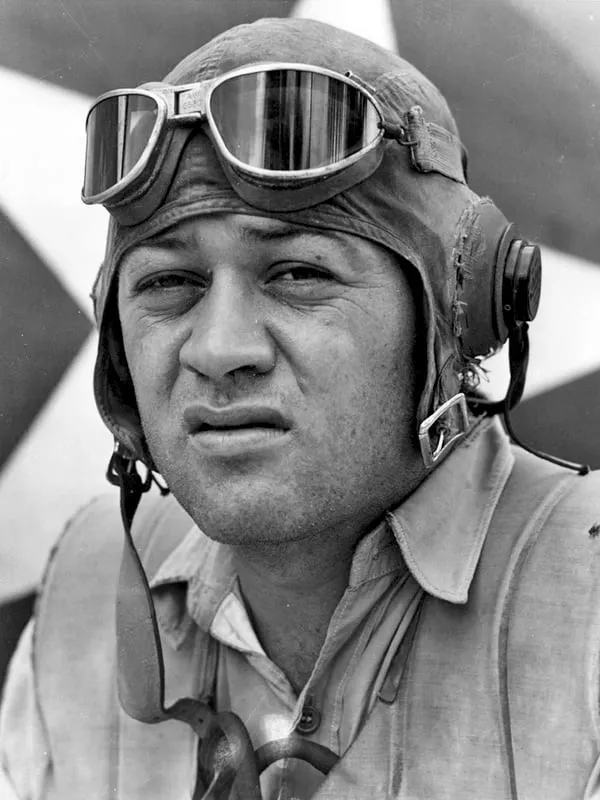
- Born:
- 4 December 1912, Coeur d'Alene, Idaho (United States)
- Died:
- 11 January 1988, Fresno, California (United States)
- Author:
- Łukasz
- Photo:
- autor nieznany, domena publiczna, Wikimedia Commons

Gregory “Pappy” Boyington was one of the most famous American airmen of the Second World War and also one of its most controversial figures. He fought the Japanese first as a volunteer with the Flying Tigers in Burma, then as commander of the Marine Corps fighter squadron VMF-214, known as the “Black Sheep”, over the Solomon Islands and Rabaul. On 3 January 1944 he was shot down, and he spent the rest of the war in Japanese captivity, believed at home to have been killed. The Marine Corps credited him with 28 aerial victories, which makes him the highest-scoring ace in its history – although part of that figure has long been questioned. Awarded the Medal of Honor and the Navy Cross, after the war he struggled with alcoholism, and in the 1970s a television series revived his legend.
Youth
He was born on 4 December 1912 in Coeur d’Alene, Idaho; he was partly descended from the Brulé Sioux. He spent his childhood in the logging town of St. Maries, and from the age of twelve lived in Tacoma, Washington. As a boy he made his first flight with the pilot Clyde Pangborn, who later made the first non-stop flight across the Pacific. He grew up under his stepfather’s surname, as Gregory Hallenbeck.
From 1930 to 1934 he studied aeronautical engineering at the University of Washington in Seattle. He was a wrestler (winning the Pacific Northwest intercollegiate middleweight title) and a swimmer, and belonged to the Army Reserve Officers’ Training Corps. In the holidays he worked in a mine, at logging and on road building. After graduating he married and worked as a draughtsman and engineer at Boeing. In 1934 he was also commissioned as a second lieutenant in the Coast Artillery Reserve.
In the Marine Corps
In the spring of 1935 he wanted to become a naval aviator, but the aviation cadet programme accepted only single men. It was then that he learned from his birth certificate that his biological father had been a dentist, Charles Boyington. Since no married Gregory Boyington appeared on any record, he applied under that name – and it was under that name that he went down in history. In 1936 he began training at Pensacola, in March 1937 he qualified as a naval aviator, and in July that year he was commissioned in the Marine Corps. He served at Quantico and San Diego, flew from the carriers USS Lexington and Yorktown, and in 1940 returned to Pensacola as an instructor.
Even then he was regarded as an outstanding but impossible pilot: he drank heavily and got into fights. When in 1941 he struck another officer and faced a court martial, he took up an offer from recruiters looking for pilots for China.
The Flying Tigers
On 26 August 1941 Boyington resigned his commission and signed a contract with the Central Aircraft Manufacturing Company. Formally a civilian firm, it in fact staffed the American Volunteer Group (AVG) – Claire Chennault’s fighter unit, which in Chinese service defended the Burma Road. From December 1941, after the outbreak of the Pacific War, the Flying Tigers fought over Burma, and in the winter of 1942 in the defence of Rangoon.
Boyington became a flight leader, but he was on bad terms with Chennault and many of the pilots. According to AVG records he was credited with two aircraft shot down in the air and one and a half destroyed on the ground; he himself claimed to have downed six. In April 1942 he broke his contract and made his own way back to the United States.
The “Black Sheep”
The Marine Corps needed experienced pilots, and on 29 September 1942 it took Boyington back with the rank of major. At the beginning of 1943 he went to Guadalcanal as executive officer of squadron VMF-122, with which he scored no victories; in the summer he briefly commanded VMF-112. In September 1943 he took command of VMF-214, which he assembled from unassigned pilots, replacements and men returning from convalescence – hence the name “Black Sheep”. At 31 he was a decade older than most of his men: they called him “Gramps”, and later, thanks to a song written by one of the pilots and taken up by the correspondents, “Pappy”.
The squadron flew Vought F4U Corsair fighters, at first from the island of Vella Lavella, over New Georgia and Bougainville, and later over New Britain and New Ireland. Boyington was a demanding, aggressive tactician: on 17 October 1943 he led 24 fighters over the Japanese airfield at Kahili on Bougainville and, circling above it, goaded the Japanese into taking off; his pilots claimed 20 kills without loss. In 32 days of intense fighting he shot down 14 fighters, and by 27 December his tally – including the six victories from Burma – stood at 25. When, after the landing on Bougainville, fighters could reach Rabaul, he led sweeps over the base designed to draw Japanese fighters into combat.
Shot down and captured
On 3 January 1944 Boyington led a sweep of about 48 American fighters over Rabaul. He shot down a Japanese Zero, which in full view of other pilots gave him his 26th victory and equalled the First World War record of Eddie Rickenbacker. Then he vanished in the fighting; his wingman, George Ashmun, was killed. His Corsair was hit and caught fire, and Boyington bailed out just above the water into St George’s Channel. Wounded, he was picked up after about eight hours in his dinghy by the Japanese submarine I-181.
Interrogated at Rabaul, then taken to the base at Truk, where he survived the American carrier raid of February 1944, he was sent to the navy’s secret interrogation camp at Ōfuna and then to the Ōmori camp on Tokyo Bay. The Japanese did not report him to the Red Cross, so at home he was regarded as missing and then as killed. In March 1944 President Franklin Delano Roosevelt awarded him the Medal of Honor. In captivity, where his fellow prisoners included Louis Zamperini, he endured beatings, hunger and forced labour; he himself admitted that enforced abstinence had improved his health.
On 29 August 1945, after Japan’s surrender, he was freed from the Ōmori camp. On his return he reported that on 3 January he had shot down two more aircraft, and the Marine Corps raised his tally to 28 (22 with the Marine Corps and six with the AVG). On 4 October 1945 General Alexander Vandegrift presented him with the Navy Cross for the action over Rabaul, and on 5 October President Harry Truman decorated him with the Medal of Honor at the White House.
The dispute over his score
The figure of 28 is the Marine Corps’ official tally, but historians point to its weaknesses. The six victories from Burma rest solely on Boyington’s own claims – the AVG records, on the basis of which bonuses were paid, credit him with two aircraft shot down in the air and one and a half destroyed on the ground. The two extra victories of 3 January 1944 have no witnesses. On the other hand, no one questions his victories over the Solomon Islands confirmed by the Marine Corps, or the fact that as a commander he made VMF-214 one of the most effective fighter squadrons in the Pacific. His biographer Bruce Gamble critically examined the legend in “Black Sheep One” (2000). The story of the Japanese pilot Masajirō Kawato, who claimed after the war that it was he who had shot Boyington down, and who appeared in public with him, also proved doubtful.
After the war
After his return Boyington made a nationwide tour promoting war bonds and served for a while longer at the Marine Corps bases at Quantico and San Diego. On 1 August 1947 he retired; because he had been decorated for his actions in combat, he was promoted to colonel on retirement. Civilian life was not easy for him. He struggled with alcoholism and took up various jobs, appearing among other things as a referee and participant in wrestling exhibitions. He married four times; from his first marriage, to Helen Clark, he had three children, who during the war were brought up by an aunt and a grandmother.
In 1958 he published his autobiography, “Baa Baa Black Sheep”, which became a bestseller, and later a novel, “Tonya”, about the Flying Tigers, with characters modelled on real people. From 1976 to 1978 NBC broadcast the series “Baa Baa Black Sheep” (later “Black Sheep Squadron”), loosely based on his memoirs, in which Boyington was played by Robert Conrad; Boyington himself made a cameo appearance in it as a general. Many veterans of the squadron protested against the series, which portrayed them as a rabble of brawlers, and Boyington publicly called it a Hollywood fairy tale. In 1981 he attended a reunion of the “Black Sheep” at the National Air and Space Museum in Washington.
A heavy smoker, he died of lung cancer on 11 January 1988 in Fresno, California. He was buried with the honours due to a Medal of Honor recipient in Arlington National Cemetery.
Significance
Boyington belongs to the group of American aces whose fame reached far beyond aviation – alongside Richard Bong and Joe Foss. His story illustrates several aspects of the Pacific War: the volunteer participation of Americans in the defence of China and Burma, prepared even before Pearl Harbor; the advantage that the Corsairs and experienced leaders gave the Americans in the air war over the Solomon Islands; the campaign that neutralised Rabaul; and the fate of prisoners whom the Japanese deliberately hid from the Red Cross. He is also an example of how wartime propaganda and popular culture create a legend: his score, his nickname and his image as the “rebel” commander of a squadron of misfits were repeated uncritically for decades, and only historians separated fact from story. The name “Black Sheep” is still borne today by Marine squadron 214, the successor to his unit.