United States
Harry S. Truman
Artillery captain (1918), senator from Missouri (1935–1945), chairman of the Truman Committee (1941–1944), Vice-President of the United States (1945), 33rd President of the United States (1945–1953)
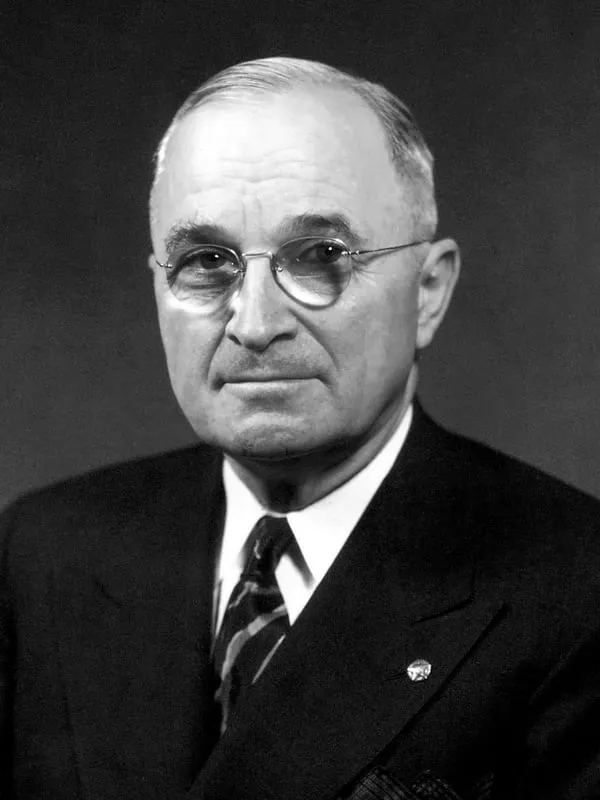
- Born:
- 8 May 1884, Lamar (Missouri, United States)
- Died:
- 26 December 1972, Kansas City (Missouri, United States)
- Author:
- Łukasz
- Photo:
- National Archives and Records Administration. Office of Presidential Libraries. Harry S. Truman Library, domena publiczna, Wikimedia Commons

Harry S. Truman was the least expected of the American presidents of the 20th century. The son of a Missouri farmer, without a college degree and with thick spectacles that barred his way to West Point, he spent many years running a farm and then a men’s outfitters that went bust. He entered politics as a protégé of Tom Pendergast’s party machine in Kansas City and reached the Senate at the age of fifty; he made his name through a wartime committee investigating waste in the armaments programme. In July 1944 he became the vice-presidential candidate alongside Franklin Delano Roosevelt, and on 20 January 1945 he took the oath of office. After 82 days in the post, on 12 April 1945, Roosevelt died, and Truman – who had been almost absent from wartime decision-making and had not been let into the secret of the atomic bomb – found himself at the head of the state in the last months of the war. It was he who went to Potsdam and approved the use of the atomic bombs, and after the war he proclaimed the doctrine of containing the USSR, backed the Marshall Plan, helped to create NATO and led America into the Korean War. He left office in 1953 as one of the least popular presidents; historians today rate him far more highly.
Lamar, Independence and the farm
He was born on 8 May 1884 in Lamar, Missouri, the eldest child of John Anderson Truman, a dealer in cattle and mules, and Martha Ellen Young. The “S” in his name stood for no name at all: his parents chose the bare letter to honour both grandfathers, Anderson Shipp Truman and Solomon Young. In 1890 the family settled in Independence, near Kansas City. Because of very poor eyesight he wore glasses from childhood; he read a great deal, especially history, and played the piano. At school he met Elizabeth “Bess” Wallace, whom he would marry only some thirty years later.
He finished high school in 1901. There was no money for college, as his father had lost his fortune speculating in grain, and his eyesight ruled out any hope of the military academy at West Point. Truman worked as a timekeeper on railway construction and then as a bank clerk in Kansas City. In 1906 he returned to the family farm at Grandview, and for eleven years he ploughed, sowed and raised cattle. From 1905 to 1911 he served in the Missouri National Guard, in an artillery battery.
Captain of Battery D
When the United States entered the First World War in April 1917, Truman was 32, already above draft age, and supporting the farm, his mother and his sister. Nevertheless he rejoined the National Guard – at his medical examination he reportedly memorised the eye chart – and became a lieutenant in the 129th Field Artillery Regiment, part of the 35th Infantry Division. In 1918 he sailed for France, and in July, as a captain, he took command of Battery D, made up mainly of Irish Catholics from Kansas City and known as unruly.
Truman imposed discipline on the battery while winning his men’s trust. In September and October 1918 his guns supported the infantry in the Meuse-Argonne offensive, the largest battle fought by the American army in that war, and fired their last rounds on the morning of 11 November, just before the armistice came into force. The war gave Truman self-confidence and a circle of veterans who became the backbone of his political career.
The shop, Pendergast and the county court
On 28 June 1919 he married Bess Wallace; their only daughter, Margaret, was born in 1924. With his wartime comrade Eddie Jacobson he opened a men’s outfitters in downtown Kansas City. The business failed in the post-war recession of 1921–1922; Truman did not declare bankruptcy and spent the next fifteen years or so paying off his debts.
It was then that he caught the eye of Thomas J. Pendergast, “Boss Tom”, head of the Democratic political machine that controlled Kansas City and much of Missouri. A war veteran with a clean reputation and wide connections in the countryside was a valuable asset to it. In 1922, with Pendergast’s backing, Truman was elected a judge of the Jackson County Court – despite its name, an administrative body that ran the county’s roads, buildings and finances. He lost the election of 1924, but in 1926 he became presiding judge of the court and held the office until 1934. He built a network of roads and awarded contracts honestly, but remained loyal to Pendergast, although in private notes he admitted that he tolerated the abuses of others.
Senator from Missouri
In 1934 Pendergast – after several other candidates had turned him down – put his money on Truman for the Senate. Truman won the Democratic primary and the election, and on 3 January 1935 he took his seat in the Senate. Washington greeted the “senator from Pendergast” coolly, but Truman, a loyal supporter of the New Deal, earned a reputation for hard work and honesty. In 1939 Pendergast was convicted of tax evasion. A year later Truman, deprived of his base and without the support of the White House, narrowly won the primary – by fewer than 8,000 votes – against Governor Lloyd Stark and the prosecutor Maurice Milligan, who had earlier brought the case against Pendergast, and in November he was re-elected.
The Truman Committee
When, after the fall of France, the United States launched a gigantic rearmament programme, Truman drove round military bases and factories in the South and the Midwest and saw waste, delays and contracts with guaranteed profits. On his initiative the Senate set up, on 1 March 1941, the Special Committee to Investigate the National Defense Program, known after him as the Truman Committee. It did not hunt for sensations but for concrete defects: faulty aero engines, overpriced army camps, shortages of raw materials. According to Truman himself and his biographers, it saved taxpayers billions of dollars – the figure most often given is 10–15 billion – and countless lives; the exact sum cannot be established. In March 1943 Truman appeared on the cover of Time magazine.
The committee respected one secret. When in 1943 its investigators came across enormous spending on mysterious plants in Tennessee and Washington State, the Secretary of War, Henry Stimson, asked Truman not to look into it. Truman agreed, without knowing that this was the Manhattan Project and the building of the atomic bomb.
His senatorial years also produced a remark for which he was often reproached later. On 24 June 1941, two days after the German invasion of the USSR, the New York Times reported him as saying that if Germany was winning, America should help Russia, and if Russia was winning, it should help Germany, and in that way let them kill as many as possible – although he did not want to see Hitler victorious under any circumstances. Soviet propaganda later quoted it as proof of his hostility. Truman himself voted for the Lend-Lease Act, which made it possible to support Britain in its fight.
Vice-President
In the summer of 1944 the leaders of the Democratic Party were determined to get rid of Vice-President Henry Wallace, whom they considered too left-wing and unpredictable. They also knew – though no one said so out loud – that the ailing Roosevelt might not survive a fourth term, and that his deputy would then become president. Truman, who had no enemies in the South, among the trade unions or in the big cities, was their compromise candidate. Roosevelt, who on 11 July 1944 had announced that he would seek a fourth term, gave his consent but told no one so directly. Until the last moment Truman insisted that he was not seeking the nomination and was supporting James Byrnes. At the convention in Chicago on 21 July 1944 Wallace led on the first ballot, and Truman won on the second.
On 7 November 1944 Roosevelt defeated Thomas Dewey, and on 20 January 1945 Truman took the vice-presidential oath on the South Portico of the White House. His tenure lasted 82 days. He presided over the Senate and caused a scandal by going to Pendergast’s funeral. According to his biographers, he met Roosevelt – who left for Yalta on 22 January – alone only twice. He took no part in war councils, did not know the details of the Yalta agreements and knew nothing of the atomic bomb.
President in the last months of the war
On the afternoon of 12 April 1945 Truman was summoned to the White House. Eleanor Roosevelt told him that the president was dead. At 7.09 p.m. the Chief Justice, Harlan Fiske Stone, swore him in as the 33rd President of the United States.
From the first days he promised to continue Roosevelt’s policies, but in relations with Moscow he adopted a tougher tone. On 23 April at the White House he sharply accused Vyacheslav Molotov of the USSR’s failure to honour its Yalta commitments on Poland; according to Truman’s memoirs, Molotov replied that he had never been talked to like that in his life. On 25 April Stimson and General Leslie Groves briefed him in detail on the atomic bomb project. The same day, the founding conference of the United Nations, convened while Roosevelt was still alive, opened in San Francisco; on 26 June Truman spoke at its close, as the United Nations Charter was being signed. He announced Germany’s surrender to the American people on 8 May 1945, his 61st birthday.
Potsdam and the atomic bomb
On 5 July 1945 the United States and Britain recognised the Provisional Government of National Unity in Warsaw and withdrew recognition from the Polish government-in-exile in London – in line with the formula agreed at Yalta, but against the hopes of the Polish émigrés. A few days later Truman sailed for Europe aboard the cruiser USS Augusta. At the Potsdam Conference (17 July – 2 August 1945) he chaired the proceedings and met Joseph Stalin and Winston Churchill for the first time; during the conference Churchill, after the Conservatives lost the election, was replaced by Clement Attlee. The Big Three agreed on the principles of the occupation of Germany, reparations, the transfer of the German population, and the placing of the lands east of the Oder and the Lusatian Neisse under Polish administration pending a peace conference that never took place.
On 16 July, the day before the talks opened, the first nuclear test was carried out in the New Mexico desert. On 24 July Truman mentioned to Stalin, without details, a new weapon of unusual destructive force; Stalin took it calmly, because thanks to his intelligence services he knew more about the project than the Americans supposed. On 26 July the United States, Britain and China called on Japan to surrender unconditionally or face “prompt and utter destruction”. The Japanese government replied that it would “ignore” the declaration in silence (mokusatsu).
Truman approved the use of the bomb; the order to the air force was issued on 25 July. On 6 August 1945 a bomb fell on Hiroshima, and on 9 August on Nagasaki; in between, the USSR declared war on Japan. According to the most frequently cited estimates, the atomic bombings had killed by the end of 1945 between about 70,000 and 140,000 people in Hiroshima and between about 40,000 and 74,000 in Nagasaki, the overwhelming majority of them civilians. On 15 August (14 August, Washington time) Emperor Hirohito announced the acceptance of the surrender terms, and the surrender of Japan was signed on 2 September 1945 aboard the battleship USS Missouri, named after Truman’s home state.
To the end of his life Truman maintained that his decision had saved hundreds of thousands of American and Japanese lives that an invasion of the Japanese home islands would have cost, and that he had not lost a single night’s sleep over it. Historians have argued about it for decades: some point out that Japan’s leaders were not ready to surrender and that the planned invasion promised a bloodbath on both sides; others argue that Japan was close to collapse, that the Soviet entry into the war weighed just as heavily in its decision, and that the post-war estimates of invasion casualties were inflated. Truman had no doubt that the president must take the final decisions upon himself; on his desk stood a sign reading “The buck stops here”.
The Cold War and Korea
After the war the alliance with the USSR quickly fell apart. On 12 March 1947 Truman told Congress that the United States would support “free peoples who are resisting attempted subjugation by armed minorities or by outside pressures”, and asked for $400 million for Greece and Turkey. The Truman Doctrine became the foundation of the policy of containment. In June 1947 the Secretary of State, George Marshall, announced a programme for the reconstruction of Europe; between 1948 and 1952 the Marshall Plan provided about $13 billion, while the countries of the Eastern Bloc, Poland among them, declined to take part under pressure from Moscow. Truman answered the Berlin Blockade (1948–1949) with an airlift, and in July 1948 he ordered the end of racial segregation in the armed forces. Defying the polls and the famous headline “Dewey Defeats Truman”, he won the 1948 election, and on 4 April 1949 the treaty establishing NATO was signed in Washington.
When North Korea attacked the South on 25 June 1950, Truman sent troops under the UN flag without a declaration of war by Congress. The Korean War cost the lives of more than 36,000 American servicemen. When Douglas MacArthur publicly demanded that the war be extended to China, Truman on 11 April 1951 relieved him of all his commands in defence of civilian control of the military, paying for it with a steep fall in popularity. At home his administration was also marked by McCarthyism, which he opposed but did not stop.
Last years
In March 1952 he announced that he would not seek re-election, and on 20 January 1953 he handed over the office to Dwight Eisenhower. He returned with Bess to Independence, wrote his memoirs and founded a presidential library. He died on 26 December 1972 in a Kansas City hospital and was buried in Independence.
Place in the war
Truman was a wartime president for less than five months, but those months brought the decisions that closed the Second World War and opened the atomic age: the surrender of Germany; Potsdam, with the new shape of Central Europe and Poland’s border; Hiroshima and Nagasaki; the surrender of Japan. To some he remains the president who ended the war and built the Western security order; to others, the only man in history to have used nuclear weapons against cities. For Poland his presidency meant both the recognition of the authorities imposed by Moscow and the birth of the Atlantic alliance, which Poland joined half a century later.
Sources
Mentioned in battles
(01)Often appears with
People who appear in the same events.
On the timeline
(60)The 40 most important of 60 events. All tagged “Harry S. Truman” (4) →
1933
1941
1942
1943
1944
1945
January
February
March
April
- 12
- Spain breaks off relations with JapanIn April 1945 Franco's Spain broke off relations with Japan, citing the murder of Spaniards in Manila. It hoped to win the Allies' favour.
- Key eventThe death of RooseveltOn 12 April 1945 President Franklin D. Roosevelt died of a cerebral haemorrhage at Warm Springs. That evening Harry Truman took the oath at the White House.
May
- 08
- Key eventVictory in Europe DayOn 8 May 1945 the West celebrated Germany's surrender in London, Paris and New York. The guns fell silent at 11.01 p.m.; in Poland, joy was clouded by doubt.
- Key eventThe surrender at KarlshorstOn 8 May 1945 in Berlin-Karlshorst, Keitel, Friedeburg and Stumpff signed Germany's final act of unconditional surrender before Zhukov and Tedder.