United States
Franklin D. Roosevelt
Assistant Secretary of the Navy (1913–1920), Governor of New York (1929–1932), 32nd President of the United States (1933–1945)
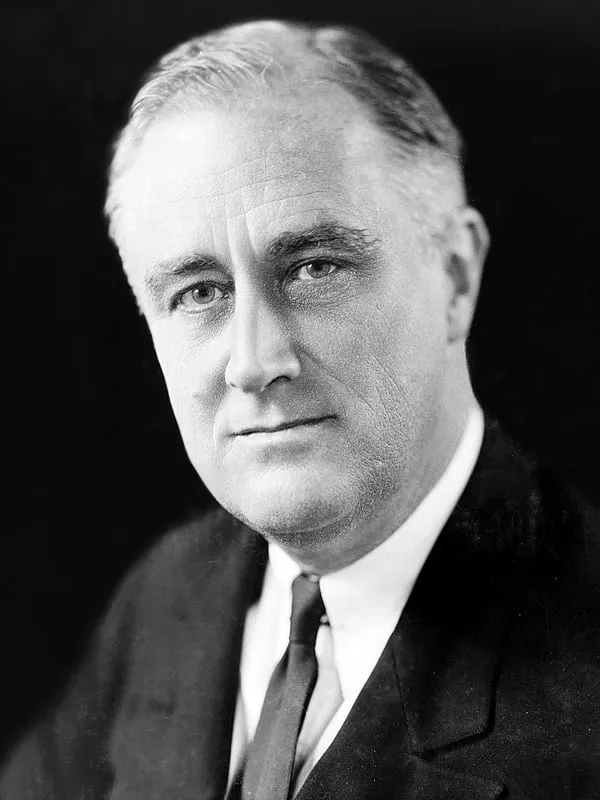
- Born:
- 30 January 1882, Hyde Park (New York, United States)
- Died:
- 12 April 1945, Warm Springs (Georgia, United States)
- Author:
- Łukasz
- Photo:
- Elias Goldensky, domena publiczna, Wikimedia Commons

Franklin Delano Roosevelt was the only President of the United States to be elected four times and one of the three leaders who decided the outcome of the Second World War. A politician paralysed by illness in 1921, he led America out of the Great Depression with the New Deal and then, step by step, out of the isolationism into which it had withdrawn after rejecting the Treaty of Versailles. He made it the “arsenal of democracy” and, after the attack on Pearl Harbor, led it in the war against Germany, Japan and Italy. Together with Winston Churchill and Joseph Stalin he shaped the post-war world order. For Poles his name is also linked with Tehran and Yalta, where he agreed to the shifting of Poland’s eastern border and to a Soviet sphere of influence in Central Europe.
Childhood and youth
He was born on 30 January 1882 at Springwood, the family estate in Hyde Park on the Hudson River, the only child of James Roosevelt, a wealthy landowner, businessman and Democrat, and his second wife, Sara Delano. He grew up among the rich New York gentry, with governesses and trips to Europe, through which he learned German and French. At fourteen he was sent to the elite boarding school at Groton, whose headmaster, Endicott Peabody, instilled in his pupils a sense of duty to public service. In 1903 he graduated in history from Harvard University, where he was editor-in-chief of the student daily. He then studied law at Columbia University, which he left in 1907 after passing the bar examination.
His model was his distant cousin, President Theodore Roosevelt. On 17 March 1905 Franklin married the president’s niece, Eleanor Roosevelt, and Theodore gave the bride away. They had six children, one of whom died in infancy. The marriage went through a deep crisis in 1918, when Eleanor discovered her husband’s affair with her secretary, Lucy Mercer. It survived as a political partnership in which Eleanor in time became a public figure in her own right.
First offices
In 1910 Roosevelt, a Democrat, unexpectedly won a seat in the New York State Senate in a district regarded as Republican. He quickly made his name as an opponent of Tammany Hall, the party machine that ran New York’s Democrats. He backed Woodrow Wilson in the contest for the presidential nomination in 1912 and was rewarded in March 1913 with the post of Assistant Secretary of the Navy. He spent seven years in this office – the same one Theodore Roosevelt had held in 1897–1898. He was an ardent advocate of expanding the fleet and preparing for war, and after the United States entered the First World War in 1917 he oversaw its great expansion. In the summer of 1918 he toured bases in Europe, met David Lloyd George and Georges Clemenceau, and on the voyage home fell seriously ill with Spanish flu. His only setback in those years was his defeat in the 1914 party primary for the US Senate.
In 1920 the Democrats chose him as their vice-presidential candidate alongside the Governor of Ohio, James M. Cox. The ticket, defending the legacy of Wilson and the League of Nations, lost on 2 November to the Republicans Warren Harding and Calvin Coolidge, but Roosevelt, who had criss-crossed the country during the campaign, became one of his party’s best-known politicians.
Illness
In August 1921, on holiday on the Canadian island of Campobello, Roosevelt fell ill. Doctors diagnosed polio. Some modern researchers believe it was more likely Guillain–Barré syndrome, but the result was the same: the 39-year-old politician was permanently paralysed from the waist down. His mother wanted him to withdraw from public life. Eleanor and his closest adviser, the journalist Louis Howe, persuaded him to fight on. For years he practised walking on crutches with steel braces on his legs, and in 1926 he bought the spa at Warm Springs in Georgia and turned it into a rehabilitation centre for polio patients. For the rest of his life he carefully concealed from the public how severely disabled he was. The press almost never photographed him in a wheelchair.
He returned to politics gradually. At the Democratic conventions of 1924 and 1928 he made the nominating speeches for the Governor of New York, Al Smith, whom he called “the Happy Warrior”. In 1928 Smith, running for president, persuaded him to stand for governor in his place. On 6 November 1928 Smith lost to Herbert Hoover, including in New York, while Roosevelt won the governorship by a margin of about 25,000 votes.
Governor and candidate
When the Wall Street Crash of October 1929 ushered in the Great Depression, Roosevelt was one of the first governors to accept that the state must help the unemployed. He set up a state relief agency, later run by Harry Hopkins, and supported unemployment insurance and old-age pensions. He spoke to the people of the state on the radio. In 1930 he was re-elected by a huge margin, and in 1932 he won the Democratic presidential nomination. He was the first candidate of a major party to accept the nomination in person: he flew to the convention in Chicago to show that his illness was no obstacle. He promised Americans “a new deal”. On 8 November 1932 he defeated Hoover, winning 57 per cent of the vote and 42 of the 48 states.
The New Deal
He took office on 4 March 1933, at the worst point of the Depression: one American in four was out of work and the banks had been closed in most states. In his inaugural address he declared that “the only thing we have to fear is fear itself”. During the first “hundred days” Congress passed a series of laws that stabilised the banks and introduced deposit insurance, public works programmes and aid for farmers. The following years brought social security, the right of workers to organise in trade unions and a minimum wage. The New Deal did not end unemployment, which fell only with rearmament, but it restored faith in democratic institutions at a time when a similar crisis in Germany had brought Adolf Hitler to power. In his radio “fireside chats” the president explained his policies to millions of listeners. In 1936 he carried 46 of the 48 states.
Neighbour and onlooker
In his first years foreign policy was a secondary matter. In November 1933 Roosevelt established diplomatic relations with the Soviet Union, agreeing the terms with the People’s Commissar for Foreign Affairs, Maxim Litvinov. Towards Latin America he proclaimed the “Good Neighbor” policy and withdrew US troops from Haiti. With regard to Europe and Asia, however, he had to reckon with the strong isolationism of Congress, which in 1935–1937 passed the Neutrality Acts, banning arms sales to belligerents, victims and aggressors alike. Roosevelt did not prevent this and did not help the Spanish Republic, which he later regretted.
After Japan’s attack on China in 1937, he called in Chicago on 5 October for a “quarantine” of the states spreading an “epidemic of lawlessness”, but the speech was received so coolly that he backed away from it. In the summer of 1938, on his initiative, the Évian Conference was convened on refugees from Germany and Austria; it came to nothing, because no country, the United States included, was willing to take in a significant number of Jews. After Kristallnacht he recalled the US ambassador from Berlin. In April 1939 he appealed to Hitler and Benito Mussolini for an assurance that they would not attack a list of named countries, to which Hitler replied with mockery in the Reichstag.
The arsenal of democracy
When Germany invaded Poland on 1 September 1939, Roosevelt proclaimed the neutrality of the United States, but in November he pushed through a change in the law allowing arms to be sold to France and Britain for cash and carried in their own ships. The fall of France in June 1940 convinced him that Britain had to survive at all costs. In September he transferred 50 old destroyers to Britain in exchange for bases, and Congress passed the first peacetime conscription in the country’s history. In November 1940, breaking a tradition going back to Washington, Roosevelt won a third term, promising mothers that their sons would not be sent into any foreign war.
In January 1941 he proclaimed the “Four Freedoms”, and in March he signed the Lend-Lease Act, which made it possible to supply arms and raw materials to Britain, China and, from the autumn, the USSR as well. In August 1941 he met Winston Churchill aboard warships off Newfoundland, and together they proclaimed the Atlantic Charter, which envisaged a world without conquests or border changes against the will of the peoples concerned. In September the US Navy began escorting convoys in the Atlantic and was ordered to fire on German U-boats. In July 1941, when Japan occupied southern Indochina, Roosevelt froze Japanese assets in the United States and cut Tokyo off from American oil.
The war
On 7 December 1941 Japan attacked Pearl Harbor. The next day Roosevelt told Congress that it was “a date which will live in infamy”, and Congress declared war on Japan. On 11 December Germany and Italy declared war on the United States. At the conference with Churchill in Washington at the turn of 1941 and 1942, Roosevelt adopted the “Germany first” principle, and on 1 January 1942 twenty-six nations signed the Declaration by United Nations. During the war the American economy produced hundreds of thousands of aircraft and tens of thousands of tanks, more than all its enemies combined.
The war also had its dark side. On 19 February 1942 Roosevelt signed the executive order under which some 110,000 Americans of Japanese descent, most of them US citizens, were removed from the West Coast to camps. His attitude to the Holocaust remains a matter of dispute among historians. From 1942 the administration knew of the mass murder of the Jews, and in July 1943 the president heard the account of Jan Karski, a courier of the Polish Underground State, in the White House. Roosevelt believed, however, that the best rescue was the swiftest possible victory, and he did not set up the War Refugee Board until January 1944.
In January 1943 at Casablanca he announced that the Allies would demand unconditional surrender from the Axis powers. He supported Chiang Kai-shek’s China, which he wanted to give a place among the “four policemen” of the post-war world, although in time he lost confidence in its government. At the Tehran Conference at the turn of November and December 1943 he met Stalin for the first time. He promised an invasion of France in 1944, and in a private conversation he gave Stalin to understand that he agreed to Poland’s borders being moved westwards, although, because of the millions of voters of Polish descent, he could not say so publicly before the 1944 election. He did not tell the Polish government in London. Prime Minister Władysław Sikorski, who came to Washington several times, had counted on his support. Roosevelt treated the Katyn massacre as a threat to the alliance and brushed aside the reports reaching him that pointed to Soviet guilt.
Yalta and death
In November 1944 he won the election for the fourth time, although he was already seriously ill with heart disease, which was concealed from the public. At the Yalta Conference in February 1945 his main aims were to secure Soviet entry into the war against Japan and Stalin’s agreement to the United Nations. In return he accepted Soviet gains in the Far East and Poland’s border along the Curzon Line, and on the question of the Polish government he accepted a formula that in practice handed power to the communists, supplemented by a declaration on free elections in liberated Europe. In March 1945 he sent Stalin sharply worded cables, accusing him of breaking the Yalta agreements.
On 12 April 1945, while resting at Warm Springs, Roosevelt died of a cerebral haemorrhage, less than a month before Germany’s surrender. He was buried at Hyde Park. He was succeeded by Vice-President Harry Truman, whom Roosevelt had not even let into the secret of the Manhattan Project, launched after Albert Einstein’s letter of 1939.
Significance
In rankings by American historians Roosevelt is almost always placed alongside Washington and Lincoln among the three greatest presidents. The New Deal permanently changed the role of the state in American life, and his wartime presidency made the United States a power responsible for world order – something Wilson had failed to achieve. The United Nations, Bretton Woods and the post-war alliances grew out of decisions taken during his time in office. His critics charge that he gave way to the isolationists for too long, that he did not do enough to save Europe’s Jews, that he interned citizens of Japanese descent, and that at Tehran and Yalta, trusting Stalin and wanting his participation in the war against Japan at any price, he acquiesced in Soviet domination of Central Europe. In Poland Yalta remains to this day the symbol of betrayal by the Western allies, although historians point out that the region’s fate was decided above all by the presence of the Red Army. It remains a fact that without Roosevelt’s leadership Britain would not have held out until America entered the war, and the coalition that defeated Hitler and Japan might never have come into being.
Sources
Mentioned in battles
(21)- Battle of the Atlantic
- Italian invasion of France
- Battle of Britain
- Japanese invasion of French Indochina
- Battle of Keren
- Anglo-Soviet invasion of Iran
- Attack on Pearl Harbor
- Philippines campaign (1941–1942)
- Battle of Gazala
- First Battle of El Alamein
- Battle of Alam el Halfa
- Operation Torch
- Naval Battle of Guadalcanal
- Dodecanese campaign
- Battle of Tarawa
- Battle of Anzio
- Operation Ichi-Go
- Salween offensive
- Battle of Normandy
- Warsaw Uprising
- Operation Dragoon
Often appears with
People who appear in the same events.
On the timeline
(321)The 40 most important of 321 events. All tagged “Franklin D. Roosevelt” (79) →