United States
Alexander Vandegrift
Commander of the 1st Marine Division (1942), commander of I Marine Amphibious Corps (1943), Commandant of the Marine Corps (1944–1947), general
- Born:
- 13 March 1887, Charlottesville, Virginia (United States)
- Died:
- 8 May 1973, Bethesda, Maryland (United States)
- Author:
- Łukasz
- Photo:
- US gov, domena publiczna, Wikimedia Commons

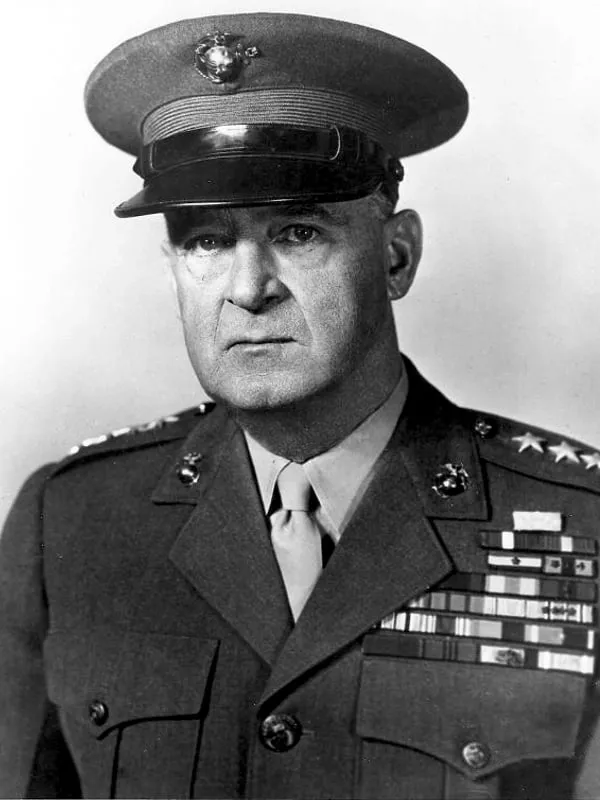
Alexander Archer Vandegrift commanded the first American land offensive of the Pacific War. On 7 August 1942 his 1st Marine Division landed on Guadalcanal and Tulagi, and over the next four months – often without support from the fleet, short of supplies and under constant air attack – it held Henderson Field airfield against successive Japanese attacks from land, sea and air. For this campaign he received the Medal of Honor. A quiet, courteous Virginian who, according to his contemporaries, looked more like a schoolmaster than a Marine general, he went on to become Commandant of the Corps, led it through the bloodiest landings of the war and, once the war was over, defended it against plans to reduce it to an auxiliary role. The first serving Marine officer in history to wear the four stars of a full general, he is regarded today as one of the founders of the modern Marine Corps.
Youth in Virginia
He was born on 13 March 1887 in Charlottesville, Virginia, into the family of an architect and building contractor of Dutch descent, settled in America since the 17th century. At home he was called Archer, after his middle name. He grew up on the stories of his grandfather, a veteran of the Confederate army, and on the adventure novels of George Alfred Henty; as a boy he devoured the history of the battles of Trafalgar and Waterloo and took Nelson and Wellington as his models. In 1906–1908 he studied at the University of Virginia, but left without a degree when he passed the competitive examination for the Marine Corps. He was commissioned as a second lieutenant on 22 January 1909, and in June that year he married Mildred Strode, with whom he had a son, who also became a Marine officer.
His beginnings gave little promise of a great career. In his first efficiency report, in 1909, his superiors judged him an officer who “does not appreciate the responsibilities of his position”, and he came close to being dismissed from the service. His later reports, however, grew steadily better.
The Banana Wars
Like most Marine officers of his generation, Vandegrift spent his youth in the Banana Wars, the United States’ interventions in the Caribbean and Central America. In 1912 he fought in Nicaragua, where in October he took part in the assault on Coyotepe Hill, and in 1914 he took part in the occupation of Veracruz in Mexico. After promotion to first lieutenant and a course in Philadelphia, he went with the 1st Marine Regiment to Haiti, occupied by the United States since 1915, where he fought the Caco guerrillas at Le Trou and Fort Capois. There he met the legendary Smedley Butler, who became his patron. It was Butler who gave him the nickname “Sunny Jim” when Vandegrift came back smiling from a task that consisted of riding on a locomotive’s cowcatcher and watching for mines on the track.
From 1916, by then a captain, he served in the Haitian Gendarmerie, a police force raised and led by Americans, first until December 1918 and then again, from July 1919, as an inspector. To his disappointment he thus spent the First World War far from Europe. In Haiti, however, he learned to fight in the tropics and against an irregular enemy, and in 1917, during an inspection, he met the young Assistant Secretary of the Navy, Franklin Delano Roosevelt. In June 1920 he was promoted to major.
Between Quantico and China
In 1923 he returned to the United States, to the base at Quantico, Virginia, where in 1926 he completed the field officers’ course, and then served on the base staff at San Diego. In 1927 he met Butler again: he went to China as operations officer of the 3rd Marine Brigade at Tientsin, sent to protect Americans during the civil war. From 1928 he worked in Washington on the budget, and then on the staff of the newly created Fleet Marine Force at Quantico. This was the period when the Corps was changing over from the role of a colonial police force to a new speciality, the landing on a defended coast, and Vandegrift took part in developing the doctrine of amphibious operations that ten years later proved crucial in the Pacific. In 1934 he was promoted to lieutenant colonel.
In 1935–1937 he was executive officer and then commander of the Marine detachment guarding the American embassy in Beijing, at a time when Japan was pressing ever harder on northern China. In September 1936 he was promoted to colonel, and in 1937 he became military secretary to the Commandant of the Corps, General Thomas Holcomb. In March 1940 he became Holcomb’s assistant, and in April he was promoted to brigadier general. His close collaboration with Holcomb, who was expanding the Corps in anticipation of war, decided the rest of his career.
The 1st Marine Division
In November 1941 Vandegrift became assistant commander of the 1st Marine Division, and on 23 March 1942, by then a major general, he took command of it. The division grew fast, taking in thousands of recruits, and its new commander unsentimentally removed officers he judged unfit. In May 1942 it became the first division in the Corps’ history to leave the United States, sailing for New Zealand, where it was to train until at least early 1943. Meanwhile, however, the Japanese began building an airfield on Guadalcanal, and on 26 June Vice Admiral Robert Ghormley told Vandegrift that in little more than a month his division was to land in the Solomon Islands.
The preparations were hurried and chaotic, and Vandegrift himself judged the rehearsal landings in Fiji a disaster. On 7 August his men landed on Guadalcanal almost unopposed and the next day took the airfield, soon named Henderson Field, while on Tulagi, Gavutu and Tanambogo they destroyed the Japanese garrison in bitter fighting. On the evening of 8 August, however, Vice Admiral Frank Jack Fletcher withdrew the carriers, and after the night-time disaster off Savo Island Rear Admiral Richmond Turner took the transports away before they had unloaded half their supplies. Vandegrift was left on the island with well over ten thousand men, food for a few weeks – counting captured Japanese rice – and ammunition for a few days of fighting. He never forgave Fletcher.
The defence of Henderson Field
Vandegrift opted for defence. Instead of seeking out the enemy in the jungle, he surrounded the airfield with a defensive perimeter, had it finished with captured Japanese machinery and waited for aircraft. The first Marine fighters and dive bombers landed on Henderson Field on 20 August and became the nucleus of the Cactus Air Force, a scratch force of Marine, Navy and Army airmen that provided the island’s air cover over the following months. The next day his men smashed the first Japanese counter-attack, by Colonel Kiyonao Ichiki’s detachment, on the Ilu River, and a Japanese attempt to bring in larger reinforcements collapsed in the Battle of the Eastern Solomons. The islanders and the coastwatchers helped in the fighting, among them Martin Clemens and a sergeant major of the local police, Jacob Vouza.
The hardest part was yet to come. On the nights of 12–13 and 13–14 September General Kiyotake Kawaguchi’s brigade attacked the airfield from the south, across a ridge held by the raiders and parachutists of Colonel Merritt Edson. The attack was beaten off with difficulty; critics reproach Vandegrift for having been too slow to see the threat from that direction. On 18 September the 7th Marine Regiment finally arrived. In October Japanese battleships shelled the airfield, and the Battle for Henderson Field on 23–26 October brought defeat for the Japanese 2nd Division. Vandegrift also had to defend himself not only against the Japanese but against Turner, who wanted to scatter his forces on secondary objectives around the island. In case the worst happened, he prepared a plan to withdraw into the hills and wage a guerrilla war from there.
The turning point in the command came with the replacement of Ghormley by Vice Admiral William Halsey on 18 October. At a conference in Nouméa on 23 October Halsey asked whether the island could be held. Vandegrift replied that it could, if he received more vigorous support, and Halsey promised it. The two became friends. After the naval battle of Guadalcanal in November, the Japanese attempts to retake the island lost their momentum. On 9 December 1942 Vandegrift handed over command to the Army’s General Alexander Patch, and the exhausted 1st Division, decimated by malaria, sailed to Melbourne to rest. For 7 August Vandegrift received the Navy Cross, and for the whole campaign from 7 August to 9 December the Medal of Honor, which President Roosevelt presented to him at the White House on 5 February 1943.
Bougainville
In July 1943 Vandegrift, by then a lieutenant general, took command of I Marine Amphibious Corps. Holcomb, who was preparing to retire, recommended him as his successor in preference to the more senior General Holland Smith. Before Vandegrift could take up his new post, his successor at the head of the amphibious corps, General Charles Barrett, was killed in an accident in Nouméa in October 1943. Vandegrift therefore returned to the Pacific and on 1 November 1943 led the landing at Empress Augusta Bay on Bougainville. Once the beachhead was secure, he handed over command to General Roy Geiger and left for Washington.
Commandant of the Corps
On 1 January 1944 Vandegrift became the eighteenth Commandant of the Marine Corps. The Corps then numbered hundreds of thousands of men, and over the following eighteen months its divisions landed in the Marianas, on Peleliu, Iwo Jima and Okinawa, suffering the heaviest losses in its history. The Commandant did not command them directly, but he was responsible for their replacements, training and equipment and defended the interests of the Corps against the Navy and the Army. On 4 April 1945 he was appointed a full general with seniority from 21 March, the first serving Marine officer in history to hold the rank.
After the war the Corps faced a threat more dangerous than Japanese resistance. In the debates on unifying the armed forces under a single department of defence, the Army, backed by President Harry Truman and General Dwight Eisenhower, proposed to reduce the Marines to small shipboard detachments and base guards and wanted to take over their land missions itself. On 6 May 1946 Vandegrift addressed the Senate Naval Affairs Committee in what went down in history as the “Bended Knee Speech”. He argued that the Corps had the right to have its future decided by Congress, which had created it, and he closed with the words: “The bended knee is not a tradition of our Corps.” If the Marines had not proved their worth after 170 years of service, he went on, they must go – but they had earned the right to depart with dignity and honour. The speech moved the senators, and the National Security Act passed in 1947 guaranteed the Corps its place in the structure of the armed forces.
On 31 December 1947 Vandegrift handed over the post of Commandant to General Clifton Cates, who had commanded one of his regiments on Guadalcanal. He formally retired on 1 April 1949, after forty years of service.
Last years
In retirement he travelled and devoted himself to charitable work. His wife Mildred died in 1952, and a year later he married Kathryn Henson. In 1964, together with Robert Asprey, he published his memoirs, Once a Marine. He died after a long illness on 8 May 1973 at the naval hospital in Bethesda and was buried in Arlington National Cemetery.
Significance
Vandegrift was not a brilliant tactician and he made mistakes, but on Guadalcanal he showed the qualities that campaign demanded most: calm, tenacity and the ability to keep up his men’s morale in conditions in which everything seemed to conspire against them. His defence of Henderson Field ensured that the first American offensive in the Pacific did not end in defeat, and that Japan bled itself white fighting for an island whose importance it had at first underestimated. As Commandant he led the Corps through its years of greatest expansion and heaviest losses, and after the war he defended its independence. The frigate USS Vandegrift and the main road of Camp Pendleton in California bear his name.
Sources
Commanded in battles
(02)Mentioned in battles
(02)Often appears with
People who appear in the same events.