Poland
Władysław Anders
Chief of Staff of the Greater Poland Army (1919), commander of the Nowogródek Cavalry Brigade (1939), commander of the Polish Army in the USSR (1941–1942) and of the Polish II Corps (1943–1946)
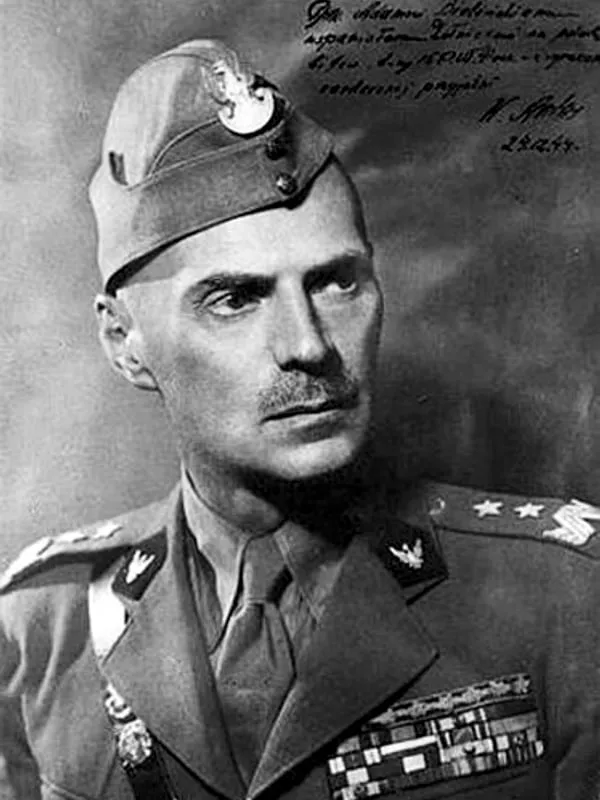
- Born:
- 11 August 1892, Błonie near Krośniewice (Russian Empire)
- Died:
- 12 May 1970, London
- Author:
- Natalia
- Photo:
- autor nieznany, domena publiczna, Wikimedia Commons

Władysław Anders was one of the most famous Polish commanders of the Second World War and a symbol of the fate that the war dealt to Poles from the eastern lands of the Polish Republic. He grew up in the Russian Empire and in the First World War fought in the tsarist cavalry. In reborn Poland he was chief of staff of the Greater Poland insurgents, a regimental commander in the war against the Bolsheviks and a cavalry general. In September 1939 he fought the Germans and the Red Army; wounded, he fell into Soviet captivity and spent almost two years in NKVD prisons. Released after the German attack on the Soviet Union, he built a new Polish army out of emaciated prisoners and deportees and led it, together with thousands of civilians, out of the USSR. In May 1944 the Polish II Corps under his command took Monte Cassino. After the war Anders did not return to a country ruled by communists, and until his death he was one of the leading figures of the Polish emigration in London.
Youth and the tsarist army
He was born on 11 August 1892 on the Błonie estate near Krośniewice, in the Kingdom of Poland, into the family of an estate manager. The family was of Baltic German origin and Lutheran faith, but had long been Polonised. All three of Władysław’s younger brothers became, like him, professional officers. He passed his school-leaving examinations in Warsaw and from 1911 studied at the polytechnic in Riga. In 1910 he had served as a volunteer in a Russian dragoon regiment and become a reserve officer.
During the First World War he fought in the Russian cavalry, was wounded several times and was awarded the Order of St George, 4th class, for bravery. In 1917 he completed a shortened course at the General Staff Academy in Petrograd. After the February Revolution he transferred to the Polish I Corps, then being formed in Russia under General Józef Dowbor-Muśnicki, in which he commanded a squadron of uhlans and later served as chief of staff of a rifle division. After the October Revolution the corps fought the Bolsheviks, and in May 1918, surrounded by the Germans, it capitulated and was disbanded.
Greater Poland and the war against the Bolsheviks
When the Polish Army was formed in November 1918, Anders joined it as a cavalry captain. At the beginning of 1919, summoned by Dowbor-Muśnicki, he came to Poznań, where the general had taken command of the forces of the Greater Poland Uprising. Anders became chief of staff after the departure of the Piłsudski loyalist Julian Stachiewicz, and helped turn the volunteer units into the regular Greater Poland Army. In April 1919 he took command of the 1st Greater Poland Uhlan Regiment, later renamed the 15th Poznań Uhlan Regiment. He led it in the Polish–Soviet War, in 1919 in the capture of Babruysk and in 1920 as part of the Polesie Group of General Władysław Sikorski. In July 1920 he was badly wounded.
Cavalry general
In 1921–1923 he studied at the École supérieure de guerre in Paris. On his return he served on the staff of the Inspector General of Cavalry, General Tadeusz Rozwadowski, and from 1925 he was military commandant of Warsaw. During the May Coup of 1926 he sided with the lawful government as chief of staff to Rozwadowski, who commanded the defence of the capital against the troops of Józef Piłsudski. Unlike Rozwadowski, he suffered no reprisals for it. The victors gave him command of a cavalry brigade and later of the brigade in Baranowicze, named the Nowogródek Cavalry Brigade in 1937. In 1934 he became a brigadier general. He was renowned as a superb horseman, and towards the end of the interwar period he was critical of Poland’s preparations for war.
September 1939
In the September Campaign the Nowogródek Cavalry Brigade fought as part of the Modlin Army, covering its left flank near Działdowo and Lidzbark, and then fought defensively near Płock. Anders was wounded by a bomb splinter. After the withdrawal across the Vistula he took command of the Cavalry Operational Group, which fought near Mińsk Mazowiecki and in the second battle of Tomaszów Lubelski, where on 22 September it captured Krasnobród. When the Red Army also attacked Poland on 17 September, Anders decided to fight his way through to Hungary. At the end of September his units clashed with Soviet troops and were scattered. Anders, wounded twice, was taken prisoner by the Soviets on 29 or 30 September, depending on the source.
The Lubyanka
He was treated first in Lwów (Lviv) and then held in Lwów’s Brygidki prison, and in February 1940 the NKVD took him to Moscow, to the Lubyanka prison. For almost two years, in harsh conditions, he was repeatedly interrogated and pressed, without success, to join the Red Army. By then thousands of his fellow officers were already dead. In the spring of 1940 the NKVD murdered some 22,000 Polish prisoners of war and prisoners in the Katyn massacre, something Anders could not have known.
Anders’s Army
After the German attack on the Soviet Union in June 1941 and the conclusion of the Sikorski–Mayski agreement, Anders was released from prison on 4 August 1941. A few days later Sikorski appointed him commander of the Polish Armed Forces in the USSR, and Anders was promoted to major general. The army formed at Buzuluk, Totskoye and Tatishchevo on the Volga, and later in Central Asia. Starving people released from the labour camps and from exile streamed to the recruiting centres, often with their families and with orphaned children. Anders ordered that everyone be taken in. The army included Poles, Jews, Ukrainians and Belarusians, all citizens of the pre-war Polish Republic. There was a constant shortage of officers. In December 1941 Anders accompanied Sikorski to a meeting with Joseph Stalin in the Kremlin, at which, asked about the thousands of missing officers, the dictator replied that they had probably fled to Manchuria.
The Soviet authorities restricted food rations and the size of the army. Anders, who distrusted Moscow, argued ever more forcefully that the army had to be taken out of the USSR, and in March 1942 he himself agreed the first evacuation with Stalin, presenting Sikorski with a fait accompli. In two waves, in the spring and summer of 1942, a total of some 115,000 people, including nearly 80,000 soldiers, left for Iran through the port of Krasnovodsk and across the Caspian Sea. For many of them it meant their lives were saved. Among the soldiers of Jewish origin who later left the army in Palestine was Menachem Begin, the future prime minister of Israel. Historians still argue over whether the evacuation, which ruled out Polish troops fighting alongside the Red Army, served Poland’s national interest. What is certain is that the Poles who remained in the USSR became, in 1943, the recruiting base for Zygmunt Berling’s army, which was subordinate to Stalin.
The dispute with Sikorski
In the Middle East Anders’s troops became the Polish Army in the East, and from it was formed the Polish II Corps, which he commanded from 1943. Anders regarded Sikorski’s policy towards Moscow as an illusion, and after the revelation of the Katyn massacre in April 1943 his soldiers, who had searched the USSR in vain for their comrades, were left with no illusions at all. At the beginning of 1943 Anders wrote to President Władysław Raczkiewicz that the government should step down. When Sikorski was killed at Gibraltar in July 1943, on his way back from an inspection of the troops in the Middle East, some of his supporters, among them the general’s widow, accused Anders of sharing moral responsibility. No evidence of any involvement by Anders in the alleged assassination has ever been produced.
Monte Cassino
In December 1943 and January 1944 II Corps was shipped to Italy, where it became part of the British Eighth Army. In March 1944 its commander, General Oliver Leese, offered the Poles the task of taking the hill of Monte Cassino with its Benedictine monastery, the key point of the German Gustav Line, which the Allies had been fighting for in vain since January. Anders accepted at once, without consulting the Commander-in-Chief, General Kazimierz Sosnkowski, who had reservations about a frontal assault. He understood that a victory there would carry political weight for the Polish cause. The first attack, on the night of 11–12 May, broke down with heavy losses. The second, on 17 May, combined with the advances of other Allied forces, compelled the Germans to withdraw, and on the morning of 18 May a Polish patrol raised the white-and-red flag over the ruins of the monastery. The corps lost 923 killed, nearly 3,000 wounded and several hundred missing.
Anders’s soldiers then took Ancona in July, broke through the Gothic Line and in April 1945 entered Bologna. Anders regarded the Warsaw Uprising as a tragic mistake by the Home Army command and wrote that the soldiers did not understand its purpose, though at the same time he admired the heroism of the fighting capital.
Yalta and exile
Anders regarded the decisions of the Yalta Conference of February 1945, which gave eastern Poland to the USSR, including Lwów and Wilno (Vilnius), where many of his soldiers came from, as a betrayal. He wanted to withdraw the corps from the front, but at the request of the Allied commanders he remained in action until the end of the war. From February to May 1945, while General Tadeusz Bór-Komorowski was a German prisoner, he served as acting Commander-in-Chief.
After the war most of his soldiers did not return home. Anders helped them settle in Britain. In 1946 the communist Provisional Government of National Unity stripped him of his Polish citizenship and his general’s rank. In exile he was Commander-in-Chief and Inspector General of the Armed Forces, in 1950–1954 the designated successor to the president, and in 1954, in a dispute with President August Zaleski, he headed the opposition Council of Three, which split the emigration into two camps. He published his war memoirs under the title Bez ostatniego rozdziału (“Without the Last Chapter”). He died in London on 12 May 1970, the anniversary of the first Polish attack on Monte Cassino. In accordance with his wishes he was buried among his soldiers in the Polish war cemetery below the monastery. In 1989 the authorities of the Polish People’s Republic revoked the decision depriving him of his citizenship.
Significance
Anders’s life sums up the fate of the generation that built an independent Poland after 1918 and lost it as a result of the Second World War. He served in the tsar’s army, fought the Bolsheviks in 1920 and in 1939 became a victim of the pact between Hitler and Stalin. Leading thousands of people condemned to death in the labour camps and in exile out of the USSR is regarded as his greatest achievement, and Monte Cassino as the most famous victory of Polish soldiers in the West. His critics accused him of political insubordination towards Sikorski and the government and of contributing to the split in the emigration. In communist Poland his name was erased from history for decades. After 1989 he became one of the heroes of Polish memory, and in 1995 he was posthumously awarded the Order of the White Eagle.
Sources
Commanded in battles
(02)Mentioned in battles
(07)Often appears with
People who appear in the same events.
On the timeline
(43)The 40 most important of 43 events. All tagged “Władysław Anders” (3) →
1939
1940
1941
1942
1943
1944
1945
February
April
May
- 08
- Key eventVictory in Europe DayOn 8 May 1945 the West celebrated Germany's surrender in London, Paris and New York. The guns fell silent at 11.01 p.m.; in Poland, joy was clouded by doubt.
- Key eventThe surrender at KarlshorstOn 8 May 1945 in Berlin-Karlshorst, Keitel, Friedeburg and Stumpff signed Germany's final act of unconditional surrender before Zhukov and Tedder.