Invasion of Poland
- Dates:
- 1 September – 6 October 1939
- Front:
- Poland
- Location:
- The territory of the Second Polish Republic and the Free City of Danzig, from Pomerania and the coast to the Carpathians and from the western border to Polesie, Volhynia and the Wilno regionOn the battle map →
- Sides:
- PolandEdward Rydz-ŚmigłyNazi GermanyWalther von Brauchitsch, Fedor von Bock, Gerd von RundstedtSlovakiaFerdinand ČatlošSoviet UnionMikhail Kovalyov, Semyon Timoshenko
- Result:
- Polish defeat. The country was occupied and partitioned by Nazi Germany and the Soviet Union, with some territory handed to Slovakia and Lithuania. Poland never capitulated, and its government and army carried on in exile.
- Author:
- Łukasz
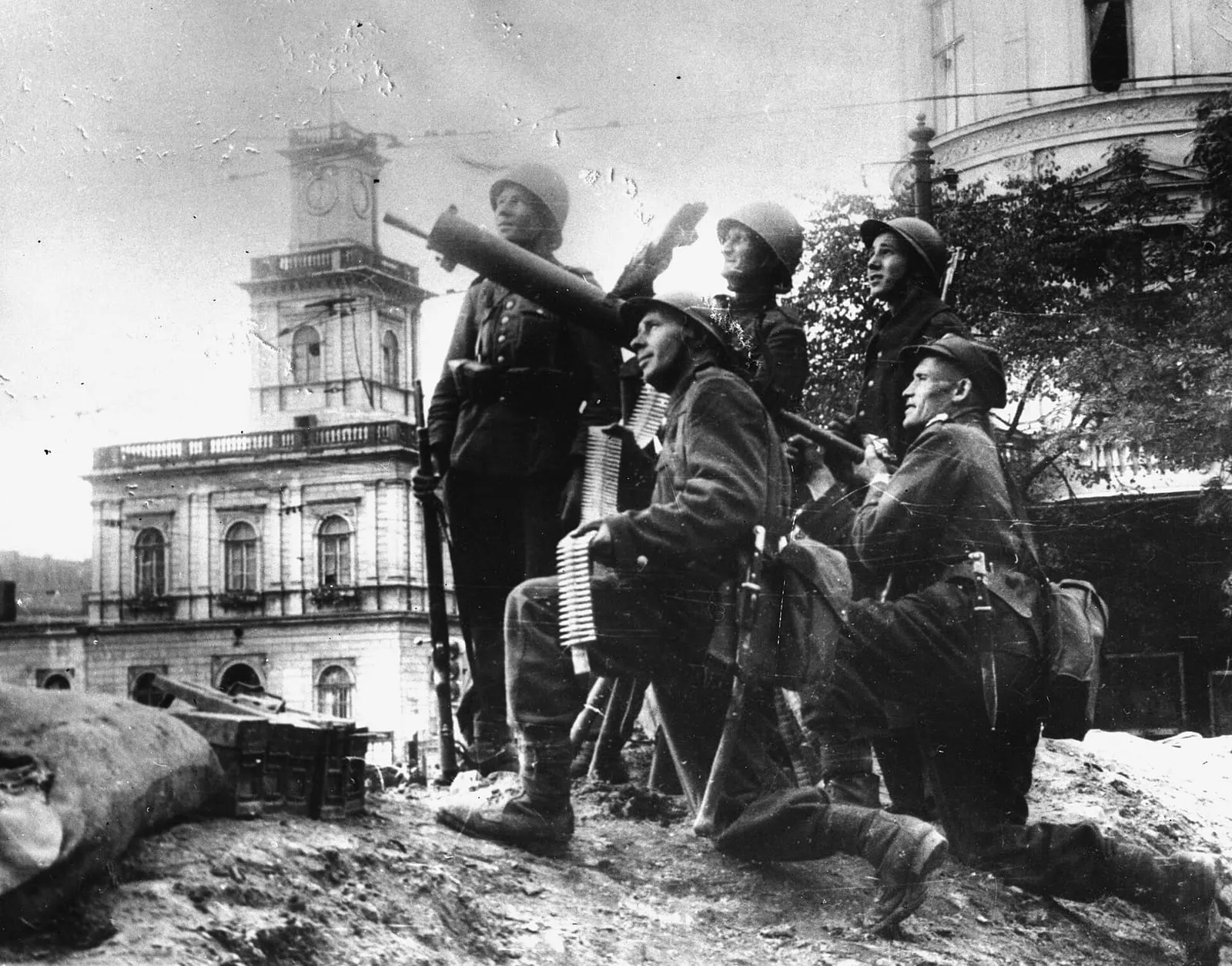
The September Campaign was the first campaign of the Second World War. On 1 September 1939 the forces of the Third Reich, supported by the Slovak army, struck Poland from three sides: from East Prussia, from Western Pomerania, and from Silesia, Moravia and Slovakia. On 3 September Britain and France declared war on Germany, but in the west they undertook nothing that might have drawn German forces away from Poland. The Polish Army, weaker in numbers and equipment, strung out along a long frontier and not fully mobilised, lost the frontier battles, failed to hold the line of the Vistula and the San, and spent the following weeks fighting in encirclements: on the Bzura, in Warsaw and Modlin, around Lwów (Lviv) and Tomaszów Lubelski, and on the Hel Peninsula. On 17 September the Red Army entered Poland, carrying out the secret protocol of the German–Soviet pact. The last regular Polish formation laid down its arms at Kock on 6 October. The Polish state was divided between its two invaders, but it never signed a capitulation. The President, the government and tens of thousands of soldiers escaped abroad to continue the fight.
Name and dates
In Poland the campaign is known as the September Campaign, the defensive war of 1939, or simply as “September”. In Germany the name “Polish campaign” (Polenfeldzug) took hold. Soviet propaganda called the aggression of 17 September the Red Army’s “liberation march” into Western Belarus and Western Ukraine – a term that belongs to the language of propaganda, not of historiography.
The campaign began on 1 September 1939. At about 4.45 a.m. the training battleship Schleswig-Holstein opened fire on the Military Transit Depot at Westerplatte (PL). At roughly the same time German aircraft attacked the bridge at Tczew and the town of Wieluń (the time of the Wieluń raid is disputed: witnesses give 4.40 a.m., German documents around 5.40 a.m.). At about the same time German troops were crossing the border at many points. The campaign is taken to have ended on 6 October, when the capitulation of Independent Operational Group Polesie at Kock brought the fighting of regular Polish Army units to a close. Hel had capitulated on 1 October, its garrison laying down its arms on 2 October. After 6 October only scattered detachments kept up resistance; the longest-lasting of them, the unit of Major Henryk Dobrzański, known as “Hubal”, was not destroyed until the spring of 1940.
Background
From 1919 onwards Poland was the principal target of German revisionism in the east. The declaration of non-aggression of 1934 brought the two countries briefly closer. After the Munich Agreement, Adolf Hitler demanded the incorporation of Gdańsk (Danzig) into the Reich and an extraterritorial road across Pomerania. Foreign Minister Józef Beck refused. When in March 1939 Germany occupied Bohemia and Moravia and Klaipėda (Memel), and Slovakia became a dependency of Berlin under a protection treaty, Poland found itself caught in German pincers from the north, the west and the south. On 31 March Britain gave Poland a guarantee. On 3 April the chief of the OKW issued the Case White directive, and on 28 April Hitler renounced the 1934 declaration.
The Danzig crisis continued through the summer. On 23 August Ribbentrop and Molotov signed a non-aggression pact in Moscow whose secret protocol divided Central and Eastern Europe into spheres of influence. In Poland the boundary between the spheres was to run along the Narew, the Vistula and the San. Hitler called off on the evening of 25 August the attack set for 26 August, after the Anglo-Polish alliance was signed in London and Mussolini announced that Italy was not ready for war. Some German sabotage groups did not receive the order in time, which led to the Jablunkov Pass incident. In the last days of August Berlin presented Poland with an ultimatum whose official text Warsaw never even had the chance to see, and on the evening of 31 August SS men staged the Gleiwitz incident, meant to show the world a “Polish attack”.
Forces and plans
Germany sent some 1.5 million men against Poland in more than 50 divisions (15 of them mobile: armoured, light and motorised), with over 2,500 tanks and around 1,600–2,000 aircraft from two air fleets. The Army High Command (OKH), under General Walther von Brauchitsch with General Franz Halder as chief of staff, divided them into two army groups. Army Group North under General Fedor von Bock comprised the Third Army of General Georg von Küchler in East Prussia and the Fourth Army of General Günther von Kluge in Pomerania. Its task was to cut the Polish Corridor, link the Reich with East Prussia and strike at Warsaw from the north and east. The main blow was to be delivered by Army Group South under General Gerd von Rundstedt: the Eighth Army of General Johannes Blaskowitz; the Tenth Army of General Walter von Reichenau, in which most of the armoured units were concentrated; and the Fourteenth Army of General Wilhelm List in Upper Silesia, Moravia and Slovakia. The two army groups were to meet east of Warsaw and destroy the main Polish forces west of the Vistula and the Narew. At sea the Kriegsmarine deployed, among other ships, training battleships, several destroyers and submarines.
The Slovak Republic fielded the Bernolák field army under the defence minister, General Ferdinand Čatloš: three divisions and a mobile group, some 50,000 men in all, who advanced into Spisz, Orawa and Podhale as part of the German Fourteenth Army. Bratislava wanted to recover the territories awarded to Poland in 1920, 1924 and 1938.
Poland could mobilise around 1.3 million men, but by 1 September it had managed to do so only in part. General mobilisation, announced on 29 August, was cancelled the same day at the request of the British and French ambassadors, who did not wish to “provoke” Hitler, and was announced again on 30 August to take effect on 31 August. At the moment of the attack, according to Polish calculations, mobilisation was about two-thirds complete and the concentration of troops less than half complete. The Polish Army had 30 active and 9 reserve infantry divisions, 11 cavalry brigades, 2 armoured-motorised brigades (one still being formed), 3 mountain brigades, and units of National Defence and the Border Protection Corps (KOP). It had several hundred tanks, most of them tankettes, and some 400 combat aircraft, largely obsolete. The Commander-in-Chief was Marshal Edward Rydz-Śmigły; his chief of staff was Brigadier General Wacław Stachiewicz.
Operational Plan West, drawn up in haste from March 1939, deployed seven armies and an independent operational group along the border: Independent Operational Group Narew and the Modlin Army facing East Prussia, the Pomorze Army in the Corridor, the Poznań, Łódź and Kraków Armies in the west and south-west, the Karpaty Army in the south, and the Prusy Army in reserve. This deployment was criticised both at the time and afterwards, since it left the troops in open country, within reach of envelopment from East Prussia and Slovakia. It rested, however, on political and economic considerations: Silesia, the Łódź industrial district and Pomerania had to be defended, and Germany had to be prevented from seizing a piece of the country and presenting the world with a fait accompli, as in Gdańsk. The army was to defend successive lines and fall back to the Vistula, the Narew and the San until the French offensive began. In the protocol of the military talks of May 1939, General Maurice Gamelin undertook that France would launch an offensive with its main forces no later than the fifteenth day of mobilisation.
The course of the campaign: the frontier battles (1–6 September)
From the first hours the Luftwaffe bombed airfields, railway junctions, bridges and towns. The destruction of Wieluń, which contained no military units, became a symbol of a war waged against civilians. Contrary to German propaganda, the Polish air force was not destroyed on the ground, having been moved to field airstrips before the war. The fighters of the Pursuit Brigade defended Warsaw, and over the whole campaign Polish airmen shot down anywhere from several dozen to more than a hundred German aircraft, but the Luftwaffe’s superiority was overwhelming.
In Gdańsk the garrison of Westerplatte, commanded by Major Henryk Sucharski, held out until 7 September, while the defenders of the Polish Post Office were overcome on 1 September itself. On the first day of the war Danzig was proclaimed part of the Reich. In the north the Modlin Army of Brigadier General Emil Krukowicz-Przedrzymirski repelled the attack of the German Third Army at Mława for three days, from 1 to 3 September. The Germans, however, outflanked the fortifications from the east, and the army had to withdraw to the Vistula and the Narew. In the Polish Corridor the Pomorze Army of Major General Władysław Bortnowski suffered heavy losses in the Tuchola Forest. On the evening of 1 September, at Krojanty, the 18th Uhlan Regiment charged German infantry; caught by fire from armoured cars, it lost its commander and several dozen men. Italian and German correspondents turned this episode into the legend of Polish lancers attacking tanks with sabres, which survived for decades. On 4 September units of the Third and Fourth Armies joined hands across the Corridor. Several Polish divisions were encircled, and General Heinz Guderian’s XIX Corps passed into East Prussia, from where it set off southwards towards Brest.
The gravest danger lay in the south-west. On 1 September at Mokra the Wołyń Cavalry Brigade of Colonel Julian Filipowicz inflicted heavy losses on the German 4th Panzer Division, but in the following days there was no stopping the XVI Motorised Corps, which drove into the gap between the Łódź and Kraków Armies. The Łódź Army of Major General Juliusz Rómmel defended the line of the Warta and the Widawka, while the Kraków Army of Brigadier General Antoni Szylling, threatened with envelopment from Silesia and from Slovakia, began to withdraw on 3 September. Upper Silesia was abandoned without a prolonged defence, although in Katowice volunteers, former Silesian insurgents and scouts fought on for several more days. In Podhale Colonel Stanisław Maczek’s 10th Cavalry Brigade delayed the German and Slovak advance. On 5 and 6 September the German Tenth Army routed the reserve Prusy Army at Piotrków and Tomaszów Mazowiecki. The road to Warsaw lay open. On 6 September the Germans took Kraków without a fight.
The course of the campaign: retreat behind the Vistula and the Battle of the Bzura (7–22 September)
During the night of 6–7 September the Commander-in-Chief left Warsaw and moved his headquarters to Brest, and later further east. The government was evacuated from Warsaw, and the radio called on men capable of bearing arms to leave the capital, which caused chaos on the roads leading east. From then on communications between the Commander-in-Chief and his armies kept breaking down. On 8 September tanks of the German 4th Panzer Division reached the Ochota district and were driven back. The defence of Warsaw had begun. It was directed by Brigadier General Walerian Czuma, from 8 September also by General Rómmel as commander of the Warsaw Army, and by the city’s mayor, Stefan Starzyński.
In the north-east the Germans were crossing the Narew and the Bug. From 7 to 10 September the sector at Wizna was held by Captain Władysław Raginis with about 700 men, who held up Guderian’s corps for three days. Raginis died on 10 September, in the final phase of the fighting. German forces got into the rear of the Polish front, and on 14 September Guderian reached Brest on the Bug, whose fortress held out until 17 September.
On 9 September the Poznań and Pomorze Armies, which were withdrawing intact towards Warsaw, under Major General Tadeusz Kutrzeba struck from the north into the flank of the German Eighth Army. So began the Battle of the Bzura, the largest battle of the campaign. The Poles smashed several German units and forced the OKH to turn back considerable forces, some of them from the Warsaw front. After a few days the Germans regained the initiative, encircled the Polish armies and, with massive air support, destroyed them within a week. Some of the troops, with General Kutrzeba, broke through to Warsaw and Modlin by 22 September, but tens of thousands of soldiers were taken prisoner, General Bortnowski among them on 21 September. Defeat though it was, the battle delayed the capture of the capital and allowed the forces east of the Vistula to fall back towards the Lublin region and the Romanian bridgehead.
In the south the Kraków and Karpaty Armies, merged on 10 September as the Małopolska Army, were retreating across the San towards Lublin and Lwów. Operations in the south were soon directed by Major General Kazimierz Sosnkowski as commander of the Southern Front. On 12 September German mountain troops reached the outskirts of Lwów, and the defence of the city began. By 15 September Warsaw was surrounded. Polish strategy now rested on holding the so-called Romanian bridgehead along the Dniester and the Stryi, close to the border with allied Romania, through which Allied supplies were to arrive. No help came. The French Saar Offensive, launched on 7 September, advanced a few kilometres and was halted on 12 September; on the same day, at the Abbeville conference, Britain and France decided that there would be no major offensive in the west. The RAF dropped leaflets over Germany.
The course of the campaign: the Soviet invasion and the last battles (17 September – 6 October)
At dawn on 17 September two Red Army fronts crossed the eastern border: the Belorussian Front of Komandarm 2nd Rank Mikhail Kovalyov and the Ukrainian Front of Komandarm 1st Rank Semyon Timoshenko, initially some 600,000–650,000 men and several thousand tanks in all, a number later increased. Moscow claimed that the Polish state had ceased to exist and that the USSR was taking Ukrainians and Belarusians under its protection. In doing so it violated the Treaty of Riga, the non-aggression pact of 1932 and the convention for the definition of aggression. The eastern border was guarded only by a few dozen battalions of the weakened Border Protection Corps, whose best units had earlier been sent west. At Kuty, Rydz-Śmigły issued a directive: “Do not fight the Bolsheviks, unless they attack or attempt to disarm our units”, and ordered a withdrawal to Romania and Hungary. Many units never received this order, or fought when attempts were made to disarm them. On the evening of 17 September President Ignacy Mościcki and the government crossed the Romanian border, followed during the night of 17–18 September by the Commander-in-Chief. All of them were interned.
Soviet troops took Wilno (Vilnius) on 18–19 September and from 20 to 22 September fought for Grodno, which was defended by remnants of the army, the police, young people and scouts. On 22 September, near Sopoćkinie, Red Army soldiers murdered Brigadier General Józef Olszyna-Wilczyński and his adjutant. That same day General Władysław Langner surrendered Lwów to the Red Army, which had taken over the siege from the Germans. The agreement guaranteeing the officers free passage was broken, and they were deported to the USSR. Also on 22 September, at Brest, Guderian and Kombrig Semyon Krivoshein took a joint parade of German and Soviet troops as the city was handed over. In Polesie and the Lublin region the KOP group of Brigadier General Wilhelm Orlik-Rückemann won the Battle of Szack on 28 September, but on 1 October it was destroyed at Wytyczno.
West of the Bug the last battles with the Germans were still being fought. In the two battles of Tomaszów Lubelski, from 17 to 20 and from 21 to 27 September, the Kraków and Lublin Armies were destroyed, followed by the Northern Front of General Stefan Dąb-Biernacki. Brigadier General Władysław Anders, with the remnants of the Nowogródek Cavalry Brigade, tried to break through to Hungary, was wounded and fell into Soviet captivity. Warsaw, bombed and shelled for weeks, endured its heaviest air raid on 25 September. Fires, the lack of water and thousands of dead decided the matter. On 28 September General Kutrzeba signed the capitulation of the capital at Rakowiec, and on 29 September Modlin capitulated. Hel, defended by the forces of Rear Admiral Józef Unrug, laid down its arms on 2 October. The last to fight was Independent Operational Group Polesie under Brigadier General Franciszek Kleeberg. From 2 to 5 October it fought the Battle of Kock against German motorised divisions. When its ammunition ran out, Kleeberg announced its capitulation on 6 October.
Losses
Estimates of losses vary with the source and the method of counting. According to post-war calculations by the War Reparations Bureau, some 66,000 Polish soldiers were killed in the fighting against the Germans and some 134,000 wounded. More recent studies (Czesław Grzelak, Henryk Stańczyk) give similar figures: about 63,000 soldiers and 3,300 officers killed and 133,700 wounded. In the fighting against the Red Army several thousand to over ten thousand soldiers were killed or wounded. Some 400,000–420,000 soldiers went into German captivity and about 230,000–250,000 into Soviet captivity. Several tens of thousands – by various calculations from about 80,000 to over 100,000 – escaped to Hungary, Romania, Lithuania and Latvia. Most of the navy’s ships escaped destruction: three destroyers had sailed to Britain before the war, and during the campaign they were joined by the submarines Orzeł and Wilk.
Older Polish publications exaggerated German losses. According to German data compiled by Burkhart Müller-Hillebrand, the army lost about 16,300 killed, several hundred missing and some 27,000 wounded. Other tallies usually fall within the range of 16,000–17,000 dead. The Wehrmacht had several hundred tanks destroyed or damaged, and the Luftwaffe lost about 280 aircraft destroyed and a similar number damaged. Red Army losses, according to Soviet documents and the research of Russian historians, came to between roughly 1,000 and 1,500 killed and missing and several thousand wounded. The Slovaks lost several dozen men.
Civilian losses are estimated at no fewer than 100,000 dead, and in some studies at 150,000–200,000. In Warsaw alone, by various calculations, between over ten thousand and more than 20,000 civilians were killed.
Crimes
From its first day the war against Poland was a war against its people. The Luftwaffe bombed towns and strafed columns of refugees. Behind the army came the Einsatzgruppen of Reinhard Heydrich’s Security Police and SD, which, working from lists prepared before the war, murdered members of the Polish elite (Operation Tannenberg). They were supported by the Selbstschutz, made up of local ethnic Germans. Wehrmacht units also committed crimes: they shot prisoners of war (at Śladów, Zambrów, Ciepielów and Zakroczym, among other places), murdered civilians in reprisal for resistance and burned villages. According to Polish historians, by the end of military administration in the second half of October German forces had carried out several hundred executions in which between over ten thousand and more than 20,000 Polish citizens were killed. In many towns the Germans burned synagogues and staged pogroms. In Przemyśl, in the second half of September, the Einsatzgruppen murdered at least several hundred Jews. On 4 October Hitler issued an amnesty decree exempting from punishment those who had committed offences in Poland “out of bitterness at the atrocities committed by the Poles”.
On 3 September in Bydgoszcz Polish soldiers, fired upon as they marched through the town, together with some of the inhabitants, killed many local Germans accused of sabotage. The number of victims is disputed: Polish historians give figures from over a hundred to several hundred dead, while Nazi propaganda inflated it many times over. After entering the town the Germans shot hundreds of Poles in reprisal. In areas through which armies passed, including Greater Poland and Pomerania, local Germans also died, killed by soldiers and civilians or during the evacuation of internees into the interior.
From the first days the Red Army and the NKVD murdered prisoners of war, policemen, officials and landowners. The most notorious crimes were committed in Grodno, Rohatyn, Mosty Wielkie (where cadets of the police school were shot) and in Polesie, where officers taken prisoner after the Battle of Szack were executed. By estimates some 2,500 soldiers and policemen and several hundred civilians fell victim to these crimes. In the south-eastern borderlands, Ukrainian nationalist and communist bands killed, by various estimates, from several hundred to several thousand Poles in September and October.
Significance
The September Campaign lasted more than five weeks, longer than the Germans had expected. Contrary to the later legend of a “Blitzkrieg”, the Wehrmacht won not through a new doctrine but through its enormous superiority in men, equipment and aircraft, a strategic envelopment from three sides, the unfinished Polish mobilisation and the inaction of the Allies. The panzer divisions mostly operated as part of ordinary armies. Even so, the experience gained in Poland helped the Germans prepare the campaign in the west in 1940, while losses of equipment and the expenditure of ammunition forced a pause of several months. The West did not make use of this time. This “Phoney War” lasted until the spring of 1940.
On 28 September Ribbentrop and Molotov signed in Moscow the German–Soviet Boundary and Friendship Treaty, which moved the dividing line to the Bug and placed Lithuania in the Soviet sphere in exchange for the Lublin region and part of Mazovia. Hitler annexed Pomerania, Greater Poland, Silesia and part of Mazovia to the Reich, and in October formed the General Government out of the rest. After rigged elections the USSR annexed the eastern borderlands to the Byelorussian and Ukrainian SSRs. It handed Wilno and its district to Lithuania, while Germany gave Slovakia small strips of Spisz and Orawa. In both parts of the country an occupation began in which millions of Polish citizens died, including almost the entire Jewish population. From the autumn of 1939 the Germans carried out the Intelligenzaktion, and the Polish officers taken prisoner by the Soviets were murdered by the NKVD in the spring of 1940 in the Katyn massacre.
Yet Poland did not capitulate. On 30 September in Paris Władysław Raczkiewicz became President, and General Władysław Sikorski became Prime Minister and, shortly afterwards, Commander-in-Chief. The soldiers who reached the West formed an army in France and later in Britain, and at home an underground state began to take shape as early as September. September 1939 was the first act of a war that would engulf the whole world, and the first campaign in which Germany and the Soviet Union acted together against a third country. Their alliance lasted until June 1941.
Sources
On the timeline
(07)1939
September
- 01
- Key eventGermany invades PolandAt dawn on 1 September 1939 the Wehrmacht attacked Poland from the north, west and south without declaring war. The Slovak army struck alongside the Germans.
- The bombing of WieluńOn the morning of 1 September 1939 Luftwaffe dive-bombers destroyed central Wieluń, a town with no troops or air defences. The first bombs hit its hospital.
- The defence of the Polish Post Office in GdańskOn 1 September 1939 Polish postal workers held the Polish Post Office in Gdańsk for about 14 hours. After their surrender 38 were sentenced to death and shot.
- 03
- Bloody Sunday in BydgoszczOn 3 September 1939 shooting broke out in Bydgoszcz amid retreating troops. Several hundred Germans died, and propaganda turned it into “Bloody Sunday”.
- The sinking of Wicher and GryfOn 3 September 1939 German dive bombers sank the destroyer Wicher and the minelayer Gryf in the naval port of Hel, Poland’s largest warships in the Baltic.