Russia
Stepan Makarov
Chief Inspector of Naval Artillery (1891–1894), Chief Commander of the port and Military Governor of Kronstadt (1899–1904), commander of the Pacific Fleet (1904)
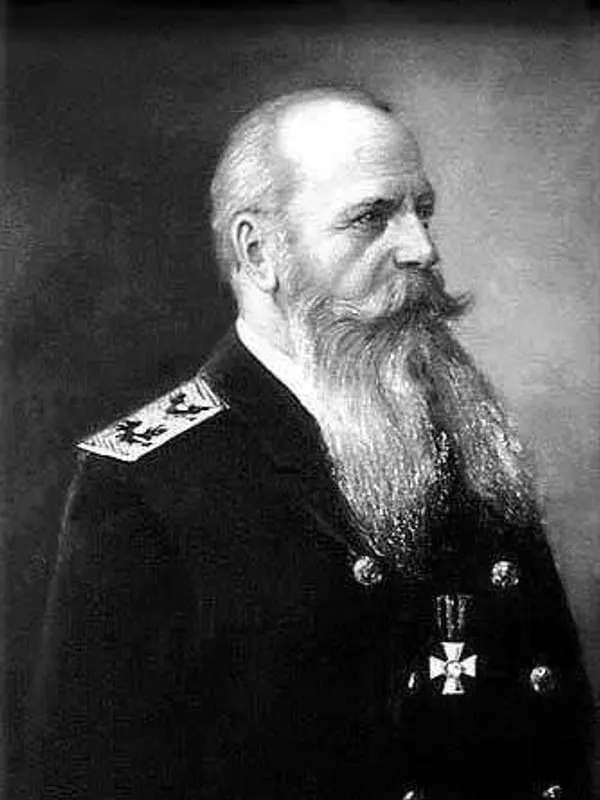
- Born:
- 8 January 1849, Nikolayev (Mykolaiv, Russian Empire)
- Died:
- 13 April 1904, Yellow Sea, off the entrance to Port Arthur
- Author:
- Natalia
- Photo:
- autor nieznany, domena publiczna, Wikimedia Commons

Stepan Makarov was the ablest and most versatile Russian naval commander of his generation. The son of an officer who had risen from the ranks, he built his career without patronage: as a young officer he carried out one of the first successful torpedo attacks in history; then, as a scientist, he studied ocean currents and sailed round the world in a research corvette, invented caps that increased the penetrating power of shells, worked out the principles of ship unsinkability and built the first great Arctic icebreaker. In March 1904 he arrived at Port Arthur to retrieve the fleet’s position after the Japanese attack. Within five weeks he had breathed a new spirit into the squadron, and on 13 April he was killed together with most of the crew of the battleship Petropavlovsk, which struck a Japanese mine. His death deprived Russia of the only admiral who could have challenged Heihachirō Tōgō, and sealed the fate of its fleet in the Far East.
Youth on the Amur
He was born on 8 January 1849 (27 December 1848 by the Julian calendar) in Nikolayev (Mykolaiv) on the Southern Bug, into the family of a naval officer who had begun his service as an ordinary seaman. In 1858 his father was transferred to Nikolayevsk-on-Amur, then Russia’s main base on the Pacific, and there the nine-year-old Stepan began his education at a naval school that trained navigators. While still a pupil he sailed in ships of the Pacific squadron, among other voyages to the coast of America in 1863. In 1866, in the corvette Askold, he sailed from the Far East to the Baltic by way of the Cape of Good Hope. The commander of a ship in which he had served earlier praised him as a young man hungry for knowledge, who repeated all the officers’ astronomical observations for his own instruction.
In 1867, while still a midshipman, he published his first scientific article in Morskoi Sbornik. In 1869, after an accident to the armoured gunboat Rusalka, which ran aground and nearly sank, he took up the problem of ship unsinkability. He proposed dividing the hull into watertight compartments, a network of piping with powerful pumps, and special mats for covering holes. His collision mat was shown at the 1873 World Exhibition in Vienna. He returned to the problem of unsinkability throughout his life.
Torpedoes off Batumi
In 1876, as war with Turkey approached, Makarov transferred to the Black Sea Fleet. Russia had almost no warships there, since for some fifteen years after the Crimean War it had not been allowed to maintain any. Makarov proposed converting the fast passenger steamer Velikiy Knyaz Konstantin into a floating base for small torpedo boats, which she would lower into the water near enemy ports. In the Russo-Turkish War of 1877–1878 his boats attacked Turkish ships several times with spar and towed torpedoes. In December 1877 off Batumi they used self-propelled Whitehead torpedoes in combat for the first time, still without result, and in January 1878 they sank the Turkish guard ship İntibah there. The attack is regarded as the first successful sinking of a ship by a self-propelled torpedo in history. Makarov received the Order of St George, Fourth Class, and became a hero.
In 1880–1881 he organised water transport across the Caspian Sea for General Mikhail Skobelev’s expedition against the Teke Turkmens. As a sign of brotherhood Skobelev exchanged St George’s Crosses with him.
Scientist and inventor
In 1881–1882 Makarov commanded the station ship Taman attached to the embassy in Constantinople. He used the time to take measurements in the Bosporus and showed that two currents flow through the strait: an upper one from the Black Sea and a lower one, running the opposite way, from the Mediterranean. His work on the exchange of waters between the two seas won him a prize from the Academy of Sciences in 1885. In 1886–1889 he commanded the corvette Vityaz on a voyage round the world, during which he took systematic measurements of water temperature, salinity and density, chiefly in the northern Pacific. He published the results in the two-volume The Vityaz and the Pacific Ocean, which secured him a lasting place in the history of oceanography.
In 1890, aged 41, he became a rear admiral, at the time the youngest in the fleet. In 1891–1894 he was Chief Inspector of Naval Artillery, and during this time he invented soft-steel caps for armour-piercing shells, the so-called Makarov caps, which increased their penetrating power. In 1895 he devised the Russian semaphore alphabet. In 1894–1895 he commanded the squadron in the Mediterranean, and when tension with Japan rose after the Sino-Japanese War he took it to the Far East. In 1896 he became a vice admiral. In 1897 he published Discussion of Questions in Naval Tactics, in which he argued that a fleet must act aggressively and always be ready for battle, since war might break out unexpectedly. His motto became the words “Remember the war”.
The Yermak
From the mid-1890s Makarov turned his attention to the Arctic. He argued that a powerful icebreaker could open the Baltic’s freezing ports to shipping, and the sea route along the northern coast of Siberia. Against many sceptics he pushed through the construction of such a vessel. The Yermak, built to his specifications by the British firm of Armstrong Whitworth at Newcastle, reached Kronstadt in March 1899, breaking through the ice of the Gulf of Finland. That same year, and again in 1901, Makarov took her into the Arctic Ocean, in 1901 as far as Franz Josef Land. The voyages showed that still more powerful vessels were needed to navigate heavy polar ice, and for a time Makarov lost the authorities’ confidence. Yet his idea survived: the Yermak served for more than half a century, and in Soviet times the Northern Sea Route became a regular shipping lane.
From December 1899 Makarov was Chief Commander of the naval port and Military Governor of Kronstadt, the main base of the Baltic Fleet. A few days before the outbreak of war with Japan he wrote a memorandum warning that the Japanese might open the war with a surprise torpedo attack on the squadron lying in the outer roadstead at Port Arthur, and pointing out the weaknesses of its defence.
Port Arthur
His fears came true on the night of 8/9 February 1904, when Japanese destroyers torpedoed Russian battleships at Port Arthur and the Russo-Japanese War began. On 14 February the Tsar appointed Makarov commander of the Pacific Fleet, and on 8 March the admiral arrived at Port Arthur. The squadron, whose command under the supervision of the Viceroy Yevgeny Alekseyev had so far mostly sheltered in harbour, was transformed within days. Makarov hoisted his flag in the battleship Petropavlovsk, took ships out to sea almost every day, went out in person aboard a small cruiser to help his destroyers, sped up repairs to the damaged battleships, organised a standing patrol in the roadstead, countered Japanese attempts to block the harbour entrance with blockships and ordered Japanese radio messages to be intercepted. Seamen and officers regained their self-confidence.
On the night of 12/13 April a Japanese minelayer quietly laid mines in the approaches to the harbour, on the route by which the Russian ships put to sea. In the morning the destroyer Strashny, returning from a night patrol, was cut off and sunk by Japanese destroyers. Makarov put to sea with battleships and cruisers to rescue her and then to pursue the Japanese. When Tōgō’s main force appeared on the horizon, he turned back towards the harbour to fight under cover of the coastal batteries. Shortly before ten o’clock the Petropavlovsk struck a mine. The explosion detonated her magazines, and the battleship sank in less than two minutes. Makarov was killed, along with his staff, more than 600 officers and men, and the celebrated battle painter Vasily Vereshchagin, who was accompanying the admiral. Several dozen men were rescued, among them Grand Duke Kirill Vladimirovich, the Tsar’s cousin. That same day another battleship, the Pobeda, also struck a mine but reached harbour.
The admiral’s body was never found. All that remained of Makarov, as a Russian military encyclopedia later put it, was his greatcoat. The wreck was bought by a Japanese businessman in search of valuables, and his men recovered the remains of several sailors, which were buried with military honours in the cemetery at Port Arthur in June 1913. The Russian admiral’s death moved even the Japanese. The young poet Takuboku Ishikawa wrote a poem in honour of the fallen enemy.
After his death
After Makarov’s death the squadron at Port Arthur once again shut itself up in harbour. His successors had neither his authority nor his will to fight. In August the squadron under Rear Admiral Wilhelm Vitgeft tried to break through to Vladivostok and was turned back in the Battle of the Yellow Sea, and in December its remnants were sunk in harbour by Japanese siege artillery. Many historians believe that had Makarov lived, the Russian Pacific fleet would have fought differently, although it is hard to say whether it could have changed the outcome of a war in which Japan had the advantage in ships and training.
In 1913 a monument to Makarov, paid for by public subscription and inscribed “Remember the war”, was unveiled in Kronstadt. His memory survived the revolution. In the Soviet Union he was honoured as a scientist, polar explorer and patriot, and in 1942, during the war with Germany, his Discussion of Questions in Naval Tactics was republished. A succession of ships bore his name, including the cruiser Nürnberg, taken over from Germany after the war and renamed Admiral Makarov. In 1946 the Japanese town of Shiritoru in southern Sakhalin, occupied by the Red Army a year earlier, was renamed Makarov.
Significance
Makarov was a combination rare in the Tsarist navy: an outstanding scientist, inventor and fighting commander. His death in April 1904 was one of the turning points of the Russo-Japanese War. Without him the squadron at Port Arthur ceased to be a threat, the Japanese could ship their armies to Korea and Manchuria unhindered, and Russia had to send the Baltic Fleet to the other side of the world, where it was destroyed at Tsushima. That defeat gave Japan command of the seas of the Far East and opened its way to Korea and Manchuria, and the Japanese navy’s conviction that wars are won by a surprise first blow and a single decisive battle survived all the way to Pearl Harbor.