Japan
Heihachirō Tōgō
Commander of the Combined Fleet (1903–1905), Chief of the Navy General Staff (1905–1909), Marshal-Admiral (gensui, from 1913), head of Crown Prince Hirohito's education (1914–1921)
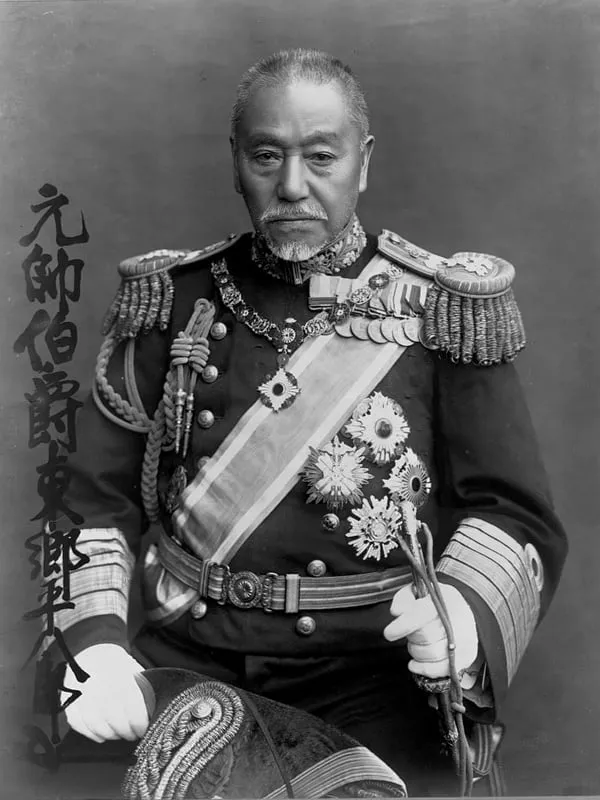
- Born:
- 27 January 1848, Kagoshima (Satsuma Domain, Japan)
- Died:
- 30 May 1934, Tokyo
- Author:
- Natalia
- Photo:
- autor nieznany, domena publiczna, Wikimedia Commons

Heihachirō Tōgō was the most celebrated admiral in Japanese history. In the Russo-Japanese War his Combined Fleet bottled up the Russian squadron in Port Arthur, and on 27 and 28 May 1905, at Tsushima, it destroyed the fleet that had sailed from the Baltic, in one of the most one-sided naval battles in history. Western journalists called him “the Nelson of the East”, and in Japan he became a national hero, revered almost as a deity in his own lifetime. That authority came at a price. When a dispute over the disarmament treaties broke out in the Japanese navy in the 1930s, the aged Tōgō sided with the admirals who demanded a free hand in armaments, and the conviction that a war at sea is decided by one great battle, as at Tsushima, and by a surprise first blow, as at Port Arthur, led the Japanese fleet all the way to Pearl Harbor.
Childhood in Satsuma
He was born on 27 January 1848 in Kagoshima, in the samurai quarter of Kajiya-chō, which produced many leaders of the Meiji era, among them Takamori Saigō and Toshimichi Ōkubo. He was the third of four sons of Kichizaemon Tōgō, a samurai in the service of the Shimazu lords who ruled the Satsuma Domain. As a boy he was called Nakagorō; he took the name Heihachirō when, in his early teens, he underwent the samurai coming-of-age ceremony.
He first encountered war in August 1863, when a British squadron bombarded Kagoshima in retaliation for the killing of an English merchant by Satsuma samurai. The fifteen-year-old Tōgō served at one of the guns defending the harbour. The power of the British warships convinced Satsuma’s leaders that they had to learn from the West, and the domain began to build its own navy. Tōgō joined it in 1866 together with two of his brothers. In the Boshin War he served on the paddle warship Kasuga, which in January 1868 fought the shogunate’s fleet in Awa Bay near Osaka, and in 1869 he took part in the last battles against its remnants in Miyako Bay and at Hakodate in Hokkaido.
Training in England
After the civil war Tōgō studied English in Yokohama and entered the newly founded naval school in Tokyo. In 1871 he was one of a small group of cadets sent to train in Great Britain, where he spent seven years. The Admiralty would not admit the Japanese to the Royal Navy’s officer school, so Tōgō trained on the Worcester, a training ship of the merchant navy school on the Thames, where he passed out second in his year. His fellow cadets nicknamed him “Johnny Chinaman”, which he greatly disliked. In 1875 he sailed round the world as an ordinary seaman on the training ship Hampshire, and then studied mathematics at Cambridge. At that time a serious eye disease nearly cost him his sight. Finally, he supervised the construction of the armoured warship Fusō, ordered by Japan, at a Thames shipyard, and in 1878 returned home aboard the new corvette Hiei.
While he was in England, the Satsuma Rebellion broke out. All three of Tōgō’s brothers fought on Saigō’s side; two were killed in battle and the third died soon after the defeat. His British years shaped him for life. For the rest of his career Tōgō regarded the Royal Navy as his model, read and wrote English, and admired Nelson.
Captain of the Naniwa
On his return he commanded a succession of ships. During the Sino-French War of 1884–1885 he observed the operations of the French fleet off the coast of China and Taiwan from the deck of the gunboat Amagi. In the late 1880s he was seriously ill with rheumatism for nearly three years and used the time to study international law.
In 1891 he took command of the cruiser Naniwa, one of the most modern ships in the fleet. On 25 July 1894, a week before the formal outbreak of the war with China, in an engagement off the island of Pungdo on the Korean coast, the Naniwa stopped the British steamer Kowshing, chartered by the Chinese, which was carrying about a thousand Chinese soldiers to Korea. The Chinese would not allow the British officers to surrender the ship, so Tōgō had her sunk. Most of the soldiers on board died, and according to survivors the Japanese also fired on men struggling in the water. The sinking of a ship under the British flag caused outrage in London, but British lawyers concluded that Tōgō had acted in accordance with the laws of war, and the affair died down. In September the Naniwa fought in the Battle of the Yalu River, in which the Japanese defeated the Chinese fleet. In 1895 Tōgō became a rear admiral; he then headed the Naval War College in Tokyo, was promoted to vice admiral in 1898, and in 1900–1901, during the Boxer Rebellion, commanded warships in Chinese waters.
The war with Russia
At the end of December 1903, with war against Russia in the air, the Navy Minister Gonnohyōe Yamamoto appointed Tōgō commander of the Combined Fleet, that is, of all the naval forces earmarked for the war. The choice surprised many officers and reportedly Emperor Meiji (Mutsuhito) himself. Yamamoto is said to have replied that Tōgō was a lucky man.
On the night of 8–9 February 1904, Tōgō’s destroyers attacked the Russian squadron in the roadstead of Port Arthur without a declaration of war, opening the Russo-Japanese War. They damaged two battleships and a cruiser but did not destroy the Russian squadron. Over the following months Tōgō blockaded Port Arthur, tried to seal the harbour entrance with blockships and laid mines, on one of which the Russian commander, Admiral Stepan Makarov, was killed in April. Russian mines in turn sank two of his six battleships in May. On 10 August, in the Battle of the Yellow Sea, he turned back to Port Arthur the Russian squadron that was trying to break through to Vladivostok. He did not dare to pursue it, however, as he did not want to risk his ships before meeting the fleet sailing from Europe. The remnants of the squadron were sunk in December by Japanese siege artillery.
On 27 May 1905 Tōgō was waiting in the Korea Strait for the Russian Second Pacific Squadron of Vice Admiral Zinovy Rozhestvensky. As the fleets closed, the “Z” flag was hoisted on the mast of his flagship Mikasa, which by the agreed code meant: “The fate of the Empire rests on the outcome of this battle. Let every man do his utmost.” Tōgō then carried out a risky turn under fire that placed his line across the Russian column and allowed him to concentrate his fire on its leading ships. In the Battle of Tsushima the Russians lost all their battleships, sunk or captured, and more than 5,000 killed; the Japanese lost three torpedo boats and just over a hundred men. Tōgō afterwards visited the wounded Rozhestvensky in hospital at Sasebo and consoled him that defeat is a soldier’s lot and that there is nothing shameful in it if one has done one’s duty. Tsushima settled the end of the war, which was concluded by the Treaty of Portsmouth.
In December 1905, when the Combined Fleet was disbanded, Tōgō delivered an address that ended with an old proverb: “After victory, tighten your helmet strap.” President Theodore Roosevelt was reportedly so taken with it that he had it translated and distributed to the officers of the US Navy.
After the war
From 1905 to 1909 Tōgō was Chief of the Navy General Staff. In 1907 he was made a count, and in 1913 he received the dignity of Marshal-Admiral (gensui), which meant lifelong service and a place among the Emperor’s closest military advisers. In 1911, together with General Maresuke Nogi, he accompanied a Japanese prince to the coronation of George V and visited his old school on the Worcester, to which he presented a flag from Tsushima. After Nogi’s suicide in 1912 he took over from him responsibility for the education of the heir to the throne, the future Emperor Hirohito. From 1914 to 1921 he headed a special school in which the young prince was taught with a few boys of his own age. Hirohito, however, never grew as close to him as he had been to Nogi.
Honours came to him from all over the world. The British awarded him the Order of Merit in 1906, and in 1925 Poland conferred on him the Grand Cross of the Order of Polonia Restituta. In 1926 he received the Collar of the Order of the Chrysanthemum, which at the time was held, apart from him, only by the heir to the throne and one of the imperial princes.
The god of the navy
Tōgō used to say that a military man should not meddle in politics, but in the last years of his life he played an important part in it. After the Washington Treaty of 1922, which limited Japan’s battleship fleet to 60 per cent of the American and British fleets, a dispute grew within the navy. The so-called Treaty Faction believed that Japan could not afford an arms race with America. The Fleet Faction, grouped around Admirals Kanji Katō and Nobumasa Suetsugu, demanded that the limits be thrown off. In 1930, when the government of Prime Minister Osachi Hamaguchi accepted the London Treaty, which also limited cruisers, Tōgō sided with its opponents. The dispute grew into a political crisis in which the government was accused of infringing the prerogatives of the high command answerable to the Emperor, and a few months later Hamaguchi was seriously wounded in an assassination attempt, as a result of which he died in 1931.
In the years that followed, Tōgō and Prince Hiroyasu Fushimi, Chief of the Navy General Staff from 1932, acted as patrons of the Fleet Faction. In the Navy Ministry they were referred to ironically as “His Highness and God”. Their backing helped to drive out of the navy many of the admirals who defended the treaties. Admiral Shigeyoshi Inoue, one of the opponents of war with America, later recalled that whenever Tōgō interfered in peacetime matters, something bad came of it, and warned that a man must never be turned into a god, because a god cannot be criticised.
Death and legend
Tōgō suffered from throat cancer. The day before his death the Emperor raised him to the rank of marquis, and on 30 May 1934 he died in Tokyo at the age of 86. Warships from Great Britain, the United States, France, Italy, the Netherlands and China came for his state funeral. In December of that year Japan gave notice that it was renouncing the Washington Treaty; two years later all limits on naval armaments lapsed and an arms race began that ended in the Pacific War. In 1940 the Tōgō Shrine was built in his honour in Tokyo, although in his lifetime he had opposed any idea of deifying him.
His legend lived on in a navy that was preparing for one great, decisive battle with the American fleet on the model of Tsushima. On 7 December 1941 the “Z” flag was hoisted once again, on the mast of the aircraft carrier Akagi, from which aircraft took off for the attack on Pearl Harbor – a strike planned by Admiral Isoroku Yamamoto, who as a young officer had lost two fingers at Tsushima. Tōgō’s grandson was killed in 1944 aboard the cruiser Maya in the Battle of Leyte Gulf. After the war the American admiral Chester Nimitz, an admirer of Tōgō, helped to save the neglected battleship Mikasa, which has been a museum at Yokosuka since 1961.
Significance
Tōgō was a model naval commander of his time: calm, meticulous, bold in his decisions when the situation demanded it, and sparing with words. His victories made Japan a great naval power and opened the way for it to Korea and Manchuria. The memory of Tsushima, however, became a trap for the next generation of Japanese officers. It confirmed them in the belief that a war against a stronger opponent could be won by a surprise attack and a single decisive battle, and the old admiral’s authority served the men who in the 1930s rejected limits on armaments and pushed Japan towards a confrontation with the United States and Great Britain. On land, the same war was won by Marshal Iwao Ōyama, who defeated the armies of Aleksey Kuropatkin in Manchuria. It was with him that Tōgō shared in Japan the fame of the greatest hero of that war.
Sources
Commanded in battles
(01)Mentioned in battles
(01)Often appears with
People who appear in the same events.