Russia
Yevgeny Alekseyev
Chief of the Kwantung Region and commander of naval forces in the Pacific (1899–1903), Viceroy of the Far East (1903–1905), commander-in-chief in the war with Japan (1904)
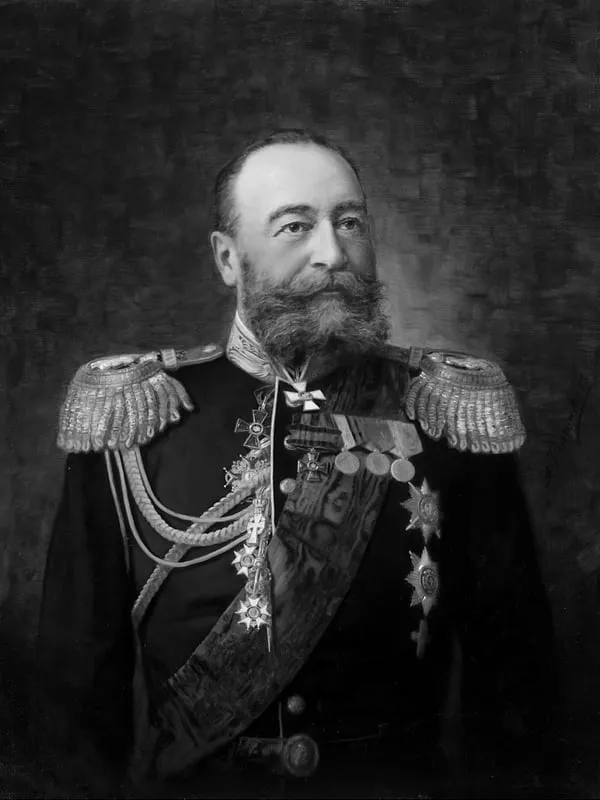
- Born:
- 23 May 1843, Sevastopol (Russian Empire)
- Died:
- 9 June 1917, Yalta
- Author:
- Natalia
- Photo:
- Alexander Fedorovich Pershakov, domena publiczna, Wikimedia Commons

Yevgeny Alekseyev was the man into whose hands Tsar Nicholas II placed the whole of Russia’s Far Eastern policy in 1903. An admiral who had built his career on court connections and long voyages, from 1899 he governed the Kwantung Peninsula, leased from China, with Port Arthur, and in the summer of 1903 he became the Tsar’s viceroy, with authority over the army, the fleet and diplomacy in the region. He belonged to the faction that wanted to hold on to Manchuria and push into Korea, and he assured the Tsar that Japan would not dare go to war. When war broke out, as commander-in-chief he quarrelled with the army commander, Aleksey Kuropatkin, over every decision. After several months of defeats the Tsar recalled him. Port Arthur, which Alekseyev had built up as Russia’s bastion on the Yellow Sea, passed into Japanese hands and became one of the pillars of Japanese power in Manchuria.
Origins and youth
He was born in Sevastopol on 23 May 1843 (11 May in the Julian calendar). He was brought up in the family of a naval officer, Ivan Alekseyev, who died when the boy was six. All his life he was dogged by the rumour that he was in fact the illegitimate son of the heir to the throne, the future Emperor Alexander II. Some encyclopaedias repeat it, but there is no evidence for it, and his remarkable career can just as well be explained by the patronage he enjoyed at court.
In 1856 he entered the Naval Cadet Corps in St Petersburg, graduating in 1863. Immediately afterwards he set off as a midshipman in the corvette Varyag on a three-year voyage round the world, during which he visited the coasts of North America, China and Japan. In 1867 he became a lieutenant. In the 1870s he served in ships in the Mediterranean and the Atlantic, among them the frigate Svetlana, commanded by Grand Duke Alexei Alexandrovich, brother of the future Tsar Alexander III and from 1881 head of the entire Russian navy. The Grand Duke’s patronage later opened one door after another for him.
A career at sea and at court
From 1878 he commanded the cruiser Afrika, in which he served in the Pacific in 1880–1883. In 1883 he went to France as representative of the Russian Naval Ministry and spent several years there, at the time when the Franco-Russian rapprochement was beginning. In 1886 he became a captain 1st rank, and in 1889–1891 he commanded the cruiser Admiral Kornilov on what was already Alekseyev’s third voyage round the world. According to some biographers his ship accompanied the Tsesarevich Nicholas at that time on his journey to the Far East, during which the future tsar got to know Japan and was nearly killed by a Japanese policeman at Ōtsu.
In 1892 Alekseyev became a rear admiral and deputy chief of the Main Naval Staff. In 1895–1897 he commanded the Pacific squadron, at the time when Russia, after the Sino-Japanese War, together with France and Germany forced Japan to give back the Liaodong Peninsula. The crew of one of his cruisers then named a peninsula on the east coast of Korea after him. In 1897 he was promoted to vice admiral and took command in the Black Sea for two years.
Master of Port Arthur
In March 1898 Russia leased from China the tip of the Liaodong Peninsula, with the naval base of Port Arthur and the commercial port of Dalny that was being built next to it. In August 1899 the Kwantung Region was created there, and Alekseyev became its chief and commander of its troops, as well as commander of Russian naval forces in the Pacific. Under his rule Port Arthur was built up into a fortress and fleet base, with docks, barracks and a European quarter.
In 1900 the Boxer Rebellion broke out in northern China. Alekseyev directed Russia’s part in the international intervention: his ships and troops took part in the capture of the Dagu (Taku) forts at the mouth of the Hai River, in the fighting for Tianjin and in the march on Beijing, for which he received a gold sword set with diamonds and inscribed “Taku, Tientsin, Peking 1900”, and the rank of adjutant general to the Tsar. At the same time Russian troops, on the pretext of protecting the Chinese Eastern Railway then under construction, occupied the whole of Manchuria. When the rebellion collapsed, Russia was in no hurry to withdraw them.
Viceroy
Two policies were then contending in St Petersburg. The Minister of Finance, Sergei Witte, wanted to bring Manchuria under Russian control peacefully, through the railway, banks and trade, and to avoid a quarrel with Japan. A group centred on a former Guards officer, Alexander Bezobrazov, which had gained the Tsar’s ear, wanted to use a timber concession on the border river Yalu to push into northern Korea, and demanded a hard line towards Tokyo. Alekseyev was among its most important allies. In July 1903 a conference was held at Port Arthur with Alekseyev, Bezobrazov, the War Minister Kuropatkin and the Russian minister in Seoul, which decided to support Korea in refusing to open the Yalu ports to the Japanese, but without risking war.
On 12 August 1903 (30 July in the Julian calendar) the Tsar appointed Alekseyev Viceroy of the Far East, and soon afterwards also made him a full admiral. The viceroy received authority over the Kwantung Region, Russia’s possessions on the Amur and the Pacific and the troops in Manchuria, as well as the conduct of diplomatic relations with China, Japan and Korea. He answered only to the Tsar and to a special committee on Far Eastern affairs, which the Tsar himself chaired. The ministers in St Petersburg lost their influence over the region’s affairs, and in August Witte lost his post as Minister of Finance. The British historian Ian Nish points out that the scope of the viceroy’s powers was never clearly defined and that Alekseyev himself was not delighted with his new title.
For the Japanese the appointment was a clear signal that Russia had no intention of giving way. In the negotiations that went on from August 1903, Russian replies passed through the viceroy’s hands and arrived weeks late. Alekseyev regarded Japan as a weak opponent and assured the Tsar that firmness would not provoke war, yet at the same time he failed to prepare either the fleet or the fortress for one. The Russian squadron lay in the outer roadstead of Port Arthur, poorly protected against torpedo attack, when Japanese destroyers struck it on the night of 8–9 February 1904.
Commander-in-chief
With the outbreak of the Russo-Japanese War Alekseyev became commander-in-chief of all land and naval forces in the Far East. From the spring of 1904 the army in Manchuria was commanded by Kuropatkin, who wanted to fall back and wait for reinforcements from European Russia. Alekseyev demanded action, the defence of Port Arthur and a swift offensive. This dual command, in which the two commanders had different plans and both wrote to the Tsar, paralysed Russian leadership.
After the death of Admiral Stepan Makarov in April 1904, Alekseyev himself commanded the squadron at Port Arthur for several weeks. For directing the repulse of Japanese attacks on the port he later received the Order of St George, 3rd class. On 5 May, on the Tsar’s orders, he left the fortress for Mukden, at the last moment before the Japanese, who were just landing on the Liaodong Peninsula, cut the railway. From Mukden he pressed Kuropatkin to send a corps to relieve the fortress, which ended in defeat at Telissu in June. On his instructions, in line with the Tsar’s wishes, Rear Admiral Wilgelm Vitgeft’s squadron tried in August to break through to Vladivostok and at the Battle of the Yellow Sea was driven back to Port Arthur.
After the defeat at Liaoyang and the indecisive battle on the Shaho River, in October 1904 the Tsar abandoned the dual command. Kuropatkin became commander-in-chief and Alekseyev was recalled to St Petersburg. In June 1905, after Mukden and Tsushima, the viceroyalty was abolished as well.
Last years
On his return Alekseyev became a member of the State Council, the upper house of the Russian parliament, and received further high orders: the Order of St Alexander Nevsky in 1908 and the Order of St Vladimir, 1st class, in 1915. He played no further political role of any importance. In public opinion, and in the memoirs of Witte and Kuropatkin, he was regarded as one of the chief culprits for the war and the defeat. After the February Revolution and the abdication of Nicholas II he retired in the spring of 1917. He died a few weeks later, on 9 June 1917 (27 May in the Julian calendar), in Yalta in the Crimea, and was buried there. He never married.
Significance
Alekseyev was a typical member of the court elite of late tsarism: a worldly officer and a capable administrator, but a man who owed his career to patronage and who, together with the Tsar, underestimated Japan. As viceroy he embodied a policy that, instead of reaching an understanding with Tokyo over the division of Korea and Manchuria, chose a hard line without preparing for war. The defeat of which he was one of the authors drove Russia to the revolution of 1905 and gave Japan everything he had built. Under the Treaty of Portsmouth Port Arthur and Dalny passed to the Japanese, and the garrison guarding the leased territory and the railway grew into the Kwantung Army, which in 1931 began the conquest of Manchuria. Port Arthur returned to Russian hands only in August 1945, when the Red Army occupied Manchuria, and the Soviet fleet used it as a base until the mid-1950s.