1904–1905: The Russo-Japanese War
The Russo-Japanese War
- Dates:
- 8 February 1904 – 5 September 1905
- Front:
- Far East
- Location:
- Manchuria (north-eastern China), the Liaodong Peninsula with Port Arthur, Korea, the Yellow Sea, the Korea Strait and the Sea of Japan, Sakhalin IslandOn the battle map →
- Sides:
- Result:
- Japanese victory. Under the Treaty of Portsmouth Russia recognised Japan's paramount position in Korea and ceded to it Port Arthur, the railway in southern Manchuria and southern Sakhalin.
- Author:
- Łukasz
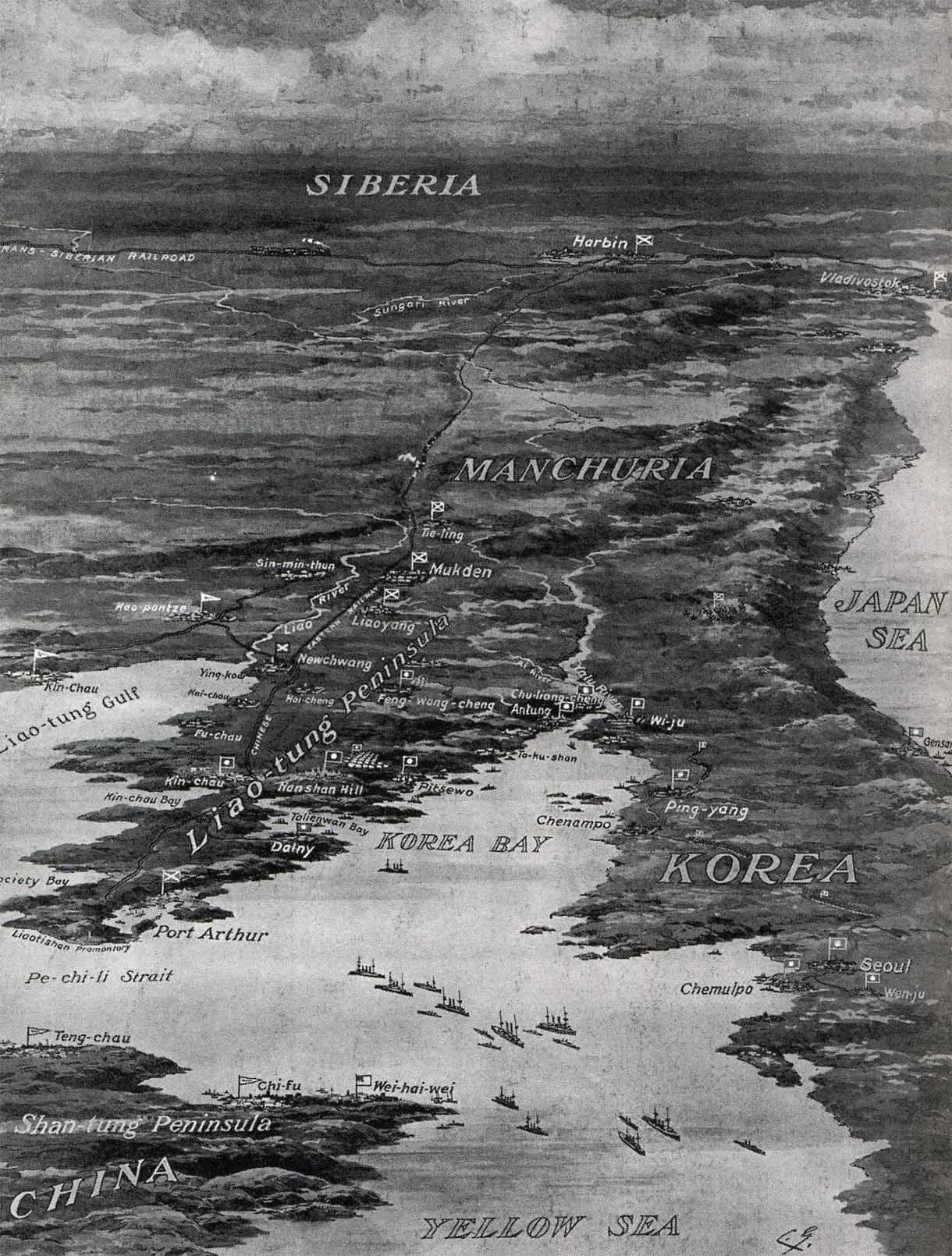
The Russo-Japanese War was the first great war between major powers in the twentieth century, and the first in modern times in which an Asian state defeated a European great power. It was fought over Korea and Manchuria – lands that formally belonged to Korea and China, but whose fate was being decided by foreign armies. During the night of 8–9 February 1904 Japanese torpedo boats attacked the Russian squadron at Port Arthur. Over the next eighteen months the Japanese beat the Russians on land in Korea and Manchuria, took Port Arthur after a five-month siege, won at Mukden in February and March 1905 one of the largest land battles in history up to that time, and in May, at Tsushima, destroyed the fleet that had sailed from the Baltic around Africa. Both sides, exhausted, accepted the mediation of the President of the United States and made peace at Portsmouth on 5 September 1905. Japan emerged from the war as a great power, with a free hand in Korea and a foothold in southern Manchuria from which, a quarter of a century later, it set out to conquer China. Russia emerged humiliated and engulfed in revolution.
Name and dates
Most Polish and Western works date the war from 8 February 1904 to 5 September 1905. It began without a declaration. Japan broke off diplomatic relations with Russia on 6 February, and during the night of 8–9 February its torpedo boats attacked the ships lying in the outer roads of Port Arthur. In Russia, which still used the Julian calendar, this was the night of 26–27 January, and it is under that date that Russian sources record the outbreak of the war. The formal declarations came only afterwards: the Tsar’s manifesto on the war is dated 9 February (27 January by the Julian calendar) and the Japanese imperial rescript 10 February. For this reason some works give 9 or 10 February as the start of the war.
The end of the war is taken to be the signing of the peace treaty at Portsmouth on 5 September 1905 (23 August by the Julian calendar). There had been no major fighting since the summer, when the Japanese occupied Sakhalin, and the peace came into force after ratification in October 1905.
Background
In the second half of the nineteenth century Japan travelled, within a single generation, from a closed feudal state to a modern great power with a conscript army modelled on Germany’s and a navy built to British patterns. Its leaders regarded Korea as the key to the islands’ security: in foreign hands the peninsula would be, as the saying went, a dagger pointed at the heart of Japan. In the First Sino-Japanese War of 1894–1895 Japan drove Chinese influence out of Korea, and by the Treaty of Shimonoseki it gained Taiwan and the Liaodong Peninsula in southern Manchuria. A few days later Russia, France and Germany “advised” it to return Liaodong to China. Japan, which could not afford a war with three great powers at once, gave way, but it did not forget the humiliation for a long time.
Russia took China’s place. In Korea it backed Queen Min, who looked to the Russians for support against the Japanese. In October 1895 the queen was murdered in her palace in Seoul by Japanese agents and soldiers, and a few months later her husband, King Gojong, fled to the Russian legation and for a year ruled the country under the protection of the Tsar’s diplomats. In 1896 Russia obtained China’s consent to build the Chinese Eastern Railway, a short cut across Manchuria for the Trans-Siberian Railway on its way to Vladivostok. In March 1898 it leased for 25 years the tip of the Liaodong Peninsula – the very territory it had taken from Japan three years earlier – with the ice-free naval base of Port Arthur and the commercial port of Dalny being built next to it. A southern branch of the railway was laid from Harbin to Port Arthur. The strip of land along the line had a Russian administration and its own guard, and quickly became a state within a state.
In 1900, during the Boxer Rebellion, Russian troops occupied the whole of Manchuria. In April 1902 Russia undertook to withdraw them in three stages over eighteen months, but after the first stage it halted the evacuation. At the court of Tsar Nicholas II the upper hand passed to a group of adventurers gathered around a former Guards officer, Alexander Bezobrazov, who wanted to exploit the forests along the border river Yalu and draw the state into the venture. In the summer of 1903 the Tsar created a Viceroyalty of the Far East headed by Admiral Yevgeny Alekseyev, to whom he subordinated the army, the navy and diplomacy in the region, bypassing the ministers in St Petersburg. The Finance Minister, Sergei Witte, an opponent of the Korean adventure, lost his post. The War Minister, Aleksey Kuropatkin, who visited Japan in June 1903, was cautious too. The Tsar, however, did not believe that the “macaques”, as he called the Japanese, would dare to go to war. He was encouraged in this by his cousin, Kaiser Wilhelm II, who wrote in his letters about the “yellow peril” and urged him to expand in Asia, hoping that Russia would turn its attention away from Europe.
Japan had been preparing for a confrontation for years. On 30 January 1902 it concluded an alliance with Great Britain, which guaranteed that if any other power helped Russia in a war, the British would side with Japan. Talks with Russia, under way since August 1903, foundered on the linkage between Korea and Manchuria. The Japanese proposed that Russia recognise their paramount position in Korea in return for Japanese recognition of Russian railway interests in Manchuria. The Russians replied that Manchuria lay entirely outside the Japanese sphere, and wanted to turn northern Korea, above the 39th parallel, into a neutral zone. Replies from St Petersburg arrived weeks late. The elder statesmen Hirobumi Itō and Kaoru Inoue warned against war, but the Prime Minister, Tarō Katsura, the Foreign Minister, Jutarō Komura, and Field Marshal Aritomo Yamagata believed that time was on the side of Russia, which with every month was moving fresh troops east along the Trans-Siberian Railway. On 4 February 1904 a conference attended by Emperor Mutsuhito – the Meiji Emperor – decided on war, and on 6 February Japan broke off relations with Russia.
Forces and plans
On paper Russia was incomparably stronger. Its peacetime army numbered more than a million men, and the empire’s population was three times that of Japan. In the Far East, east of Lake Baikal, however, it had at the outbreak of war only some 100,000–150,000 men, scattered from Vladivostok to Port Arthur, and a large part of them were guarding the railway and fortresses. Reinforcements could arrive only by the single-track Trans-Siberian Railway, which was still unfinished around Baikal. The journey from European Russia to Manchuria took several weeks, and in the first months of the war the line could handle only a few pairs of trains a day. The Russian plan therefore relied on defence and delay: the troops in Manchuria were to fall back and wait for reinforcements, and go over to the offensive only after several months.
Japan could field 13 divisions at once, and with its reserves it had several hundred thousand trained soldiers under arms. At sea the forces were evenly matched. The Russian Pacific Squadron at Port Arthur and Vladivostok had seven battleships; Vice Admiral Heihachirō Tōgō’s Combined Fleet had six modern battleships, built in Britain, and more armoured cruisers. Russia had two more fleets in Europe, but the Black Sea Fleet was shut in by the Turkish Straits and the Baltic Fleet would have had to sail halfway round the world. The Japanese plan therefore depended on speed. The navy was first to paralyse the Russian squadron at Port Arthur and give the army free passage for its troops across the sea. The army was to occupy Korea, land in southern Manchuria, cut off and take Port Arthur, and destroy the main Russian forces before they had time to grow.
Course of the war: 1904
The outbreak of war. During the night of 8–9 February Japanese destroyers made a torpedo attack on the ships lying in the outer roads of Port Arthur. They damaged the two most powerful battleships, Tsesarevich and Retvizan, and the cruiser Pallada. In the morning Tōgō approached the port with his main force, but in an engagement with the Russian ships and shore batteries he achieved little and withdrew. The same day a Japanese squadron under Rear Admiral Sotokichi Uryū forced into action the cruiser Varyag and the gunboat Koreets, which were lying in the Korean port of Chemulpo. After a short battle their crews scuttled both ships. The first units of General Tamemoto Kuroki’s Japanese First Army were already landing at Chemulpo. The Japanese occupied Seoul, and on 23 February forced the Korean government, which had declared neutrality in January, to sign a protocol allowing them to use Korean territory for military purposes. By the end of April the First Army stood on the Yalu.
The blockade of Port Arthur. Several times the Japanese tried to block the harbour entrance by sinking old ships in the channel, but without success. In March Vice Admiral Stepan Makarov, the ablest Russian naval commander, arrived at Port Arthur, put new life into the squadron and took it out to sea. On 13 April his flagship, Petropavlovsk, struck Japanese mines and sank within a few minutes. Makarov was killed, together with more than 600 sailors and the battle painter Vasily Vereshchagin. After his death the squadron again shut itself up in harbour. The Russians repaid the Japanese in kind: on 15 May two of the six Japanese battleships, Hatsuse and Yashima, sank on mines laid by the minelayer Amur.
The Yalu, and Port Arthur cut off. On 30 April and 1 May Kuroki forced the Yalu and in the Battle of the Yalu River routed General Mikhail Zasulich’s Russian Eastern Detachment. It was the first land battle of the war and the first victory in a long time of an Asian army over a European one, and it made an impression around the world. From 5 May General Yasukata Oku’s Second Army landed on the Liaodong Peninsula. It cut the railway linking Port Arthur with Manchuria, and on 26 May, in the Battle of Jinzhou – known to the Japanese as the Battle of Nanshan – it took, at the cost of several thousand killed and wounded, the fortifications on the isthmus that barred the way to the fortress. A few days later the Japanese occupied the almost undamaged port of Dalny, today’s Dalian, through which they thereafter supplied the army besieging Port Arthur. Under pressure from the Viceroy Alekseyev and the Tsar, Kuropatkin, who commanded the Manchurian Army, sent General Georgy Stackelberg’s corps south to relieve the fortress, but on 14–15 June Oku threw it back in the Battle of Telissu (Wafangou).
The siege of Port Arthur. The newly formed Third Army under General Maresuke Nogi moved up to the fortress. The siege began in earnest in August. Port Arthur was defended by a garrison of some 50,000 men including the sailors, and command was divided between General Anatoly Stessel, the commandant of the fortress, and the naval commanders. The soul of the defence was General Roman Kondratenko. The first general assault, on 19–24 August, broke down under machine-gun and artillery fire, and the Japanese lost well over ten thousand men. Nogi turned to a regular siege, with saps, mines and fire from heavy 280-millimetre howitzers brought from Japan, but the further assaults in the autumn again ended in slaughter. Meanwhile, on 10 August, the squadron, now under Rear Admiral Wilgelm Vitgeft, tried on the Tsar’s orders to break through to Vladivostok. In the Battle of the Yellow Sea a shell from a Japanese battleship killed Vitgeft on the bridge of his flagship; the squadron lost formation and returned to port, and several ships escaped to neutral harbours, where they were interned. Four days later Vice Admiral Hikonojō Kamimura’s cruisers defeated the Vladivostok cruiser squadron off Ulsan and sank the Rurik.
The key to the fortress proved to be Hill 203, from which the harbour could be seen. After ten days of bloody fighting the Japanese took it on 5 December. Nogi lost his younger son there (the elder had been killed at Jinzhou in May), and the 7th Division, which had stormed the hill, was almost wiped out. With an observer on the summit, the heavy howitzers sank the remnants of the squadron in the harbour within a few days. On 15 December Kondratenko was killed by a shell. As more forts fell, Stessel, without consulting most of his officers, asked for terms and surrendered the fortress on 2 January 1905. Some 24,000 soldiers and officers went into captivity, more than ten thousand of them sick and wounded, and the Japanese found considerable stocks of food and ammunition in the depots. Stessel was later sentenced to death in Russia; the Tsar commuted the sentence to imprisonment, from which he was soon released.
Liaoyang and the Shaho. In the main theatre in Manchuria command of the Japanese armies was taken by Field Marshal Iwao Ōyama, with General Gentarō Kodama as his chief of staff. In the summer three Japanese armies – Kuroki’s First, Oku’s Second and General Michitsura Nozu’s Fourth – advanced on Liaoyang, the main Russian base in southern Manchuria. The battle lasted from 25 August to 3 September. The Russians had the advantage in numbers and for several days repulsed attacks from the south, but when Kuroki crossed the Taizi River and threatened their line of retreat to the north, Kuropatkin, overestimating the enemy’s strength, ordered a withdrawal to Mukden. He retreated in good order and lost no guns, but the battle, in which the two sides together lost some 40,000 men, was a heavy blow to Russian morale. In October Kuropatkin attempted an offensive. The Battle of the Shaho River, from 5 to 17 October, ended indecisively and cost the Russians more than 40,000 and the Japanese about 20,000 killed and wounded. The two armies dug in facing each other for the winter. In October the Tsar appointed Kuropatkin commander-in-chief of all land and naval forces in the Far East in place of Alekseyev.
The Baltic Fleet sets out. On 15 October Vice Admiral Zinovy Rozhestvensky’s Second Pacific Squadron, made up of ships of the Baltic Fleet, left Libau; its task was to regain command of the sea. As early as the night of 21–22 October, in the North Sea, Russian ships mistook British fishing trawlers for Japanese torpedo boats and opened fire on them, killing two fishermen. The Dogger Bank incident brought Russia and Britain to the brink of war, and only an international commission of inquiry defused the tension. The squadron sailed on by two routes: the new battleships around Africa, the older ships through the Suez Canal. News of the fall of Port Arthur, its intended destination, reached it in Madagascar.
Course of the war: 1905
Revolution in the background. On 22 January 1905 (9 January by the Julian calendar) troops in St Petersburg fired on a peaceful procession of workers who were marching to the Tsar with a petition. Bloody Sunday unleashed a revolution that over the following months engulfed the towns and the countryside and, in the end, the army and navy as well. From then on the Tsar had to wage war on two fronts, against Japan and against his own society. In the Kingdom of Poland, where conscription for the army bound for Manchuria and a crisis in the Łódź industry, cut off from its Far Eastern markets, had sharpened discontent, the revolution took a particularly violent form. As early as 1904 two Poles had travelled separately to Tokyo: Józef Piłsudski, seeking Japanese help for an uprising, and Roman Dmowski, who warned against one. The Japanese gave the PPS (the Polish Socialist Party) some financial help, but approached the Polish question with caution.
Sandepu. At the end of January the Russians tried to strike before Nogi’s army could arrive from Port Arthur to join Ōyama. In the Battle of Sandepu, on 25–29 January, General Oskar Grippenberg’s Second Army took the Japanese left wing by surprise, but without support from its neighbours it stalled, and Kuropatkin ordered the attack broken off. Grippenberg, accusing the commander-in-chief of sabotaging his victory, left the army.
Mukden. The decisive land battle of the war was fought at Mukden, today’s Shenyang. The battle lasted from 20 February to 10 March 1905, on a front more than a hundred kilometres long. More than half a million soldiers took part: some 270,000 on the Japanese side and some 300,000 on the Russian. Ōyama intended to envelop the Russians from both flanks. He struck first at the eastern wing, and when Kuropatkin shifted his reserves there, Nogi’s Third Army began to outflank the Russian western wing and work round into the rear, north of Mukden, towards the only railway. Kuropatkin moved units from place to place, breaking up his formations, and his counter-attacks were late and weak. On the evening of 9 March, during a sandstorm, with the Japanese closing on the railway from both sides, he ordered a general retreat. On 10 March the Japanese entered Mukden. In places the retreat turned into flight. The Russians lost some 90,000 men, including more than 20,000 prisoners, and the Japanese some 70,000 killed and wounded. The encirclement, however, failed: the Russian army survived and halted only at Sipingjie, two hundred kilometres to the north. Kuropatkin was removed from the supreme command and replaced by General Nikolai Linevich. The Japanese, who had lost their best soldiers and officers and exhausted their reserves, no longer had the strength to pursue. 10 March was later celebrated in Japan as Army Day.
Tsushima. After a stay of several weeks off the coast of Madagascar, in the roads of Nosy Be, the Russian squadron crossed the Indian Ocean to the coast of French Indochina, where in May it was joined by a squadron of old ships under Rear Admiral Nikolai Nebogatov. Since Port Arthur no longer existed, Rozhestvensky headed for Vladivostok by the shortest route, through the Korea Strait. On the morning of 27 May a Japanese armed merchant cruiser sighted him, and Tōgō came out to meet him with the whole Combined Fleet. On the mast of the battleship Mikasa the “Z” flag was hoisted, standing for a pre-arranged signal: “The fate of the Empire depends on the outcome of this battle. Let every man do his utmost.” In the afternoon Tōgō made a turn that placed his line across the Russian column, and concentrated his fire on the Russian flagships. The Japanese ships were faster, their gunners better trained and their shells more powerful. Rozhestvensky was wounded and lost consciousness, and by evening four Russian battleships had gone down. During the night Japanese destroyers and torpedo boats finished off the fleeing ships, and on the morning of 28 May Nebogatov, surrounded by the Japanese fleet, surrendered the rest of his force. The Battle of Tsushima was the most one-sided major naval battle of the battleship era. The Russians lost all their battleships, sunk or captured, more than 5,000 killed and some 6,000 prisoners, among them both admirals. Only a cruiser and two destroyers reached Vladivostok. The Japanese lost three torpedo boats and just over a hundred killed.
Sakhalin and peace. After Tsushima Japan, whose money and manpower were running out, secretly asked President Theodore Roosevelt to mediate. On 8 June Roosevelt invited both sides to talks. After long hesitation the Tsar agreed. To have Russian territory in hand, the Japanese landed on Sakhalin in July and by the end of the month had taken the island, which was defended mainly by poorly trained units made up largely of convicts. In August the negotiations opened at the Portsmouth Navy Yard, which lies on an island within the boundaries of Kittery, Maine, across the river from the town of Portsmouth, New Hampshire. Russia was represented by Witte, Japan by Komura. Russia was ready to give way over Korea and Manchuria, but refused to pay an indemnity or to cede the whole of Sakhalin. Japan, which could not carry on the war and faced an ever stronger Russian army in Manchuria, gave way. The treaty signed on 5 September granted it a paramount position in Korea, the Russian lease of Port Arthur and Dalny, the railway from Changchun to Port Arthur, and the southern half of Sakhalin, up to the 50th parallel. Both sides were to withdraw their troops from Manchuria, except from the leased territory and the railway guard. In Japan, where public opinion, fed on news of one victory after another, had expected an indemnity and the whole of Sakhalin, the news of the peace terms set off several days of rioting in Tokyo in which more than a dozen people were killed, and the government declared martial law in the capital.
Losses
The casualty figures given in the literature vary considerably. Japan lost some 80,000–90,000 killed and dead, of whom about 27,000 died of disease, above all beriberi, and the number of wounded reached 150,000–170,000. Estimates of Russian losses range from about 45,000 to more than 70,000 killed and dead of wounds and disease, depending on how the missing and the navy’s losses are counted. More than 70,000 Russians fell into Japanese hands, most of them at Port Arthur, Mukden and Tsushima. The prisoners were well treated, because Japan wanted to show the world that it waged war according to the rules of civilised nations. The least well documented are the losses of the Chinese population of Manchuria, on whose land the war was fought. Its villages were burned and plundered above all by the Russians, but also by the Japanese, and both sides shot people suspected of spying without trial.
Russia spent more than two billion roubles on the war, more than its annual pre-war budget. Japan covered a large part of the cost with loans raised in London and New York, and its debt grew several times over.
Significance
The war shook established ideas about the world. For the first time in modern history an Asian state had defeated a European great power in open war, and the news of Tsushima was celebrated from Egypt to India and China as proof that Europeans were not invincible. The fields of Manchuria also displayed every feature of the coming world war: trenches and barbed-wire entanglements, machine guns, indirect artillery fire, battles lasting weeks on fronts a hundred kilometres long, and enormous losses among infantry attacking fortifications. Military observers from all over the world watched closely, but most of them concluded that a determined attack would always break through in the end, since in the end the Japanese had won.
For Russia defeat was the beginning of a crisis that did not end until the fall of the monarchy. The revolution of 1905, in which warships too mutinied – among them the battleship Potemkin – forced the Tsar to make concessions and to establish the Duma. With its road to the east closed, Russia turned once more towards Europe and the Balkans. In 1907 it came to an understanding with Great Britain over spheres of influence in Asia, which completed the Entente with France and Britain, while its weakness emboldened Austria-Hungary in the Bosnian crisis of 1908. In this way the war in the Pacific contributed to the balance of power that led to war in Europe in 1914.
Its longest shadow, however, fell on the Far East. As early as November 1905 Japan imposed a protectorate on Korea, and in 1910 it annexed the country. In Manchuria it took over from Russia the lease of the Kwantung Territory, with Port Arthur and Dalny, and the railway south of Changchun. On that basis the South Manchuria Railway Company was founded in 1906, a powerful enterprise that ran not only the line but also mines, ports and towns in the railway zone. The garrison guarding the leased territory and the railway was transformed in 1919 into the Kwantung Army. It was its officers who in September 1931 blew up the railway track near Mukden, and the Mukden Incident served as the pretext for the conquest of all Manchuria and the creation of the puppet state of Manchukuo. Japanese officers presented Manchuria as land “won with the blood of a hundred thousand dead” in the war with Russia, which must never be given up.
Victory strengthened the prestige of the army and navy in Japan, together with the conviction that a war against a stronger enemy could be won with an unexpected first blow and a single great, decisive battle. On that conviction the Japanese navy based its doctrine for decades to come. In December 1941, aboard the aircraft carrier from which the aircraft took off for the attack on Pearl Harbor, the “Z” flag was hoisted once again, and the plan of the strike had been prepared by Admiral Isoroku Yamamoto, who as a young officer had been wounded at Tsushima. The Russians, too, remembered the reckoning of 1905. In 1939 the Red Army defeated the Japanese at Khalkhin Gol, and in August 1945 it occupied Manchuria, southern Sakhalin and Port Arthur. On 2 September 1945, in his address on the occasion of Japan’s surrender, Joseph Stalin recalled the defeat of 1904 as a “black stain” on the country’s honour and declared that people of the older generation had waited forty years for this day.