1941–1945: The partisan war in Yugoslavia
Battle of the Sutjeska
- Dates:
- 15 May – 16 June 1943
- Front:
- Balkans
- Location:
- Northern Montenegro and south-eastern Bosnia: the Durmitor massif, the canyons of the Tara, the Piva and the Sutjeska, Zelengora (Italian-occupied Montenegro and the Independent State of Croatia; today Montenegro and Bosnia and Herzegovina)On the battle map →
- Sides:
- Yugoslav PartisansJosip Broz Tito, Sava Kovačević, Peko DapčevićNazi Germany and its alliesAlexander Löhr, Rudolf Lüters
- Result:
- Failure of the Axis plan. The Partisans lost about a third of their strength, including almost all the wounded of the central hospital, but the main force with Tito broke out of the encirclement across the Sutjeska and Zelengora into eastern Bosnia.
- Author:
- Natalia
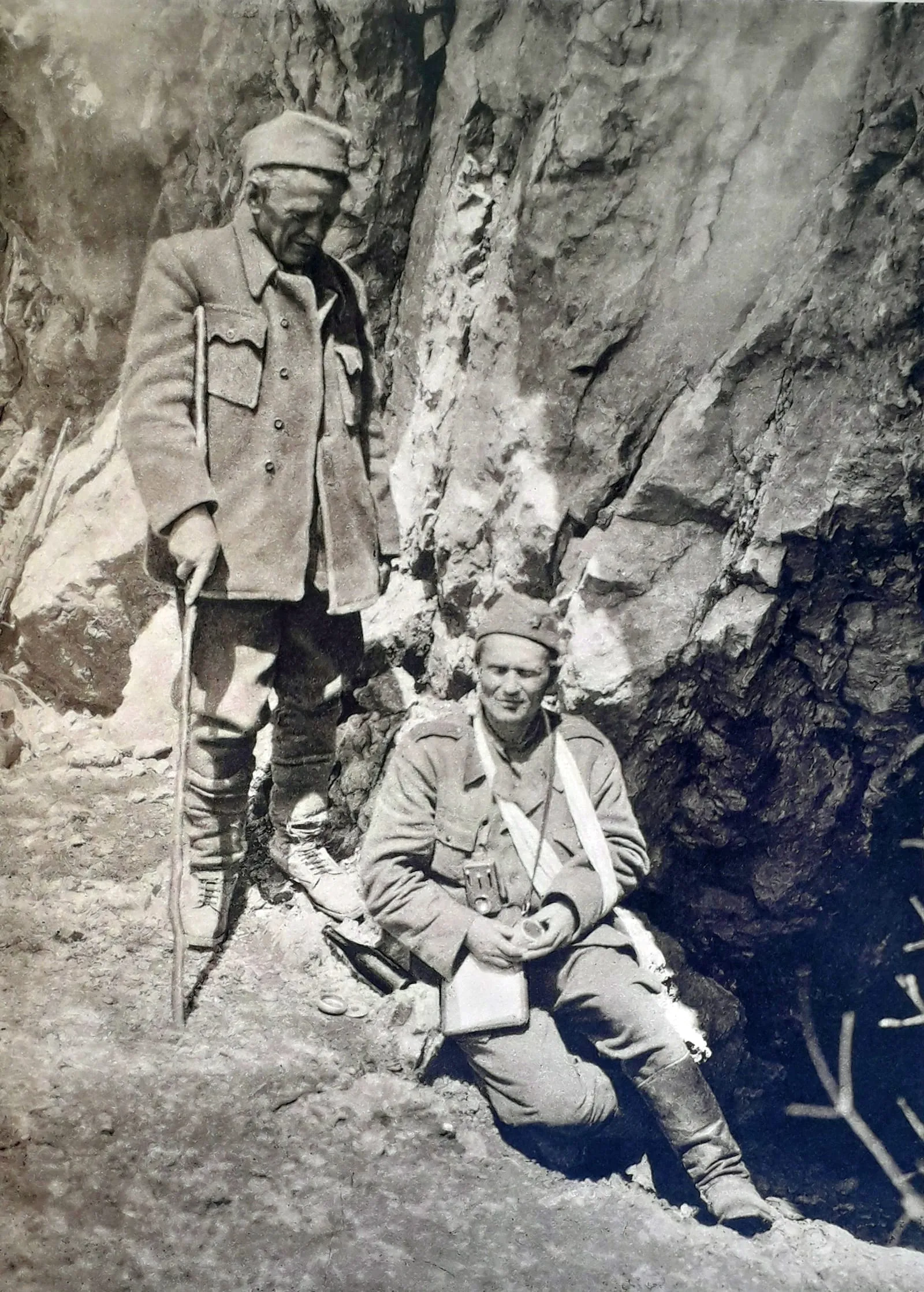
The Battle of the Sutjeska was the largest and bloodiest battle of the Yugoslav partisan war. From 15 May to 16 June 1943 some 120,000 German, Italian, Bulgarian and Croatian troops tried to trap and destroy, in the mountains of northern Montenegro, the main operational group of the National Liberation Army of Yugoslavia – some 22,000 Partisans dragging with them a hospital with several thousand wounded and typhus-stricken men – together with its commander-in-chief, Josip Broz Tito. The Germans closed the ring between the canyons of the Tara and the Piva, the Durmitor massif and the valley of the Sutjeska. The Partisans broke out of it in mid-June, but at the cost of about a third of their men. The wounded left behind in the pocket were massacred by the Germans.
In this battle Tito came within a hair’s breadth of death. The survival of his army convinced the British that it was the Partisans, not the Chetniks, who were the force to be reckoned with in Yugoslavia.
Name and dates
The German code name for the operation was “Schwarz” (“Black”), known in English as Case Black. Yugoslav historiography called it the Fifth Enemy Offensive (peta neprijateljska ofanziva), and its final phase the Battle of the Sutjeska (bitka na Sutjesci), after the river in eastern Herzegovina through whose valley the Partisans escaped from the encirclement. The two names are often used interchangeably, although strictly speaking the fighting on the Sutjeska itself began only at the start of June.
German and Yugoslav historiography agree on the dates: the offensive began on 15 May 1943, and the German command declared the operation over on 16 June. It was preceded by the concentration of forces from the beginning of May, and on 14 May the Germans disarmed the Chetniks near Kolašin. Reconstructions of the individual days of June rely on Yugoslav accounts and German reports, which differ in detail by a day or two.
Background
After the surrender and partition of Yugoslavia in 1941, its territory became the scene of a partisan war that was at the same time a civil war. Tito’s communist Partisans and the royalist Chetniks of Draža Mihailović turned against each other in the autumn of 1941, and some Chetnik commanders, especially in Montenegro and Herzegovina, collaborated with the Italians. In 1941–1942 the Germans and their allies carried out several large operations against the Partisans but failed to destroy them. After the uprising in Montenegro in July 1941 and the flight from western Serbia, Tito moved to Bosnia, where an extensive liberated territory took shape in 1942, and in November the Anti-Fascist Council for the National Liberation of Yugoslavia (AVNOJ) met in Bihać.
In the winter of 1943 the Germans launched Case White (Fall Weiss), known in Yugoslavia as the Fourth Offensive. In the Battle of the Neretva in February and March the Partisans broke out of the encirclement, routed the Chetniks fighting against them alongside the Italians, and crossed into Herzegovina and Montenegro. There they intended to rest, treat their wounded and move on towards Kosovo and southern Serbia. In April and early May they drove the Chetniks and Italians out of one place after another, besieged Foča and Kolašin, and the Supreme Staff settled in the Durmitor mountains.
Adolf Hitler saw the Balkans through the lens of the war in Africa. With the Axis defeat in Tunisia inevitable, he expected an Allied landing in Greece or on the Adriatic coast – an expectation reinforced at the turn of April and May by the British deception known as Operation Mincemeat. The hinterland of the coast therefore had to be cleared of any forces that might support a landing: not only the Partisans but also the Chetniks, who the Germans believed would go over to the Allies if they landed. The dispute over the Chetniks, who were being armed by the Italian command, was one of the subjects of Hitler’s meeting with Mussolini at Klessheim in April 1943. Benito Mussolini gave way, but the Italian commanders on the spot, led by General Alessandro Pirzio Biroli, the governor of Montenegro, delayed disarming their allies until the Partisans had been defeated.
Overall direction of the operation was assumed by the German Commander-in-Chief South-East, Colonel General Alexander Löhr. He entrusted tactical command to the commander of German troops in Croatia, General Rudolf Lüters; the grouping was named the Croatia Corps. The Italians kept a separate chain of command.
Forces and plan
According to German documents, on which most historians rely, the Axis assembled some 120,000–127,000 troops and more than 300 aircraft for the operation. The core consisted of four German divisions: the elite 1st Mountain Division, brought in from the East; the 7th SS Volunteer Mountain Division Prinz Eugen, made up mainly of Banat Germans; the 118th Jäger Division; and the 369th Infantry Division, known as the “Legion” division because its rank and file were Croats. They were joined by the Brandenburg Regiment, a reinforced regiment of the 104th Jäger Division, a Croatian Home Guard (Domobrani) jäger brigade, two Bulgarian infantry regiments and the Italian Taurinense, Venezia and Ferrara divisions. Four more Italian divisions guarded the coast and the Neretva valley from Albania to Metković.
According to Yugoslav tallies, the Partisans’ main operational group numbered 22,148 fighters in 16 brigades, grouped in four divisions – the 1st Proletarian under Koča Popović, the 2nd Proletarian under Peko Dapčević, the 3rd Assault and the 7th Banija – and two independent brigades. More than half were Serbs, including Serbs from Croatia and Bosnia, followed by Croats, Montenegrins and Muslims. The army was accompanied by the central hospital with some 3,000 wounded and sick. Food, medicine and ammunition were short, and typhus was spreading through the units. Members of the AVNOJ council and of the party’s Central Committee, among them Milovan Đilas, also travelled with the Supreme Staff.
The German plan exploited the terrain. The Partisans were to be pushed onto a desolate, almost uninhabited plateau between the deep canyons of the Tara and the Piva and the Durmitor massif, and destroyed there by artillery fire, air attacks and the advance of the mountain troops. From the east and north, from the Sandžak and the Foča area, the 1st Mountain Division, the 369th Division, the 118th Division and the Italians of the Venezia Division were to attack; from the south and south-east, the SS Prinz Eugen Division and the Italian Taurinense and Ferrara. Finally, the 118th Division was to occupy the left bank of the Piva – or, failing that, the Sutjeska valley – and close the ring on the rivers, which could be crossed at only a few points.
The course of the battle: disarming the Chetniks and tightening the ring (14–27 May)
The operation was preceded by a blow against the Italians’ recent allies. On the morning of 14 May the Germans, despite the protests of the commander of the Italian XIV Corps, caught several thousand Montenegrin Chetniks asleep near Kolašin and disarmed them. Their commander, Pavle Đurišić, who only a few days earlier had been seeking an understanding with the Germans, was taken away to a prisoner-of-war camp. Earlier, at Foča, the Germans had relieved an Italian battalion besieged by the Partisans along with about a thousand Chetniks, whom they also disarmed. Mihailović, who was in Montenegro at the time, slipped away to Serbia. The disarmament covered only some of the Chetniks, however: where the Italians had the final say, most units kept their weapons.
The main attack began on 15 May. The first clashes broke out in the north, between Čajniče and Foča, with units of the 369th Division, and in the east, around Brodarevo and Mojkovac, with the 1st Mountain Division. For a long time the Partisans did not grasp the scale of the threat: some of their divisions were still besieging Kolašin and fighting the Italians. From 18 May the SS Prinz Eugen Division and the Italian Ferrara Division advanced from the south towards Šavnik and Žabljak. The Dalmatian and Montenegrin brigades held them up for several days.
When it became clear that large German forces were approaching from the east, the Supreme Staff decided to open a route north into eastern Bosnia via Foča. From 21 to 25 May the reinforced 1st Proletarian Division attacked the positions of the 118th Division and the Croatian Home Guard. The Partisans won several tactical successes, routing two enemy regiments on 21 and 24 May, but after units of the 369th Division struck their flank near Gradac on 25 May the attack lost its purpose. On 27 May the Supreme Staff ordered all forces across to the left bank of the Tara.
At the same time a struggle was being fought that decided the Partisans’ fate. On 22 May a German regiment of the 118th Division reached Vučevo – a plateau west of the Piva that commanded the crossings – without a fight. It then split up its battalions, unable to supply them in the trackless terrain, and on 29 May two battalions of the 2nd Proletarian Brigade drove the one battalion left in place off the dominating heights. The Partisans held Vučevo and prevented the Germans from closing the ring on the Piva. The next obstacle on which the Germans could do so was the Sutjeska valley.
The British mission
On the night of 27–28 May a six-man mission of the British Special Operations Executive (SOE), sent from Derna in Libya under the code name “Typical”, parachuted onto the shore of the Black Lake at the foot of Durmitor. It was led by Captain William Deakin, before the war an Oxford historian who had helped Winston Churchill write the biography of his ancestor, the Duke of Marlborough, and Captain William F. Stuart, who had worked at the British consulate in Zagreb before the war and knew the language. They were the first British officers permanently attached to Tito’s headquarters; the British had been sending missions to Mihailović’s Chetniks since 1941.
Tito received them the very next day. He asked for military assistance and for air strikes on German concentrations. The British were to find out whether the Partisans were really a serious force and to persuade them to sabotage lines of communication – above all the railway to Greece – in the event of an Allied offensive in the Mediterranean. Instead, Deakin and his men lived through the hardest weeks of the Partisans’ war alongside them, marching under constant fire and air attack. Their reports from the encirclement reached Cairo and London just as the British were reassessing whom to back in Yugoslavia.
The course of the battle: the pocket on the Sutjeska (28 May – 9 June)
From 31 May to 5 June the Montenegrin, Krajina and Herzegovina brigades fought exhausting battles with the Germans on the slopes of Mount Bioč and along the upper Piva, but failed to open a route. The Germans had reserves; the Partisans had none. There was no supply from the air, and the Sutjeska valley and the camps were bombed and strafed every day by low-flying aircraft. On 3 June Tito and the Supreme Staff crossed the Piva near Mratinje. By the first days of June the whole operational group, together with the central hospital, was surrounded.
At a meeting of the Supreme Staff the situation was judged critical. The only way out lay to the west and north-west, through the Sutjeska valley onto the Zelengora massif and on into eastern Bosnia, where the Germans were weakest. Since the upper reaches of the river were heavily held, however, the staff divided its forces. The first group, made up of the 1st and 2nd Proletarian Divisions with the Supreme Staff, was to break through across the Sutjeska to the north-west. The second – the 3rd and 7th Divisions with the central hospital and some of the AVNOJ members – was, under Đilas’s political leadership, to return to the right bank of the Tara, towards the Sandžak, and thereby stretch the German forces. On 6 June command of the 3rd Division passed to Colonel Sava Kovačević, a Montenegrin, a former blacksmith and woodcutter, and one of the most popular Partisan commanders, known for his personal courage.
The key to escaping from the pocket was holding a passage across the Sutjeska. The 1st Proletarian Division forced the river and, over the Milinklade ridge, reached Zelengora on 8 June. The Germans realised what was happening and began to occupy the whole valley from Tjentište to the river’s confluence with the Drina. Fierce fighting raged around the canyons of the Sutjeska and the Suha for the surrounding peaks, which changed hands several times. Dapčević’s 2nd Proletarian Division, following the 1st, bled itself white in clashes with the 118th Division at Bare, near Mount Volujak.
On 9 June, on Milinklade, a German aerial bomb landed right next to the Supreme Staff group. Tito was wounded in the arm by a splinter. Captain Stuart was killed on the spot, and Deakin was also slightly wounded. Post-war legend credited Tito’s survival to his Alsatian, Luks, who was said to have shielded him with its own body; this version cannot be confirmed. The wounded commander marched on with his troops.
The course of the battle: the breakthrough and the destruction of the hospital (10–16 June)
On 10 June the 1st Proletarian Division broke through the lines of the German 369th Division near Balinovac and opened the way north-west towards eastern Bosnia. The main force with Tito and the Supreme Staff passed through the breach, fighting almost exclusively against German troops: the 118th and 104th Jäger Divisions and the 369th Division. For the second group the plan to return across the Tara proved impossible, and it too turned towards the Sutjeska – but by then the Germans had closed the valley again.
The most tragic fate befell the 3rd Division and the central hospital. Kovačević’s units, weighed down by the wounded, covered the withdrawal of the others and were cut off. On 13 June Kovačević was killed at Krekovi near Tjentište while personally leading an attack on the trenches of the 118th Division. The remnants of the division fought their way out in small groups, and many soldiers were killed. The Partisans hid in forests and caves some of the seriously wounded who could not be carried – about 700 people according to Yugoslav sources – together with nurses.
Löhr, in line with Hitler’s guidelines, ordered the encircled forces to be destroyed without taking prisoners, the wounded and unarmed medical staff included. German units combed the terrain, also with dogs, and killed the wounded they found almost to the last man. A report of the 1st Mountain Division recorded: “498 prisoners taken, of whom 411 shot.” Reprisals also fell on the inhabitants of villages in the combat area; according to German reports, more than 2,500 civilians regarded as Partisan sympathisers were shot, and the SS Prinz Eugen Division was notorious for the mass killing of villagers suspected of helping the Partisans.
On 16 June the Germans declared the operation over. The main Partisan forces, exhausted and decimated, were outside the ring, in the mountains of eastern Bosnia.
Losses
Partisan losses were enormous, though the sources give different figures. Yugoslav historiography, followed for example by Marko Attila Hoare, speaks of 7,543 dead, including the wounded murdered at the hospital – more than a third of the initial strength. Other tallies give some 6,400 killed. German reports spoke of 7,489 confirmed enemy dead and a further 4,000–5,000 estimated, and some German historians put total Partisan losses (killed and missing) as high as about 11,000. Among the dead were many party members and experienced commanders, and the 3rd Division practically ceased to exist.
According to General Lüters’s report of 20 June 1943, the German forces lost 583 killed, 1,760 wounded and 425 missing. Italian, Bulgarian and Croatian losses were smaller and are less well documented. To these must be added the victims among the civilian population of Montenegro and Herzegovina, whose full number has never been established.
Significance
Case Black was the last great joint German–Italian operation against the Partisans, and it ended in failure for the Axis. Despite a numerical superiority of at least five to one, command of the air and favourable terrain, the Germans destroyed neither the main Partisan forces nor their leadership. In his final report General Lüters admitted that the “communist rebels” were well organised, skilfully led and had incredibly high morale. In passing, the Germans had broken up the Montenegrin Chetniks, which weakened the Partisans’ rival more than the Partisans themselves.
Tito’s army quickly rebuilt its strength. Within three weeks of the battle it went over to the offensive in eastern Bosnia, capturing the garrisons at Vlasenica, Srebrenica, Olovo, Kladanj and Zvornik, and gained new volunteers, including among Croats and Muslims. In September 1943 the Italian capitulation handed the Partisans the weapons and equipment of many Italian divisions, and their army grew to more than 100,000 men.
The battle also had political consequences. Deakin’s reports confirmed what the British were already beginning to see in decrypted German signals: that it was the Partisans, not the Chetniks, who were fighting the Germans most effectively. In September 1943 a military mission under Brigadier Fitzroy Maclean, sent by Churchill, arrived at Tito’s headquarters, and at the end of the year, at the Tehran Conference, the Allies decided to support the Partisans. In November 1943 AVNOJ, meeting in Jajce, proclaimed itself the supreme authority, and Tito took the title of Marshal. In 1944 the British withdrew their support from Mihailović.
The Sutjeska became one of the founding myths of post-war Yugoslavia – a symbol of the Partisans’ sacrifice, suffering and endurance. A monumental memorial complex was built at Tjentište, and in 1973 the film “The Fifth Offensive” was made, with Richard Burton as Tito. After the war Löhr, together with the commanders of the 118th and 369th Divisions, Josef Kübler and Fritz Neidholdt, was tried in Yugoslavia, among other things for crimes committed during this operation; all three were executed in 1947.