United Kingdom
Winston Churchill
Home Secretary (1910–1911), First Lord of the Admiralty (1911–1915, 1939–1940), Secretary of State for War (1919–1921), Chancellor of the Exchequer (1924–1929), Prime Minister of the United Kingdom (1940–1945, 1951–1955)
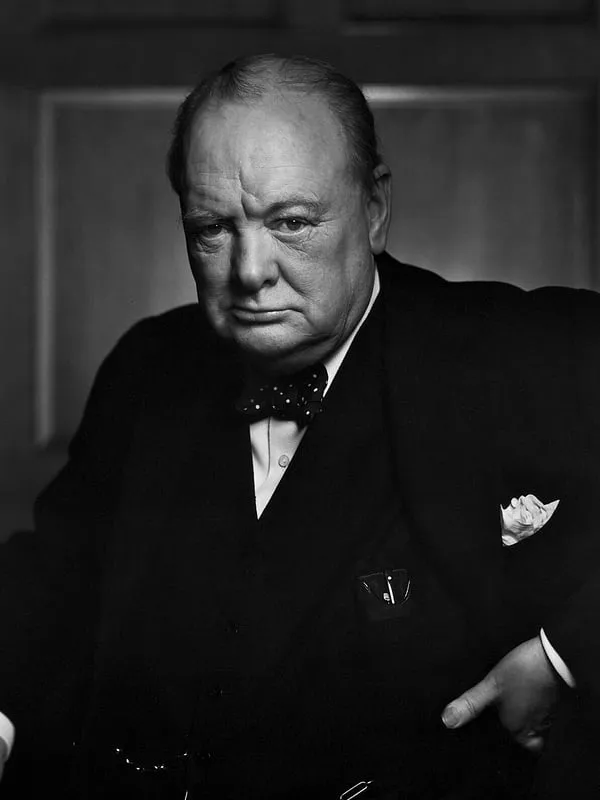
- Born:
- 30 November 1874, Blenheim Palace, Woodstock (Oxfordshire, England)
- Died:
- 24 January 1965, London (England)
- Author:
- Łukasz
- Photo:
- Yousuf Karsh, domena publiczna, Wikimedia Commons

For more than half a century Winston Leonard Spencer Churchill was one of the most prominent and at the same time most controversial British politicians. Soldier, war correspondent, writer and orator, he changed parties twice, ran the Admiralty at the start of both world wars and, in May 1940, as France was collapsing, took the helm of government and led Britain through the most difficult period in its history. To some he is the symbol of resistance to Hitler; to others, a defender of empire who did not understand the world that came after it. For Poles he is a figure with two faces: an ally in 1940 and also one of the authors of the decisions taken at Yalta.
An aristocrat with an American mother
He was born on 30 November 1874 at Blenheim Palace, the seat of the Dukes of Marlborough. His father, Lord Randolph Churchill, a younger son of the seventh duke, was a brilliant Conservative politician and for a few months Chancellor of the Exchequer. His mother, Jennie Jerome, was the daughter of a New York financier. His parents paid him little attention, and his father, who died in 1895, thought him of little ability. Churchill did poorly at Harrow School and got into the military college at Sandhurst only at the third attempt, graduating in 1894. In 1895 he joined the 4th Hussars.
He sought the fame that might open the way to politics. In 1895 he observed the Spanish fighting the insurgents in Cuba, in 1897 he fought the Pashtun tribes on India’s North-West Frontier, and on 2 September 1898 he took part in the charge of the 21st Lancers at the Battle of Omdurman in the Sudan. From every campaign he wrote dispatches and books. During the Boer War, as a correspondent for The Morning Post, he was taken prisoner on 15 November 1899 when the Boers attacked an armoured train, and in December he escaped from a camp in Pretoria and made his way to Mozambique. The escape made him a hero in England.
From Conservative to Liberal
In 1900 he was elected Conservative MP for Oldham. He soon fell out with his own party over protective tariffs, and in May 1904 he crossed the floor to the free-trading Liberals. In Liberal governments he was Under-Secretary for the Colonies and, from 1908, President of the Board of Trade, where together with David Lloyd George he helped shape the first social reforms: labour exchanges and minimum wages in the worst-paid trades. In September 1908 he married Clementine Hozier, who for 56 years was his closest confidante. They had five children.
As Home Secretary in 1910 he carried out a reform of the prisons, but he became known above all for using police and troops against striking miners in Wales and for his personal involvement in the Siege of Sidney Street in London in January 1911. The labour movement long held these events against him, and in time attributed to him deeds he had not committed, as the legend of the Battle of George Square in 1919 shows.
The First World War
In October 1911 he became First Lord of the Admiralty. He accelerated the conversion of the fleet from coal to oil, the building of battleships with 15-inch guns and the development of naval aviation, and in July 1914 he did not disperse the fleet after manoeuvres, so that the Royal Navy was ready for war. He supported work on the first tanks. His biggest undertaking, however, proved to be the operation in the Dardanelles, which was meant to open the way to Constantinople. The naval attack of March 1915 and the landings at Gallipoli ended in disaster. In May 1915, when a coalition government was formed, the Conservatives demanded his removal from the Admiralty. At the end of the year Churchill resigned from the government and went to the Western Front, where in 1916 he commanded a battalion of Scottish fusiliers for several months.
Lloyd George brought him back into government in July 1917 as Minister of Munitions. From 1919 Churchill was Secretary of State for War and Air. He was the most ardent advocate of intervention against the Bolsheviks during the Russian Civil War and called for Bolshevism to be “strangled in its cradle”. As Colonial Secretary in 1921–1922 he chaired the Cairo Conference, which settled British policy in the Middle East, and helped bring about the Anglo-Irish Treaty. In the autumn of 1922 he was among the strongest advocates of a hard line against Turkey during the Chanak Crisis. He lost his seat at the election of November 1922.
Chancellor of the Exchequer and the wilderness years
In 1924 he returned to the House of Commons and to the Conservative Party. Stanley Baldwin surprised everyone by making him Chancellor of the Exchequer. In 1925 Churchill restored the convertibility of the pound into gold at the pre-war parity, which overvalued the currency and harmed exports, and during the General Strike of 1926 he edited the government newspaper, the British Gazette, and was among the most uncompromising ministers. After the Conservatives’ defeat in 1929 he did not return to government for ten years.
In the 1930s Churchill was an isolated figure. In 1931 he left the party’s front bench in protest against self-government for India and fought the reform until 1935, which many regarded as a sign of anachronistic imperialism. He lived at Chartwell, his house in Kent, wrote a biography of his ancestor, the Duke of Marlborough, and newspaper articles that paid his way. From 1933 he warned more and more often of Hitler’s rearmament, and from 1934 he argued in the House of Commons that the Luftwaffe would soon overtake the RAF. He drew on confidential information passed to him by officials and officers alarmed at the government’s sluggishness. Baldwin did not take him into the government after the 1935 election. Churchill’s standing was weakened by his support for Edward VIII during the abdication crisis of 1936, when he was shouted down in the House of Commons.
Under Neville Chamberlain’s government he was the loudest critic of appeasement. After the Munich Agreement he told the House of Commons on 5 October 1938 that Britain had suffered “a total and unmitigated defeat”. At the same time he sharply criticised Poland’s seizure of Zaolzie. In 1939 he called for an agreement with the Soviet Union and supported the British guarantee to Poland. Over the summer the press pressure to bring him into the government grew.
Back at the Admiralty
On 3 September 1939, the day war was declared on Germany, Chamberlain appointed him First Lord of the Admiralty and a member of the War Cabinet. According to Churchill’s own memoirs, the Board of Admiralty then signalled to the fleet “Winston is back”, although the text of the signal has never been found. During the Phoney War the navy was the only service engaged in real fighting, and Churchill, who broadcast regularly, became the most visible minister. On 1 October 1939, after the Red Army had entered Poland, he described Russia as “a riddle wrapped in a mystery inside an enigma”, and said of Poland that her soul was indestructible and that she would rise again like a rock.
He was the chief advocate of cutting the supply routes of Swedish iron ore to Germany through Norwegian waters. In the spring of 1940 the Germans forestalled the Allies and occupied Denmark and Norway, and the Norwegian campaign ended in failure, for which Churchill bore much of the responsibility. Paradoxically, however, it was Chamberlain who lost the confidence of the House of Commons after the debate of 7–8 May 1940.
Wartime Prime Minister
On 10 May 1940, the day of the German offensive in the west, King George VI asked Churchill to form a government after Lord Halifax had declined. Churchill formed a coalition with the Labour Party, with Clement Attlee as his deputy, and also took the new post of Minister of Defence. On 13 May he told the House of Commons that he had nothing to offer but “blood, toil, tears and sweat”. At the end of May, as the encircled British Expeditionary Force was being evacuated from Dunkirk (Operation Dynamo), the War Cabinet argued for several days over whether to explore the possibility of negotiations through Italy. Churchill, backed by Chamberlain and the Labour ministers, persuaded his colleagues to fight on.
After the fall of France, Britain fought Germany for a year without a major ally. Churchill received General Władysław Sikorski and the Polish troops evacuated from France and promised that Poland would not be abandoned. On 3 July 1940 he ordered an attack on the French fleet at Mers-el-Kébir (Operation Catapult) to keep it out of German hands. During the Battle of Britain he said on 20 August that never had so much been owed by so many to so few – and among those few were Polish airmen, including those of No. 303 Squadron. He sought American help and built a close, though not conflict-free, relationship with Franklin Delano Roosevelt, which yielded Lend-Lease and, in August 1941, the Atlantic Charter. When Germany attacked the USSR on 22 June 1941, Churchill, a lifelong opponent of communism, promised aid to Stalin that very evening.
After the United States entered the war in December 1941, Churchill and Roosevelt directed the strategy of the Western Allies. The year 1942 brought defeats – the fall of Singapore in February and of Tobruk in June – after which he had to defend himself in the House of Commons. The victory at El Alamein in November 1942 and the landings in North Africa turned the tide. Churchill pressed for a peripheral strategy – North Africa, Sicily and Italy – and long resisted American pressure for an early landing in France, which finally took place in June 1944 (Operation Overlord). He met Roosevelt at Casablanca, and Roosevelt and Stalin at Tehran and Yalta. As American and Soviet power grew, his influence on decisions waned.
Churchill and Poland
The Polish question was one of the most difficult problems of the war for Churchill. After the Katyn massacre came to light in April 1943, the British government, though aware of the probable Soviet responsibility, prevented it from being publicly acknowledged for the sake of the alliance with Stalin. At Tehran Churchill agreed that Poland’s eastern border should run roughly along the Curzon Line, with compensation at Germany’s expense. He pressed Prime Minister Stanisław Mikołajczyk to accept this, in very harsh terms during the talks in Moscow in October 1944. During the Warsaw Uprising he demanded that Stalin help Warsaw and allow supply aircraft to land, and British, Polish and South African airmen flew supplies to the insurgents from Italy. At Yalta in February 1945, however, he and Roosevelt accepted arrangements that placed Poland in the Soviet sphere of influence. He defended them in the House of Commons, although in private he doubted Stalin’s good faith.
Assessment and controversies
Among Churchill’s most sharply criticised decisions is his government’s attitude to the Bengal famine of 1943–1944, in which between 2 and 3 million people died. Historians disagree over how far the blame lies with London’s decisions on the allocation of shipping and its refusal to speed up food deliveries, and how far with the war against Japan, crop failure and the mistakes of the authorities in India. Also controversial are the strategy of area bombing of German cities, symbolised by the bombing of Dresden in February 1945, and his views on the empire and colonial peoples.
After the war
At the election of July 1945 the Conservatives suffered a heavy defeat, and Attlee became Prime Minister, replacing Churchill in the middle of the Potsdam Conference. On 5 March 1946 in Fulton, Missouri, in the presence of President Harry Truman, Churchill declared that from Stettin in the Baltic to Trieste in the Adriatic an iron curtain had descended across the Continent. The speech came to be seen as one of the symbolic beginnings of the Cold War. In September 1946, in Zurich, he called for a United States of Europe founded on reconciliation between France and Germany.
In 1948–1953 he published his six-volume memoir, The Second World War, which shaped the picture of the war for decades, especially in the English-speaking world, and in which he defended his own decisions. In 1953 he was awarded the Nobel Prize in Literature. From October 1951 to April 1955 he was Prime Minister again. In June 1953 he suffered a stroke, which was concealed from the public. After resigning he remained an MP until 1964. In 1953 he accepted the Order of the Garter, and in 1963 he was made an honorary citizen of the United States.
He died on 24 January 1965 at his London home in Hyde Park Gate, aged 90, exactly seventy years to the day after his father’s death. His state funeral on 30 January 1965, a rare honour for someone outside the royal family, was attended by representatives of more than a hundred countries. He was buried in the family grave at the church in Bladon, near Blenheim Palace, where he had been born.
Sources
Commanded in battles
(01)Mentioned in battles
(58)- The Russian Civil War
- The Greco-Turkish War
- Battle of the Atlantic
- Winter War
- Battle of the River Plate
- Battles of Narvik
- Norwegian Campaign
- Belgian Campaign
- Battle of France
- Dutch Campaign
- Battle of Sedan (1940)
- Battle of Dunkirk
- East African Campaign
- Battle of Britain
- Italian invasion of British Somaliland
- Italian invasion of Egypt
- Battle of Dakar
- Greco-Italian War
- Operation Compass
- Battle of Keren
- Rommel’s first offensive
- German invasion of Greece
- Siege of Tobruk
- Anglo-Iraqi War
- Operation Rheinübung
- Battle of Crete
- Operation Exporter
- Operation Battleaxe
- Operation Barbarossa
- Continuation War
- Anglo-Soviet invasion of Iran
- Operation Crusader
- Battle of Hong Kong
- Malayan campaign
- Burma campaign (1942)
- Rommel's second offensive (1942)
- Battle of Singapore
- Indian Ocean raid
- Battle of Madagascar
- Battle of Gazala
- First Battle of El Alamein
- Operation Pedestal
- Battle of Alam el Halfa
- Second Battle of El Alamein
- Operation Torch
- Tunisian campaign
- Battle of the Sutjeska
- Dodecanese campaign
- Battle of Anzio
- Siege of Myitkyina
- Battle of Normandy
- Warsaw Uprising
- Operation Dragoon
- Battle of the Bulge
- Operation Nordwind
- Vistula–Oder offensive
- The Rhine crossings
- The Prague offensive
Often appears with
People who appear in the same events.
On the timeline
(513)The 40 most important of 513 events. All tagged “Winston Churchill” (78) →
1938
1939
1940
January
February
April
May
- 10
- Key eventGermany attacks in the WestOn 10 May 1940 the Wehrmacht struck the Netherlands, Belgium and Luxembourg. The Allies advanced into Belgium as Kleist's tanks entered the Ardennes.
- Key eventChurchill becomes Prime MinisterOn 10 May 1940, the day of the German offensive in the West, Chamberlain resigned and the King asked Churchill to form a coalition government.