Yugoslavia
Draža Mihailović
Leader of the Chetniks (1941–1945), Minister of War of the Yugoslav government-in-exile (1942–1944), General of the Army
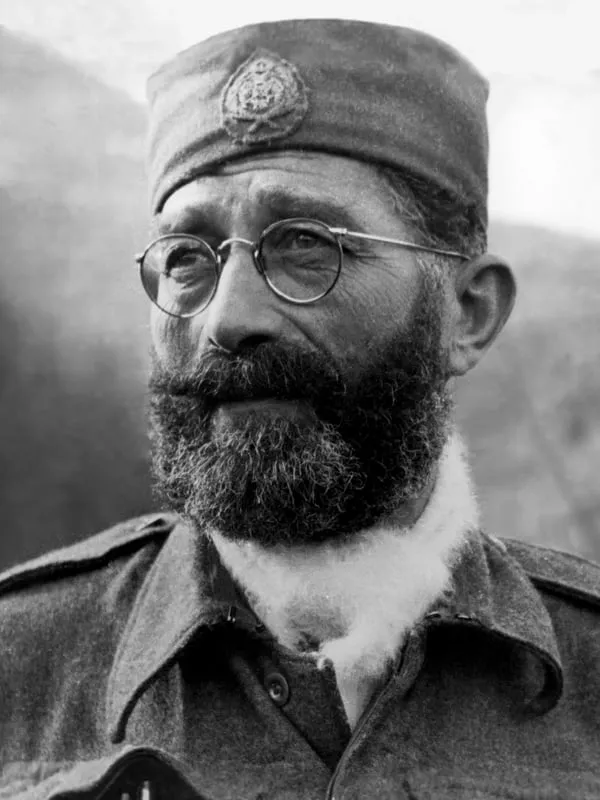
- Born:
- 26 April 1893, Ivanjica (Kingdom of Serbia)
- Died:
- 17 July 1946, Belgrade
- Author:
- Łukasz
- Photo:
- Aleksandar Simić (1923-2007) (remastered by Savasampion), domena publiczna, Wikimedia Commons

Dragoljub Mihailović, known as Draža, was a professional officer of the Serbian and Yugoslav armies who refused to lay down his arms after Yugoslavia’s defeat in April 1941 and, in the mountains of western Serbia, created the Chetnik movement, the first organised military underground in the occupied country. In 1941 British propaganda made him one of the most famous resistance leaders in Europe, and King Peter II’s government-in-exile made him a general and Minister of War. Yet his strategy of waiting for an Allied landing, his war against the communist Partisans of Josip Broz Tito, the deals many of his commanders struck with the occupiers and the Chetniks’ crimes against Muslims and Croats led the Allies to abandon him in favour of Tito. Defeated in the civil war and captured in 1946, he was sentenced to death and shot in Belgrade. He remains one of the most contested figures of the Second World War in the Balkans: to some a Serbian hero and a victim of communism, to others a collaborator who shares responsibility for ethnic cleansing.
Childhood and the Balkan Wars
He was born on 26 April 1893 (14 April by the Julian calendar then in use in Serbia; some sources give 27 April) in Ivanjica, a small town in the mountainous west of Serbia. His father, Mihailo, was a clerk in the local district office. The boy lost both parents early: his father died of tuberculosis when Draža was a small child, and his mother a few years later. In 1901 the orphans were taken in by their paternal uncle, an army veterinary officer with the rank of major, who brought them to Belgrade. Two other uncles were also soldiers, and this decided the boy’s path. In the autumn of 1910 he entered the Military Academy in Belgrade.
His studies were interrupted by war. As a cadet he fought in the First Balkan War against Turkey on the Macedonian front and was awarded the silver medal for bravery. In the Second Balkan War of 1913 he fought the Bulgarians, and then Albanian insurgents in the border areas. After the wars his year completed a shortened course, and in 1914 Mihailović was commissioned as a second lieutenant, one of the best graduates of his class.
The First World War
In the First World War he followed the whole path of the Serbian army: the victorious battles of 1914 against Austria-Hungary, the defeat of the autumn of 1915 and the Albanian Golgotha, the winter retreat across the mountains of Albania to the Adriatic coast in which tens of thousands of soldiers and civilians died. After the army was rebuilt on Corfu he fought on the Salonika front; in September 1916 he was badly wounded but refused to be sent to the rear and returned to the front line a few months later. He was decorated several times, and in 1918 took part in the offensive that liberated Serbia.
Career in the Kingdom of Yugoslavia
After the war he served first in Macedonia and Kosovo, then in the Royal Guard in Belgrade, from which, after a brawl in a café, he was returned in 1920 to a regiment in Skopje. In 1920 he married Jelica, daughter of Colonel Jevrem Branković. They had four children, one of whom died in infancy. In 1921–1923 he completed the Higher Military School in Belgrade and joined the General Staff corps. He served on divisional staffs and in the Royal Guard, became a lieutenant colonel in 1930 and attended a course of several months in France. Claims that he graduated from a military academy there or became friends with Charles de Gaulle are unconfirmed.
In 1935 he went to Sofia as military attaché, and in September of that year was promoted to colonel. There he made contact with Bulgarian officers linked to the Zveno group, which was hostile to Tsar Boris III and favoured closer ties with Yugoslavia. The Bulgarian government regarded this as interference in the country’s internal affairs and in 1936 demanded his recall. Mihailović moved to the post of attaché in Prague, where he spent a year, and from 1937 he was chief of staff of a division in Ljubljana and commander of an infantry regiment in Celje.
An inconvenient critic
By the late 1930s Mihailović saw ever more clearly that Yugoslavia was not prepared for a war with Germany. In a memorandum submitted to his superiors he argued that the army could not defend the long northern frontier and should, in the event of war, concentrate its forces in the mountains of the interior. He also proposed forming nationally homogeneous units – Serbian, Croatian and Slovene – because he believed that sabotage came more easily in mixed units, and organising mobile Chetnik detachments to wage irregular warfare behind enemy lines. The Minister of War, General Milan Nedić, punished him for the memorandum with thirty days’ arrest. Mihailović became a lecturer at the military academy, but in 1940 he again fell foul of his superiors: at a gathering organised by the British military attaché he spoke so sharply against the Germans that the Reich’s envoy protested. He was again placed under arrest and transferred to a staff post in Mostar. He was saved from further punishment by Nedić’s departure from the ministry in November 1940.
April 1941
After the coup of 27 March 1941, Hitler resolved to destroy Yugoslavia. When on 6 April Germany attacked the country, Mihailović was on the staff of the 2nd Army in Bosnia, according to most sources as deputy chief of staff. Contrary to what some accounts say, he did not command that army. In the April War the Yugoslav army disintegrated within a few days, and in Bosnia and Slavonia the Ustaše, who had proclaimed their state on 10 April, were disarming retreating units. On 13 April Mihailović took command of an improvised “rapid detachment” in the area of Doboj. When news arrived on 15 April that the Supreme Command was seeking a ceasefire, he refused to obey the order and took to the mountains with a few dozen men, almost all of them Serbs. Two days later the Yugoslav army capitulated.
For two weeks the group fought its way through eastern Bosnia, clashing with the Ustaše and local Muslim units. Around 29 April, by then some eighty strong, it crossed the Drina into occupied Serbia. It found no fighting units there. According to the movement’s tradition on 13 May 1941 – according to some Serbian authors on 11 May – Mihailović, with seven officers and twenty-four NCOs and soldiers, reached Ravna Gora, a wooded plateau in the Suvobor massif between Valjevo and Gornji Milanovac. There he set up the Command of the Chetnik Detachments of the Yugoslav Army.
Ravna Gora and the uprising of 1941
In the summer of 1941 Mihailović built up a clandestine organisation: he gathered officers who had escaped captivity, created an intelligence network, drew up lists of reservists and won the support of local officials and gendarmes. Civilians from the Serbian Cultural Club joined his staff, among them Dragiša Vasić and Stevan Moljević, author of a programme for a Greater Serbia whose borders would also take in Bosnia and a large part of Croatia. In August a Central National Committee was formed as the movement’s civilian arm. To distinguish themselves from the Chetniks of the pre-war vojvoda Kosta Pećanac, who had come to terms with the Germans, Mihailović’s men called themselves the Ravna Gora movement. The strategy was clear from the start: not to provoke a premature uprising that would bring German terror down on the Serbs, but to build a secret army and strike only when the Allies appeared in the Balkans.
These plans were upset by the German attack on the Soviet Union. In July 1941 Tito’s Yugoslav communists launched an uprising in western Serbia and quickly won popularity among people who wanted to fight at once. Under pressure from their own men, some Chetnik units joined the fighting at the end of August and captured towns together with the Partisans. In September Mihailović established radio contact with the British and the government-in-exile, and at the end of October a British mission under Captain Duane T. “Bill” Hudson reached him. On 19 September and at the end of October he met Tito, but they failed to reach agreement. Tito wanted a joint offensive; Mihailović considered it suicidal and had no intention of ceding leadership to the communists. The Germans responded to the uprising with mass executions, shooting a hundred hostages for every soldier killed. In October they murdered several thousand civilians in Kraljevo and Kragujevac, which Mihailović took as proof that he had been right.
On 1 November 1941 the Chetniks attacked the Partisan capital at Užice. This began a civil war that would last until the end of the war. At the same time Mihailović sought an understanding with the Germans: his envoys were in contact with Nedić’s government, and on 11 November he himself met German officers at Divci, offering to cease operations in return for weapons with which to fight the communists. The Germans demanded unconditional surrender and the talks came to nothing. The Partisans beat off the attack and surrounded Ravna Gora, and in December the Germans struck at the Chetnik camp in an operation named after him. Mihailović narrowly escaped capture, and some of his men went over to the “legalised” detachments under Nedić’s command. Paradoxically, it was at this very moment that his fame in the West reached its peak. The BBC presented him as commander of the Yugoslav Army in the Homeland, leading the first great resistance movement in occupied Europe, and on 7 December his promotion to brigadier general was announced.
A war minister without an army
In January 1942 the new government-in-exile of Slobodan Jovanović appointed him Minister of War, and in June chief of staff of the Supreme Command of the Yugoslav Army in the Homeland. He was soon promoted to General of the Army. In the spring of 1942 he moved from Serbia, where he was hiding from the Germans, to Montenegro, which was occupied by the Italians. There he found that local Chetnik commanders such as Pavle Đurišić had long been collaborating with the Italians against the Partisans and recognised his authority only when it suited them. It was the same in Herzegovina, Dalmatia and Bosnia, where Chetnik units served as an Italian anti-communist militia and some even concluded truces with the Ustaše. Mihailović accepted these arrangements as a way of obtaining weapons ahead of the expected Allied landing.
From the outset the Chetnik movement had a Greater Serbian programme, and Ustaše violence against Serbs provoked retaliatory massacres. Chetnik units committed many crimes against Muslims and Croats, especially in eastern Bosnia, the Sandžak and Herzegovina in 1941–1943. The most notorious of them, Đurišić’s operations at the beginning of 1943, claimed thousands of victims, mainly women, children and old people, and the man who carried them out reported on them to Mihailović. Historians differ in their assessment of his personal responsibility. An instruction of December 1941 survives ordering the “cleansing” of lands regarded as Serbian of national minorities, Muslims and Croats; some scholars consider it a forgery by his subordinates, but even they agree that Mihailović knew of the crimes and did nothing to stop them. His Chetniks also killed Partisan supporters in Serbia itself.
Losing Allied support
In 1943 Mihailović’s position began to deteriorate rapidly. In February and March his units, supported by the Italians, suffered a heavy defeat in the Battle of the Neretva, where the Partisans broke out of encirclement and routed the Chetniks. At the same time the liaison officer Colonel William Bailey reported a speech in which Mihailović was said to have declared that his enemies were first and foremost the Partisans, the Ustaše, the Muslims and the Croats, and only after them the Germans and Italians. The general’s defenders maintain that his words were twisted, but the impression in London was disastrous. Decrypted German signals convinced Winston Churchill that it was Tito’s Partisans who were tying down the largest Axis forces, while the Chetniks were more often fighting the communists than the occupier. Convinced that the British were handing Yugoslavia over to the communists, Mihailović carried out several acts of sabotage in the autumn of 1943 but did not carry out the operation the British regarded as his last chance. After the Tehran Conference the Allies backed Tito. In the spring of 1944 the British mission left the Chetnik headquarters; in the summer the new government-in-exile of Ivan Šubašić no longer gave him a ministerial portfolio; and on 29 August King Peter II dissolved his command and in September called on his countrymen to join Tito’s army.
Mihailović still tried to give the movement a more democratic face. In January 1944 he convened a congress in the village of Ba, near Ravna Gora, which announced a federal Yugoslavia under the king. In the summer and autumn of 1944 his men, working with the American intelligence service, the OSS, hid some five hundred downed Allied airmen, most of them American, and helped evacuate them from improvised Yugoslav airstrips. It was one of the largest operations of its kind during the war.
Defeat and trial
In the autumn of 1944 the Red Army and the Partisans entered Serbia. Some Chetnik commanders tried to cooperate with the Russians, but the Russians disarmed them and handed them over to the Partisans. Towards the end of the war some of Mihailović’s subordinates also made open deals against the communists with the Germans and with the collaborationist formations of Nedić and Dimitrije Ljotić. Mihailović withdrew with the remnants of his forces to Bosnia, still counting on a landing by the Western Allies. He turned down an offer of evacuation made to him by the Americans in November 1944. In the spring of 1945 he tried to fight his way back into Serbia, but in May his main forces were surrounded and destroyed on Zelengora. His son Vojislav was killed there, and according to Serbian historians the Partisans shot thousands of prisoners. Mihailović hid with a handful of men for almost another year.
On 13 March 1946 he was captured by officers of OZNA, the Yugoslav security service. The circumstances of his capture were long kept secret; according to one version he was lured into a trap by men posing as British emissaries, according to another he was betrayed by one of his commanders, Nikola Kalabić. His trial before a military court in Belgrade lasted from 10 June to 15 July 1946. He was charged with treason, collaboration with the occupier and war crimes, and some members of the government-in-exile were tried with him in absentia. The American airmen he had saved were not allowed to testify. In his final statement he said: “I strove for much, I started much, but the gales of the world carried away me and my work.” Sentenced to death, he was shot in Belgrade on 17 July 1946. His burial place has never been revealed. Historians, including those critical of him, consider the trial a political show trial, though not all the charges were unfounded.
Memory and controversy
Assessments of Mihailović have always been shaped by politics. In communist Yugoslavia he was a traitor and collaborator. In the West and among the Serbian diaspora his defenders stressed that in 1941 he had been one of the first to take up the fight against Hitler, and that his allies had abandoned him for the communists. In 1948 President Harry Truman posthumously awarded him the Legion of Merit for rescuing the airmen, but the award was kept secret so as not to provoke Tito; it was presented to his daughter only in 2005. As early as 1943 de Gaulle had awarded him the Croix de Guerre, and after the war Churchill wrote that under the pressure of German reprisals the general had gradually allowed his commanders to make deals with the occupier, but that history should not strike him from the roll of Serbian patriots.
Historians such as Jozo Tomasevich and Stevan K. Pavlowitch see him rather as an officer out of his depth: brave and devoted to the king, but politically helpless, unable to control his own commanders and a prisoner of a waiting strategy that in practice led to accommodations with the occupier and war against the Partisans rather than against the Germans. The dispute revived after the break-up of Yugoslavia. In 2004 the Serbian parliament gave Chetnik and Partisan veterans equal rights, and on 14 May 2015 a court in Belgrade annulled the 1946 verdict as political. In Croatia and in Bosnia and Herzegovina the decision was received with outrage, because there Mihailović remains a symbol of the crimes against Muslims and Croats, and in the 1990s Serbian paramilitary formations invoked his legacy. Ravna Gora, where his war began in May 1941, has become the site of annual gatherings of Serbian monarchists and nationalists.
Sources
Mentioned in battles
(03)Often appears with
People who appear in the same events.