Germany
Adolf Hitler
Leader of the NSDAP (1921–1945), Reich Chancellor (1933–1945), Führer and Reich Chancellor (1934–1945), supreme commander of the Wehrmacht
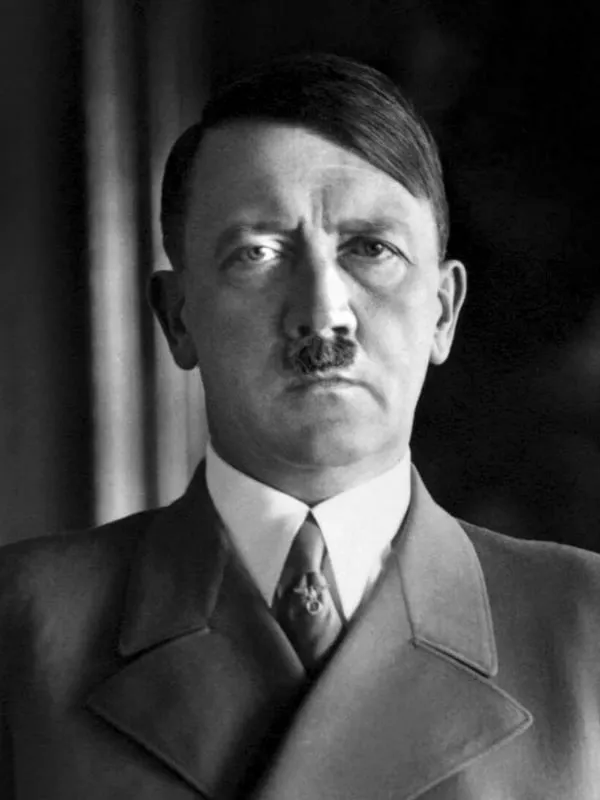
- Born:
- 20 April 1889, Braunau am Inn (Austria-Hungary)
- Died:
- 30 April 1945, Berlin
- Author:
- Łukasz
- Photo:
- Heinrich Hoffmann / Bundesarchiv, CC BY-SA 3.0 DE, Wikimedia Commons

Adolf Hitler is the figure around whom the entire history of the Second World War revolves. The Austrian-born son of a customs official, a failed painter and a front-line soldier of the Great War, after Germany’s defeat in 1918 he built up in Munich a party that promised revenge for Versailles and a reckoning with the “November criminals” and with the Jews, whom he blamed for all of Germany’s misfortunes. In 1933, during the Great Depression, he became Reich Chancellor, and within eighteen months he had destroyed Weimar democracy. Then, step by step, he dismantled the Versailles order until, on 1 September 1939, he attacked Poland and unleashed a war that claimed tens of millions of lives. His regime murdered some six million European Jews, as well as millions of Poles, Soviet prisoners of war, Roma, the mentally ill and others deemed “inferior” or enemies. He took his own life in a Berlin bunker a week before Germany’s surrender.
Childhood and the Vienna years
He was born on 20 April 1889 in Braunau am Inn, a small town on the border river Inn, on the Austrian side of the frontier with Bavaria. His father, Alois, was an official of the Austrian customs service, an illegitimate son who took the surname Hitler only when he was nearly forty. His mother, Klara, née Pölzl, was Alois’s third wife and a distant relative. Of her six children only Adolf and his younger sister Paula survived into adulthood. The family moved several times before settling near Linz. His strict father wanted his son to become a civil servant. Adolf, a mediocre and steadily worsening pupil at the Realschule, dreamed of a career as an artist. Alois died in 1903, and two years later his son left school without a leaving certificate.
In 1907 he applied to the Academy of Fine Arts in Vienna and was turned down. On 21 December that year his mother, to whom he was deeply attached, died of cancer. In 1908 the academy rejected him a second time, this time without even admitting him to the examination. Hitler stayed in Vienna. He lived on an orphan’s pension and his inheritance, and when the money ran out he lodged in a men’s hostel and sold watercolours of city views. In the multi-ethnic capital of the Habsburg monarchy he encountered mass politics, and his models became the mayor of Vienna, Karl Lueger, who knew how to win elections with anti-Semitic slogans, and the pan-German nationalist Georg von Schönerer. In Mein Kampf Hitler wrote that it was in Vienna that his world view, including his hatred of the Jews, took shape. Historians treat this claim with caution, since little evidence from those years confirms a radical anti-Semitism, but there is no doubt that in Vienna he acquired his contempt for the multinational monarchy and his belief in German superiority.
In May 1913, after receiving the last instalment of his father’s legacy, he moved to Munich. In doing so he was also evading service in the Austro-Hungarian army, having failed to report for conscription. When the Austrian authorities finally tracked him down, a medical board in Salzburg declared him unfit for service in February 1914.
Soldier of the Great War
Hitler greeted the outbreak of war in August 1914 with enthusiasm. He volunteered for the Bavarian army and was posted to the 16th Bavarian Reserve Infantry Regiment, known as the List Regiment after its first commander. For almost the entire war he served as a dispatch runner for the regimental staff on the Western Front, in Flanders and northern France. In December 1914 he received the Iron Cross Second Class. In October 1916 he was wounded in the thigh at the Battle of the Somme. In August 1918 he was awarded the Iron Cross First Class, a rare decoration for a private soldier, on the recommendation of a Jewish officer, Lieutenant Hugo Gutmann. He never rose above the rank of Gefreiter (one step below corporal), because his superiors did not see him as leadership material.
In mid-October 1918, near Ypres, he was gassed with mustard gas and temporarily lost his sight. He was treated in hospital at Pasewalk in Pomerania, and there he learned of the revolution in Germany, the Kaiser’s abdication and the armistice. He experienced the defeat as a personal catastrophe. In Mein Kampf he wrote that it was then that he decided to become a politician. Like millions of Germans, he came to believe that an army undefeated in the field had been betrayed by politicians, socialists and Jews at home. This stab-in-the-back legend became one of the pillars of his propaganda.
From agitator to party leader
After the war Hitler stayed in the army, because he had nowhere to return to. In the spring of 1919 he lived through the brief rule of the Bavarian Soviet Republic in Munich and its bloody suppression by the army and the Freikorps. That summer the Reichswehr command in Bavaria, which was looking for men to counter left-wing influence among the troops, sent him on propaganda courses. He turned out to have an extraordinary gift for public speaking. In September 1919, as an army observer, he attended a meeting of Anton Drexler’s small German Workers’ Party and soon joined it. In his first known political text, a letter of 16 September 1919, he was already calling for an “anti-Semitism of reason”, whose “ultimate aim” must be “the removal of the Jews altogether”.
On 24 February 1920, in Munich’s Hofbräuhaus beer hall, he proclaimed the 25-point programme of the party, which soon took the name National Socialist German Workers’ Party (NSDAP). The programme demanded the union of all Germans in a single state, the annulment of the treaties of Versailles and Saint-Germain, “living space” and the stripping of Jews of their civil rights. At the turn of March and April 1920 Hitler left the army and devoted himself entirely to politics. His speeches drew thousands of listeners, and money and contacts in Munich society were provided by, among others, the journalist Dietrich Eckart. In July 1921, by threatening to resign, he forced the party to grant him almost dictatorial power. The party acquired a strong-arm wing, the Sturmabteilung (SA), in which Captain Ernst Röhm played an important part, and the leadership principle: its members began to call Hitler “Führer”.
The Munich Putsch and Mein Kampf
Hitler saw 1923, the year of the occupation of the Ruhr and of hyperinflation, as an opportunity to seize power on the model of Mussolini’s March on Rome. On the evening of 8 November 1923 he burst with armed followers into a meeting of the Bavarian authorities in the Bürgerbräukeller beer hall and proclaimed a “national revolution”. He was backed by General Erich Ludendorff, the most famous commander of the Great War after Hindenburg. The next day the Bavarian police broke up the putschists’ march in the centre of Munich. Sixteen Nazis and four policemen were killed. The Munich Putsch had failed, and Hitler was arrested.
His trial in Munich in the spring of 1924, however, turned defeat into a propaganda success. The judges allowed Hitler to deliver long speeches against the “November traitors”, and on 1 April 1924 they sentenced him to the minimum possible penalty, five years’ fortress detention. Ludendorff was acquitted. In Landsberg prison, in comfortable conditions, Hitler dictated the first volume of Mein Kampf (published in 1925; the second volume followed in 1926). The book combined autobiography with an exposition of his ideology: history is a struggle between races, the Jews are the mortal enemy of the German nation, and Germany must win “living space” in the east at the expense of Russia and its neighbours. After little more than a year, on 20 December 1924, he was released.
The road to power
In February 1925 he refounded the party, which had been banned after the putsch, and changed tactics: power was now to be won legally, through elections, although the SA continued to fight street battles with the communists. In April 1925 he renounced his Austrian citizenship and remained stateless for seven years. During the years of the republic’s relative stability the NSDAP stayed on the fringes: in the elections of May 1928 it won 2.6 per cent of the vote. Around Hitler, however, gathered the men who were to rule Germany after 1933, among them Joseph Goebbels, Hermann Göring, Rudolf Hess and Heinrich Himmler, head of the SS from 1929.
The breakthrough came with the Great Depression. Unemployment in Germany passed six million, the government of Chancellor Heinrich Brüning, ruling by presidential decree, deepened the misery with its austerity policy, and Hitler promised everything to everyone: work, order, national rebirth and an end to Versailles. In September 1930 the NSDAP won 18.3 per cent of the vote and 107 seats, becoming the second-largest party in the Reichstag. In February 1932 Hitler acquired German citizenship through a sham appointment as an official of the state of Brunswick and stood in the presidential election against Paul von Hindenburg. He lost, but in the second round in April he won almost 37 per cent of the vote. In the Reichstag elections of 31 July 1932 the Nazis took 37.3 per cent of the vote and 230 seats and became the largest party in Germany. In the November elections they lost some two million votes, and the party fell into financial and internal crisis.
It was therefore not an electoral triumph that brought Hitler to power, but a deal with the conservative elite. General Kurt von Schleicher, and then Chancellor Franz von Papen, wanted to harness the Nazis’ mass movement, but Hitler demanded the chancellorship for himself, and in August 1932 Hindenburg refused it to him. In January 1933 Papen, who had been ousted, came to terms with Hitler against Schleicher and persuaded the president’s entourage that the NSDAP leader, surrounded by conservative ministers, could be kept under control. On 30 January 1933 Hindenburg appointed Hitler Reich Chancellor. His first cabinet included only three Nazis.
Dictatorship
Control proved an illusion. After the Reichstag fire on the night of 27 February 1933 Hindenburg signed a decree suspending basic civil rights, and thousands of communists and social democrats were thrown into prisons and the first concentration camps. In the elections of 5 March, held in an atmosphere of terror, the NSDAP won 43.9 per cent of the vote. On 23 March the Reichstag – with the Social Democrats voting against and the Communists under arrest or in hiding – passed the Enabling Act, which gave the government the power to make laws. On 1 April the SA organised a boycott of Jewish shops, and on 7 April the civil service law removed Jews from public office. Within a few months the trade unions and all parties other than the NSDAP had been dissolved, and the federal states had lost their autonomy.
The last rival within the movement was Röhm’s SA, which had several million members and was demanding a “second revolution” and its own replacement of the army. At the end of June 1934, in the Night of the Long Knives, Hitler had Röhm and other SA leaders murdered, and old opponents along with them, including the former chancellor Schleicher. The army was satisfied. When Hindenburg died on 2 August 1934, Hitler merged the offices of president and chancellor, and the soldiers swore an oath of loyalty to him personally as “Führer of the German Reich and People”.
Economic policy, rearmament and public works quickly eliminated unemployment, which won the regime broad support. At the same time the state excluded the Jews from society step by step. The Nuremberg Laws of 15 September 1935 stripped them of Reich citizenship and banned marriages with “Aryans”, and on the night of 9–10 November 1938, during Kristallnacht, the Nazis burned synagogues throughout Germany, murdered 91 people according to official figures – in reality more – and sent some thirty thousand Jewish men to camps.
Overturning the Versailles order
In foreign policy Hitler spent his first years protesting his love of peace while systematically breaking down the provisions of the Treaty of Versailles. In October 1933 Germany walked out of the Disarmament Conference and the League of Nations. On 26 January 1934, to the world’s surprise, he concluded a declaration of non-aggression with the government of Józef Piłsudski, which for several years eased tension on the border with Poland and broke up the French alliance system in the east. In January 1935 the people of the Saar voted in a plebiscite to return to the Reich, and on 16 March Hitler announced the reintroduction of universal military service and the creation of an army of 36 divisions. Britain, rather than objecting, concluded a naval agreement with him in June 1935.
On 7 March 1936 German troops marched into the demilitarised Rhineland. France did not respond with force, and Hitler became convinced that the Western powers would not fight. That same year Germany, together with Benito Mussolini’s Italy, backed General Franco in the Spanish Civil War, the Berlin–Rome Axis was proclaimed, and on 25 November Germany concluded the Anti-Comintern Pact with Japan. On 5 November 1937 Hitler set out before his military commanders and the foreign minister his plans to win “living space” by force, beginning with Austria and Czechoslovakia, as is known from the memorandum of his adjutant Hossbach. At the beginning of 1938 he removed the sceptical generals, including the war minister Werner von Blomberg, and himself assumed supreme command of the Wehrmacht.
On 12 March 1938 German troops entered Austria, and Hitler’s homeland became part of the Reich (the Anschluss). The next target was Czechoslovakia. The Sudeten crisis (PL) provoked by Hitler ended in the Munich Agreement of 29–30 September 1938, in which the prime ministers of Britain and France, Neville Chamberlain and Édouard Daladier, agreed to the annexation of the Sudetenland by Germany. In October 1938 the foreign minister, Joachim von Ribbentrop, demanded that Poland agree to the incorporation of the Free City of Danzig into the Reich and to an extraterritorial motorway and railway line across Pomerania, and that it join the Anti-Comintern Pact. Poland refused. On 30 January 1939 Hitler declared in the Reichstag that if a new world war broke out, its result would be “the annihilation of the Jewish race in Europe”.
On 15 March 1939, in breach of the Munich Agreement, Germany occupied Bohemia and Moravia, and a week later Lithuanian Klaipėda (Memel). Britain responded on 31 March with guarantees to Poland. In April Hitler ordered preparations for an attack on Poland, and on 28 April he renounced the 1934 declaration and the Anglo-German Naval Agreement. That summer he took a step that had only recently seemed impossible: on 23 August 1939 in Moscow, Ribbentrop and Vyacheslav Molotov signed a non-aggression pact whose secret protocol divided Central and Eastern Europe between Germany and Joseph Stalin’s Soviet Union. With a free hand in the east, Hitler attacked Poland on 1 September 1939. On 3 September Britain and France declared war on Germany.
War
The September Campaign and the Soviet attack of 17 September ended in the partition of Poland. From the first days of the occupation the Germans murdered the Polish intelligentsia, clergy and Jews, expelled the population from the lands annexed to the Reich, and in the rest set up the General Government. Hitler also signed an authorisation, backdated to 1 September 1939, for the killing of the incurably ill. Under Aktion T4, some 70,000 psychiatric patients were murdered in gas chambers by August 1941, and in all far more fell victim to “euthanasia”.
In the spring of 1940 the Wehrmacht occupied Denmark and Norway, and from 10 May, within a few weeks, it defeated the Netherlands, Belgium and France. On 22 June 1940 the French signed an armistice in the same railway carriage in the Forest of Compiègne in which the Germans had accepted the armistice terms in 1918, and Hitler afterwards visited defeated Paris. He was at the height of his popularity. Yet he could neither defeat Britain, led by Winston Churchill, nor force it to make peace. In September 1940 Germany, Italy and the Japan of Emperor Hirohito concluded the Tripartite Pact, later joined by, among others, Miklós Horthy’s Hungary and Ion Antonescu’s Romania. In the spring of 1941 Germany conquered Yugoslavia and Greece.
On 22 June 1941 Hitler began the war for which he had been preparing all his life: the attack on the Soviet Union (Operation Barbarossa). It was to be a war of annihilation, waged without regard for the laws of war. His orders called for the shooting of the Red Army’s political commissars, and behind the front the Einsatzgruppen carried out mass murders of Jews, women and children included. Of some 5.7 million Soviet prisoners of war in German hands, around three million died, mostly of starvation. SS planners in the Generalplan Ost envisaged the expulsion or death of tens of millions of Slavs. In December 1941 the offensive stalled outside Moscow. On 11 December, a few days after the Japanese attack on Pearl Harbor, Hitler declared war on the United States, and on 19 December he took personal command of the army.
The Holocaust
In the autumn of 1941 the crimes that accompanied the war grew into genocide on a continental scale. From the ghettos in the occupied Polish lands and from all over Europe, Jews were deported to extermination camps such as Bełżec, Sobibór, Treblinka and Auschwitz-Birkenau, where they were murdered in gas chambers. On 20 January 1942, at the Wannsee Conference, state and party officials agreed on the organisation of the “final solution of the Jewish question”. The Holocaust claimed some six million victims, including about three million Polish Jews. No written order from Hitler decreeing the extermination has been found, and historians disagree about exactly when the key decisions were taken. They agree, however, that it would not have been possible without his will and approval: from 1919 Hitler had preached the need to “remove” the Jews, he publicly announced their annihilation, and Himmler and the other perpetrators invoked his orders. The victims of Nazi racial policy and terror also included the Roma, millions of Poles and other inhabitants of occupied Europe, homosexuals, political opponents and prisoners of war.
Defeat and death
From the surrender of the 6th Army at Stalingrad at the beginning of 1943, Germany was in retreat. Hitler cut himself off ever more from reality, spending his time in field headquarters such as the Wolf’s Lair at Gierłoż in East Prussia, forbidding retreats and dismissing generals. On 20 July 1944 Colonel Claus von Stauffenberg planted a bomb in a briefcase at the Wolf’s Lair. Hitler was only lightly wounded, and the regime took its revenge on the conspirators and thousands of suspects. The last months of the war brought Germany its heaviest losses, because Hitler would not countenance surrender, and in March 1945 he ordered the destruction of the country’s infrastructure ahead of the advancing Allies.
In January 1945 he returned to Berlin, and from February he lived permanently in the bunker beneath the Reich Chancellery. When the Red Army closed its ring around the city, on the night of 28–29 April he married his long-time companion Eva Braun and dictated a political testament in which he blamed the Jews for the war and called for the struggle against them to continue. On the afternoon of 30 April 1945 the two of them committed suicide, he with a pistol shot, she with poison. Their bodies were burned outside the bunker. On 8 May Germany surrendered unconditionally.
Significance
No one bears such direct responsibility for the Second World War in Europe as Hitler. It was he who decided to attack Poland, knowing that it might mean war with Britain and France, and he who turned the war in the east into a racial war of annihilation. Historians from Alan Bullock to Ian Kershaw have debated how much in the Third Reich depended on his personal decisions and how much on the rivalry of subordinates who were “working towards the Führer”, as Kershaw put it, trying to anticipate and pre-empt his will. There is no doubt, however, that his ideas – racism, anti-Semitism and the obsession with living space in the east – set the direction of the entire regime.
Hitler is the point at which almost all the threads of the history leading to the Second World War converge. His career grew out of the defeat of 1918, the revolution and the stab-in-the-back legend, out of hatred of Versailles and the crisis of the Weimar Republic, which conservatives such as Hindenburg, Papen and Schleicher themselves undermined. His successes in the 1930s were helped by the weakness and appeasement of the Western powers, the revisionism of states such as Hungary, Japan’s expansion in the Far East and Stalin’s cynical calculation. The war he unleashed ended in the destruction of Germany, its division and the loss of its eastern provinces, as well as in Soviet domination of Central and Eastern Europe. The crimes committed on his orders and in his name became after the war the basis of the Nuremberg trials and of new international law on genocide and crimes against humanity.
Sources
Mentioned in battles
(85)- The Russian Civil War
- The Hungarian–Romanian War
- The Greco-Turkish War
- The Japanese invasion of Manchuria
- The Second Italo-Ethiopian War
- The Spanish Civil War
- Invasion of Poland
- Battle of Hel
- Battle of Kock
- Winter War
- Battle of Suomussalmi
- Battle of the River Plate
- Breaking of the Mannerheim Line
- Norwegian Campaign
- Belgian Campaign
- Battle of France
- Battle of Sedan (1940)
- Battle of Dunkirk
- Italian invasion of France
- Siege of Malta
- Battle of Britain
- The Blitz
- Greco-Italian War
- Operation Compass
- Rommel’s first offensive
- Invasion of Yugoslavia
- German invasion of Greece
- Anglo-Iraqi War
- Operation Rheinübung
- Battle of Crete
- Battle of Białystok–Minsk
- Operation Barbarossa
- Continuation War
- Battle of Kiev (1941)
- Battle of Smolensk (1941)
- Siege of Leningrad
- Battle of Moscow
- Siege of Sevastopol (1941–1942)
- Battle of Rostov (1941)
- Fighting on the Kerch Peninsula (1941–1942)
- Rzhev–Vyazma offensive (1942)
- Rommel's second offensive (1942)
- Second Battle of Kharkov
- Battle of Gazala
- Case Blue
- First Battle of El Alamein
- Battle of Stalingrad
- Second Battle of El Alamein
- Operation Torch
- Tunisian campaign
- Operation Uranus
- Operation Winter Storm
- Battle of the Sutjeska
- Battle of Kursk
- Allied invasion of Sicily
- Battle of the Dnieper
- Battle of Salerno
- Battle of Anzio
- Battle of the Korsun–Cherkassy Pocket
- Battle of Narva (1944)
- Crimean offensive (1944)
- Battle of Normandy
- Vyborg–Petrozavodsk offensive
- Warsaw Uprising
- Operation Dragoon
- Jassy–Kishinev offensive
- Baltic offensive (1944)
- Battle of Hürtgen Forest
- Battle of Metz
- Battle of Aachen
- Battle of the Scheldt
- Battle of Debrecen
- Battle of the Bulge
- Siege of Budapest
- Operation Nordwind
- Vistula–Oder offensive
- East Prussian offensive
- Colmar Pocket
- East Pomeranian offensive
- Siege of Breslau
- Operation Frühlingserwachen
- The Rhine crossings
- The Vienna offensive
- The Ruhr Pocket
- The Battle of Berlin
Often appears with
People who appear in the same events.
On the timeline
(678)The 40 most important of 678 events. All tagged “Adolf Hitler” (121) →