Yugoslavia
Josip Broz Tito
Leader of the Communist Party of Yugoslavia (1937–1980), Supreme Commander of the Partisans (1941–1945), Marshal of Yugoslavia (from 1943), Prime Minister (1945–1963), President of Yugoslavia (1953–1980)
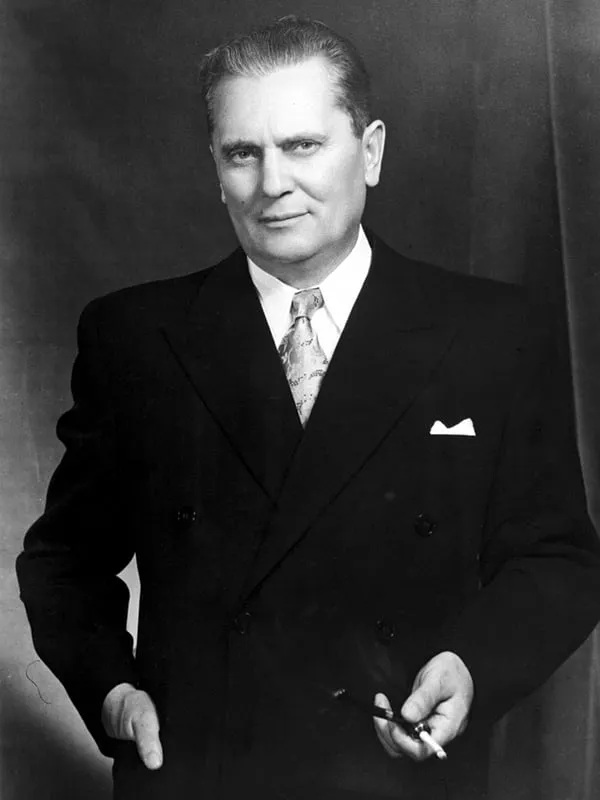
- Born:
- 7 May 1892, Kumrovec (Austria-Hungary)
- Died:
- 4 May 1980, Ljubljana
- Author:
- Łukasz
- Photo:
- Photo Division, Ministry of Information & Broadcasting, Government of India, domena publiczna, Wikimedia Commons

Josip Broz, known by his party pseudonym Tito, was a Croatian metalworker who went from non-commissioned officer in the Austro-Hungarian army and prisoner of war in Russia to professional revolutionary of the Communist International, and who during the Second World War led the communist Partisans in occupied Yugoslavia. He turned them into one of the strongest partisan armies in Europe, fought and won at the same time a war against the occupiers and a civil war against the Chetniks of Draža Mihailović and the Ustaše of Ante Pavelić, and in 1945 took power in a country liberated largely by his own forces. For thirty-five years he ruled Yugoslavia as a dictator; in 1948 he became the first communist leader to break with Stalin, and he later co-founded the Non-Aligned Movement. To some he remains a hero of the struggle against fascism and the creator of a state in which the peoples of Yugoslavia lived in peace for decades; to others he is the man responsible for the mass crimes of 1945 and the political prison camp on Goli Otok.
Childhood and youth
He was born on 7 May 1892 in Kumrovec (PL), a village in the Hrvatsko Zagorje region of the Kingdom of Croatia-Slavonia, then part of Hungary. His military papers gave the date as 25 May, and Tito later used this as his birthday; in communist Yugoslavia it was celebrated as Youth Day. He was the seventh child of Franjo Broz, a Croatian peasant, and Marija, née Javeršek, a Slovene. The family was poor and his father struggled to keep the farm going. Josip spent part of his childhood with his grandparents in Podsreda in Slovenia and attended school in Kumrovec for four years; in 1907, aged fifteen, he left for Sisak, where he was apprenticed to a locksmith.
After completing his apprenticeship in 1910 he worked in Zagreb and joined the metalworkers’ union and the Social Democratic Party of Croatia and Slavonia. Then, like many itinerant workers of the Habsburg monarchy, he looked for work in Ljubljana, Trieste, Bohemia and Germany – among other places at the Benz works in Mannheim – and finally in Vienna and at the Daimler works in Wiener Neustadt, where he was a test driver. He learned German and Czech.
The First World War and Russia
In 1913 he was called up and posted to the 25th Croatian Home Guard Regiment in Zagreb. He was quickly promoted to sergeant, becoming one of the youngest NCOs of that rank in the regiment, and took second place in an army fencing competition. On the outbreak of war in 1914 he was briefly arrested for anti-war remarks and held in the fortress of Petrovaradin. His regiment fought first against Serbia, something Tito later kept quiet about, and at the beginning of 1915 it was moved to the Eastern Front. On 25 March 1915, in Bukovina, Broz was badly wounded by the lance of a Circassian cavalryman and taken prisoner by the Russians.
He spent more than a year in a hospital in a monastery at Sviyazhsk on the Volga, where he learned Russian, and then worked in prisoner-of-war camps, most recently on the railway near Kungur in the Urals. After the February Revolution he escaped to Petrograd and in July 1917 took part in the anti-government demonstrations known as the July Days. Arrested by the government of Alexander Kerensky, he escaped from a prisoner transport and reached Omsk, where after the October Revolution he joined the international Red Guard. When the Whites seized power in Siberia in the summer of 1918, he went into hiding among the Kazakhs. In Omsk he married the teenage Pelageya Belousova. In the autumn of 1920 he returned home with her, to the new Kingdom of Serbs, Croats and Slovenes.
Revolutionary in the Kingdom of Yugoslavia
At home he joined the Communist Party of Yugoslavia (KPJ), which won almost sixty seats in the 1920 elections but was outlawed before the end of that year and banned completely in 1921. He worked as a mechanic in a mill, at the shipyard in Kraljevica and in railway workshops, everywhere organising unions and strikes and everywhere quickly losing his job. In 1927 he became secretary of the metalworkers’ union in Zagreb, and in 1928 secretary of the party’s Zagreb organisation. In August 1928 the police arrested him in a flat where weapons and bombs were found. In the so-called Bomb Trial of November 1928 he was sentenced to five years’ imprisonment. He served it in Lepoglava and Maribor, where his teacher of Marxism was the Belgrade communist Moša Pijade. He was released in March 1934, by which time Adolf Hitler was already in power in Germany.
From then on he was a professional revolutionary. He used many pseudonyms; from 1934 one of them, with which he signed his articles, was “Tito”. At the end of 1934 he joined the party’s Politburo, and after the Marseille assassination, in which King Alexander I was killed, he left the country. From February 1935 he worked in Moscow in the apparatus of the Comintern, living in the Hotel Lux. In 1936–1937, from Paris and Zagreb, he organised the dispatch of volunteers from Yugoslavia and from the Yugoslav émigré community to Spain, though he did not fight there himself.
The Great Purge in the USSR decimated the leadership of the KPJ. The NKVD shot the party’s general secretary, Milan Gorkić, and several dozen other Yugoslav communists, and both of Tito’s wives, the first and the second, were also arrested. Tito survived by avoiding stays in Moscow, and when he had to go there in 1938 he managed to clear himself of the charges against him. Whether he bought his survival by denouncing his comrades is still debated; the documents do not confirm it. From August 1937 he was acting general secretary, and in January 1939 the Comintern confirmed him in the post. He built a new, young leadership loyal to himself, including the Slovene Edvard Kardelj, the Serb Aleksandar Ranković and the Montenegrin Milovan Đilas, and moved it back into the country. After the Molotov–Ribbentrop Pact he faithfully followed Moscow’s line, which presented the war as a clash between imperialists.
The uprising of 1941
The German attack on Yugoslavia on 6 April 1941 found Tito in Zagreb. After the capitulation of the army and the proclamation of the Ustaše state, the party decided at a meeting in May to prepare for armed struggle, and the leadership moved to Belgrade. The signal was the German attack on the Soviet Union. On 27 June Tito took command of the General Staff of the partisan detachments, on 4 July the Politburo decided to launch an uprising, and on 7 July the first shots were fired in western Serbia. Soon afterwards the uprising in Montenegro broke out, and the fighting spread to Bosnia, Croatia and Slovenia.
On 16 September Tito left Belgrade for the liberated territory in western Serbia, centred on Užice. Twice, on 19 September and at the end of October, he met Mihailović, who since May had been building the Chetnik movement, but they failed to reach agreement. At the beginning of November the Chetniks attacked the Partisans and an open split followed. At the end of November a German offensive, supported by the forces of Milan Nedić’s government, took Užice, and Tito withdrew with the remnants of his units to the Sandžak. On 21 December 1941, at Rudo in Bosnia, he formed the 1st Proletarian Brigade, the first mobile unit able to fight far from its soldiers’ home districts.
The partisan war
Over the following years Tito’s main forces, directed by the Supreme Staff, moved through the mountains of Bosnia, Montenegro and Croatia, creating liberated territories and escaping from one encirclement after another. Tito consistently combined war with revolution: national liberation committees were set up in the areas the Partisans held, and in November 1942 the Anti-Fascist Council for the National Liberation of Yugoslavia (AVNOJ) met in Bihać. The Partisans accepted people of all nationalities into their ranks, including Jewish survivors of the Holocaust and many Serbs fleeing Ustaše terror, and their slogan of “brotherhood and unity” set them apart from the nationalist Chetniks and Ustaše. They too used terror against political opponents, especially in the winter of 1941/1942 in Montenegro and Herzegovina, which the communist leadership later called “left deviations”.
In 1943 the Germans and their allies made two attempts to destroy the main partisan forces. During the Battle of the Neretva Tito sent a delegation to the Germans, which in March held talks on an exchange of prisoners and a ceasefire; the Partisans gained time and crushed the Chetniks before Hitler forbade any further talks. In the Battle of the Sutjeska in May and June the Partisans broke out of encirclement at the cost of huge losses, and on 9 June Tito was wounded by a bomb splinter. The Italian capitulation in September 1943 gave the Partisans the weapons of several Italian divisions. At about the same time the British, persuaded by decrypted German signals and by the reports of their liaison officers that it was the Partisans who were tying down the largest Axis forces, sent a military mission to Tito. On 29 November 1943, in Jajce, the second session of AVNOJ set up the National Committee for the Liberation of Yugoslavia as a provisional government headed by Tito, barred King Peter II from returning to the country until the form of government had been decided, and conferred on Tito the rank of Marshal of Yugoslavia. At the same time, at the Tehran Conference, the Big Three decided to give aid to the Partisans.
On 25 May 1944, his official birthday, German paratroopers and glider-borne troops attacked Tito’s headquarters at Drvar in Operation Rösselsprung. Tito escaped from the cave that housed his staff and was taken to the island of Vis, which was protected by the British. There in June he concluded his first agreement with the new prime minister of the government-in-exile, Ivan Šubašić, and on 12 August he met Winston Churchill in Naples. In September, without warning the British, he flew secretly to Moscow and agreed with Stalin that the Red Army would enter north-eastern Yugoslavia. On 20 October 1944 Soviet and partisan units liberated Belgrade. In March 1945 Tito became head of the provisional government of Democratic Federal Yugoslavia, and his army – some 800,000 strong according to Yugoslav figures – drove the Germans and their allies out of the country and entered Trieste, Carinthia and Istria.
The end of the war brought crimes for which Tito, as supreme commander, bears responsibility, although its extent remains disputed. In May 1945 tens of thousands of soldiers of Croatian, Slovene, Serbian and Montenegrin collaborationist formations, together with the civilians accompanying them, who had been sent back by the British from Austria, died in executions and death marches known as the Bleiburg massacre. The German minority in Vojvodina and Slovenia was confined in camps, where tens of thousands died, and then expelled. In 1946, after a show trial, Mihailović was shot.
The break with Stalin
In November 1945 the People’s Front, whose list included only supporters of the new regime, won the elections, and on 29 November the Constituent Assembly proclaimed the Federal People’s Republic of Yugoslavia, made up of six republics. Tito was prime minister and minister of defence, and in its first years his state faithfully copied the USSR: nationalisation, collectivisation, trials of the clergy, headed by the Archbishop of Zagreb, Alojzije Stepinac, and persecution of opponents. But Tito’s ambitions increasingly irritated Stalin: he supported the communists in the Greek Civil War, wanted to absorb Albania and planned a federation with Bulgaria, and above all he had no intention of sharing power with Soviet advisers. On 28 June 1948 the Cominform expelled the Yugoslav party.
Stalin was convinced that Tito would fall, but he held on to power. Moscow’s supporters in the party and the army were dealt with ruthlessly: between ten and twenty thousand people passed through the camp on the island of Goli Otok, where many died. Throughout the Eastern Bloc, including Poland and the Hungary of Mátyás Rákosi, the charge of “Titoism” became a pretext for purges and show trials. Threatened with Soviet intervention, Yugoslavia accepted economic and military aid from the West, though without joining NATO.
President and leader of the non-aligned
After the break with Moscow, Tito and his ideologists, Kardelj and Đilas, began to look for their own road to socialism. In 1950 workers’ self-management was introduced in enterprises, and on 14 January 1953 Tito became President of the Republic. When Đilas began to call for genuine democratisation, he was removed from power in 1954 and later imprisoned several times. After Stalin’s death, in 1955, Nikita Khrushchev came to Belgrade to apologise. Yet in 1956 Tito supported the Soviet intervention in Hungary, even though he had given Imre Nagy asylum in the Yugoslav embassy.
In foreign policy he staked everything on non-alignment. Together with Jawaharlal Nehru, Gamal Abdel Nasser and Sukarno he created the Non-Aligned Movement, whose first summit was held in Belgrade in September 1961. Yugoslavia opened its borders, its citizens went to work in the West, and living standards were markedly higher than in the countries of the Soviet bloc. It nonetheless remained a one-party state with an all-pervasive political police. In 1966 Tito dismissed the head of that police, Ranković; in 1968 he condemned the Warsaw Pact intervention in Czechoslovakia; and in 1971 he suppressed the Croatian Spring, only to meet some of its demands in the constitution of 1974. The same constitution made him president for life and transferred considerable power to the republics.
Death and legacy
In January 1980 Tito was admitted to hospital in Ljubljana with blocked arteries. His left leg was amputated, but he died on 4 May 1980, three days before his 88th birthday. Delegations from more than 120 countries on both sides of the Iron Curtain attended his funeral in Belgrade on 8 May. He was buried in the mausoleum known as the House of Flowers. He was married four times: to Pelageya Belousova, with whom he had a son, Žarko; to the Austrian Johanna Koenig; to Herta Haas, mother of his son Aleksandar, known as Mišo; and from 1952 to Jovanka Broz.
Yugoslavia outlived its creator by only eleven years. In 1991 it began to break apart in a series of wars, and Tito became a contested figure. Historians point out that he led the most effective partisan movement in occupied Europe, which tied down dozens of Axis divisions and liberated the country largely by its own efforts, and that his was the only movement in Yugoslavia to reject the nationalism in whose name the Ustaše and the Chetniks murdered civilians. At the same time his war was from the outset also a revolution in which political opponents were treated without mercy, his rule rested on the terror of 1945–1948 and on Goli Otok, and the federation he built did not survive without him. Many people in the former Yugoslavia remember him with nostalgia as a symbol of an era of peace and relative prosperity; others, especially the victims and their descendants, see him as a communist dictator.
Sources
Commanded in battles
(02)Mentioned in battles
(03)Often appears with
People who appear in the same events.