Italy
Benito Mussolini
Founder of the Fasci di combattimento (1919) and the National Fascist Party (1921), Prime Minister of Italy and Duce of Fascism (1922–1943), leader of the Italian Social Republic (1943–1945)
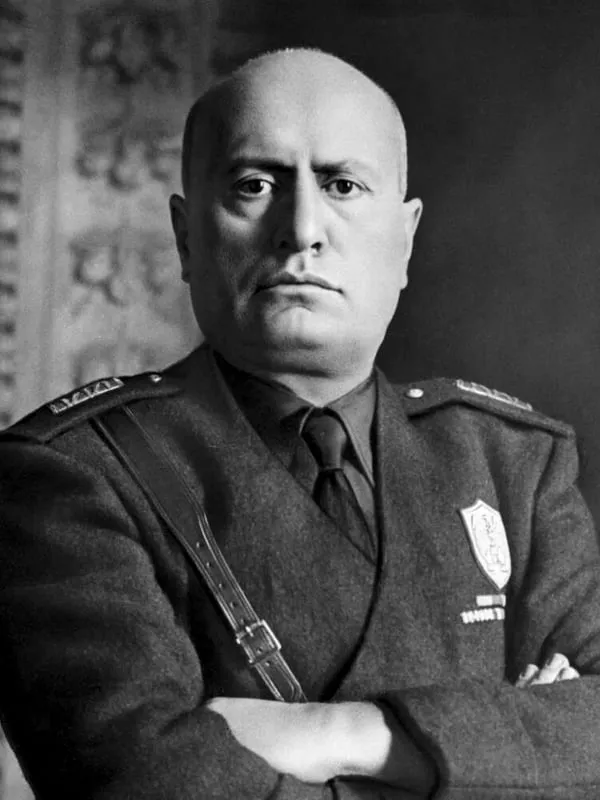
- Born:
- 29 July 1883, Dovia di Predappio (Kingdom of Italy)
- Died:
- 28 April 1945, Giulino di Mezzegra (Italy)
- Author:
- Łukasz
- Photo:
- autor nieznany, domena publiczna, Wikimedia Commons

Benito Mussolini invented Fascism, gave it its name and was the first to build a state upon it. The son of a socialist blacksmith from the Romagna, before the First World War he was the most popular leader of the revolutionary wing of the Italian socialists; in 1914 he broke with them to clamour for war, and after the war he founded a veterans’ movement which, within three years, seized power through the violence of its squads and the passivity of the king. In October 1922 he became prime minister, and from 1925 he ruled as a dictator. In the 1920s he was a teacher and model for Adolf Hitler. In the 1930s, after the invasion of Ethiopia and the intervention in Spain, he bound Italy to Germany, and in June 1940 he led it into the war. The war, in which Italy proved the weaker and increasingly dependent partner, destroyed his regime. In July 1943 the king had him arrested; the Germans freed him and installed him at the head of a puppet state in the north of the country, and in April 1945 partisans shot him by Lake Como.
The blacksmith’s son from the Romagna
He was born on 29 July 1883 in Dovia, a hamlet in the municipality of Predappio near Forlì, the eldest child of the blacksmith Alessandro Mussolini and the schoolteacher Rosa Maltoni. His father was a well-known local socialist with anarchist sympathies and named his son after revolutionaries: Benito after the Mexican president Benito Juárez, Andrea and Amilcare after Italian socialists. His mother was a devout Catholic. The boy was gifted but hot-tempered. He had to leave the Salesian college at Faenza after wounding a fellow pupil with a penknife in a fight. He obtained his teaching diploma in 1901 at a secular college in Forlimpopoli.
In 1902 he left for Switzerland, and because he failed to report for conscription, a military court sentenced him in absentia for desertion. He worked as a casual labourer, wrote for the socialist press, spoke at rallies and was arrested and expelled several times. In Lausanne he read Marx, Nietzsche, Georges Sorel and Vilfredo Pareto, from whom he took a faith in creative violence, in the myth that mobilises the masses and in the rule of determined elites. In 1904 an amnesty allowed him to return to Italy; he did his military service and taught in schools. In 1909 he worked as a socialist journalist in Trento, then still Austrian, from which he was expelled. He returned to Forlì, where he set up home with Rachele Guidi. Their daughter Edda was born in 1910; they married in 1915.
Revolutionary socialist
He made his name at the congress of the Italian Socialist Party at Reggio Emilia in July 1912, where a fiery speech of his secured the expulsion of the moderate reformists, among them the future prime minister Ivanoe Bonomi. Shortly before, he had come out of prison, where he had spent five months for inciting violence during a strike against the war with Turkey over Libya. In December 1912, aged 29, he became editor-in-chief of the party daily Avanti! in Milan and within two years multiplied its circulation several times over. He was the most electrifying orator of the far left, an enemy of parliament, the monarchy, the army and the Church.
When war broke out in August 1914, Mussolini, like the whole party, argued for neutrality. In the autumn he changed his mind. He concluded that a war against Austria-Hungary and Germany could become a revolution of nations and that the socialists could not stand aside. When the party rejected his position, he left Avanti! and on 15 November 1914 brought out the first issue of his own daily, Il Popolo d’Italia, financed by industrialists and later also by the French and the British. At the end of November the party expelled him. From then on he was a traitor to his former comrades and an ally to the nationalists. In May 1915 the agitation of the interventionists, among them Mussolini and Gabriele D’Annunzio, helped to draw Italy into the war.
In the summer of 1915 Mussolini was called up. He served with the Bersaglieri on the Austrian front and rose to the rank of corporal. In February 1917 he was badly wounded in an accidental mortar explosion and returned to his newspaper. After the defeat at Caporetto he called for ruthless discipline and a military dictatorship, and in 1918 he changed the paper’s subtitle from “socialist daily” to “daily of combatants and producers”. He proclaimed that a new aristocracy had been born in the trenches and had the right to rule the country.
The Fasci di combattimento
On 23 March 1919, in the Piazza San Sepolcro in Milan, Mussolini and a few dozen veterans, Futurists and syndicalists founded the Fasci italiani di combattimento. From the outset its members reached for cudgels and revolvers: in April they burned down the offices of Avanti!. In November 1919 the movement lost the election, and Mussolini himself received fewer than five thousand votes. Among the veterans he was overshadowed by D’Annunzio, who had seized Fiume. Mussolini borrowed much from the poet: the balcony speeches, the Roman salute, the black shirts, the chants and the rituals.
Fascism became a mass movement at the turn of 1920 and 1921, when armed squads financed by landowners began to destroy socialist unions and local councils in the Po valley, often with the sympathy of the police and the army. In May 1921 Mussolini entered parliament on the list of the “national blocs” of Prime Minister Giovanni Giolitti. When he concluded a truce with the socialists that summer, the local squad leaders rebelled against him. The dispute was settled at a congress in Rome, where on 9 November 1921 the movement was transformed into the National Fascist Party. Mussolini was acknowledged as Duce, but he had to abandon the truce and accept the squads into the party.
The road to power and dictatorship
In the autumn of 1922, with the liberal state paralysed, Mussolini threatened a march on Rome. On 28 October King Victor Emmanuel III refused to sign a decree declaring a state of siege, and the next day he summoned Mussolini to form a government. Mussolini became prime minister at the age of 39, at the head of a coalition in which the Fascists held a minority of the portfolios. For two years he assured the liberals that he would restore order, while at the same time turning the squads into a state-funded militia and forcing through an electoral law that gave two-thirds of the seats to the list with the most votes. In the elections of April 1924, held in an atmosphere of violence, his list won about two-thirds of the vote. In 1923 he had also shown what his foreign policy would be: after the murder of an Italian general on the Greek–Albanian border he had the Greek island of Corfu bombarded and occupied, and the League of Nations had to content itself with the matter being settled by the Conference of Ambassadors.
On 10 June 1924 Fascists from his entourage kidnapped and murdered the socialist deputy Giacomo Matteotti, who had accused them of rigging the elections. The murder provoked outrage and shook the government for several months. The opposition walked out of parliament and counted on the king to intervene, but Victor Emmanuel III did nothing. On 3 January 1925 Mussolini declared in the Chamber that he assumed political responsibility for everything Fascism had done, and began building the dictatorship. The laws of 1925–1926 made the government answerable to him alone and abolished every party except the Fascist one, the free press and the independent unions; they created a Special Tribunal to try political offences and the secret police, the OVRA. Opponents were sent into internal exile on islands, and thousands emigrated. The regime’s watchword became the totalitarian state, in which there was “everything within the state, nothing outside the state, nothing against the state”.
The Duce in Europe
In the 1920s and early 1930s Mussolini was a respected figure in Europe. Conservatives saw him as the man who had saved Italy from Bolshevism, and Winston Churchill praised him publicly in 1927. In 1925 Italy became a guarantor of the Locarno Treaties, in 1928 it signed the Kellogg–Briand Pact, and on 11 February 1929 Mussolini and Cardinal Pietro Gasparri signed the Lateran Treaties, which ended the quarrel between the Italian state and the papacy and won the regime the support of Catholics. In 1928 he concluded a treaty of friendship with Ethiopia. At home he waged propaganda campaigns: the “battle for grain”, the draining of the Pontine Marshes, the building of new towns and the drive to raise the birth rate. The cult of the Duce – speaking from the balcony of the Palazzo Venezia, shown at the harvest, at the controls of an aircraft and on horseback – became the axis of the regime.
Beneath this façade, colonial crimes went on. In 1929–1932 the army under Pietro Badoglio and Rodolfo Graziani crushed the rising in Libyan Cyrenaica, deporting some hundred thousand people to camps, where tens of thousands died. The leader of the rising, Omar al-Mukhtar, was hanged in 1931.
At first Mussolini regarded Hitler with reserve. He mocked the Nazi theory of race, and the two dictators’ first meeting, in Venice in June 1934, did not bring them closer. When Austrian Nazis murdered Chancellor Engelbert Dollfuss in July 1934, Mussolini sent troops to the Brenner Pass, and in April 1935 at Stresa he joined Britain and France in condemning German rearmament.
Ethiopia, Spain and the Axis with Berlin
The turn came in 1935. Mussolini wanted an empire. On 3 October 1935, without a declaration of war, Italy invaded Ethiopia, a member state of the League of Nations. The Duce authorised the use of poison gas, including mustard gas, against civilians as well. On 9 May 1936 he proclaimed the empire from his balcony, and Victor Emmanuel III assumed the title of Emperor of Ethiopia. The League of Nations imposed sanctions on Italy, but they were weak and short-lived. Emperor Haile Selassie appealed in vain at Geneva. The occupation was brutal: in February 1937, after an attempt on Graziani’s life, thousands of people were massacred in Addis Ababa.
Sanctions and condemnation by the democracies pushed Mussolini towards Hitler, who had backed him over Ethiopia. From 1936 both supported General Francisco Franco in the Spanish Civil War, to which Mussolini sent tens of thousands of soldiers. On 1 November 1936 in Milan he announced the Rome–Berlin “Axis”. In 1937 Italy joined the Anti-Comintern Pact and left the League of Nations. In March 1938 Mussolini, who four years earlier had defended Austria, accepted its annexation by the Reich without protest. In September 1938 at Munich he posed as mediator and helped to force Czechoslovakia to surrender the Sudetenland. That autumn he introduced racial laws that drove Jews out of public office, schools, the army and many professions. In April 1939 Italy occupied Albania, and on 22 May 1939 Mussolini concluded the Pact of Steel with Hitler, an unconditional military alliance.
The war
When Germany invaded Poland on 1 September 1939, Mussolini, aware of his army’s weakness, declared “non-belligerence”. But when Germany crushed France in May and June 1940, he concluded that the war was already decided. On 10 June 1940, from the balcony of the Palazzo Venezia, he announced the declaration of war on France and Britain. He was counting on a “parallel war” in which Italy would win spoils of its own. The attack in the Alps achieved little, and on 28 October 1940 the Italian army struck at Greece from Albania and was thrown back. In November British aircraft sank and damaged part of the fleet at Taranto, and in the winter the British routed the Italian army in Libya. The Italians were rescued from their troubles by the Germans, who in the spring of 1941 occupied Yugoslavia and Greece and sent Rommel’s corps to Africa. From then on Mussolini was Hitler’s subordinate in the war.
Italy occupied parts of Yugoslavia, Greece and France, and in the annexed Slovene and Croatian lands it set up camps for civilians in which thousands died of hunger and disease. In June 1941 Mussolini sent an expeditionary corps to the war against the USSR, and in 1942 a whole army, which the Red Army destroyed on the Don in the winter of 1942/1943. In December 1941 he declared war on the United States. The defeat at El Alamein in the autumn of 1942 and the surrender of the Axis forces in Tunisia in May 1943 meant the loss of Africa. On 10 July 1943 the Allies landed in Sicily.
Fall, Salò and death
On the night of 24–25 July 1943 the Grand Council of Fascism voted by a majority for a motion by Dino Grandi that the king should take over command of the armed forces. On the afternoon of 25 July Victor Emmanuel III received Mussolini at his villa, dismissed him and had him arrested. Marshal Badoglio became prime minister. The regime collapsed within a single day, and no one defended it. Mussolini was moved from place to place until he was held in a hotel on the Gran Sasso in the Abruzzi. On 12 September 1943, a few days after the announcement of Italy’s armistice with the Allies, German paratroopers freed him in Operation Eiche.
Hitler placed him at the head of a new Fascist state in the north of Italy, occupied by the Wehrmacht, called the Italian Social Republic and also, after the seat of some of its ministries on Lake Garda, the Republic of Salò. It was a German puppet. In January 1944, after the Verona trial, five members of the Grand Council who had voted against Mussolini were shot, among them his son-in-law, the former foreign minister Galeazzo Ciano. The Republic declared Jews to be “aliens belonging to an enemy nationality”, and its police and militia helped the Germans in round-ups. Several thousand Jews were deported from Italy to the extermination camps, and only a small fraction of them returned. The Salò Fascists fought alongside the Germans against the Italian resistance in a savage civil war.
In April 1945 the front collapsed. Mussolini tried to escape in a German column heading for Merano. On 27 April partisans stopped him at Dongo on Lake Como. The next day, 28 April 1945, he was shot together with his mistress Clara Petacci at Giulino di Mezzegra. The circumstances of the execution, and who exactly fired the shots, remain disputed to this day. On 29 April their bodies, together with those of other Fascist leaders, were hung upside down from a petrol station in Milan’s Piazzale Loreto. Two days after Mussolini’s death Hitler killed himself in Berlin. In 1957 Mussolini’s remains were handed over to his family and buried in Predappio.
Legacy
Mussolini was the first leader in Europe to take power at the head of a party with its own army and to build around himself a cult, a ritual and a state that he himself called totalitarian. The word “Fascism”, which he coined for his movement, became the name of an entire era. Hitler imitated him from 1922 onwards, from the Munich Putsch to the rituals of the party rallies, and even after he had outgrown his teacher he remained loyal to him to the end.
His role on the road to the Second World War was twofold. The invasion of Ethiopia in 1935 dealt a mortal blow to the League of Nations and the system of collective security, and Italy’s move from the Stresa Front to the Axis with Berlin opened Hitler’s way to Vienna and beyond. At the same time Mussolini was never an equal partner for Germany. His armies, thrown into the war unprepared, suffered defeat after defeat, and in 1943 the regime that for twenty years had promised Italians greatness collapsed in a single night. It cost Italy hundreds of thousands of dead and two years of war on its own soil.
Sources
Commanded in battles
(02)Mentioned in battles
(31)- The Hungarian–Romanian War
- The Greco-Turkish War
- The Japanese invasion of Manchuria
- The Second Italo-Ethiopian War
- The Spanish Civil War
- The Italian invasion of Albania
- East African Campaign
- Siege of Malta
- Battle of Britain
- Italian invasion of British Somaliland
- The Blitz
- Italian invasion of Egypt
- Greco-Italian War
- Operation Compass
- Battle of Keren
- Rommel’s first offensive
- Battle of Cape Matapan
- Invasion of Yugoslavia
- German invasion of Greece
- Operation Barbarossa
- Rommel's second offensive (1942)
- Battle of Gazala
- Case Blue
- First Battle of El Alamein
- Operation Pedestal
- Battle of Alam el Halfa
- Second Battle of El Alamein
- Tunisian campaign
- Battle of the Sutjeska
- Allied invasion of Sicily
- Dodecanese campaign
Often appears with
People who appear in the same events.
On the timeline
(229)The 40 most important of 229 events. All tagged “Benito Mussolini” (53) →