1942–1943: Guadalcanal and New Guinea
Kokoda Track campaign
- Dates:
- 21 July – 16 November 1942
- Front:
- Pacific
- Location:
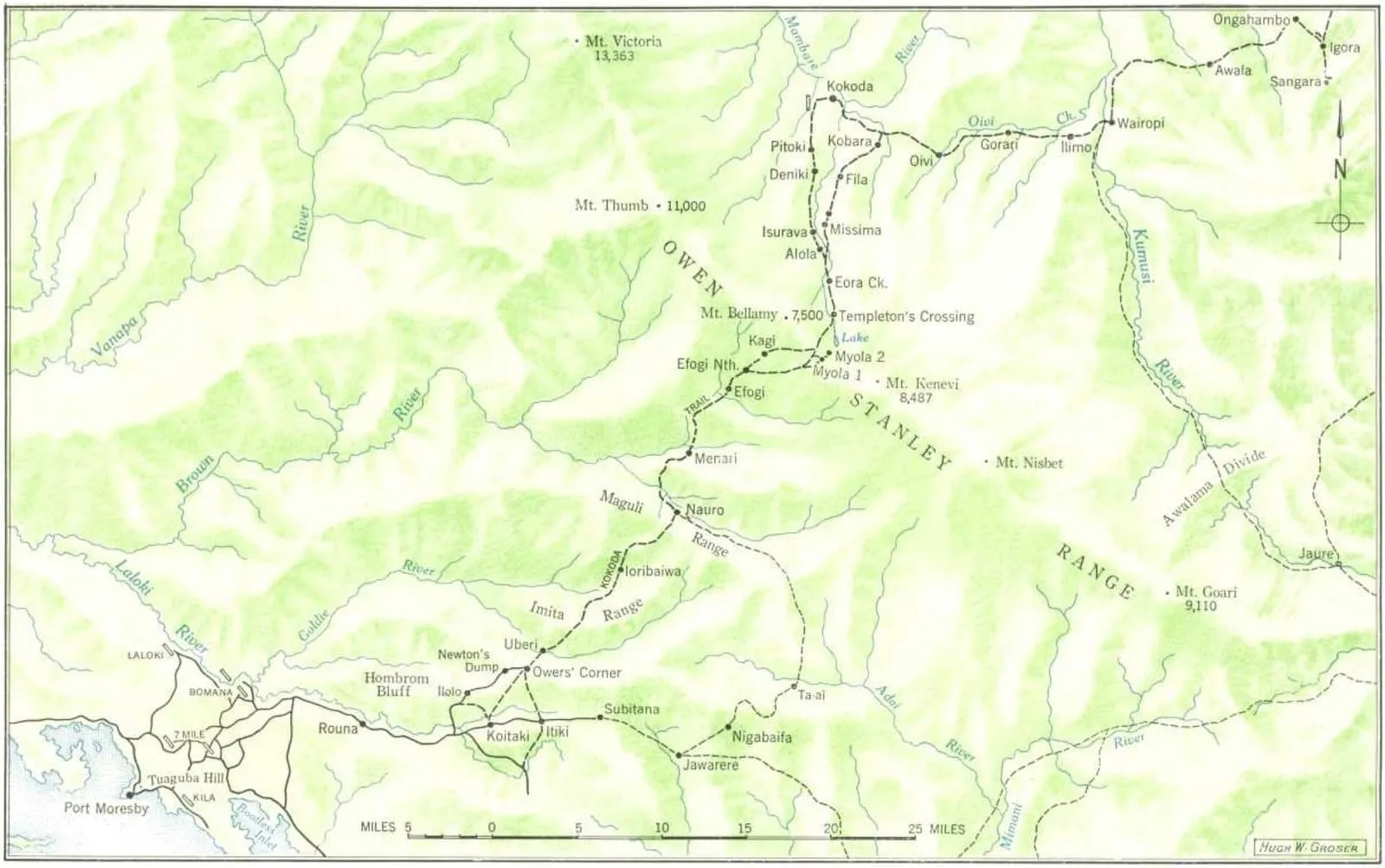
- Territory of Papua (New Guinea): the Kokoda Track across the Owen Stanley Range between Port Moresby and the village of Kokoda, and the route from Kokoda to the Kumusi River and the coast at Buna and GonaOn the battle map →
- Sides:
- JapanTomitarō HoriiAustraliaSydney Rowell, Arthur Allen, Thomas Blamey
- Result:
- Australian victory. In September the South Seas Detachment came within 30–40 km of Port Moresby, but, exhausted and cut off from its supplies, it was ordered to withdraw. The Australians retook Kokoda, defeated the Japanese at Oivi and Gorari and in mid-November crossed the Kumusi, advancing on the beachheads at Buna and Gona.
- Author:
- Natalia
Name and dates
The Kokoda Track campaign (or Kokoda Trail campaign) is the name given to the struggle between Japanese troops and Australian and Papuan forces in the Territory of Papua, the part of New Guinea then administered by Australia, from July to November 1942. The Japanese intended to march on foot from the north coast of the island to Port Moresby, the main Allied base in New Guinea, along a narrow path across the Owen Stanley Range. The path began at the village of Kokoda on the northern foothills of the range, beside the only airstrip in the area, and took its name from it.
The official battle honour is “Kokoda Trail”, but since the 1990s the form “Kokoda Track” has prevailed in Australia.
Dudley McCarthy’s Australian official history and most studies set the limits of the campaign at 21 July – 16 November 1942: from the evening landing of the Japanese advance guard near Gona to the moment when two brigades of the Australian 7th Division completed their crossing of the Kumusi River at Wairopi and moved against the Japanese beachheads on the coast. The subsequent fighting at Buna, Gona and Sanananda, waged together with the Americans until January 1943, forms a separate battle. Australian battle casualties are usually counted from the first clash on 22–23 July.
The campaign consisted of several battles that the Australians name separately: the first and second battles of Kokoda (28–29 July and 8–10 August), the Battle of Isurava (26–31 August), the fighting at Eora Creek and Templeton’s Crossing during the withdrawal (31 August – 5 September), the Battle of Mission Ridge and Brigade Hill (6–9 September), the Battle of Ioribaiwa (13–16 September), the second battle of Eora Creek and Templeton’s Crossing during the pursuit (11–28 October), and the Battle of Oivi and Gorari (4–11 November). The dates in the sources differ by a day or two.
Background
After the fall of Singapore in February 1942 Australians feared a Japanese invasion of their own continent. Prime Minister John Curtin turned to the United States for help, and in March General Douglas MacArthur arrived in Australia and took command of the new South West Pacific Area. His deputy and commander of Allied land forces was General Thomas Blamey, recalled from the Middle East.
In reality Japan had no intention of conquering Australia. At the beginning of 1942 the navy had considered it, but the army refused, since it had neither the troops nor the shipping. In March an indirect plan was adopted: to cut Australia off from the United States by taking Port Moresby, the Solomon Islands, New Caledonia, Fiji and Samoa. From Rabaul on New Britain, captured in January, the Japanese landed at Lae and Salamaua in March, but the seaborne landing at Port Moresby turned back after the Battle of the Coral Sea at the beginning of May. A month later, at Midway, the Japanese fleet lost four large carriers, and major amphibious operations in the South Pacific became impossible for the time being.
It was then that Rabaul returned to the idea of an overland advance. Lieutenant General Harukichi Hyakutake’s 17th Army relied on pre-war information according to which a road ran from the north coast of Papua to Kokoda and on to Port Moresby. The task was given to the South Seas Detachment (Nankai Shitai) of Major General Tomitarō Horii, a veteran of the capture of Guam and Rabaul. According to the Japanese official history, Horii doubted that the operation could succeed because of the difficulties of supply, but did not protest firmly.
The Allies, too, had their eye on the north coast. On 9 June MacArthur asked Blamey what had been done to defend the approach from Buna, and at the end of June the commander of New Guinea Force, Major General Basil Morris, was ordered to send Australian infantry to Kokoda. The choice fell on the 39th Battalion – a Militia unit, that is, conscripts intended for the defence of Australian territory, poorly trained and until then employed mainly on labouring work at Port Moresby. It was commanded by Lieutenant Colonel William Owen, and the whole force, together with the Papuan Infantry Battalion (about 300 men, 30 of them Europeans), was given the code name Maroubra. Captain Sam Templeton’s B Company set out along the track on 8 July and reached Kokoda on 14 July. MacArthur’s headquarters was already planning Operation Providence – the construction of an airfield in the Buna area – but the Japanese forestalled it. At the same time, in the Solomon Islands, they were building an airfield on Guadalcanal, which in August would decide the fate of this campaign as well.
Terrain, disease and supply
The Kokoda Track was a footpath, used before the war by the mail service. From Kokoda to Owers’ Corner, where the road from Port Moresby ended, it measured about 96 km, although in a straight line the distance was only 60 km. It climbed and fell the whole way – thousands of metres of ascent and descent in all – and at its highest point, near Mount Bellamy, it reached almost 2,200 m. It was covered in dense jungle; the valleys were humid and hot, the nights in the mountains were cold, and the peaks were often shrouded in cloud.
The soldiers of both sides suffered from malaria (especially in the lowlands at either end of the track), dysentery, scrub typhus, tropical ulcers and fungal infections. Disease put more men out of action than bullets.
The greatest problem was supply. The Australian officer Bert Kienzle, who led Templeton’s company across the mountains, calculated that a carrier could carry food for 13 days, but that walking alongside the soldier for whom he carried it, the two would eat it in six and a half days; the march to Kokoda took eight days. Without air drops, fighting was therefore impossible. The Allies, however, had very few transport aircraft and were short of parachutes, and loads were dropped wrapped in blankets or in sacks – depending on the place, half, and sometimes up to 90 per cent, of the drops were lost or ruined. On 3 August Kienzle discovered the dry lake bed of Myola in the mountains, which became the main dropping zone. On 17 August a Japanese air raid on Port Moresby destroyed or damaged the aircraft parked close together on the airfield, including almost all the transports. Japanese supply was not much better. The road to Kokoda mentioned in the pre-war information did not exist; the Japanese made only the stretch to Sonobo, roughly halfway from Gona to the Kumusi, passable for vehicles, and beyond it everything was carried by porters, pack horses and the soldiers themselves, while Allied aircraft bombed the Kumusi crossing so heavily that it could not be used by day.
Course of the campaign: the landing and the fighting for Kokoda (21 July – 14 August)
On the evening of 21 July 1942, at about 5.30 p.m., Colonel Yosuke Yokoyama’s advance guard began coming ashore near Gona (at Basabua). It consisted of most of the 15th Independent Engineer Regiment, the 1st Battalion of the 144th Infantry Regiment and a mountain artillery company, accompanied by some 500 labourers from Korea and Taiwan and about 2,000 native carriers from Rabaul. At the same time the navy landed a unit that was to build an airfield at Buna. Allied aircraft attacked the convoy until dusk and again in the morning, sinking one transport, but did not stop the landing. One infantry company set off inland at once.
The first clash came on the afternoon of 23 July at Awala, where a patrol of the Papuan Infantry Battalion under Lieutenant Chalk laid an ambush. As they fell back, the Australians destroyed the wire-rope bridge over the Kumusi at Wairopi and set further ambushes. On 24 July Lieutenant Colonel Owen flew in to Kokoda, and on 26 July the only serviceable aircraft brought in a platoon of reinforcements in two trips. That day at Oivi the Japanese almost surrounded Templeton’s company; the captain himself went to warn approaching soldiers and vanished without trace. The remnants of the force broke through to Deniki, and on 27 July Owen, having lost contact with his forward platoons, abandoned Kokoda.
When it turned out that the village was empty, Owen returned to Kokoda on 28 July with a force numbering, according to various accounts, between 80 and 148 men. In the afternoon Captain Ogawa’s company of about 200 men arrived. During the night it bombarded the defenders with light mortars and an infantry gun, to which the Australians had no answer, and at about 2.30 a.m. on 29 July it launched an assault. Owen, who was fighting in the front line, was mortally wounded in the head, and Major William Watson withdrew the remnants of the defenders to Deniki. Kokoda and its airstrip were in Japanese hands.
For a few days the fighting died down while both sides brought up reinforcements. On 4 August Major Allan Cameron took command of Maroubra Force and decided to retake Kokoda by striking with three companies along three routes. He set out on 8 August with about 550 men against roughly 660 soldiers of Lieutenant Colonel Hatsuo Tsukamoto’s 1st Battalion, 144th Regiment, which that same day was itself advancing on Deniki. Two Australian companies were stopped and turned back, but Captain Noel Symington’s A Company entered Kokoda by a side track unknown to the Japanese, almost without a fight. Cut off and without the promised supplies, it held out until the evening of 10 August and withdrew by a roundabout route to Isurava; the air drops, delayed by the weather, fell on 12 August into Japanese hands. On 13 August the Japanese attacked Deniki, and on the morning of 14 August Cameron withdrew the 39th Battalion to Isurava.
Course of the campaign: Isurava (26–31 August)
The Japanese did not advance again at once. Horii was assembling at Kokoda the main body of the South Seas Detachment, which landed near Buna in successive convoys: the bulk of the 144th Regiment on 18 August and the 41st Regiment on 21 and 27 August. For the offensive he had five infantry battalions with mountain artillery, in all – according to various estimates – between 3,000 and 5,000 men. Carrying food for sixteen days, they were to reach Port Moresby.
On the Australian side, on 12–13 August Lieutenant General Sydney Rowell, with the headquarters of I Corps, took over command of New Guinea Force from Morris, while at Isurava the 39th Battalion – under Lieutenant Colonel Ralph Honner from 16 August – waited to be relieved. On their way to it were the Militia’s 53rd Battalion and two battalions of veterans of the Syrian campaign from Brigadier Arnold Potts’s 21st Brigade of the Second Australian Imperial Force (the 2/14th and 2/16th Battalions). Potts reached Myola on 21 August and, instead of the promised 40,000 rations, found about 8,000 there; he had to hold back his battalions until a stockpile had been built up. The fate of the missing drops remains unclear; McCarthy attributed it to mistakes by inexperienced staff officers. On 23 August Potts took command of the whole force with orders to retake Kokoda.
The Japanese got in first. The position at Isurava lay on a ridge above the Eora Creek gorge, between two streams, but it was overlooked from the north by a higher ridge from which the defenders could be fired on. On 26 August, while the 2/14th Battalion was still relieving the 39th in its positions, the Japanese attacked with four battalions – some 2,100 men in all, with artillery – on both sides of the gorge. On the eastern flank the 53rd Battalion failed to hold, and its commander, Lieutenant Colonel Kenneth Ward, was killed in an ambush; the situation there was saved by two companies of the 2/16th Battalion. At Isurava itself hand-to-hand fighting took place on 27–29 August. Private Bruce Kingsbury of the 2/14th Battalion, firing a Bren light machine gun from the hip, broke through the Japanese line and on 29 August halted the attack before he was killed by a sniper’s bullet. He was awarded a posthumous Victoria Cross, regarded as the first awarded for fighting on Australian territory (Papua formally being such territory).
The outcome was decided by the Japanese artillery. According to the historian Peter Williams, the Japanese had eight guns at Isurava, while the Australians had a single mortar, delivered by air drop on 27 August. The Australian command had judged that Vickers heavy machine guns and mortars were too heavy and of little use in the jungle, so the first battalions went in without them; Nicholas Anderson attributes roughly 35 per cent of Australian casualties in the whole campaign to Japanese artillery. On the night of 29 August the defenders fell back to the rest house beyond Isurava, and when on 30 August the Japanese outflanked them from the west and cut the track to Alola, Potts ordered a withdrawal. During it the commander of the 2/14th Battalion, Lieutenant Colonel Arthur Key, was taken prisoner and murdered.
Course of the campaign: from Brigade Hill to Ioribaiwa (31 August – 16 September)
The 21st Brigade fell back, defending successive positions at Eora Creek and Templeton’s Crossing, and by 5 September had managed to break contact with the enemy. It lost Myola, however, where it destroyed the supplies it could not carry away.
Meanwhile, on 25 August, Japanese naval infantry had landed at Milne Bay on the eastern tip of New Guinea. Once the Australians had won there, Potts’s third battalion – the 2/27th – set out along the track, and Potts, under pressure from his superiors, decided to give battle on Mission Ridge, a ridge running from Brigade Hill towards the village of Efogi. On 7 September Allied B-26 bombers attacked the Japanese, while the Japanese artillery shelled the 2/27th Battalion. During the night the 2nd Battalion of the 144th Regiment slipped unseen round the Australians’ western flank and at dawn on 8 September emerged on the track between brigade headquarters and the forward battalions, while the 3rd Battalion struck frontally at the same time. Counter-attacks from both sides failed to remove the wedge. Brigade headquarters fell back to Nauro, the 2/14th and 2/16th Battalions fought their way east through the jungle, and the 2/27th Battalion was given up for lost until its remnants emerged from the jungle three weeks later. The Battle of Brigade Hill is described as the most painful Australian defeat of the campaign.
Rowell recalled Potts to Port Moresby; command passed to Brigadier Selwyn Porter and then to Brigadier Kenneth Eather with the fresh 25th Brigade. On 14 September, while Eather’s battalions were still taking up their positions at Ioribaiwa, Colonel Masao Kusunose’s Japanese attacked. On 16 September Eather, fearing that the Japanese wedge between his battalions would tear his defence apart, obtained permission from Major General Arthur Allen, commander of the 7th Division, to withdraw to Imita Ridge – the last position before the start of the track. Allen stipulated that there would be no further withdrawal. Peter Williams considers that Eather withdrew too early, since the Japanese themselves had stalled.
From the ridge at Ioribaiwa the Japanese soldiers could see the lights of Port Moresby and the sea. They were some 30–40 km from their objective in a straight line – and they went no further.
The Japanese withdrawal
The Japanese halted not only because of Australian resistance. On 7 August the US Marines had landed on Guadalcanal and seized the airfield under construction there, and the attempts to retake it were consuming the strength of the 17th Army. From the second half of August Horii had been receiving instructions from Rabaul and Tokyo to halt the advance south and concentrate his forces on the northern side of the mountains; according to the Japanese official history, as translated by Steven Bullard, he carried them out reluctantly and pressed on. When on 12–14 September the force of Major General Kiyotake Kawaguchi suffered a bloody defeat on Guadalcanal, the Japanese command concluded that it could not sustain two fronts at once. Hyakutake decided to settle the fight for Guadalcanal first and ordered Horii to withdraw to the Kokoda and Isurava area. The decision was also influenced by fear of an Allied landing at Buna and by hunger: a convoy carrying supply companies had not arrived in time. Japanese soldiers were dying of malnutrition as they withdrew; the Australians found evidence that some had eaten roots, grass and wood, as well as the bodies of the dead – both Japanese and Australian.
On 24 September the 2nd Battalion of the 144th Regiment left Ioribaiwa, and on the night of 25/26 September the last Japanese rearguard followed. When on 28 September Eather’s 25th Brigade moved off for its planned attack, it found the trenches empty.
Course of the campaign: the pursuit – Templeton’s Crossing and Eora (October)
Allen knew that every step forward took him further from his supplies, and he advanced cautiously. The Japanese, meanwhile, had prepared four defensive positions in advance, manned by the Stanley Detachment, made up mainly of the 2nd Battalion, 144th Regiment. On 10 October the Australians occupied Myola without a fight. From 16 October the 25th Brigade fought at Templeton’s Crossing. The attacks of 17 and 18 October brought no decision; only when the 2/2nd Battalion of Brigadier John Lloyd’s 16th Brigade attacked from higher ground on 20 October did the Japanese withdraw during the night.
The last Japanese barrier was a position above the village of Eora, fortified over almost two months, with heavy machine guns and five guns. On 22 October Lloyd, against the advice of his battalion commanders, ordered a frontal attack; until 24 October the attackers lay pinned down by fire, with 34 dead and many wounded. Only the 2/3rd Battalion, which had spent two days climbing to the ridge above the Japanese positions, struck from above on 27 and 28 October. Horii had already ordered the position abandoned, and the defence turned into flight.
The crisis of command
The rapid Japanese advance in August and September caused a nervousness in Port Moresby, Brisbane and Canberra that the Australian official history calls outright a “crisis of command”. MacArthur had a low opinion of Australian soldiers and did not understand the conditions of fighting in the mountains. On 6 September he wrote to General George Marshall that the Australians had “proven themselves unable to match the enemy in jungle fighting”. At his urging Curtin sent Blamey to Port Moresby to take personal command; Blamey arrived on 23 September. Rowell, with whom he had been on bad terms since Greece and the Middle East, took this as a vote of no confidence and protested openly. On 28 September Blamey relieved him, replacing him with Lieutenant General Edmund Herring. Potts, who had returned to his brigade after Brigade Hill, lost it in October.
During the pursuit MacArthur and Blamey pressed Allen to move faster. On 17 October Blamey passed on to him MacArthur’s words that “extremely light casualties” showed that no serious effort had yet been made, and on 21 October that the tactical handling of the troops was “faulty”. Allen replied that he had complete confidence in his brigade commanders and his men. On 28 October Blamey relieved him and sent Major General George Vasey in his place. The historian David Horner judged these decisions harshly: MacArthur interfered in the tactics of troops 2,400 km from his headquarters, and Blamey sacrificed his subordinates so as not to endanger his own position; Peter Williams, however, considers that Allen really was advancing more slowly than conditions allowed.
The most notorious episode was Blamey’s address to the men of the 21st Brigade at Koitaki camp near Port Moresby – on 9 November 1942 according to the Australian official history (some authors give 22 October). The veterans of Isurava and Brigade Hill expected thanks, but were told that they had been beaten by a weaker enemy and that the Japanese had to be flushed out of their holes like rabbits, because “it’s the rabbit that runs who gets shot, not the man holding the gun”. The soldiers took this to mean that the general had called them running rabbits.
Course of the campaign: Kokoda, Oivi and Gorari, the Kumusi (November)
Vasey moved off on 29 October. On 2 November a patrol of the 2/31st Battalion entered the abandoned village of Kokoda, and the following day Vasey ceremonially raised the flag there.
Horii gathered the rest of his forces in previously prepared positions on the hills at Oivi and, further back, at Gorari, covering the route to the Kumusi. The 16th Brigade ran into them on 4 November and attacked frontally without success until 6 November. Vasey therefore sent Eather’s 25th Brigade along a parallel track to the south, into the Japanese rear. On 9 November the Australian battalions bypassed the Japanese barrier and struck at Gorari, held by the 1st Battalion, 144th Regiment and Horii’s headquarters. On 10 November Horii ordered a withdrawal, which turned into a disorderly rout; by noon on 11 November the fighting had ceased. According to Australian estimates the Japanese lost some 430 killed and 400 wounded, and abandoned fifteen guns.
The shattered units fled to the swollen Kumusi; some 1,200 men reportedly managed to cross. Horii, wanting to reach the beachheads on the coast more quickly, went down the river on a raft and then in a canoe, which was carried out to sea and capsized; he drowned in the second half of November (23 November is the date most often given, some authors give 19 November). On the morning of 16 November two Australian brigades completed their crossing of the river: the 25th Brigade advanced on Gona and the 16th Brigade on Sanananda. From the south-east the US 32nd Infantry Division was advancing on Buna.
The Papuan carriers
Without the Papuans the campaign would have been impossible. On 15 June 1942 Morris issued a regulation for the compulsory employment of natives, and thousands of men from Papuan villages carried ammunition and food along the track from the dropping zones to the front. During the Australian pursuit more than 1,600 of them were working with the 7th Division, and in all, by Paul Ham’s estimate, up to 3,000 passed along the track; many fell ill, and roughly one in three deserted. On the way back they carried the wounded – eight men to each stretcher – and cared for them so devotedly that the Australian soldiers called them the “Fuzzy Wuzzy Angels”. The Japanese brought about 2,000 labourers from Rabaul and recruited several hundred on the coast; they treated them badly and often killed the sick and wounded.
Losses
According to the Australian official history, between 22 July and 16 November 1942, 625 Australians were killed or died of wounds on the track (39 officers and 586 other ranks) and 1,055 were wounded; in the first month of fighting three battalion commanders were killed or captured. Losses to disease were not precisely counted and are estimated at two to three times the battle casualties. No one knows the Japanese losses exactly. Peter Williams puts the battle casualties of the South Seas Detachment from Awala to Oivi and Gorari at about 2,050 men, and estimates that, counting disease and hunger, up to 75 per cent of the roughly 6,000 soldiers who fought on the track were lost to the ranks. Both sides committed crimes: the Japanese murdered every Australian they took prisoner, as well as civilians, including two Anglican missionaries, May Hayman and Mavis Parkinson; the Australians rarely took prisoners, and there were cases of them robbing and desecrating the bodies of Japanese soldiers.
Significance
The Kokoda Track campaign was the first land campaign since the start of the Pacific War in which a Japanese advance was halted and turned back. Together with the victory at Milne Bay – the first clear defeat of Japanese land forces in the war – it marked the end of Japanese attempts to take Port Moresby. Historians point out, however, that Guadalcanal did just as much to decide Horii’s withdrawal: Japan did not have the strength to conduct two offensives at once at the far edges of its conquests. Nicholas Anderson judged the campaign an important Allied victory, but less important for the outcome of the war than the fighting on Guadalcanal, while the American official historian Samuel Milner wrote bitterly that after six months of fighting in Papua and some 8,500 casualties, including 3,000 dead, the Allies were where they could have been in July had they managed to occupy the coast before the Japanese.
The campaign also exposed the weaknesses of both armies. The Australians went into the mountains in light khaki uniforms, without mortars or heavy machine guns, with their supply dependent on a handful of aircraft. The lessons of Kokoda and of the fighting that followed were quickly applied: Australian “jungle divisions” with fewer vehicles were formed, battalions received more mortars and Vickers guns, and a jungle warfare training centre was opened at Canungra in Queensland. The Japanese, for their part, learned that an offensive in the jungle without supplies and air support ends in starvation.
From 16 November 1942 the Australians and Americans fought the Battle of Buna–Gona against Japanese troops entrenched on the coast and reinforced from Rabaul; it lasted until 22 January 1943. The fighting in New Guinea then continued until 1945.
In Australia the Kokoda Track became a national symbol, compared with Gallipoli – for the first time in the country’s history its own territory seemed directly threatened. Damien Parer’s 1942 newsreel Kokoda Front Line! won Australia its first Oscar. The Battle of Isurava was called “Australia’s Thermopylae”, although research has shown that the Australians there were not as heavily outnumbered as legend had it, and that Japan, contrary to the fears of the time, was not planning an invasion of Australia. That does not alter the fact that in 1942 the narrow path across the Owen Stanley Range was one of the places where Japanese expansion to the south came to an end.