1941–1942: The Japanese offensive in the Pacific
Battle of the Coral Sea
- Dates:
- 4–8 May 1942
- Front:
- Pacific
- Location:
- The Coral Sea between New Guinea, the Solomon Islands and north-eastern Australia: Tulagi in the Solomons and the waters south of the Louisiade Archipelago and west of GuadalcanalOn the battle map →
- Sides:
- JapanShigeyoshi Inoue, Takeo Takagi, Chūichi Hara, Aritomo GotōUnited StatesFrank Jack Fletcher, Aubrey FitchAustraliaJohn Crace
- Result:
- Tactical Japanese victory, strategic Allied victory. The Japanese sank the carrier Lexington, the destroyer Sims and the oiler Neosho and damaged Yorktown, while losing the light carrier Shōhō, a destroyer and several smaller vessels; Shōkaku was badly damaged. Inoue called off the seaborne landing at Port Moresby – the first time in the war that a Japanese offensive had turned back short of its objective – and a month later Shōkaku and Zuikaku were missing at Midway.
- Author:
- Natalia
Name and dates
The Battle of the Coral Sea is the name given to the fighting between the Japanese fleet and American and Australian naval and air forces in the first days of May 1942, in the waters between New Guinea, the Solomon Islands and the north-eastern coast of Australia. In Japan it is known as the Naval Battle of the Coral Sea (サンゴ海海戦, Sangokai kaisen). It was brought on by the Japanese Operation MO, whose aim was to capture Port Moresby, the main Allied base in New Guinea, and Tulagi in the Solomon Islands.
It was the first naval battle in history in which the opposing ships never once sighted each other or fired a single shot at each other from their guns. The whole fight was waged by carrier aircraft at ranges of two hundred nautical miles and more. It was also the first battle in which aircraft carrier fought aircraft carrier.
Most studies date the battle from 4 to 8 May 1942: from the first strike by American carrier aircraft on the ships off Tulagi to the clash of the carriers on 8 May, after which both sides withdrew. The landing on Tulagi itself, which opened Operation MO, took place a day earlier, on 3 May, and some authors date the battle from then. Its epilogue came in the days that followed: on 10 May the Japanese carrier force gave up the pursuit, and on 11 May an American destroyer finished off the drifting wreck of the oiler Neosho.
Times differ between sources, because the Japanese kept Tokyo time and the Americans the time of the zone in which they were operating. The numbers of aircraft shot down and of men killed also vary, often because they include or omit land-based aircraft and seaplanes. Where figures are given, their origin is therefore indicated.
Background
In the first five months of the Pacific War Japan conquered more than it had itself planned. After Pearl Harbor, Malaya, Singapore and the Dutch East Indies, Vice Admiral Shigeyoshi Inoue’s 4th Fleet captured Rabaul on 23 January 1942 on New Britain and made it Japan’s main base in the South Pacific. On 8 March the Japanese landed at Lae and Salamaua in New Guinea, and in March and April they reached into the northern Solomon Islands.
What should come next was a matter of dispute in Tokyo. The Naval General Staff under Admiral Osami Nagano even considered a landing in northern Australia, but the army refused, having neither the troops nor the shipping for it. An intermediate solution, favoured by Inoue, was adopted: to take Port Moresby and Tulagi in order to shield Rabaul and bring northern Australia within range of Japanese aircraft, and later, in Operation FS, to seize New Caledonia, Fiji and Samoa, cutting the route from the United States to Australia. Once Port Moresby had been taken, the ships were also to occupy Nauru and Banaba (Ocean Island), with their phosphate deposits, in Operation RY.
The March landing at Lae and Salamaua had taught Inoue caution. On 10 March aircraft from the carriers Lexington and Yorktown, flying over the mountains of New Guinea, sank three of his transports off the coast, and bombers from airfields in Australia, beyond the reach of Japanese aircraft, were appearing ever more often over Port Moresby and Rabaul. Inoue concluded that a troop convoy would not reach Port Moresby without carrier cover, and he asked the commander of the Combined Fleet, Admiral Isoroku Yamamoto, to provide it.
Yamamoto had other plans at the time. He was preparing a great operation against Midway for June, which was meant to draw the American carriers into a decisive battle in the central Pacific, and the Doolittle Raid of 18 April had convinced the Naval General Staff that it could not be postponed. Even so, Yamamoto detached for Operation MO the 5th Carrier Division – two large, modern ships, Shōkaku and Zuikaku, which had taken part in the attack on Pearl Harbor in December and in the Indian Ocean raid in April as part of Vice Admiral Chūichi Nagumo’s force – as well as the light carrier Shōhō, heavy cruisers and destroyers. The naval side of the operation was commanded by Inoue, who directed it from the cruiser Kashima at Rabaul. The carriers were to return to the Combined Fleet in time for Midway. Historians, among them H. P. Willmott, Jonathan Parshall and Anthony Tully, regard this division of forces as one of Yamamoto’s most serious mistakes: two operations at once weakened the Japanese fleet in both battles.
The plan was typically Japanese, split among many forces operating from different directions. On 3 May Rear Admiral Kiyohide Shima’s force was to seize Tulagi and set up a seaplane base there. The Port Moresby Invasion Force under Rear Admiral Kōsō Abe – eleven transports carrying about 5,000 soldiers of the South Seas Detachment and about 500 naval infantry, escorted by a light cruiser and six old destroyers under Rear Admiral Sadamichi Kajioka – was to leave Rabaul on 4 May, pass through the Jomard Passage in the Louisiade Archipelago, round the south-eastern tip of New Guinea and land near Port Moresby on 10 May. Close cover was to be provided by Rear Admiral Aritomo Gotō’s Covering Group with Shōhō and four heavy cruisers. Vice Admiral Takeo Takagi’s Carrier Striking Force – Shōkaku and Zuikaku, two heavy cruisers and six destroyers, with Rear Admiral Chūichi Hara commanding the carriers – was to swing round the Solomon Islands from the east, enter the Coral Sea from the direction of Guadalcanal and destroy any Allied ships that came to Port Moresby’s rescue.
At that time Port Moresby was held by just over 5,000 troops, most of them poorly trained and poorly armed Australian militiamen. A landing by experienced Japanese units had every prospect of success.
Allied intelligence and decisions
The Japanese did not know that their enemies had been reading their plan for weeks. American cryptanalysts were working on the Japanese navy’s main operational code, which they called JN-25B. At the beginning of 1942 they could read only fragments of messages, but by the end of April they understood a considerable part of them. Teams in Washington, in Hawaii (Station HYPO under Lieutenant Commander Joseph Rochefort) and in Melbourne (the joint American–Australian–British FRUMEL) were working on the code. In March the codename MO appeared in the traffic, and on 13 April the British decrypted a message stating that the 5th Carrier Division was on its way from Formosa via Truk to join Inoue; they themselves identified Port Moresby as the likely target. By 27 April intelligence had established most of the details, including the approximate dates.
Admiral Chester Nimitz, commander of the Pacific Fleet, after consulting Admiral Ernest King, decided to confront the Japanese with all four carriers he had. Two of them, Enterprise and Hornet, were however only just returning from the raid on Tokyo, and Vice Admiral William Halsey’s force could not reach the Coral Sea in time. Saratoga was under repair after being torpedoed in January. The fighting therefore fell to two carriers: Rear Admiral Frank Jack Fletcher’s Task Force 17 with Yorktown, which had been operating in the South Pacific since February, and Rear Admiral Aubrey Fitch’s Task Force 11 with Lexington. Fletcher, as the senior officer, took overall command. Although the Coral Sea lay within the area commanded by General Douglas MacArthur, who had been in Australia since March, Fletcher reported to Nimitz, and he cooperated with MacArthur’s land-based aircraft at a distance and with great difficulty.
The carriers were joined by a cruiser force under Rear Admiral John Crace, an Australian-born Royal Navy officer who commanded the Australian Squadron: the Australian cruisers Australia and Hobart, the American cruiser Chicago and destroyers.
Opposing forces
On the Japanese side Operation MO involved three carriers – Shōkaku, Zuikaku and Shōhō – with about 140 aircraft, nine cruisers, a dozen or more destroyers, auxiliaries and transports, together with the land-based aircraft of the 25th Air Flotilla at Rabaul and flying boats and seaplanes from bases in the Solomon Islands and the Louisiades. According to the American historian John Lundstrom, Shōkaku had 58 aircraft, Zuikaku 63 and Shōhō 18. The aircrews of the 5th Carrier Division were among the best trained in the world, although they were less seasoned than the veterans of Akagi or Kaga.
The Allies had two large carriers with about 130 aircraft – F4F Wildcat fighters, SBD Dauntless dive-bombers and obsolete TBD Devastator torpedo bombers – eight cruisers, fourteen destroyers and two oilers, and in Australia and at Port Moresby B-17 bombers and other land-based aircraft. The Americans had the advantage of radar, which allowed them to detect incoming aircraft early and direct fighters on to them; the Japanese had better torpedo aircraft and better coordinated aircrews.
Course of events: Tulagi (3–4 May)
On 1 May Yorktown and Lexington met about 300 nautical miles north-west of New Caledonia. As Fitch’s force was to be refuelling until 4 May, Fletcher sailed north-west alone with Yorktown. On the same day Takagi’s force left Truk. The Japanese wanted to ferry nine Zero fighters to Rabaul on the way, but the weather thwarted two attempts, which cost them two days. The line of submarines that was supposed to detect the Americans took up its position too late: Fletcher was already in the Coral Sea.
On the morning of 3 May Shima’s force landed naval infantry on Tulagi unopposed; the small Australian garrison, warned in good time, had evacuated the day before. The Japanese immediately began building a seaplane base, and aircraft from Shōhō covered the landing until the afternoon, after which Gotō’s force sailed off to refuel. In the evening Fletcher received a report of Japanese ships off Tulagi and headed north at full speed.
On the morning of 4 May, from a position about 100 nautical miles south of Guadalcanal, Yorktown launched three successive strikes totalling 60 aircraft. The Japanese were taken completely by surprise. The aviators reported sinking many ships, but in reality they sank the destroyer Kikuzuki and three small minesweepers, damaged several other vessels and destroyed four seaplanes. The Americans lost three aircraft, but all the crews were rescued. The result was modest for the effort expended, and American bombs and torpedoes frequently missed. Something else mattered more: the Japanese learned that there was at least one American carrier in the Coral Sea. Takagi broke off refuelling and headed south.
Course of events: the search for each other (5–6 May)
On 5 May Yorktown joined Lexington and Crace’s cruisers about 320 nautical miles south of Guadalcanal. Fighters from Yorktown shot down a Japanese H6K flying boat before it could send a report, but its disappearance told the Japanese enough. From Pearl Harbor Fletcher was informed that the landing at Port Moresby would take place on 10 May and that the Japanese carriers would be close to the convoy; he therefore decided to refuel and fight the battle off the Louisiades on 7 May.
Takagi, meanwhile, had swung round the Solomon Islands from the east and on the night of 5/6 May entered the Coral Sea. At about 10 a.m. on 6 May a flying boat from Tulagi detected Fletcher’s force. Takagi, still refuelling, was then about 300 nautical miles to the north, at the limit of his aircraft’s range, and did not attack; he merely sent Hara south with the carriers so as to be ready to strike at dawn. American reconnaissance aircraft found nothing all day, because the Japanese were just beyond their range. B-17 bombers from Australia, on the other hand, made several fruitless attacks on the approaching invasion convoy and on Gotō’s force, and their reports of a carrier with the convoy confirmed Fletcher in his belief that the main Japanese forces lay to the north-west.
In the evening Fletcher detached the oiler Neosho with the destroyer Sims to the south, to a position he considered safe, and turned his force towards the Louisiades. At about 8 p.m. the carriers of the two sides were only some 70 nautical miles apart, but neither side knew it; Hara turned back to rejoin Takagi.
Course of events: Neosho, Sims and Shōhō (7 May)
On 7 May both sides struck at targets other than those they were looking for. At dawn Fletcher sent Crace’s cruisers west to block the Jomard Passage, even though they would have no air cover and his own carriers would lose part of their anti-aircraft screen; he judged that the convoy must not be allowed to slip through to Port Moresby while he himself was fighting the carriers. Both sides sent out reconnaissance aircraft.
At 7.22 a.m. an aircraft from Shōkaku reported “a carrier, a cruiser and three destroyers” to the south. They were in fact Neosho and Sims. Hara, with Takagi’s approval, launched everything he had: 78 aircraft. Over the target the aviators searched in vain for carriers for two hours before realising their mistake; the torpedo aircraft turned back, and 36 dive-bombers fell on the two ships. Sims, hit by three bombs, broke in two and sank within moments – of a crew of nearly two hundred, only a dozen or so men survived. Neosho, hit by seven bombs and also struck by a bomber that had been shot down, did not sink but drifted without power for four days, and the incorrect position she reported hampered the search. For the Japanese this attack meant a lost day: their main striking force was fighting an oiler while the American carriers remained undiscovered.
Fletcher fell victim to a similar error. At 8.15 a.m. a pilot from Yorktown reported “two carriers and four heavy cruisers” north of the Louisiades; in reality he had seen two cruisers and two destroyers, and the error had arisen when the report was encoded. Fletcher, convinced he had found the Japanese carriers, sent 93 aircraft to attack. By the time the pilot landed and the mistake came to light, the aircraft were already airborne. Chance saved the situation: B-17 bombers reported a carrier with the convoy nearby, and Fletcher redirected the strike against it. It was Shōhō with Gotō’s force.
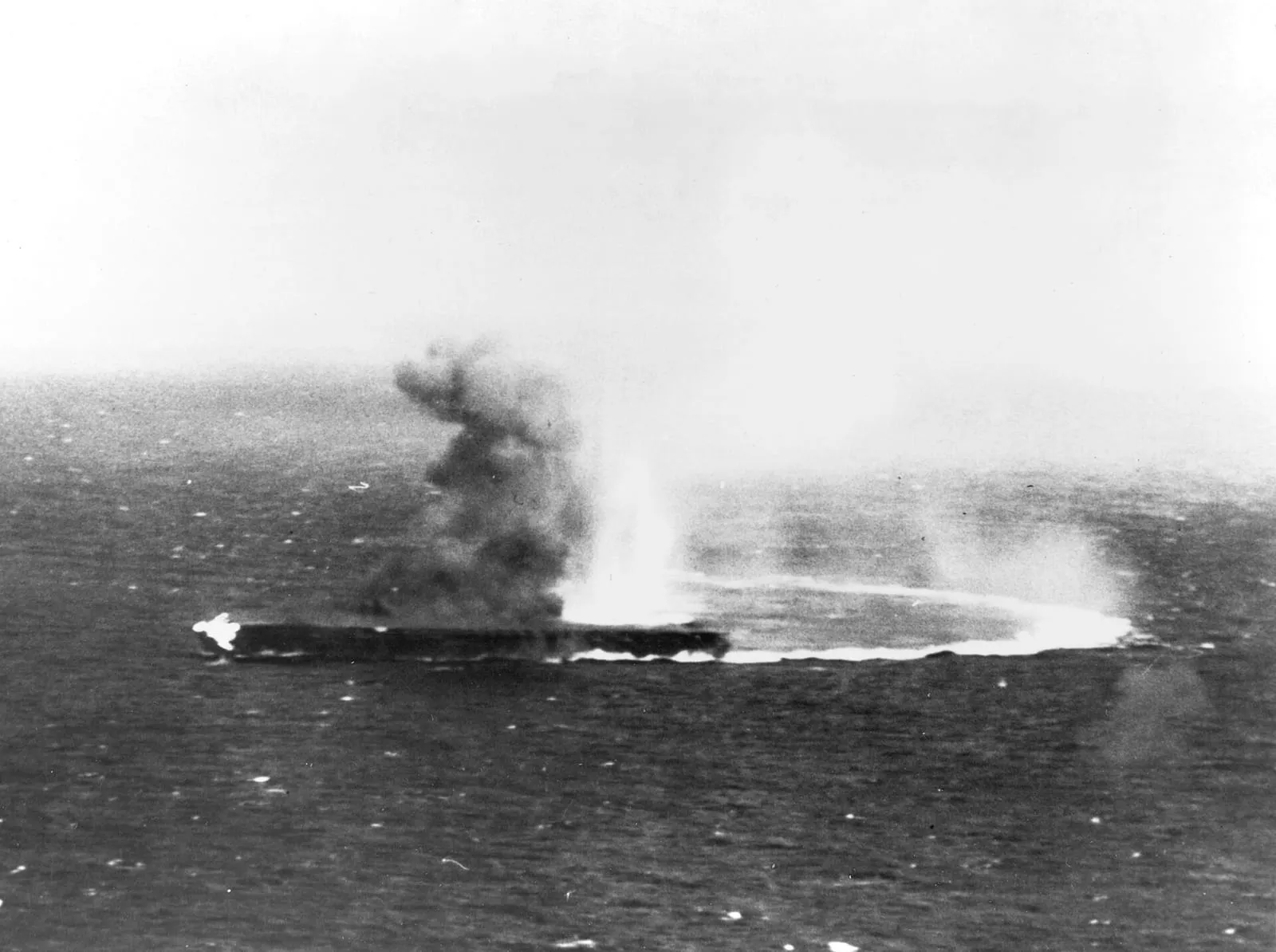
At about 10.40 a.m. Lexington’s aircraft appeared over Shōhō, which was covered by only a handful of fighters, followed by Yorktown’s. According to American figures the light carrier was hit by a dozen or more bombs and at least seven torpedoes, and at 11.35 a.m. she sank near Misima Island; about 200 of her crew of more than 800 were rescued. The Americans lost three aircraft. Lieutenant Commander Robert Dixon of Lexington sent an improvised report – “Scratch one flattop!” – which became one of the most famous lines of the Pacific War. She was the first Japanese carrier sunk in the war.
The loss of Shōhō shook Inoue. He ordered the convoy to turn back north and told Takagi to destroy the American carriers. In the afternoon land-based aircraft from Rabaul – G4M torpedo bombers and G3M bombers – attacked Crace’s force and reported sinking a battleship. In reality skilful manoeuvring saved the cruisers from bomb and torpedo hits – two sailors were killed aboard Chicago, which was strafed by the aircraft – while the Japanese lost four torpedo bombers; immediately afterwards the force was mistakenly bombed by American B-17s, fortunately without effect. Crace, without air cover and without word from Fletcher, who was maintaining radio silence, withdrew south of the Louisiades, while still guarding the approach to Port Moresby.
At dusk Hara sent 27 of his best crews west, to where he suspected the Americans were. Radar picked them up over Fletcher’s force; the Wildcats shot down several aircraft, and the rest jettisoned their bombs and torpedoes into the sea. After sunset several Japanese bombers, lost in the darkness, tried to land on Yorktown, mistaking her for their own carrier, before the destroyers’ anti-aircraft fire drove them off. Of the 27 aircraft, 18 returned. In the evening Inoue postponed the landing at Port Moresby to 12 May.
Course of events: the carrier battle (8 May)
By the morning of 8 May the roles had been reversed. The cloud front that had concealed the Americans the day before had moved over Takagi’s force, while the sky above Fletcher’s carriers, which Fitch was directing tactically that day, was almost clear. At 8.20 a.m. a scout bomber from Lexington spotted the Japanese carriers through a gap in the clouds; two minutes later an aircraft from Shōkaku found the Americans. They were about 210 nautical miles apart. Both sides launched their strikes almost at the same moment: the Japanese 69 aircraft, the Americans – separately from each carrier – 39 from Yorktown and 36 from Lexington.
Yorktown‘s dive-bombers reached the target at 10.32 a.m. and waited for the slower torpedo aircraft. Zuikaku hid in a rain squall and escaped the attackers’ notice. Shōkaku was hit by two bombs, which tore open her bow and wrecked the forward part of her flight deck; the torpedo aircraft missed, their torpedoes being in any case slow and unreliable. Most of Lexington’s group failed to find the target in the clouds, but its bombers hit Shōkaku with a third bomb. The carrier was on fire, had more than two hundred killed and wounded, and could no longer recover aircraft. Her buckled, wrecked flight deck put her out of the fight. At 12.10 p.m. Shōkaku, escorted by destroyers, withdrew to the north.
The Japanese strike was better coordinated. At 10.55 a.m. Lexington’s radar detected it at a range of nearly 70 nautical miles, but most of the defending fighters, stationed too low, missed the attackers. The attack began at 11.13 a.m. Yorktown, smaller and more manoeuvrable, evaded the torpedoes, but at 11.27 a.m. a bomb pierced four decks and exploded inside her, killing and wounding several dozen men; near misses damaged her hull. The great Lexington, converted from a battlecruiser and far less manoeuvrable, was caught by torpedo aircraft from both sides and took two torpedoes and two bombs. After a quarter of an hour or so of attacks the listing carrier could still steam at 24 knots and recover aircraft, and the fires were soon brought under control. On their way home the two strike groups passed each other and fought in the air; among those killed was the leader of the Japanese strike, Lieutenant Commander Kakuichi Takahashi.
At 12.47 p.m. aboard Lexington, sparks from electric motors left running unattended ignited aviation-fuel vapour that had leaked from tanks cracked by a torpedo. The explosion killed 25 men and started a fire. Further explosions followed at 2.42 and 3.25 p.m., and at 3.38 p.m. the fire was judged to be beyond control. After 5 p.m. the crew began to abandon ship – calmly and in good order – and the destroyers took nearly everyone off, from the water and from the ship’s sides, including Fitch and the captain, Captain Frederick Sherman. In the evening the destroyer Phelps finished off the burning carrier with five torpedoes; at 7.52 p.m. Lexington sank, taking with her 216 members of her crew and 36 aircraft. She was the first large American carrier lost in the war (the only earlier loss, in February, had been the former Langley, by then serving as an aircraft transport), and a quarter of the Pacific Fleet’s carrier strength.
In the afternoon both sides took stock. Fletcher was receiving reports of two undamaged Japanese carriers; with both his own ships damaged, heavy losses in fighters and no fuel from Neosho, he withdrew to the south. Takagi had only a few dozen serviceable aircraft on Zuikaku – according to Hara 24 fighters, 8 dive-bombers and 4 torpedo aircraft – and little fuel. He reported to Inoue that two American carriers had been sunk, but added that he could no longer cover the landing. Inoue recalled the convoy to Rabaul and postponed Operation MO to 3 July.
Epilogue (9–11 May)
On the evening of 8 May Yamamoto, displeased with Inoue’s caution, ordered him to turn back, finish off the Allied ships and complete the capture of Port Moresby. Inoue did not, however, rescind the recall of the convoy; he merely sent Takagi and Gotō in pursuit. Takagi’s ships spent the whole of 9 May refuelling, and when their aircraft searched the Coral Sea on 10 May, Fletcher and Crace were already far away. Takagi turned back, and Yamamoto sent Zuikaku home to Japan for new aircraft. On 11 May an American patrol aircraft found the drifting Neosho; the destroyer Henley took off 109 survivors and 14 men saved from Sims, and sank the wreck with gunfire. Some of the crew who had prematurely abandoned the oiler on rafts after the attack of 7 May perished; only a few of them were found later.
Operation RY also failed. On 12 May an American submarine sank its flagship, and when on 15 May a Japanese aircraft sighted Halsey’s force east of the Solomon Islands – Nimitz had deliberately ordered it to show itself to the enemy – Inoue called off this operation as well.
Losses
According to tallies based on the research of Lundstrom and other historians, the Americans lost the carrier Lexington, the destroyer Sims and the oiler Neosho, and Yorktown was damaged. They lost some 69 carrier aircraft, more than fifty of them from Lexington. Between about 650 and more than 700 men were killed, depending on how the dead of Sims and Neosho are counted; most of them were aboard Sims, Neosho and Lexington.
The Japanese lost the light carrier Shōhō, the destroyer Kikuzuki, three minesweepers off Tulagi and several smaller vessels, and Shōkaku was badly damaged. The number of aircraft they lost varies between studies from about 70 to nearly 100, depending on whether land-based aircraft and seaplanes are counted, as well as aircraft pushed overboard as beyond repair. About 966 men were killed, more than 600 of them from Shōhō. In tonnage sunk the Japanese won decisively: they sent more than 41,000 tons to the bottom while losing about 19,000.
The human losses, however, tell something more important. At the Coral Sea Japan lost about 90 experienced carrier aviators whom it had no one to replace; the Americans lost about 35. Both sides also exaggerated in their communiqués: the Americans announced the sinking of a dozen or more, even several dozen, Japanese ships, and the Japanese the sinking of two American carriers and a battleship.
Significance
Counted in ships, the outcome of the battle favoured Japan: it sank a large carrier, a quarter of American carrier strength in the Pacific, at the cost of a light carrier. Strategically, however, the battle was an Allied victory. The Japanese failed to achieve the aim for which they had started it: the troop convoy turned back to Rabaul, and Port Moresby was not attacked from the sea. For the first time in the war a Japanese offensive had been stopped short of its objective, which after five months of defeats from Pearl Harbor to Singapore and Java was of enormous moral importance to the Allies. In Australia, which still feared invasion, the outcome was received with relief, though at first also with disappointment – at the end of May the Australian Advisory War Council judged it “rather disappointing”, given that the Allies had known the Japanese plan in advance. In time, however, the battle became in Australia a symbol of deliverance and of the American–Australian alliance, commemorated every year at the beginning of May.
The most important consequences emerged a month later. Shōkaku needed repairs in Japan that lasted until July – two months according to some accounts, nearly three according to others – and Zuikaku, though untouched, had lost so many aircraft and aviators that the Japanese did not even try to replenish her air group in time. At Midway in June Nagumo led four carriers instead of six. The Americans did the opposite: Yorktown, whose repairs had been estimated at several months, was made battleworthy at Pearl Harbor in three days, her air group being made up with squadrons from Saratoga. At Midway her aircraft helped to sink two Japanese carriers, and Yorktown herself drew both Japanese counter-attacks, sparing the other carriers; badly damaged, she was finished off by a submarine. Willmott, Parshall and Tully point out that Yamamoto failed to draw two lessons from the Coral Sea: that the American carriers had turned up exactly where they were needed, which might indicate that the Japanese codes had been broken, and that American carrier aviators were capable of inflicting serious losses. Both factors decided the defeat at Midway.
The battle also changed the course of the fighting in New Guinea. After Midway Japan no longer had the carriers to renew the seaborne landing at Port Moresby, and it tried to take the town overland. In July 1942 its troops landed near Buna and Gona on the north coast of Papua and set off across the Owen Stanley Range along the Kokoda Track. The Australians, who had been sending reinforcements to Port Moresby since mid-May, halted them in September a few dozen kilometres from the town, and at the same time repulsed a Japanese landing at Milne Bay. Tulagi, captured on the first day of Operation MO, and neighbouring Guadalcanal, where the Japanese had begun building an airfield, became in August 1942 the targets of the first American offensive in the Pacific.
Finally, the Coral Sea opened a new era of naval warfare. Commanders on both sides had to take decisions on the basis of uncertain and often mistaken reports from aviators, at distances of hundreds of miles and within minutes. Both sides made many mistakes; victory went to whoever found the enemy first, and chance – a squall over Zuikaku, a coding error, an oiler mistaken for a carrier – weighed more heavily than ever before. The Americans learned from the battle: they improved their fighter tactics and the coordination of their strikes, their anti-aircraft defence, the protection of fuel tanks and their firefighting, the lack of which had doomed Lexington. Japan, by contrast, began here the process that by the autumn of 1942 deprived it of most of its veteran carrier aviators. The carriers of the two fleets met again in 1942 at Midway, in the Eastern Solomons and at Santa Cruz, and in 1944 in the Philippine Sea and at Leyte Gulf.