- Category:
- Military operations
- Front:
- Pacific
- Date:
- 15 February 1942
- Author:
- Łukasz
- Battle:
- Battle of Singapore
- Tags:
- Japan, United Kingdom, Australia, India
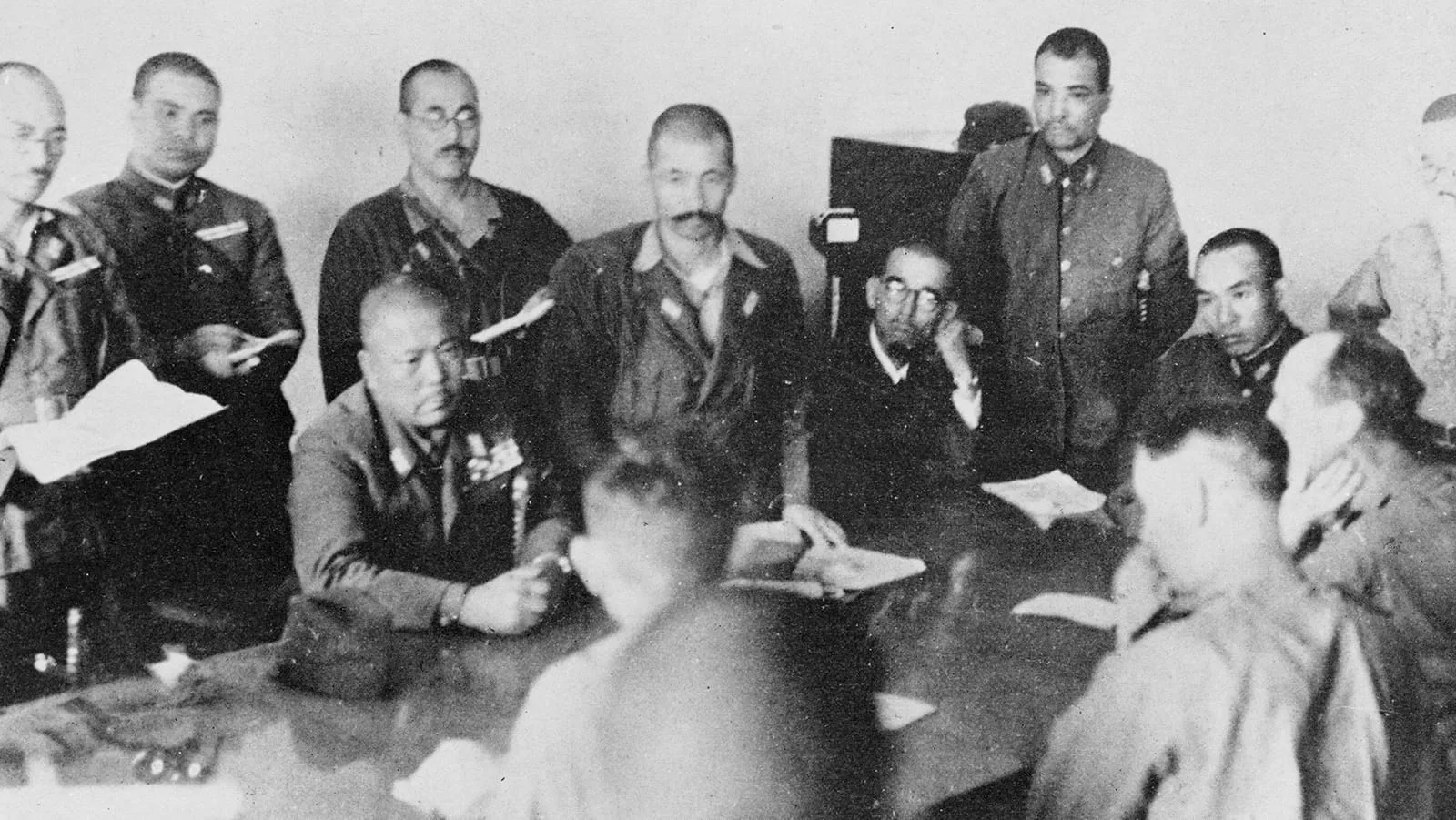
On the afternoon of 15 February 1942, the first day of the Chinese New Year, a car flying the Union Jack and a white flag of truce took Lieutenant General Arthur Percival to the Ford assembly plant at Bukit Timah, where the commander of the Japanese 25th Army, Lieutenant General Tomoyuki Yamashita, was waiting for him. Shortly after 6 p.m. Percival signed the unconditional surrender of the Singapore garrison. At 8.30 p.m. the firing stopped. According to British figures, some 80,000 British, Indian, Australian and local troops went into captivity on the island, and some 130,000 over the whole Malayan campaign. The fortress that had been built up for twenty years as the pillar of imperial defence in the East fell after a week of fighting on the island itself and seventy days after the first Japanese landing in Malaya. Winston Churchill later called it the worst disaster and largest capitulation in British history.
The last perimeter
After the landing on the night of 8–9 February and the loss of Bukit Timah hill on 11 February, the defence of the island had nothing left to rest on. On the night of 12–13 February Percival pulled his troops back from the north and east coasts, including the naval base and Changi areas, and deployed them on a perimeter some 45 kilometres long around the city. The Australians of the 8th Division shut themselves into a perimeter of their own around Tanglin Barracks; to their right stood the British 18th Division, the 11th Indian Division and the 2nd Malaya Brigade, and to their left, down to the sea, the 44th Indian Brigade and the 1st Malaya Brigade. In the north the Japanese 5th Division and the Imperial Guards pressed along the roads leading into the city, and on 13 February engineers repaired the Causeway, over which more tanks crossed to the island.
Nearly a million people were crowded into the city on its scrap of the island: residents, refugees from Malaya and troops. The Japanese air force, now completely unopposed, and the artillery on the western hills pounded the harbour, the streets and the residential districts. Hardly any shelters had been built, and the number of civilian dead rose by the day; estimates speak of several thousand victims in the last week, but the exact figure is unknown. In the harbour oil tanks were burning, and the shattered water mains poured onto the streets water that was ever scarcer in the taps. From 11 to 13 February the last ships and small evacuation craft left the harbour with women, children, wounded, medical staff and military specialists. Most of them never reached their destination: Japanese warships and aircraft sank or intercepted dozens of vessels in the straits south of Singapore, and thousands of people were killed or captured on the islands off the coast of Sumatra.
On 13 February senior commanders began urging Percival to surrender before civilian casualties grew still greater. Percival refused, but asked General Archibald Wavell, head of the Allied ABDA command on Java, for discretion to decide when further resistance would cease to make sense. Wavell replied that the fight must go on, house by house if necessary.
Pasir Panjang
The heaviest fighting of the last days took place at the western end of the perimeter, on the Pasir Panjang ridge, which runs along the south coast west of the city. The ridge dominated the Alexandra district, where the main ammunition depots, stores, fuel tanks and the military hospital stood. It was held by the 1st Malaya Brigade: the British 2nd Battalion, Loyal Regiment, and the 1st Battalion of the Malay Regiment, raised in the 1930s from Malay volunteers, which had not yet been under fire.
On the afternoon of 13 February the 56th Infantry Regiment of the Japanese 18th Division attacked the ridge, supported by artillery and tanks. B Company of the Malay Regiment was overwhelmed after a bayonet fight, and after dark both brigades, the 44th Indian and the 1st Malaya, fell back to a new line. On the morning of 14 February the Japanese attacked again after heavy mortar and artillery fire. The defenders repulsed several assaults, but in the afternoon, when the Japanese broke their left flank, C Company took up a last position on Bukit Chandu, “Opium Hill”, named after the old opium factory at its foot. It was commanded by Second Lieutenant Adnan Saidi. According to a tradition preserved in Malaysia and Singapore, including in school textbooks, the defenders unmasked a group of Japanese disguised as Punjabi soldiers because they were marching in fours rather than threes, and fired on them at close range. Then came an assault that the company, out of ammunition and with many wounded, could not withstand. Adnan Saidi, badly wounded, was captured and murdered; accounts differ in detail, but all speak of death by the bayonet. The Malay Regiment lost 159 killed in the campaign, most of them on 13–15 February. It is often said that Commonwealth forces lost this strategic ridge on 13 February; in fact the fighting lasted two days, and the ridge finally fell on 14 February. For Malaysia and Singapore the fight on Bukit Chandu became one of the most important symbols of the war, and Adnan Saidi a national hero.
The Alexandra Hospital
The fall of the ridge opened the way for the Japanese to the Alexandra military hospital. At around 1 p.m. on 14 February Japanese soldiers – from the 18th Division, according to most findings – approached the building. A British lieutenant who went out to meet them with a white flag to explain that it was a hospital was bayoneted. The Japanese entered and began murdering doctors, orderlies and wounded, including a patient on the operating table and the anaesthetist attending him. Some two hundred men from among the staff and the walking wounded were tied up, herded into a few cramped rooms in nearby buildings and held overnight without water; some of them died before morning. The next day the rest were led out and bayoneted. A few survived by feigning death and gave evidence after the war. The Alexandra Hospital massacre, in which more than two hundred people were killed in all, was one of the first atrocities committed on the island itself and a portent of what was to follow the surrender.
The decision
The perimeter held through the night of 14–15 February, but the situation had become hopeless. According to the reports of the municipal services, the water supply could last another day, two at most. Food was running out, vehicle fuel was almost exhausted, and few shells were left for the field and anti-aircraft artillery. Looting was spreading in the city, and units, especially those made up of recently arrived replacements, were melting away through desertion.
At 9.30 a.m. on 15 February Percival called his commanders to a conference in the underground command post at Fort Canning. He presented two options: an immediate counter-attack to recover the reservoirs and the depots at Bukit Timah, or surrender. The commanders agreed unanimously that a counter-attack was impracticable. Post-war analyses suggest that the Japanese were at the end of their strength and that their artillery was short of ammunition, but the British did not know this. That morning a telegram also arrived from Wavell permitting Percival to cease resistance when he was “fully satisfied” that further fighting was impossible. Percival decided to surrender.
A delegation went to the Japanese lines: the staff officer Brigadier Terence Newbigging, the Colonial Secretary Hugh Fraser and, as interpreter, Major Cyril Wild, who spoke Japanese. It returned with the demand that Percival present himself in person to Yamashita, and that the Japanese flag be hoisted over the tallest building in the city, the Cathay Building. Percival ordered the destruction of ciphers, secret documents, technical equipment and heavy guns.
At the Ford factory
The meeting at the new Ford factory near Bukit Timah, where cars had been assembled only a few months earlier, lasted about an hour. Yamashita demanded immediate and unconditional surrender. Percival tried to gain time and asked for permission to keep an armed force to maintain order in the city. According to a famous account, Yamashita struck the table with his hand and demanded the answer “yes or no”; he himself later said that what had made him impatient was above all the slow double translation of the conversation. Photographs of the meeting, showing the tall, thin Percival sitting opposite the stocky Yamashita, were spread across Asia by Japanese propaganda.
Percival signed the instrument of surrender, according to most accounts, at 6.10 p.m. Under its terms all military forces in Singapore surrendered unconditionally, the firing was to stop at 8.30 p.m., the troops were to remain in their positions and lay down their arms within an hour, and the British could keep a thousand armed men to maintain order until the Japanese replaced them. Yamashita accepted responsibility for the lives of the civilian population.
The commander of the 8th Australian Division, Major General Gordon Bennett, acted differently. On learning of the surrender, he handed over command to his divisional artillery commander and on the night of 15–16 February escaped with a few officers by boat across the strait, then made his way through Sumatra and Java to Australia, which he reached in early March. He explained that he had wanted to bring home the lessons of fighting the Japanese. His soldiers, meanwhile, were going into captivity. The commander’s escape weighed on Bennett’s reputation for the rest of his life, and an Australian royal commission set up in 1945 found that he had had no right to relinquish his command on his own authority.
The toll
According to Japanese figures the 25th Army lost some 1,700 killed and between 2,800 and 3,400 wounded in the fighting for the island. The defenders’ losses in killed and wounded over the same days are estimated at some 5,000, a large proportion of them Australians. Some 80,000 soldiers went into captivity on the island; together with those taken earlier on the mainland, the number of prisoners reached about 130,000. According to the most frequently cited breakdown for the whole campaign, they included some 38,000 British, 18,000 Australians, 67,000 men of the Indian Army and 14,000 local volunteers. Never before or since has the British Army laid down its arms in such numbers. Japan had taken Singapore and the whole of Malaya, the world’s largest producer of rubber and tin, with forces numerically weaker than the defenders.
On the evening of 15 February Churchill made a radio broadcast in which he announced the fall of Singapore and called for unity and endurance. The defeat came at the worst possible moment for him: three days earlier German capital ships had, against all expectations, passed through the English Channel under the nose of the Royal Navy, and in the Philippines the Americans were now holding out only on Bataan and Corregidor. In the following days Churchill reshaped his War Cabinet under pressure of criticism in Parliament and the press. In Australia the Prime Minister, John Curtin, said that the fall of Singapore, like Dunkirk two years earlier, opened the battle for his own country.
After the surrender
For the prisoners and the inhabitants the surrender did not end the violence. The Japanese renamed the city Shōnan-tō, “Light of the South Island”. British and Australian prisoners were assembled in camps at Changi in the east of the island, from where thousands were later sent to build the Burma Railway and to other labour camps; many of them died of hunger, disease and ill-treatment. Indian prisoners were separated from their British officers and on 17 February, at a gathering in Farrer Park, handed over to the Japanese Major Iwaichi Fujiwara, who placed them under the orders of Captain Mohan Singh; Mohan Singh called on them to join the Indian National Army then being formed to fight for India’s liberation from British rule. A considerable number volunteered; their motives, from conviction to the wish to escape the camps, are still disputed.
From 18 February the Japanese military police, the Kempeitai, and units of the 25th Army carried out a “purge” of the Chinese population of Singapore, and later of the whole of Malaya, known as Sook Ching. Men arbitrarily judged “anti-Japanese” were taken to beaches and shot. After the war the Japanese command admitted to some 5,000–6,000 victims; Singaporean and Chinese estimates speak of several tens of thousands. Among those held jointly responsible is Lieutenant Colonel Masanobu Tsuji of the 25th Army staff.
Place in the war
The surrender of Singapore ended the Malayan campaign and was the greatest defeat in the history of British arms. Many causes contributed to it: a strategy that rested the defence of the base on a fleet that in 1941 did not exist; the loss of the Prince of Wales and Repulse on 10 December; the weakness of the air force; the underestimation of the Japanese; the inadequate training and dispersal of the Commonwealth forces; and finally the decisions of Percival himself, which many historians judge harshly, though others point out that he had been given an impossible task. The argument over responsibility, including between the British and the Australians, continued long after the war.
The fall of Singapore, following the loss of Hong Kong in December, opened the way for the Japanese to Sumatra and Java, towards the Indian Ocean and Burma, and four days later their aircraft struck Darwin in Australia. Australia, which had lost most of the 8th Division at Singapore, turned to the United States and demanded ever more insistently the return of its troops from the Middle East. The longest-lasting consequence, however, was the loss of prestige. The peoples of Asia saw the army of a European empire surrender to an Asian army, and tens of thousands of white prisoners march into Japanese camps. When the British returned to Singapore in September 1945, their rule never regained its former standing, and the fall of the fortress is regarded as one of the beginnings of the end of the British Empire in Asia. Percival survived captivity and was present at the surrender of Japan in Tokyo Bay on 2 September 1945. Yamashita, hailed in Japan as the “Tiger of Malaya”, was soon sent off to Manchuria, and in 1946 he was executed in the Philippines after a trial for crimes committed under his command.
Sources
Meanwhile
(04)Elsewhere, within a week.
- 11 February 1942 · Western FrontThe Channel Dash (Operation Cerberus)On the night of 11–12 February 1942 Scharnhorst, Gneisenau and Prinz Eugen left Brest and broke through the English Channel by day to German ports.
- 19 February 1942 · PoliticsExecutive Order 9066On 19 February 1942 Roosevelt authorised the army to create exclusion zones, the basis for the incarceration of Japanese Americans from the West Coast.
- 19 February 1942 · PoliticsConscription in CanadaIn February 1942 Ottawa argued over a plebiscite to release King's government from its pledge not to send conscripts overseas. No conscription act was passed.
- 10 February 1942 · SocietyThe Normandie fireOn 9 February 1942 the liner Normandie, being converted into a troopship, caught fire in New York. Early on 10 February she capsized onto her side.
Related events
(04)The same battle, people or subject.
- 9 February 1942 · PacificThe Japanese land on SingaporeOn the night of 8–9 February 1942 two divisions of the 25th Army crossed the Johor Strait to the north-west shore of Singapore, held by the Australians.
- 31 January 1942 · PacificThe retreat to SingaporeOn 31 January 1942 the last Commonwealth units crossed from Johor to Singapore Island and sappers blew up the Causeway. The Battle of Malaya was over.
- 19 January 1942 · PacificThe Battle of MuarIn Johor on 14–22 January 1942 the Japanese destroyed the 45th Indian Brigade and two Australian battalions, and murdered some 150 wounded POWs at Parit Sulong.
- 11 January 1942 · PacificThe Japanese take Kuala LumpurOn 7 January 1942 Japanese tanks shattered the 11th Indian Division at the Slim River. Wavell gave up central Malaya; on 11 January Kuala Lumpur fell.