1941–1942: The Japanese offensive in the Pacific
Battle of Midway
- Dates:
- 3–7 June 1942
- Front:
- Pacific
- Location:
- Central Pacific: the waters north-west, west and north-east of Midway Atoll in the Hawaiian chain, about 2,100 km from OʻahuOn the battle map →
- Sides:
- JapanIsoroku Yamamoto, Chūichi Nagumo, Nobutake Kondō, Tamon YamaguchiUnited StatesChester Nimitz, Frank Jack Fletcher, Raymond Spruance
- Result:
- Decisive American victory. The Japanese lost four fleet carriers (Akagi, Kaga, Sōryū and Hiryū) and the heavy cruiser Mikuma, some 3,000 men and almost all of Nagumo's carrier aircraft; Yamamoto called off the capture of Midway. The Americans lost the carrier Yorktown, the destroyer Hammann, about 300 men and about 150 aircraft.
- Author:
- Natalia
Name and dates
The Battle of Midway is the name given to the clash between the Japanese Combined Fleet and the US Pacific Fleet, together with the aircraft based on Midway Atoll, fought in the first week of June 1942 in the central Pacific. In Japan it is known as the Naval Battle of Midway (ミッドウェー海戦, Middowē kaisen). It was the outcome of the Japanese Operation MI, which was intended to seize the atoll and to draw the American carriers that had survived the attack on Pearl Harbor into a decisive battle. Operation AL against the Aleutian Islands, formally part of the same plan, was fought in parallel.
As in the Coral Sea a month earlier, the main surface forces of the two sides never once sighted each other; the outcome was decided by aircraft.
The battle can be dated 3–7 June 1942: from the moment an American flying boat spotted the Japanese transport group and B-17 bombers from Midway first attacked it, to the sinking of Yorktown on the morning of 7 June. Some accounts and many studies date the battle from 4 June, when the carriers clashed; but 3 June was the first day of fighting, and on the night of 3/4 June American flying boats torpedoed a Japanese oiler.
Japanese and American dates differ. The Japanese kept Tokyo time, on the far side of the International Date Line, so for them the decisive day fell on 5 June. Dates and times are given in Midway local time (21 hours behind Tokyo), as in most Western studies; times in the sources usually differ by a few minutes.
Background
In the first five months of the Pacific War Japan took Malaya, Singapore, the Philippines, the Dutch East Indies and Burma, while the carriers of Vice Admiral Chūichi Nagumo ranged from Hawaii by way of Darwin to Ceylon without losing a single ship. The American carriers remained an unattained objective: they had not been at Pearl Harbor on 7 December 1941, since February they had been raiding Japanese bases in the Marshall and Gilbert Islands, and on 18 April they launched bombers against Tokyo in the Doolittle Raid.
The commander of the Combined Fleet, Admiral Isoroku Yamamoto, had been looking for a way to destroy them since the start of the year. He believed that Japan could not win a long war against the United States, and he wanted to crush the American fleet before American industry could build a new one. He chose Midway, a small atoll at the western end of the Hawaiian chain, with an airfield on Eastern Island and a flying-boat base on Sand Island. He reckoned that the Americans would not let an outpost of Hawaii be taken without a fight and would bring their carriers out to sea, where Japanese forces would destroy them in a decisive battle. The Naval General Staff preferred operations in the South Pacific but gave way to Yamamoto, and the Doolittle Raid silenced the remaining objections.
The first consequence of this haste was the Battle of the Coral Sea at the beginning of May. Yamamoto had detached the 5th Carrier Division for the operation against Port Moresby, and lost it for June: Shōkaku was damaged, and Zuikaku had lost too many aircrew and aircraft to be made good in time. At Midway Nagumo therefore had not six large carriers but four. The Americans, who had lost Lexington in the Coral Sea, were on the other hand able – thanks to a superhuman effort by the Pearl Harbor navy yard – to send the damaged Yorktown into battle as well.
Plan and forces
An Imperial General Headquarters order of 5 May instructed the Combined Fleet to take Midway and the western Aleutians. The plan was sprawling and fragmented. Nagumo’s Kidō Butai with four carriers – Akagi and Kaga of the 1st Division, and Sōryū and Hiryū of Rear Admiral Tamon Yamaguchi’s 2nd Division – was to destroy Midway’s air strength and defences on 4 June and cover the landing over the following days. From the south-west came the invasion force of Vice Admiral Nobutake Kondō: two battleships, the light carrier Zuihō, cruisers, and a dozen or so transports from Saipan, escorted by Rear Admiral Raizō Tanaka’s destroyers and carrying some 5,000 army troops and naval infantry. Several hundred miles behind Nagumo sailed Yamamoto’s own Main Body, with the battleship Yamato, two other battleships and the small carrier Hōshō. In the north, Vice Admiral Boshirō Hosogaya’s Northern Force, with the light carriers Ryūjō and Jun’yō, was to strike Dutch Harbor and seize Kiska, Attu and Adak.
Nagumo’s four carriers had 248 aircraft on board (according to Jonathan Parshall and Anthony Tully), among them Mitsubishi A6M Zero fighters, Aichi D3A dive bombers and Nakajima B5N torpedo bombers. Their crews were among the best in the world, but the ships had no radar, communication with the fighters of the combat air patrol was poor, and the escort had too few anti-aircraft guns. Reconnaissance before the battle failed. The submarines took up their positions too late, and a repeat of Operation K, a flying-boat reconnaissance over Pearl Harbor, fell through because American ships were already lying at the refuelling point.
The Americans knew the enemy’s plan. The cryptanalysts of Commander Joseph Rochefort at Pearl Harbor had read from Japanese signals the objective, the date and the general composition of the forces, and a ruse about a supposed breakdown of Midway’s water-distillation plant confirmed that the target designated “AF” was indeed the atoll. Admiral Chester Nimitz, Commander-in-Chief of the Pacific Fleet, gathered everything he had. Task Force 16 under Rear Admiral Raymond Spruance, who had replaced the ailing Vice Admiral William Halsey, had the carriers Enterprise and Hornet; Task Force 17 under Rear Admiral Frank Jack Fletcher had Yorktown, repaired in three days. Fletcher, the senior officer, took command of both task forces, which met north-east of Midway on 2 June. The three carriers had some 230 aircraft: F4F Wildcat fighters, SBD Dauntless dive bombers and obsolete TBD Devastator torpedo bombers. On Midway itself there were about 120 Navy, Marine Corps and Army Air Forces aircraft, from Catalina flying boats to B-17 bombers, and a dozen or so submarines watched the approaches to the atoll.
The Japanese had far more ships at sea, including eleven battleships, but they were dispersed in groups that could not support one another. In the air, counting the aircraft on Midway, the Americans were a match for Nagumo.
Course of the battle: 3 June
The battle began in the north. On the morning of 3 June aircraft from Rear Admiral Kakuji Kakuta’s Ryūjō and Jun’yō attacked the naval base at Dutch Harbor on Unalaska Island in the Aleutians, and repeated the attack the next day. The American command had expected this blow, but Rear Admiral Robert Theobald’s cruiser force was waiting in the wrong place, and Nimitz had sent no carrier north.
At about 9.00 a Catalina flying boat of patrol squadron VP-44, piloted by Ensign Jack Reid, sighted the Japanese transport group more than 500 nautical miles west-south-west of Midway. Reid reported it as the “main body”, which caused alarm on Midway and at Pearl Harbor for several hours. Nimitz and Fletcher, knowing from intelligence that the carriers would come from the north-west, were not deceived. In the afternoon nine B-17 bombers from Midway found the transports and bombed them from high altitude. The crews reported hits on several ships, but none was damaged.
On the night of 3/4 June four Catalinas armed with torpedoes attacked the same group by moonlight. At about one in the morning a torpedo struck the oiler Akebono Maru, killing about ten men; the ship nevertheless remained serviceable and sailed on. It was the only successful American aerial torpedo attack of the whole battle.
Nagumo did not know that the American carriers were nearby. Indications of increased American fleet activity, picked up in Tokyo and aboard Yamato, were not passed on to him, because Yamamoto was keeping radio silence. The carriers of the Kidō Butai, hidden in a belt of fog and cloud, were closing from the north-west, intending to strike the atoll at dawn.
Course of the battle: the morning of 4 June
At 4.30 a.m. 108 aircraft took off from the four carriers – 36 each of dive bombers, torpedo bombers armed with bombs, and fighters – led by Lieutenant Jōichi Tomonaga (PL) of Hiryū. Mitsuo Fuchida, who had led the strike on Pearl Harbor, was lying aboard Akagi after an appendectomy. At the same time Nagumo sent out seven floatplanes and carrier aircraft to scout – too few for the area they had to search. Floatplane No. 4 from the cruiser Tone took off half an hour late; its search line led straight over the American carriers.
The Americans found the enemy first. At 5.34 a Catalina reported two carriers, and a few minutes later incoming aircraft. At 5.53 the radar on Midway picked up the Japanese formation, and four minutes later everything on the atoll that could fly took off. The Marine Corps fighters – mostly obsolete Brewster F2A Buffalos and a few Wildcats – attacked at about 6.20 and were routed: of 26 machines, most were shot down or badly damaged. From 6.30 the Japanese bombed the hangars, fuel tanks and power station, but the runways remained usable. Of the 108 aircraft, 11 did not return and several dozen were damaged. At 7.00 Tomonaga reported that a second strike was needed.
Meanwhile aircraft from Midway that had taken off before the raid appeared over Nagumo’s carriers: six new TBF Avenger torpedo bombers of VT-8, four B-26 bombers armed with torpedoes, the Marine dive bombers of Major Lofton Henderson, who was killed in the attack, and B-17s. They attacked one after another, without escort and without coordination, from roughly 7.10 to 8.40. Japanese fighters and anti-aircraft fire shot down more than a dozen of them, and not a single bomb or torpedo hit its target. The American submarine Nautilus worked its way close to the force and fired a torpedo at a battleship, without result.
The raids from Midway did no damage, but they convinced Nagumo that the atoll had to be attacked again. At 7.15 he ordered the reserve aircraft – the torpedo bombers on Akagi and Kaga, held ready in case the American fleet appeared – to be rearmed from torpedoes with high-explosive bombs. At about 7.40, however, the floatplane from Tone reported “ten enemy ships” to the north-east, without stating their type. Nagumo suspended the rearming and demanded details. Only at about 8.20 did a report arrive that the group probably included a carrier.
Nagumo now faced a choice that has since become one of the most discussed in the history of naval warfare. Rear Admiral Yamaguchi urged him to strike at once with whatever was ready. But the aircraft returning from Midway were circling overhead on the last of their fuel, and the flight decks were taken up by the combat air patrol fighters, which were taking off and landing to fend off one raid after another. Preparing and launching a strike would have taken at least half an hour, and the bombers would have flown without fighter escort – Nagumo had just watched how easily Japanese fighters disposed of unescorted American aircraft. In accordance with doctrine he decided first to recover Tomonaga’s aircraft, rearm the reserve once more with torpedoes and armour-piercing bombs, and then strike with full force. At about 9.17 he completed the recovery and turned his force to the north-east.
Course of the battle: the American carrier strike
The American aircraft were already airborne. Fletcher, having received the Catalinas’ reports in the morning, had ordered Spruance to attack as soon as possible, while keeping Yorktown in reserve for the time being in case more Japanese carriers appeared. Spruance set the launch for 7.00, although the range was at the limit, reckoning that he would catch the Japanese carriers just as they were recovering their aircraft returning from Midway. Enterprise and Hornet needed more than an hour to launch 117 aircraft, and Spruance, unwilling to lose time, ordered the squadrons to set off for the target without waiting for the others. Yorktown launched her aircraft between 8.30 and 9.08. The strike thus went in as several separate groups on different courses, and when Nagumo turned north-east some of them did not find him in the expected position.
Hornet’s air group under Commander Stanhope Ring flew a course of 265 degrees – due west – instead of south-west, where the enemy was. The dive bombers found nothing and turned back to the carrier or to Midway, and all ten Wildcats accompanying them had to ditch for lack of fuel. This “flight to nowhere” remains controversial to this day, because Hornet’s reports obscured what happened. The commander of torpedo squadron VT-8, Lieutenant Commander John Waldron, broke away from the group, however, and led his fifteen Devastators straight to the carriers.
At about 9.20 VT-8 attacked without fighter cover. All fifteen aircraft were shot down and no torpedo hit. Of the thirty airmen only Ensign George Gay survived, spending the rest of the day afloat among the Japanese ships. A quarter of an hour or so later torpedo squadron VT-6 from Enterprise lost ten of its fourteen aircraft, and at about 10.00 VT-3 from Yorktown, covered by a handful of fighters under Lieutenant Commander John Thach, lost ten of twelve. Not one of the several dozen torpedoes hit; the American Mark 13 aerial torpedoes were, moreover, unreliable at the time. Of the 41 Devastators only a few returned.
Yet the sacrifice of the torpedo squadrons was not in vain. The Japanese combat air patrol had come down low after the torpedo bombers and concentrated on the south-eastern side of the force, while the carriers, turning hard, could not prepare their own strike. No one was guarding the sky above them. It was at that moment, at about 10.20, that three squadrons of dive bombers arrived from two directions almost simultaneously. Two of them, VS-6 and VB-6 from Enterprise, were led by the air group commander, Lieutenant Commander Clarence Wade McClusky. Having failed to find the enemy in the expected position, and with fuel running low, he kept searching, spotted the destroyer Arashi rejoining the force after chasing Nautilus, and followed her. The third squadron, Lieutenant Commander Maxwell Leslie’s VB-3 from Yorktown, came straight onto the target.
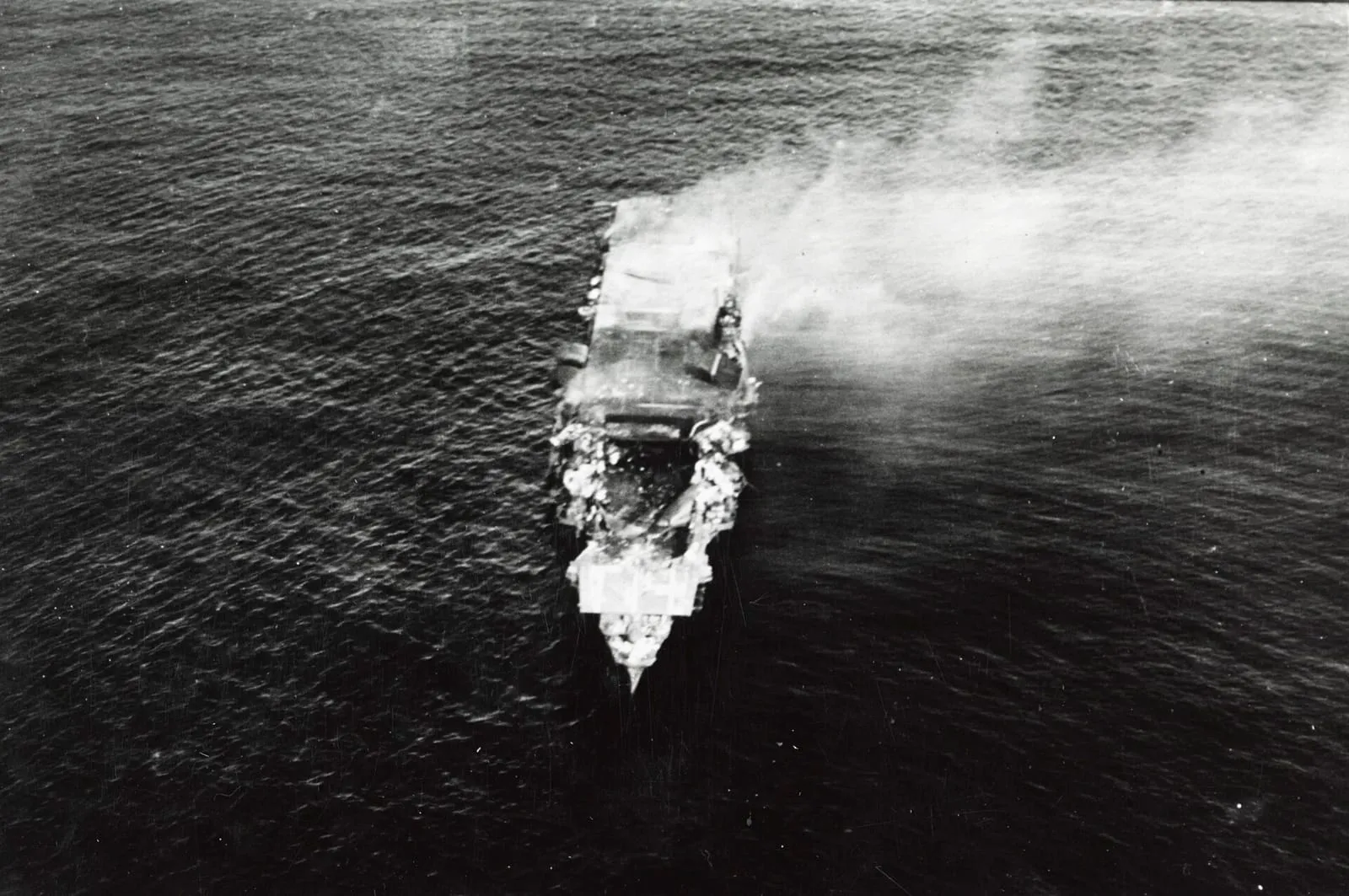
The attack lasted a few minutes. Through a misunderstanding almost all of McClusky’s group dived on Kaga, which took at least three hits – four, according to Parshall and Tully; one bomb killed the ship’s captain, Captain Jisaku Okada, on the bridge. Lieutenant Richard Best and his two wingmen pulled out of the dive and attacked Akagi. Nagumo’s flagship took a single bomb, almost certainly Best’s, which pierced the deck beside the midships elevator and exploded in the hangar among fuelled and armed aircraft; a second, near miss astern jammed her rudder. At the same time VB-3 hit Sōryū three times. On all three ships aviation fuel caught fire, and the bombs and torpedoes that had been left in the hangars during the rearming instead of in the magazines began to explode. Within minutes Kaga and Sōryū were ablaze from bow to stern; Akagi burned more slowly, but the fire could not be brought under control. At 10.46 Nagumo, persuaded by his chief of staff, Rear Admiral Ryūnosuke Kusaka, transferred his flag to the light cruiser Nagara. Command of air operations passed in practice to Yamaguchi in Hiryū, which was sailing somewhat apart and was untouched.
Sōryū and Kaga sank on the evening of 4 June. The Japanese kept the burning wreck of Akagi afloat through the night in the hope of towing her; at dawn on 5 June, on Yamamoto’s orders, she was finished off by torpedoes from Japanese destroyers.
Course of the battle: Hiryū’s counter-attack
Yamaguchi did not wait for orders. At about 10.50 eighteen dive bombers and six fighters took off from Hiryū and followed the returning American aircraft. Around noon they found Yorktown. Fighters and anti-aircraft fire shot down most of the attackers, but three bombs hit; one put out most of her boilers and the ship came to a stop. Fletcher moved his staff to the heavy cruiser Astoria. Within an hour Captain Elliott Buckmaster’s damage-control parties had patched the deck and relit some of the boilers; Yorktown was again making nearly 20 knots and could recover aircraft.
The second wave from Hiryū – ten torpedo bombers and six fighters – took off at about 1.30 p.m. It was led by Tomonaga, whose aircraft had had its left-wing fuel tank holed in the morning raid and could not carry enough fuel for the return flight; he went all the same. The Japanese airmen took the carrier, now steaming normally, for a second, undamaged ship. At about 2.40 p.m. two torpedoes struck Yorktown on the port side. She lost power and listed more than 20 degrees; at 3.00 p.m. Buckmaster ordered her abandoned. Tomonaga was killed. Few aircraft returned to Hiryū, and their crews reported two American carriers sunk. Yamaguchi prepared a third strike, at dusk, with what he had left.
He did not get the chance. A scout plane from Yorktown had found Hiryū at about 2.45 p.m., and Spruance – who, since Fletcher had left his carrier, was in effect directing the battle – sent 24 dive bombers from Enterprise, including fourteen surviving aircraft of Leslie’s squadron from Yorktown. At about 5.00 p.m. they attacked out of the sun and hit Hiryū with four bombs. Her flight deck collapsed and her hangars were engulfed in fire. Aircraft from Hornet, launched late, hit no ship; nor did a B-17 raid. During the night the crew lost the battle against the fire. Before dawn on 5 June they were taken off, and a Japanese destroyer fired a torpedo into the wreck. Yamaguchi, regarded as one of Japan’s ablest carrier commanders, and the ship’s captain, Captain Tomeo Kaku, stayed aboard. Hiryū sank on the morning of 5 June, a few hours after an aircraft from Hōshō had spotted her. Several dozen men from her engine rooms, who had been left aboard, escaped in a boat; 35 of them were picked up by an American ship two weeks later.
On the evening of 4 June Fletcher, who could not effectively direct a carrier battle from a cruiser, left the conduct of operations to Spruance. Four of the six carriers that had attacked Pearl Harbor half a year earlier were burning or already on the bottom.
Course of the battle: 5–7 June
For several hours Yamamoto refused to accept the defeat. On the evening of 4 June he ordered Kondō and the remnants of Nagumo’s force to seek out the American fleet and force it into a night action, in which Japanese battleships and cruisers had the advantage, and he instructed the four heavy cruisers of Rear Admiral Takeo Kurita to bombard Midway. Spruance understood the danger. After dark he withdrew eastward, and at midnight turned back west, so as to be within range again at dawn without letting himself be caught at night. He was later criticised for his caution, but most historians consider that a night pursuit would have ended in disaster. The Japanese found no one, and at 2.55 a.m. on 5 June Yamamoto called off Operation MI and ordered a general withdrawal.
Kurita’s cruisers ran into the American submarine Tambor as they withdrew. While turning to avoid torpedoes, Mogami rammed Mikuma; both ships, damaged, fell behind. On 5 June they were attacked by Marine aircraft from Midway; Captain Richard Fleming was killed in the attack and posthumously awarded the Medal of Honor. Spruance’s evening bomber strike that day found nothing. On 6 June aircraft from Enterprise and Hornet, in three raids, sank Mikuma, with the loss of some 700 men, and badly damaged Mogami, which nevertheless reached Truk. Then Spruance turned back: his destroyers were running out of fuel, his airmen were exhausted, and further pursuit would have taken him within range of aircraft from Wake.
Yorktown was still afloat. On 5 June the minesweeper Vireo had taken her in tow, on the morning of 6 June Buckmaster’s salvage party went back aboard, and the destroyer Hammann came alongside to supply power to the pumps. On the afternoon of 6 June the Japanese submarine I-168 under Lieutenant Commander Yahachi Tanabe, which had shelled Midway on the night of 4/5 June, slipped through the destroyer screen and fired four torpedoes. Two hit Yorktown; one broke Hammann in two, and she sank within minutes; most of the roughly 80 dead were killed by the explosion of her own depth charges in the water. There was no longer any point in trying to save the carrier. On the morning of 7 June Yorktown rolled over to port and sank.
On 6 and 7 June the Japanese landed unopposed on Kiska and Attu in the western Aleutians. Major General Clarence Tinker, commander of the Seventh Air Force, was killed on 7 June when the bomber he was leading against the withdrawing Japanese went missing near Midway.
Losses
Japan lost four fleet carriers and the heavy cruiser Mikuma; Mogami was out of action for many months. According to Parshall and Tully, who counted the dead by name, 3,057 Japanese were killed, more than 2,100 of them on the carriers – the most on Kaga (811) and Sōryū (711) – and some 700 on Mikuma. Almost all the aircraft of Nagumo’s force were lost, about 250 machines, most of them on the decks and in the hangars of the sinking ships. A total of 110 carrier airmen were killed – roughly one in four of those who had sailed from Japan in the four carriers – as well as a large proportion of the trained mechanics and deck crews. Several dozen sailors were taken prisoner, among them men from Hiryū’s engine rooms.
The United States lost the carrier Yorktown and the destroyer Hammann, about 150 aircraft (sources give figures from about 145 to more than 150, depending on whether they count aircraft from Midway that crashed after the fighting) and 307 men. The installations on the atoll were badly damaged. Three American airmen picked up by Japanese destroyers were murdered after interrogation – thrown into the sea weighted down.
Myths and controversies
For decades the picture of the battle was shaped by the book by Mitsuo Fuchida and Masatake Okumiya, published in Japan in 1951 and in English four years later. Fuchida claimed that when the bombs fell, fuelled and armed aircraft ready to strike were standing on the decks of the Japanese carriers and the first of them was just taking off: five more minutes would have been enough for the counter-strike to get airborne. This version found its way into many studies and films, and from them into many summaries of the battle and war chronologies, which speak of decks “cluttered with fuel lines and munitions”.
In their book Shattered Sword (2005), based on Japanese ships’ logs, Jonathan Parshall and Anthony Tully showed that this was not so. At that moment only the combat air patrol fighters were on the flight decks; the strike aircraft were being fuelled and armed in the hangars, in accordance with Japanese practice, and the strike could not have been launched in less than about half an hour, and more probably later. It was precisely the hangars, full of fuel, aircraft, and bombs and torpedoes hastily set aside, that proved fatal. Nagumo thus did not lose by five minutes, but because he was surprised by an enemy whose presence he had not known of. Popular accounts also repeat a lesser error: Richard Best, who scored the hit on Akagi, was at the time a lieutenant, not a lieutenant commander.
There is also disagreement over whether Midway was the turning point of the war. Some historians hold that the real turning point came only with the Guadalcanal campaign. Parshall and Tully showed that Japanese naval aviation lost fewer experienced pilots at Midway than legend had it, and that it was worn down only by the fighting for the Solomon Islands in the autumn of 1942; what was irreversible was the loss of the four carriers and their trained crews. Other historians stress that Midway robbed Japan of the initiative, which it never regained.
Significance
Midway was the Japanese navy’s first great defeat in its modern history and the Allies’ first decisive naval victory in the war against Japan. In a few minutes on the morning of 4 June the hitherto unbeaten Kidō Butai ceased to exist. Of its large carriers Japan kept only Shōkaku and Zuikaku; while it built a handful of new ones, the United States commissioned several dozen carriers of various classes, including, from the end of 1942, the ships of the Essex class. The balance of power in the Pacific was restored before American war production had even come into play.
The Japanese offensive in the Pacific came to a halt. Plans to take New Caledonia, Fiji and Samoa were shelved indefinitely in July. The initiative passed to the Americans: on 7 August 1942 the Marines landed on Guadalcanal and Tulagi, opening the six-month fight for Guadalcanal, which wore Japanese naval aviation down.
The battle was a victory for intelligence. Without the breaking of the Japanese code Nimitz would not have known where and when to strike, and his three carriers would not have been lying in ambush on the enemy’s flank. In April 1943 the codebreakers’ work made it possible to shoot down Yamamoto’s aircraft. The secret nearly came out: on 7 June the Chicago Tribune published an article from which it could be inferred that the Americans had known the Japanese plan. The Japanese drew no conclusions from it, and proceedings against the newspaper were dropped so as not to draw attention to the matter.
It was also a victory for commanders who took risks. Spruance, an officer with no aviation training, launched his aircraft early and at the limit of their range at the crucial moment, and then, on the night of 4/5 June, refused to be drawn into a pursuit that his force might not have survived. But luck played its part too: the destroyer that showed McClusky the way, and the fact that three squadrons of dive bombers arrived at the very moment when the Japanese fighters were fighting low down against the torpedo bombers.
In Japan the defeat was concealed. The radio announced a great victory and the capture of islands in the Aleutians. Only Emperor Hirohito and a narrow circle of the naval leadership knew the true losses; for a time even the army did not know the truth. The wounded were isolated in hospitals and the survivors dispersed to distant units. Nagumo kept his post and commanded the rebuilt carrier force in the battles for the Solomon Islands. In the United States Nimitz announced that Pearl Harbor had been “partially avenged”.