- Category:
- Crimes and repression
- Front:
- Poland
- Date:
- 11 July 1943
- Author:
- Natalia
- Tags:
- Poland, Ukraine, Third Reich
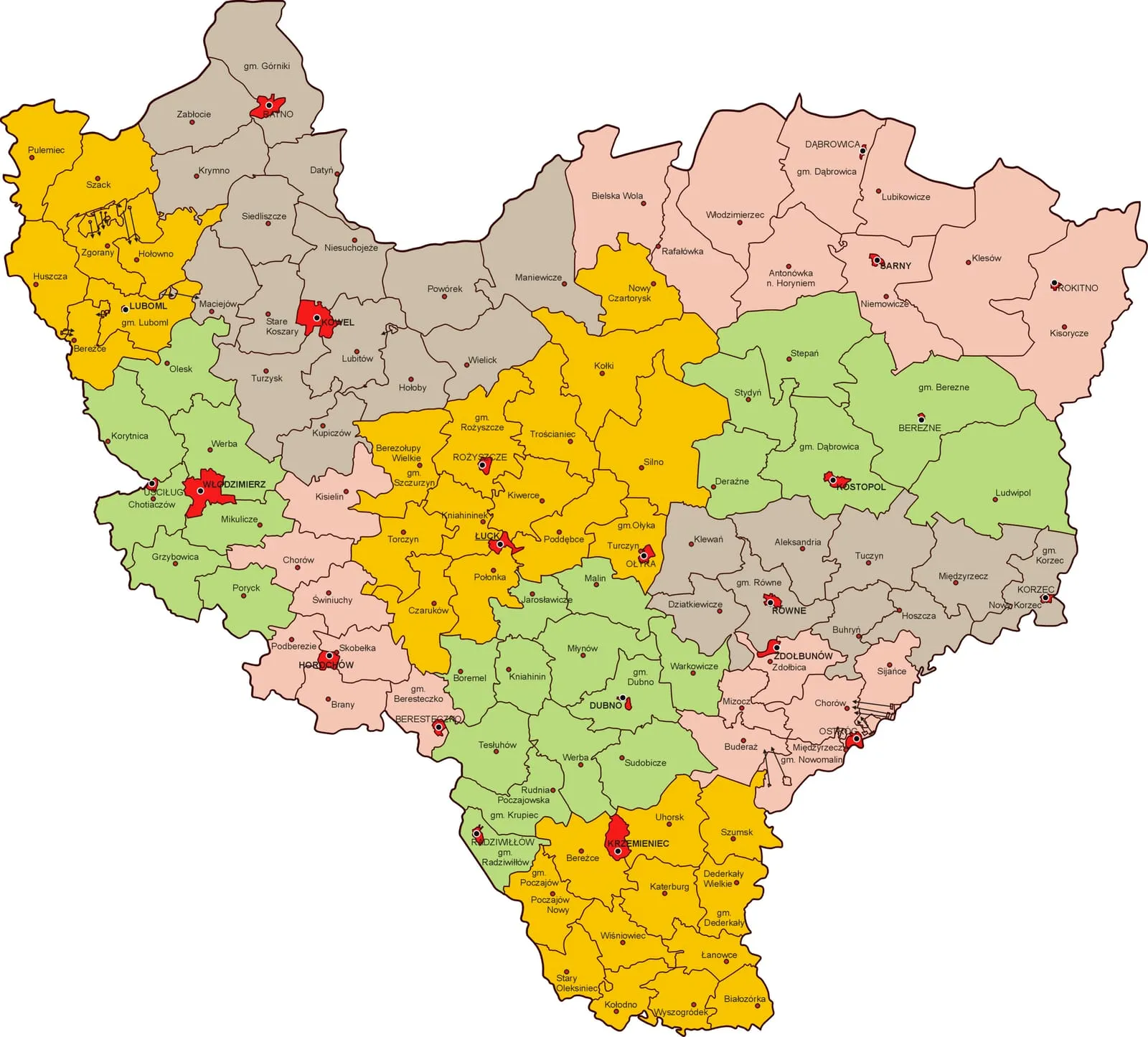
On Sunday 11 July 1943, at around 3 a.m., units of the Ukrainian Insurgent Army (UPA), supported by squads of the OUN Security Service (SB) and by peasants from neighbouring Ukrainian villages, struck simultaneously at Polish villages, settlements and small towns in the western part of Volhynia. According to the findings of Władysław and Ewa Siemaszko, 99 localities were attacked on that single day: 96 in the counties of Horochów and Włodzimierz and 3 in Kowel county. The attackers surrounded the villages so that nobody could escape, killed the inhabitants regardless of age or sex – often with axes, pitchforks and knives – and then looted and burned the buildings. In many places the attack was aimed at people gathered for Sunday Mass. The next day some fifty more villages were attacked, and the main wave lasted until 16 July.
One of these places was Dominopol (PL) near Włodzimierz Wołyński (today Volodymyr), where at least some two hundred Poles were killed. English-language chronologies of the war often list only this one name under this date – “UPA murders Poles in Dominopol”. That is true, but it is only a fragment of the truth: Dominopol was one of nearly a hundred targets of a coordinated operation that in Poland is called “Bloody Sunday”. It was the bloodiest day of the Volhynia massacres – a campaign to murder and expel the Polish population waged by OUN-B and the UPA in Volhynia in 1943–1944, and later in Eastern Galicia as well. The investigative branch of Poland’s Institute of National Remembrance (IPN) classifies these crimes as genocide; some historians, especially Ukrainian ones, use the term “ethnic cleansing”.
Volhynia between two occupations
The pre-war Volhynian Voivodeship had belonged to Poland under the Peace of Riga of 1921. According to the 1931 census, some two-thirds of its inhabitants were Ukrainians, about 16 per cent Poles and nearly 10 per cent Jews; Czechs, Germans and Russians lived alongside them. Polish policy towards the Ukrainians was inconsistent. In the 1930s the Voivode (provincial governor), Henryk Józewski, sought a rapprochement with moderate Ukrainian circles, but military settlement, restrictions on schooling and the 1938 Polonisation and “revindication” campaign, in which more than a hundred Orthodox churches were demolished in the Chełm region and Podlasie, deepened mutual distrust. The most radical response to these tensions was the Organisation of Ukrainian Nationalists (OUN) – an underground movement that sought an independent, ethnically homogeneous Ukraine and did not rule out terror as a means of struggle.
After the Soviet invasion of 17 September 1939, Volhynia came under Soviet rule, and on 1 November it was incorporated into the Ukrainian SSR. The NKVD arrested and deported tens of thousands of people into the interior of the USSR, above all Poles – officials, settlers, foresters, policemen and their families. In the summer of 1941, after the German attack on the Soviet Union, came the second occupation. Volhynia was incorporated into the Reichskommissariat Ukraine, ruled by Erich Koch, who treated the country purely as an economic hinterland of the Reich: heavy delivery quotas, deportations for forced labour, executions of hostages. The Ukrainian nationalists who on 30 June 1941 had proclaimed the restoration of the Ukrainian state in Lwów (Lviv) – in the days when a pogrom of the Jews was under way in the city and the Germans were preparing the murder of the Lwów professors – quickly learnt that the Germans had no intention of tolerating it; the leader of OUN-B, Stepan Bandera, was held in German custody from the summer of 1941 and later in Sachsenhausen concentration camp.
In 1942 the Germans murdered almost the entire Jewish population of Volhynia – an estimated 150,000 people. The Ukrainian Auxiliary Police assisted in the liquidation of the ghettos and in the executions. Historians point out that the experience of mass murder, witnessed at close quarters and sometimes carried out with one’s own hands, lowered the threshold of violence towards the next group. In March and April 1943 several thousand Ukrainian policemen deserted from German service with their weapons and went to the forests, where they became the core of the units of the UPA, which was dominated by the Bandera faction of the OUN (OUN-B).
The decision and the first mass murders
After the German defeat at Stalingrad, the leaders of OUN-B concluded that the war might end with both great powers exhausted, as in 1918, and that borders would then be decided by faits accomplis. The Poles – in their view the main rival for Volhynia and Eastern Galicia, backed by the government in London, which had not renounced the pre-1939 borders – were to disappear from these lands. The circumstances in which the decision was taken remain a subject of research. According to some Polish historians (Władysław Filar, Czesław Partacz), it was made as early as the Third Conference of OUN-B in February 1943. The IPN’s investigative branch, as well as Grzegorz Hryciuk and Grzegorz Motyka, take the view that the decision to launch the anti-Polish operation was made independently by the Volhynian leadership of OUN-B, above all by Dmytro Klyachkivsky (“Klym Savur”), commander of UPA-North. In June 1943, according to the post-war testimony of one of the UPA commanders, he issued a secret directive for a large-scale operation to liquidate the Polish male population aged 16 to 60 – in practice women and children were killed as well. Klyachkivsky’s line was endorsed by an OUN-B congress in August 1943, and the new leadership under Roman Shukhevych did not revoke it.
Isolated killings of Polish foresters, estate managers and village heads had already occurred in 1942. The IPN regards as the first mass murder of the Volhynia massacres the attack on the settlement of Parośla I in Sarny county on 9 February 1943, in which 173 Poles were killed. On the night of 26–27 March at least 179 people were killed in Lipniki (PL), and on 23 April some 600 in Janowa Dolina. In the spring the wave of attacks covered the counties of Sarny, Kostopol and Krzemieniec in eastern Volhynia; in the summer it moved westwards, towards counties more densely settled by Poles. According to estimates by Polish historians, some 15,000 Poles had already been killed by July 1943.
The Polish underground – the Government Delegation for Poland and the Volhynia District of the Home Army (AK) – was weak in Volhynia, and the Polish population was scattered across settlements and small villages. Talks were attempted. On 7 July a preliminary meeting with a local representative of the OUN Security Service took place near Świnarzyn. For the next one, on 10 July, the plenipotentiary of the district Government Delegate, Zygmunt Rumel (“Krzysztof Poręba”) – a poet who in his poem “Two Mothers” had written of his attachment to both Poland and Ukraine – travelled without an armed escort to the village of Kustycze, together with the Home Army representative Krzysztof Markiewicz (“Czort”) and their driver, Witold Dobrowolski. All three were detained and murdered, according to some sources on the night of 10–11 July. The Polish command, which on the basis of false information expected a Ukrainian attack around 20 July, was taken completely by surprise.
Sunday 11 July
The operation had been carefully prepared. UPA sotnias (companies) were concentrated in the forests west of Poryck and around Grzybowica, and in the days before it began meetings were held in Ukrainian villages at which peasants were persuaded of the need to “remove the Lakhs” (a derogatory term for Poles). The massacre began at around 3 a.m. in Gurów, where about 70 of some 480 Polish inhabitants survived. In the settlement of Orzeszyn (PL), of 340 Poles between 270 and more than 300 were killed, depending on the source; in the village of Sądowa about 20 of 600 survived, and in the settlement of Zagaje only a dozen or so people escaped. Once the inhabitants had been murdered, carts from neighbouring Ukrainian villages drove in and carried off their belongings; the buildings were burned so that survivors would have nowhere to return to.
The attacks on churches were especially harrowing. In Poryck (PL) some twenty attackers entered the Church of the Holy Trinity during Mass and within about half an hour killed around a hundred people – women, children and old people; in all, some two hundred Polish inhabitants of the small town were killed. In Chrynów a unit made up partly of former policemen murdered the parish priest, Jan Kotwicki, and about 150 worshippers, most of them women and children. In Kisielin, in Horochów county, about 90 Poles were killed; a group of worshippers who barricaded themselves in the church buildings held out until the evening. Among the other places attacked were Zabłoćce, Krymno, Zdżary, Swojczów and Gucin. Survivors fled to towns with German garrisons – Włodzimierz, Horochów and Kowel – or to villages where self-defence units were active. The Germans generally did not intervene to protect those attacked, although in some places their posts took in refugees.
The killers included UPA soldiers, members of the OUN Security Service and of the self-defence units of Ukrainian villages, but also – which was particularly painful for the survivors – neighbours. At the same time, Polish sources record numerous cases of Ukrainians who warned, hid or led Poles to safety, often at the risk of their lives; the UPA punished such people with death, sometimes together with their families.
Dominopol
Dominopol, a village in the commune of Werba in Włodzimierz county, fell victim to the same plan, but with an additional, cruel ruse. According to research by Polish historians, the UPA unit “Sich” of Porfiriy Antoniuk (“Sosenko”), operating together with an OUN Security Service squad, had earlier lured several dozen young Poles to the vicinity of the village, convinced that they were joining a Polish partisan unit cooperating with the UPA against the Germans; they were murdered in the forest. Then the village itself was attacked. The number of victims is disputed: Polish reference works give about 200–250 killed, other estimates based on the number of families murdered as many as about 490, while the report of the UPA unit itself, which exaggerated the results of the operation, spoke of several hundred “agents” allegedly liquidated for collaborating with the German police. A Ukrainian leaflet distributed in the area on 17 July presented the attack as a punishment for Poles who had supposedly been planning “treason”; the Ukrainian historian Ivan Patryliak has observed that in practice nobody distinguished “agents” from ordinary inhabitants. The houses of the victims were taken over by Ukrainians, and after the war the village was renamed. Antoniuk himself, a former corporal of the Polish Army, was shot in March 1944 on the sentence of a UPA court, after his unit had been driven out by Soviet partisans.
Self-defence and reprisals
As news of the attacks spread, self-defence units began to form in Polish villages from the turn of 1942 and 1943. Most were small and poorly armed, and individual outposts fell under UPA pressure. It was above all the large bases that survived, where several neighbouring villages were surrounded by fortifications and defended jointly: Przebraże in Łuck county, where some thousand people took up arms, Pańska Dolina, Stara Huta, Bielin and Zasmyki (PL) near Kowel. Huta Stepańska in Kostopol county held out for several days in mid-July 1943, after which its defenders and inhabitants had to fight their way out to the north, suffering heavy losses. Only in July 1943 did the District Government Delegation issue instructions on forming self-defence bases and partisan units – by which time more than ten thousand people had already been killed. Przebraże obtained some of its weapons from the Germans on the pretext of defence against “forest bands” and cooperated with Soviet partisans; similar tactical arrangements with one occupier against the threat from the UPA were common in Volhynia and were later used by OUN propaganda as evidence of Polish “collaboration”.
The response also included violence against Ukrainians. Some of the Polish survivors – an estimated 1,200 people – joined the German police, others Soviet partisan units; in their ranks they took part in the pacification of Ukrainian villages. Polish partisan and self-defence units carried out reprisal actions in which civilians were also killed. Grzegorz Motyka estimates that some 2,000–3,000 Ukrainians were killed in Volhynia as a result of Polish reprisals (Grzegorz Hryciuk gives 2,000–2,200), and some 10,000–15,000 across all the disputed territories, including Eastern Galicia and the Lublin region. Ukrainians themselves also fell victim to the UPA: those who helped Poles or refused to take part in the killings, members of mixed families, as well as Jews hiding in the forests, Czechs and Russians.
How many victims
The exact number of those killed cannot be established: many villages vanished together with all their inhabitants, and the survivors were scattered across Poland and the world. In communist Poland the subject was passed over in silence, and systematic documentation of the crimes became possible only in the late 1980s. According to the most comprehensive study, prepared by Władysław and Ewa Siemaszko, more than 36,000 Polish victims in Volhynia have been documented by name, and the authors estimate the total at 50,000–60,000. Other researchers give figures ranging from 30,000–40,000 (Ryszard Torzecki) to more than 60,000; most Polish historians regard 40,000–60,000 as the most likely range. Estimates for July 1943 alone, when at least 520 Polish localities were attacked, range from about 10,000 to 17,000 killed. Including the victims in Eastern Galicia, Polesie and the Lublin region, the number of Poles murdered by the OUN and UPA is, according to Motyka, about 100,000, and according to other authors up to about 130,000.
Place in the war
Bloody Sunday did not end the massacres. On 28–31 August 1943 the UPA carried out a similarly coordinated attack on 85 localities in the counties of Kowel, Włodzimierz and Luboml; on 30 August some thousand people in all were killed in Wola Ostrowiecka and Ostrówki. At the turn of 1943 and 1944 the wave of violence moved to Eastern Galicia. In January 1944, when the Red Army crossed Poland’s pre-war border, the Volhynian partisan and self-defence units formed the Home Army’s 27th Volhynian Infantry Division, which as part of Operation Tempest fought the Germans, but also the UPA. After the war Volhynia remained within the USSR, and the surviving Poles were resettled westwards; the Polish–Ukrainian conflict continued in the lands that remained part of Poland until Operation Vistula in 1947 – the forced resettlement of the Ukrainian population to the western and northern territories.
For the Polish government-in-exile, July 1943 was an especially grim time. A week earlier General Władysław Sikorski had been killed in the air crash at Gibraltar, and since April, following the German disclosure of the Katyn massacre, Moscow had broken off diplomatic relations with London. The massacre in Volhynia – a land whose ownership was at the same time disputed with the USSR – undermined Polish claims to the Riga border in the most brutal way possible: by the physical removal of the Polish population. For the Germans, who formally held power in Volhynia, it was a marginal event; outside the towns and main routes their control of the country was by then largely illusory.
Memory
In Soviet Ukraine the UPA was portrayed solely as a “band” in the service of Germany. After 1989 the subject returned with great force. On 11 July 2003 Presidents Aleksander Kwaśniewski and Leonid Kuchma unveiled a monument to reconciliation in Pavlivka, formerly Poryck. In 2013 the Sejm, the lower house of the Polish parliament, described the events as “ethnic cleansing bearing the hallmarks of genocide”, and by a resolution of 22 July 2016 it established 11 July as the National Day of Remembrance of the Victims of the Genocide committed by Ukrainian nationalists against citizens of the Second Polish Republic; in 2025 the Sejm passed a law making the day a state holiday. The term “genocide” is contested in Ukraine, and some Ukrainian historians speak of a “second Polish–Ukrainian war”, emphasising Polish reprisals and the pre-war policies of the Second Polish Republic. The dispute over the classification of the crimes, over the commemoration of UPA commanders in Ukraine and over the exhumation of the victims, most of whom still lie in unmarked pits, remains one of the most difficult issues in Polish–Ukrainian relations. Common ground lies at least in what Kwaśniewski said in Pavlivka: responsibility for the crime lies not with an entire nation but with the specific people who planned and carried it out.
Places·Volhynia
Sources
Meanwhile
(04)Elsewhere, within a week.
- 12 July 1943 · Eastern FrontThe Battle of ProkhorovkaOn 12 July 1943 the 5th Guards Tank Army struck the SS Panzer Corps at Prokhorovka. It lost hundreds of tanks but halted the German advance.
- 13 July 1943 · Eastern FrontHitler calls off Operation CitadelOn 13 July 1943 at the Wolf’s Lair Hitler told Kluge and Manstein he was ending the Kursk offensive. The Red Army was already counter-attacking near Oryol.
- 7 July 1943 · MilitaryDornberger and von Braun meet HitlerOn 7 July 1943 at the Wolf’s Lair Dornberger and von Braun showed Hitler a film of an A4 launch. Hitler gave the programme top armaments priority.
- 6 July 1943 · PacificThe Battle of Kula GulfOn the night of 5–6 July 1943 Japanese destroyers torpedoed USS Helena in Kula Gulf. Japan lost two ships but landed its reinforcements.
Related events
(04)The same battle, people or subject.
- 4 January 1944 · Eastern FrontThe Red Army crosses the pre-war Polish borderOn the night of 3–4 January 1944 troops of the 1st Ukrainian Front crossed the pre-war Polish border near Rokitno in Volhynia.
- 26 March 1943 · PolandAction at the ArsenalOn 26 March 1943 scouts of the Grey Ranks Assault Groups freed Jan Bytnar “Rudy” and 20 other prisoners from the Gestapo in Warsaw.
- 16 March 1943 · PolandThe discovery of the Katyn gravesIn March 1943 the German Secret Field Police examined mass graves of Polish officers in the Katyn Forest. The world learned of them only in April.
- 13 March 1943 · PolandThe liquidation of the Kraków GhettoOn 13–14 March 1943 the Germans liquidated the ghetto in Kraków's Podgórze. Those fit to work were driven to Płaszów; some 2,000 were killed on the spot.