- Category:
- Military operations
- Front:
- Poland
- Date:
- 17 September 1939
- Author:
- Natalia
- Battle:
- Soviet invasion of Poland
- Tags:
- Poland, Soviet Union, September Campaign, Red Army
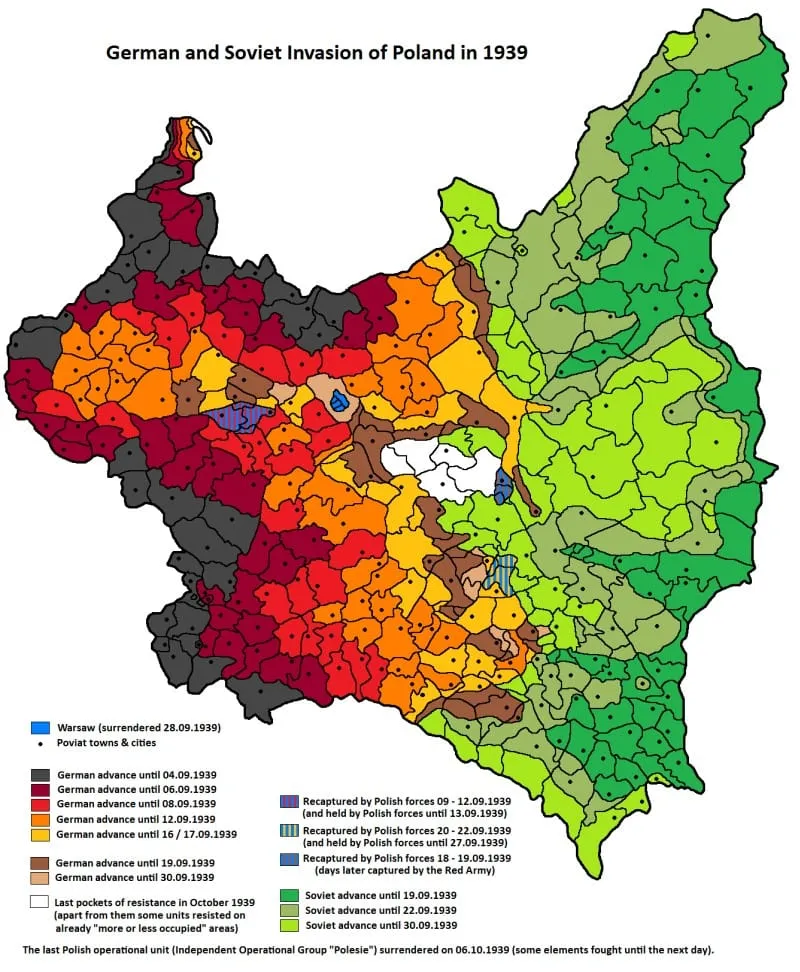
At dawn on 17 September 1939, on the seventeenth day of the war with Germany, the troops of two Red Army fronts crossed Poland’s eastern border along its entire length, from the Dvina to the Dniester. A few hours earlier in Moscow the deputy people’s commissar for foreign affairs, Vladimir Potemkin, had tried to hand the Polish ambassador a note according to which the Polish state had “ceased to exist”. No war was declared. The Soviet Union was carrying out the secret protocol of the Molotov–Ribbentrop Pact of 23 August, which assigned it the eastern part of Poland, and it did so at the very moment when the Polish Army, shattered in its battles with the Wehrmacht, was still trying to defend Warsaw, Lwów (Lviv) and the bridgehead on the Romanian border. From that day Poland was fighting two invaders at once, and its fate in this campaign was sealed.
Three weeks of waiting
The secret protocol of 23 August did not speak openly of war. It merely laid down that in the event of a “territorial and political rearrangement” of the lands of the Polish state, the boundary between the German and Soviet spheres of interest would run roughly along the Narew, the Vistula and the San. When Germany invaded Poland on 1 September, Berlin expected Moscow to occupy its share as quickly as possible. As early as the evening of 3 September the foreign minister, Joachim von Ribbentrop, instructed the ambassador in Moscow, Friedrich-Werner von der Schulenburg, to sound out when the Red Army would move. Joseph Stalin was in no hurry. On 5 September Molotov replied that the time had not yet come. On 7 September Stalin explained to the head of the Comintern, Georgi Dimitrov, that the war was being fought between two groups of capitalist states, which it would be good to see weakened, and that Poland was a fascist state whose destruction would mean one such state fewer.
Meanwhile a covert mobilisation, called “large-scale exercises”, had been under way in the Soviet Union’s western military districts since the beginning of September. The people’s commissar for defence, Kliment Voroshilov, and the chief of the General Staff, Boris Shaposhnikov, prepared directives for two fronts, and on 8 September the people’s commissar for internal affairs, Lavrentiy Beria, issued an order on the operational groups of the NKVD, which were to follow the troops and take over the administration, the archives and the people on lists drawn up in advance. On 9 September Vyacheslav Molotov told Schulenburg that the operation would begin “within the next few days”, but a day later he had to retract: the concentration of troops had fallen behind schedule.
Stalin was waiting for one more thing. In the Far East the war at Khalkhin Gol with Japan was still going on. On 15 September a ceasefire was agreed in Moscow, which came into force the following day. The Soviet Union now had a quiet rear. On 14 September Pravda published an article on the alleged oppression of Ukrainians and Belarusians in Poland, preparing public opinion. Warsaw had been encircled since 15 September, and the Polish forces were falling back towards the Lublin region and the Romanian bridgehead. What remained was to settle on a pretext. Molotov wanted to announce that the Soviet Union had to “protect” the Ukrainians and Belarusians from the Germans. Berlin protested, since such a justification cast Germany as the threat. In the end the formula chosen was that the Polish state had collapsed of its own accord.
At 6 p.m. on 16 September Molotov warned Schulenburg that military action might begin as early as the following day. At about two o’clock in the morning of 17 September the ambassador was summoned to the Kremlin, where Stalin received him in the presence of Molotov and Voroshilov. He declared that the Red Army would cross the border at six in the morning Moscow time along its entire length from Polotsk to Kamianets-Podilskyi, and asked that from then on German aircraft should not venture east of the Białystok–Brest–Lwów line.
The note Grzybowski would not accept
At about three in the morning Moscow time Potemkin summoned the Polish ambassador, Wacław Grzybowski, and read him a note from the Soviet government. It stated that the Polish–German war had “revealed the internal bankruptcy of the Polish state”, that Warsaw no longer existed as a capital, that the Polish government had disintegrated and showed no sign of life, and that the Polish state and its government had therefore “in fact ceased to exist”. With them, the agreements concluded between the Soviet Union and Poland had lapsed. The Soviet government could not therefore remain indifferent to the fate of its “kindred” Ukrainians and Belarusians, left to their fate, and was ordering the Red Army to “take under its protection” their lives and property. The note also announced that it wished “to deliver the Polish people from the ill-fated war”.
Grzybowski refused to accept the note. He replied that the Polish government was functioning on Polish soil, that the army was fighting, and that none of the claims advanced entitled the Soviet Union to break its treaties. According to his account, the note was afterwards delivered to the embassy, and he sent it back. Moscow, holding that Poland did not exist, denied Polish diplomats their diplomatic rights and tried to detain the embassy staff. Their departure was secured only by the dean of the diplomatic corps, the German ambassador Schulenburg.
The note was false on every essential point. The President, the government and the Commander-in-Chief were on Polish territory, near Kołomyja and Kuty on the Romanian border, and Warsaw was holding out. By entering Poland the Soviet Union broke the Treaty of Riga of 1921, which had fixed the common border; the non-aggression pact of 1932, extended in 1934 until the end of 1945; the London Convention for the Definition of Aggression of July 1933; and the obligations arising from its membership of the League of Nations. That same day Molotov repeated the arguments of the note in a radio address to Soviet citizens.
The attack of two fronts
Two fronts formed from the Belorussian and Kiev Special Military Districts invaded Poland. The Belorussian Front (PL) of Army Commander 2nd Rank Mikhail Kovalyov advanced on Wilno (Vilnius), Grodno, Wołkowysk, Białystok and Brest. The Ukrainian Front of Army Commander 1st Rank Semyon Timoshenko moved on Równe, Łuck, Tarnopol, Lwów and Stanisławów and towards the Romanian and Hungarian borders. According to Polish calculations the first echelon comprised some 620,000 men, nearly 4,700 tanks and about 3,300 aircraft. Russian historians give smaller figures for the first day, in the order of 470,000 men, but in the following days the forces on Polish territory kept growing. Fast armoured and cavalry groups were to reach the borders with Lithuania, Latvia, Romania and Hungary as quickly as possible, so as to cut off the Polish units’ escape routes.
There were hardly any troops on the eastern border. The defence plan assumed that in a war with Germany the Soviet Union would remain neutral, so most of the divisions from the east had been sent west. The border was guarded by the Border Protection Corps (KOP), weakened by the transfer of its best battalions to the field armies: by various calculations, somewhere between ten-odd and twenty-odd thousand men scattered among watchtowers and battalions. Many border posts fought to the end, some of them even before dawn, when they were attacked by units of the NKVD border troops. From 17 to 20 September the KOP Sarny Regiment defended the bunkers of the Sarny Fortified Area (PL). Tarnopol and Równe, however, fell on the very first day. In many towns commanders did not know whether the Red Army men were coming as enemies or as allies against the Germans. The Soviets exploited this confusion: at times they gave assurances of a common struggle against the Germans and then surrounded and disarmed the bewildered units.
The decision at Kuty: “do not fight the Bolsheviks”
News that the border had been crossed reached the Commander-in-Chief, Marshal Edward Rydz-Śmigły, in the morning. According to those present, he considered ordering his troops to fight, and also declaring war on the Soviet Union, but politicians advised him against it, among them the prime minister, Felicjan Sławoj Składkowski. They argued that a war on two fronts with a shattered army would only lead to its annihilation, and that a formal state of war with the Soviet Union might complicate relations with Britain and France, which would not declare war on Moscow. On 17 September, most probably at Kuty, Rydz-Śmigły issued the so-called general directive, transmitted by radio that evening:
The Soviets have invaded. I order a general withdrawal to Romania and Hungary by the shortest routes. Do not fight the Bolsheviks unless they attack or try to disarm our units. The task of Warsaw and of the towns that were to defend themselves against the Germans is unchanged. Towns approached by the Bolsheviks should negotiate with them over the withdrawal of their garrisons to Hungary or Romania.
The order failed to reach many units, or reached them late and in garbled form. Where it was known, it caused hesitation and contributed to tens of thousands of soldiers letting themselves be disarmed without a fight. Where the Soviets tried to disarm Polish units, the same directive ordered them to defend themselves. Opinions of the directive differ to this day: some see in it an attempt to save the army from pointless fighting and preserve it for the army being rebuilt in France; others charge it with having disarmed the soldiers morally and delivered them into the hands of the NKVD.
The Polish government did not declare war on the Soviet Union. Prime Minister Składkowski sent a note of protest, and President Ignacy Mościcki, in a proclamation issued at Kosów, spoke of Poland being invaded by two neighbours. Polish diplomatic missions informed the allied governments of the aggression. During the evening and night of 17–18 September, as Soviet tanks drew near to Kuty, the President, the government and the Commander-in-Chief crossed the bridge over the Czeremosz into Romania, where they were interned.
Wilno, Grodno, Lwów
The cities that had not been meant to defend themselves against the Germans were left on their own. Wilno had a few thousand armed soldiers and volunteers. When the first tanks approached the city on the evening of 18 September, Colonel Jarosław Okulicz-Kozaryn (PL) ordered a withdrawal to Lithuania, but some units and volunteers fought on until the morning of 19 September, when the Red Army took the city.
Of the large cities of the eastern borderlands, Grodno held out longest. From 20 to 22 September several thousand soldiers from reserve units, policemen, volunteers, scouts and schoolboys fought Soviet tank brigades, destroying anywhere from a dozen to several dozen tanks with petrol bombs and a handful of light guns. The defence was organised by the deputy mayor, Roman Sawicki, and Major Benedykt Serafin, and later commanded by Brigadier General Wacław Przeździecki. On 22 September, on the road to the Lithuanian border near Sopoćkinie, Red Army men stopped the commander of Corps District III, Brigadier General Józef Olszyna-Wilczyński, and his aide-de-camp, Captain Mieczysław Strzemeski, and shot them before the eyes of the general’s wife.
The Soviets reached Lwów, besieged by the Germans since 12 September, on 19 September. On orders from Berlin the Wehrmacht withdrew from the city, since Lwów lay in the Soviet sphere. On 22 September at Winniki, Major General Władysław Langner signed a protocol handing the city over to the Red Army. It guaranteed soldiers and policemen free passage out of the city, and officers personal freedom and the possibility of going abroad. The Soviets broke it at once. The officers were detained and taken to a camp at Starobilsk, and in the spring of 1940 they were murdered in Kharkiv. On the same day, 22 September, German troops handed Brest-on-the-Bug over to the Red Army.
Units that had not managed to get across the border fought on. The KOP group of Brigadier General Wilhelm Orlik-Rückemann, withdrawing westwards from Polesie, routed units of the Soviet 52nd Rifle Division at the Battle of Szack on 28 and 29 September. On 1 October it was itself broken up at Wytyczno in the Lublin region, and its remnants joined Brigadier General Franciszek Kleeberg’s Independent Operational Group Polesie, which at the end of September fought successful engagements with Soviet units at Jabłoń and Milanów, and on 6 October capitulated to the Germans at Kock.
Crimes
From the first hours of the invasion, Red Army soldiers and NKVD officers killed prisoners of war, policemen, officials and landowners. Propaganda portrayed Polish officers as “lords” and oppressors, and leaflets dropped from aircraft called on soldiers to hand over their officers and on the population to deal with them. A leaflet attributed to the command of the Ukrainian Front exhorted: “With rifles, scythes, pitchforks and axes strike down your age-old enemies – the Polish lords”. After taking Grodno the Soviets, in reprisal for its resistance, shot about 300 defenders and inhabitants according to the findings of Polish historians, among them teenage boys. Some prisoners were killed where the fighting had taken place, and witnesses reported that during the battle prisoners and children were tied to the hulls of tanks as human shields. At Rohatyn, in the first days of the occupation, Red Army men murdered many Polish soldiers and civilians, according to witnesses. After the fighting in the Sarny Fortified Area, captured KOP soldiers were shot; after the Battle of Szack eighteen officers and men were killed in the village of Mielniki; and in Lwów policemen were killed in breach of the capitulation agreement. On 24 or 25 September at Grabowiec in the Lublin region several dozen prisoners were killed, including wounded men and the staff of a military hospital.
The exact number of victims cannot be established. According to estimates cited by the Institute of National Remembrance (IPN), the crimes of the Red Army and the NKVD in September and October 1939 claimed some 2,500 soldiers and policemen and several hundred civilians. The more cautious estimates of Czesław Grzelak speak of about 1,500 killed. In the eastern borderlands the Soviet entry was also exploited by communist armed bands and some Ukrainian nationalists. They attacked retreating soldiers, policemen, settlers and landowners. According to various estimates, between several hundred and several thousand people were killed. Many Ukrainians, Belarusians and Jews, especially the poor, nevertheless greeted the Red Army with relief or hope, which the occupation soon put to the test.
Where the new border ran
It is often said that the Soviet Union seized the lands “east of the Curzon Line, together with the Białystok region and Eastern Galicia”. This is a simplification. The Curzon Line, proposed in July 1920 by the British foreign secretary as an armistice line in the Polish–Soviet War, ran roughly along the Bug through Grodno and Brest, and its course in Eastern Galicia was unclear and disputed. The boundary of the spheres in the secret protocol of 23 August lay much further west, along the Narew, the Vistula and the San, and also gave the Soviet Union part of Mazovia, including the Praga district of Warsaw, and the Lublin region. After 17 September the Wehrmacht, which in many places had crossed this line, withdrew behind it, handing over to the Red Army Białystok, Brest and the area around Lwów with the Borysław and Drohobycz oilfield. Only on 28 September in Moscow did Germany and the Soviet Union change the arrangements: in exchange for Lithuania, Stalin ceded the Lublin region and eastern Mazovia to Germany, and the new dividing line ran along the Pisa, the Narew, the Bug and the San. In the north it put Białystok and Łomża, lying west of the Curzon Line, on the Soviet side, and in the south the whole of Eastern Galicia with Lwów. On its central stretch, along the Bug, it did indeed coincide with the Curzon Line. Moscow later turned this very resemblance into an argument in the disputes over Poland’s eastern border.
Reactions
On 18 September Germany and the Soviet Union issued a joint communiqué stating that their troops had no aims in Poland contrary to the non-aggression treaty, but intended to “restore order and peace” disrupted by “the disintegration of the Polish state”. Britain and France confined themselves to protests. Ambassador Edward Raczyński reminded the Foreign Office that the alliance treaty of 25 August spoke of aggression by “a European power”, but was told that under the secret protocol the obligation applied only to Germany. London and Paris did not want war with a second great power and counted on Stalin’s alliance with Hitler not lasting. Romania, Hungary, Lithuania and Latvia, which took in interned Polish soldiers, also remained neutral towards the Soviet Union.
Significance
The invasion of 17 September decided the September Campaign. The plan to make a stand on the Romanian bridgehead, on the border with allied Romania, through which supplies from the West were to flow, lost its point the moment the Red Army entered its rear. The Polish Army was crushed between two invaders, and some 230,000–250,000 soldiers fell into Soviet captivity, including more than ten thousand officers and policemen, whom the NKVD separated from the rest. By various calculations between 3,000 and 7,000 Polish soldiers were killed in the fighting with the Red Army. Molotov gave Soviet losses in October as 737 killed and 1,862 wounded; Russian historians estimate them at about 1,500 killed and missing.
The Soviet Union seized some 200,000 square kilometres, more than half of Poland’s territory, inhabited by about 13 million people. After coerced elections to “people’s assemblies” on 22 October, these lands were incorporated into the Ukrainian and Byelorussian Soviet Socialist Republics at the beginning of November 1939. In October Stalin handed Wilno and its surroundings to Lithuania, which half a year later served as a prelude to the seizure of Lithuania itself. Occupation began in the eastern borderlands: arrests, Sovietisation and, in 1940–1941, the mass deportation of hundreds of thousands of Polish citizens into the interior of the Soviet Union. In the spring of 1940 the NKVD murdered nearly 22,000 prisoners of war and prison inmates, including officers captured in September, in the Katyn massacre.
On 17 September the Soviet Union in effect entered the war on Germany’s side, although it formally remained neutral towards Britain and France. The cooperation of the two dictatorships lasted until June 1941, when Hitler attacked the Soviet Union and Stalin found himself on the side of the Allies. Poland then had to sign an agreement with Moscow that annulled the arrangements of 1939 but did not settle the borders. The dispute over whether the eastern border should run along the Riga line or the Curzon Line was ended in 1945 at Yalta and Potsdam, as Stalin wished. Throughout the decades of communist Poland it was forbidden to speak of 17 September as an act of aggression. In Polish memory the day, the “stab in the back”, became one of the symbols of September 1939, alongside 1 September.
Sources
Meanwhile
(04)Elsewhere, within a week.
- 18 September 1939 · PoliticsThe Polish government crosses into RomaniaOn the night of 17–18 September 1939 the President, government and Commander-in-Chief crossed into Romania, hoping to reach France. They were interned.
- 18 September 1939 · Military operationsThe escape of Orzeł from TallinnOn the night of 17–18 September 1939 ORP Orzeł, interned in Tallinn, escaped. Moscow said Estonia could not guard its neutrality and began to apply pressure.
- 14 September 1939 · DiplomacyGerman pressure on RomaniaOn 14 September 1939, under pressure from Berlin, Romania resolved to intern Polish leaders if they crossed its border and restricted arms transit to Poland.
- 14 September 1939 · AtlanticThe sinking of U-39On 14 September 1939 U-39 attacked the carrier Ark Royal, but its torpedoes exploded prematurely. Destroyers sank it, the first U-boat lost in the war.
Related events
(04)The same battle, people or subject.
- 19 September 1939 · PolandGerman and Soviet troops meetThe Red Army took Wilno and met the Wehrmacht near Lwów and Brest. On 22 September Guderian handed Brest over to Krivoshein’s tank brigade.
- 28 September 1939 · DiplomacyThe German–Soviet Boundary and Friendship TreatyOn 28 September 1939 Ribbentrop and Molotov signed the Boundary and Friendship Treaty, moving the partition line to the Bug and giving Lithuania to the USSR.
- 28 September 1939 · DiplomacyThe Soviet–Estonian Mutual Assistance PactOn 28 September 1939, under threat of war, Estonia signed a mutual assistance pact in Moscow, giving the USSR bases and the right to station 25,000 troops.
- 23 August 1939 · DiplomacyThe Molotov–Ribbentrop PactOn the night of 23/24 August 1939 Ribbentrop and Molotov signed a non-aggression pact in Moscow. A secret protocol carved up Poland and Eastern Europe.