- Category:
- Military operations
- Front:
- Mediterranean
- Date:
- 10 July 1943
- Author:
- Natalia
- Battle:
- Allied invasion of Sicily
- Tags:
- Italy, United States, United Kingdom, Canada
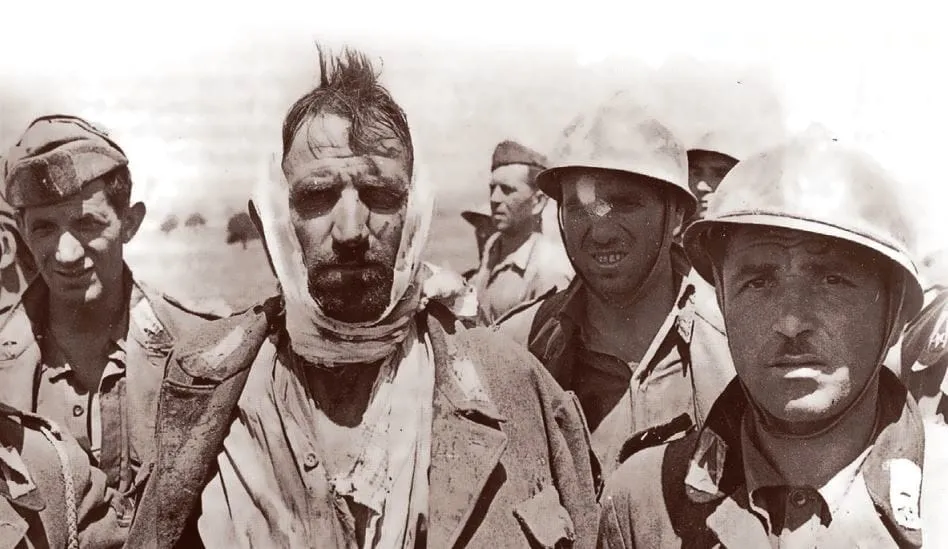
On the night of 9–10 July 1943 hundreds of transport aircraft and gliders flew over the south-eastern coast of Sicily, and soon afterwards, at around 2.45 a.m., the first waves of infantry came out of the sea onto the beaches. So began Operation Husky – the Allied landing in Sicily and the first landing by the Western Allies on Axis territory in Europe. The British Eighth Army of General Bernard Montgomery came ashore on the south-eastern tip of the island, between Cape Passero and the Gulf of Noto, and the American Seventh Army of Lieutenant General George Patton on the south coast, in the Gulf of Gela. On the first day seven divisions landed: three American, three British and one Canadian.
It was the largest amphibious operation of the war up to that time, both in the length of the landing front (some 170 km of coastline and 26 main beaches) and in the number of divisions put ashore on the first day. According to various tallies the invasion fleet numbered from 2,500 to more than 3,000 warships, transports and landing craft, and some 150,000–180,000 troops landed in the first days (estimates vary depending on whether they include second-echelon units). By the evening of 10 July the Allies held secure beachheads on the island and the port of Syracuse, and fears of a massive counter-attack from the air had proved exaggerated.
The road to Sicily
The invasion had been decided upon in January 1943 at the Casablanca Conference. The British argued that a blow against Sicily or Sardinia would force the Germans to disperse their forces, might knock Italy out of the war and would open the Mediterranean to Allied shipping. The Americans, who wanted to land in France as soon as possible, agreed mainly for this last reason: convoys sailing through the Mediterranean instead of around Africa saved an enormous amount of tonnage. In May, at the Trident Conference in Washington, it was confirmed that after Sicily the aim would be to eliminate Italy from the war, and the landing in France was postponed to 1944.
The Supreme Commander was General Dwight Eisenhower, Allied Commander-in-Chief in North Africa. His deputy and commander of the land forces (15th Army Group) was General Harold Alexander; the naval forces were commanded by Admiral Andrew Cunningham, and the air forces by Air Chief Marshal Arthur Tedder. The original plan envisaged dispersed landings at several points on the island, including near Palermo, so as to seize airfields and ports at once. Montgomery criticised it sharply and, at conferences on 2–3 May, pushed through the concentration of the whole effort on the south-eastern corner of Sicily. This meant that for the first weeks the troops would have to be supplied over the beaches, but the risk turned out to be smaller than feared – largely thanks to the new DUKW amphibious trucks, which Alexander later described as having revolutionised the supply of beachheads.
The invasion was preceded by weeks of preparation. British intelligence carried out Operation Mincemeat: the body of a supposed Royal Marines officer was planted off the coast of Spain with a briefcase of forged letters indicating that the Allies would strike at Greece and Sardinia and that Sicily was merely a cover. The Germans believed the documents to be genuine and strengthened the defences of the Balkans and Sardinia. In June the Allies took Pantelleria and Lampedusa, and from May their air forces had been bombing the airfields, ports and railway junctions of Sicily, Sardinia and southern Italy. By July the Axis air forces on the island had been seriously weakened, and Allied fighters could cover the beaches from Malta, Gozo and Pantelleria.
The island’s defenders
Sicily was defended by the Italian Sixth Army of General Alfredo Guzzoni – two corps with a total of some 200,000 Italian troops, roughly half of them in four field divisions and the rest in poorly armed coastal divisions and brigades. There were also some 32,000 German troops on the island and 30,000 Luftwaffe ground personnel. The strongest units were the two German divisions: the Hermann Göring Panzer Division (around 100 tanks, including a company of heavy Tigers, but only three infantry battalions) and the 15th Panzergrenadier Division. Formally they were subordinate to Guzzoni, but in practice they took their orders from the German liaison officer, General Fridolin von Senger und Etterlin, and through him from Field Marshal Albert Kesselring, the German Commander-in-Chief South. Guzzoni’s plan assumed that the coastal units would merely delay the attacker, while the decisive counter-attack would be delivered by the field divisions held back in the interior of the island.
The airborne landings
The first to reach Sicily, just after midnight on 10 July, were paratroopers and glider-borne troops. The weather wrecked the plan: winds of up to 70 km/h blew the aircraft off course, and the inexperienced transport crews, under anti-aircraft fire, lost their way over the blacked-out coast. The American 505th Parachute Infantry Regiment of Colonel James Gavin, part of the 82nd Airborne Division and making its first combat jump, was scattered over several dozen kilometres between Gela and Syracuse. Half the paratroopers failed to reach their assembly points.
The British Operation Ladbroke fared even worse. The 1st Airlanding Brigade of the 1st Airborne Division flew in almost 150 gliders, mostly American Waco CG-4s, towed by C-47 aircraft. Many were released too early, over the sea: some 65–70 gliders came down in the water, and, depending on the source, from just over 200 to around 250 men drowned. Only a handful reached the designated landing zone. Even so, a platoon of the 2nd Battalion, South Staffordshire Regiment, captured the key Ponte Grande bridge near Syracuse and held it until the afternoon; when the defenders, reduced to a dozen or so men, ran out of ammunition, they surrendered to the Italians – less than an hour before the British 5th Division arrived. Scattered groups of paratroopers, acting on their own initiative, cut telephone lines, attacked patrols and spread confusion, which to some extent made up for the failed drops.
The landings from the sea
The same wind that scattered the paratroopers hampered the seaborne landings – the waves were several metres high, many soldiers were seasick, and landing craft ran onto uncharted sandbars. Yet it also brought surprise: many defenders assumed that nobody would dare to land in such weather. Some units came ashore in the wrong places and several hours late, but the resistance of the Italian coastal units was mostly weak, although some battalions fought doggedly.
In the east, the British XIII Corps of General Miles Dempsey landed in the Gulf of Noto, near Avola and Cassibile, and XXX Corps of General Oliver Leese on both sides of Cape Passero, near Pachino. XXX Corps included the 1st Canadian Infantry Division of General Guy Simonds; its participation in the operation had been insisted upon by the Canadian Prime Minister, William Lyon Mackenzie King, who wanted Canadians to take part in land fighting at last. By the evening the British 5th Division had taken Syracuse with its port undamaged; the next day the British set off northwards, towards Augusta and Catania.
In the west, in the American sector, the 3rd Infantry Division of Major General Lucian Truscott captured the port of Licata before noon, losing fewer than a hundred men. In the centre, near Gela, the 1st Infantry Division landed together with the Ranger battalions of Lieutenant Colonel William Darby, which took the town at dawn. The Italians blew up the pier at Gela, and the 429th Coastal Battalion defending the beaches lost almost half its strength. Furthest east, near Scoglitti, landed the 45th Infantry Division of Major General Troy Middleton, which had sailed straight from the United States. On the Axis side it was the air forces that made themselves felt most: German and Italian aircraft sank, among others, the American destroyer USS Maddox (most of her crew were killed), a minesweeper, the tank landing ship LST-313 and the British hospital ship Talamba.
The counter-attacks at Gela
As early as 10 July the Italians tried to drive the Americans back into the sea. Light tanks of the Niscemi tactical group and infantry of the Livorno Division reached the very outskirts of Gela, but they were stopped by the fire of the destroyer USS Shubrick and the cruiser USS Boise, and the Rangers rounded up the rest. The Hermann Göring Division, which was to have attacked at the same time, arrived late, and its attack was halted on the Piano Lupo hills by Gavin’s scattered paratroopers and the 16th Infantry Regiment.
The most dangerous crisis came on the morning of 11 July. Italians of the Livorno Division again attacked Gela from the west, while some 60 German tanks of the Hermann Göring Division in two columns – from Niscemi and from Ponte Olivo airfield – broke through the positions of the 26th Infantry Regiment and came to within about 2 kilometres of the beaches. American tanks, unloaded during the night, were bogged down in the sand of the dunes. Everyone with a weapon was thrown into the firing line – engineers, beach parties, even naval personnel. The attack was broken only by the ships’ guns, directed by observers ashore, the divisional artillery and a few tanks of the 2nd Armored Division. That day the cruiser USS Savannah fired hundreds of shells at the advancing Italian infantry. Patton, who came ashore that day, was seen by eyewitnesses personally pointing out targets for the mortars. By the evening the Axis tanks had withdrawn, and on 12 July the 1st Division took Ponte Olivo airfield.
The tragedy of the 504th
That same day Patton decided to reinforce the Gela beachhead with his reserve – the 504th Parachute Infantry Regiment of Colonel Reuben Tucker from the 82nd Division (less one battalion, which had already jumped with Gavin). The divisional commander, Major General Matthew Ridgway, had warned in advance that the flight path led over the invasion fleet, and orders about the planned flight had been passed several times to the ships and to the troops ashore. But when 144 C-47 transports appeared over the Gulf of Gela late in the evening of 11 July, another German air raid had ended only a few dozen minutes earlier. The first wave dropped its paratroopers unhindered, but then one of the ships opened fire, and soon almost every anti-aircraft gun in the fleet and on the beachhead was firing.
It was one of the worst cases of friendly fire in the history of airborne forces. Twenty-three of the 144 aircraft were shot down and 37 more were damaged; some of the paratroopers died in the burning machines, others jumped far from their objective. According to American figures the losses amounted to 318 killed, wounded and missing, including 83 killed (among the paratroopers alone, 229, including 81 killed); among the dead was the assistant division commander, Brigadier General Charles Keerans. Ridgway cancelled the lift of the glider-borne 325th Regiment planned for the following night. The investigation identified no single culprit – coordination had failed, as had the nerves of gunners after a whole day of air raids. The lessons learnt (better aircraft recognition training, white stripes on the wings of transports, flight corridors) were put to use a year later in Normandy.
The first days
The invasion went better than its planners had feared. On 12 July Kesselring visited Sicily and concluded that most of the Italians had stopped fighting and that the Germans were in practice defending the island alone; he decided to give up the western part of the island and to halt the Allies on a line covering Etna and Messina. On 13 July the British entered Augusta, and on the night of 13–14 July British paratroopers landed near the Primosole bridge on the road to Catania (Operation Fustian), where they ran into German paratroopers who had just been flown in. The fighting of the first days also had a dark side: on 14 July soldiers of the American 45th Division, in two separate incidents near Biscari airfield, murdered a total of some 70 prisoners, almost all of them Italians (the figure most often given is 73) – a crime known as the Biscari massacre. Sergeant Horace West was sentenced by court martial to life imprisonment, but his sentence was remitted as early as 1944, and Captain John Compton was acquitted.
Place in the war
The landing in Sicily opened the Western Allies’ first land front in Europe – at a time when in the east the Battle of Kursk had already been raging for five days. Its effects were soon felt far from the island. On 13 July Adolf Hitler, citing among other things the situation in Italy, called off the offensive at Kursk and began transferring some of his forces to southern Europe. In Italy the collapse of faith in the country’s ability to defend its own territory hastened the crisis of the regime: on 25 July the Grand Council of Fascism and King Victor Emmanuel III removed Benito Mussolini from power, and the new government of Marshal Pietro Badoglio began secretly looking for a way to surrender.
The campaign itself lasted less than six weeks. The Americans made a rapid drive through western Sicily and took Palermo on 22 July, while the British were held up on the Catania plain and had to go round Etna from the west. In August the Germans managed to evacuate some 40,000 troops and much of their equipment across the Strait of Messina, and the Italians some 60,000–70,000 men (about 100,000 in all, according to the most frequently cited estimates). On 17 August Patton’s patrols entered Messina, a few hours ahead of the British. The experience of Husky – both the successful landing on a broad front and the costly mistakes of the airborne operations – became a lesson for the landings in Italy in September 1943 and in Normandy in June 1944.
Sources
Meanwhile
(04)Elsewhere, within a week.
- 12 July 1943 · PacificThe Battle of KolombangaraOn the night of 12–13 July 1943 the Allies sank the cruiser Jintsū, but Japanese torpedoes damaged three Allied cruisers and sank the destroyer Gwin.
- 12 July 1943 · Eastern FrontThe Battle of ProkhorovkaOn 12 July 1943 the 5th Guards Tank Army struck the SS Panzer Corps at Prokhorovka. It lost hundreds of tanks but halted the German advance.
- 13 July 1943 · Eastern FrontHitler calls off Operation CitadelOn 13 July 1943 at the Wolf’s Lair Hitler told Kluge and Manstein he was ending the Kursk offensive. The Red Army was already counter-attacking near Oryol.
- 6 July 1943 · PacificThe Battle of Kula GulfOn the night of 5–6 July 1943 Japanese destroyers torpedoed USS Helena in Kula Gulf. Japan lost two ships but landed its reinforcements.
Related events
(04)The same battle, people or subject.
- 22 July 1943 · MediterraneanThe capture of PalermoOn 22 July 1943 Patton’s Americans entered Palermo. The drive across western Sicily netted some 53,000 prisoners, but its military value was disputed.
- 17 August 1943 · MediterraneanThe end of the fighting in SicilyOn the night of 16–17 August 1943 US patrols entered Messina, and Patton drove in that morning. After 38 days of fighting all of Sicily was in Allied hands.
- 11 August 1943 · MediterraneanThe Axis evacuation of SicilyOn the night of 11–12 August 1943 the Germans began Operation Lehrgang. By 17 August more than 100,000 Axis troops had crossed from Sicily to Calabria.
- 7 May 1943 · MediterraneanThe capture of Tunis and BizerteOn 7 May 1943 British armour of the First Army entered Tunis and Americans of II Corps entered Bizerte. The Axis front in Tunisia broke into isolated groups.