1942: The German summer offensive
Battle of Stalingrad
- Dates:
- 23 August 1942 – 2 February 1943
- Front:
- Eastern Front
- Location:
- Stalingrad (now Volgograd) on the Volga and the steppe between the Don and the Volga, from Kalach-on-Don to Kotelnikovo and the middle DonOn the battle map →
- Sides:
- Nazi Germany, Romania, Italy and HungaryFriedrich Paulus, Hermann Hoth, Maximilian von Weichs, Erich von MansteinSoviet UnionVasily Chuikov, Andrei Yeremenko, Konstantin Rokossovsky, Nikolai Vatutin, Georgy Zhukov, Aleksandr Vasilevsky
- Result:
- Decisive Soviet victory. After three months of street fighting the Red Army encircled the 6th Army and part of the 4th Panzer Army, repulsed the relief attempt and forced the trapped troops to surrender; about 91,000 soldiers were taken prisoner together with Field Marshal Paulus, and the Romanian, Italian and Hungarian armies on the Don were destroyed.
- Author:
- Natalia
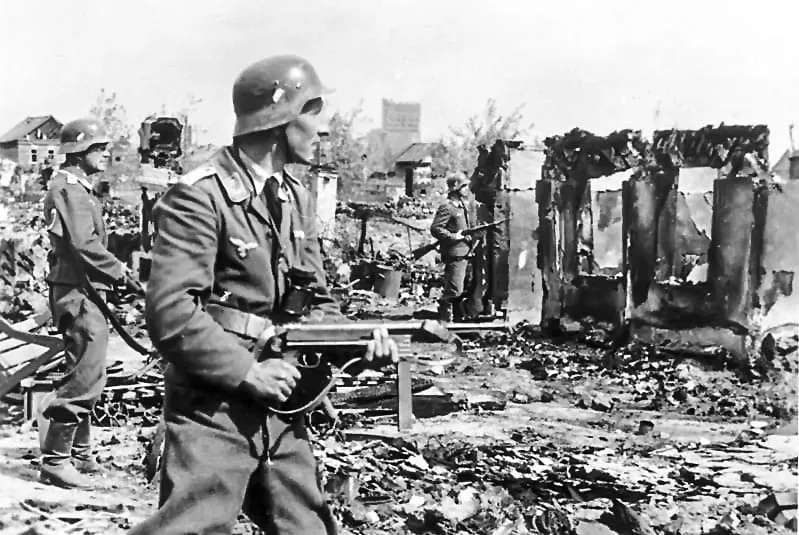
The Battle of Stalingrad was the largest and bloodiest battle of the Second World War and the point at which Germany finally lost the initiative on the Eastern Front. It began on 23 August 1942, when German tanks reached the Volga north of the city and the Luftwaffe turned it into a sea of fire. Over the next three months General Friedrich Paulus’s 6th Army took the ruins of Stalingrad yard by yard from General Vasily Chuikov’s 62nd Army, but it never drove the defenders into the river. On 19 November the Red Army went over to the counter-offensive, smashed the Romanian armies on the flanks and within four days had trapped more than a quarter of a million Axis soldiers in a pocket. Erich von Manstein’s relief attempt stalled a few dozen kilometres from the pocket, the airlift could not deliver even a fraction of the supplies needed, and on 31 January and 2 February 1943 the remnants of the 6th Army surrendered. For the first time in the war an entire German field army had ceased to exist, and its commander, newly promoted to field marshal, went into captivity.
Name and dates
In Polish the battle is called the Battle of Stalingrad, the battle for Stalingrad or the battle at Stalingrad; Soviet and Russian historiography also uses the name “the battle on the Volga”. The city, founded as Tsaritsyn, bore the name of Joseph Stalin from 1925, and in 1961 it was renamed Volgograd. The dates of the battle depend on the perspective adopted. Soviet historiography counts it from 17 July 1942, when the advance guards of the 6th Army clashed on the river Chir with units of the newly formed Stalingrad Front, and divides it into a defensive phase (to 18 November) and an offensive phase (from 19 November to 2 February 1943). The fighting in the great bend of the Don in July and August may also be regarded as part of Case Blue; in a narrower sense the battle begins on 23 August, with the German breakthrough to the Volga and the great air raid on the city, and ends on 2 February 1943 with the surrender of the northern group of trapped troops in the factory district.
Background
Adolf Hitler laid out the summer offensive of 1942 in Directive No. 41 of 5 April. Its main objective was the oilfields of the Caucasus; Stalingrad – a large industrial centre and communications hub on the Volga – was to be reached, or at least brought within artillery range, so as to cut shipping on the river and cover the march into the Caucasus from the north-east. Capturing the city itself was not a primary objective in April. Case Blue, launched on 28 June, brought the Germans rapid progress but no great encirclements: for the first time on such a scale, the Soviet forces were withdrawing eastwards before the pincers could close.
Impressed by these illusory successes, on 23 July – the day his troops entered Rostov – Hitler issued Directive No. 45. It split the forces in the south: Army Group A was simultaneously to occupy the whole of the Caucasus including Baku, while General Maximilian von Weichs’s Army Group B was to take Stalingrad and advance down the Volga to Astrakhan. Two diverging offensives, conducted by armies that had been fighting and marching without a break for a month, stretched the German front several times over, and its flanks on the Don were manned by Germany’s allies. General Hermann Hoth’s 4th Panzer Army, first directed towards the Caucasus, was turned back towards Stalingrad at the end of July to approach the city from the south-west.
For both dictators Stalingrad took on a significance that strategy alone could not justify. The city bore the name of Stalin, who had defended Tsaritsyn here during the Civil War; for Hitler its capture became a matter of prestige, especially once the offensive in the Caucasus began to bog down. On the Soviet side, Order No. 227 – “Not a step back!” – issued on 28 July, was in force, introducing blocking detachments and penal companies. Stalingrad was also the third-largest industrial centre of the USSR: it was home to the Tractor Factory, which built T-34 tanks, the Barrikady arms works and the Red October (Krasny Oktyabr) steelworks, and oil from Baku travelled up the Volga to central Russia. In August the 6th Army destroyed the Soviet forces in the bend of the Don, forced the river and on 21 August seized bridgeheads at Vertyachy, from which it set off for the Volga two days later.
Forces
The striking force was Paulus’s 6th Army, the largest field army of the Wehrmacht, numbering some 250,000–270,000 men in the summer of 1942 in more than twenty divisions, including three panzer and three motorised divisions. From the south came Hoth’s 4th Panzer Army with Romanian divisions, and the whole force at Stalingrad was directed by the commander of Army Group B, General (from 1 February 1943 Field Marshal) Maximilian von Weichs. Air support came from General Wolfram von Richthofen’s Luftflotte 4, then the most powerful air formation in the world, which dominated the skies over the city by day until November. The flanks along the Don were covered by the Italian 8th Army, the Hungarian 2nd Army and the Romanian 3rd and 4th Armies. In the city itself the fighting was done almost exclusively by German units, the exception being the Croatian 369th Infantry Regiment, attached to the 100th Jäger Division. Tens of thousands of Hilfswillige – former Soviet prisoners of war and civilians serving as auxiliaries – also served in the ranks of the 6th Army.
On the Soviet side the defence was conducted by the Stalingrad Front and the Southeastern Front, from 13 August under the single command of General Andrei Yeremenko, with Commissar Nikita Khrushchev on the military council. In the city and on its approaches fought the 62nd Army and, to the south, General Mikhail Shumilov’s 64th Army. Both had been bled white in the fighting on the Don: by various calculations, in mid-September the 62nd Army had 20,000–40,000 men, about 90 tanks and 700 mortars. Throughout the autumn the Supreme High Command (the Stavka) sent across the Volga into the city only as many divisions as were needed to hold the bridgehead, and massed most of its reserves on the flanks for the coming counter-offensive. On the eastern bank of the river stood a powerful artillery force, including Katyusha rocket launchers, which the Germans never managed to silence. The Deputy Supreme Commander, Georgy Zhukov, and the Chief of the General Staff, Aleksandr Vasilevsky, coordinated the operations of the fronts on behalf of the Stavka.
Course of the battle
The approach and the air raid of 23 August
At dawn on 23 August the 16th Panzer Division and the 3rd Motorised Division of XIV Panzer Corps broke out of the bridgehead at Vertyachy on the Don with about 120 tanks and more than 200 armoured personnel carriers. They punched through weak Soviet units, cut the railway to Stalingrad around midday, and in the afternoon, after covering some 60 kilometres, Count Hyazinth Strachwitz’s armoured battlegroup reached the Volga at Rynok and Latashanka in the northern suburbs, near the Tractor Factory. The first to face it were the crews of the 1077th Anti-Aircraft Artillery Regiment – many of them young women – who fired at the tanks over open sights. Workers from the Tractor Factory drove T-34s straight off the assembly line against the Germans, and hastily assembled battalions of workers’ militia halted the attack on the edge of the factory district.
That same afternoon and evening Luftflotte 4 carried out the heaviest air raid yet seen on the Eastern Front. In the course of that day and the days that followed some 1,000 tonnes of high-explosive and incendiary bombs fell on the city. Wooden houses burned, as did the oil tanks along the river and the Volga itself, covered in burning fuel; most of the housing was destroyed. The evacuation of civilians across the river began late and went slowly – according to some historians Stalin did not want it, believing that the presence of the inhabitants would stiffen the will to defend the city – so that several hundred thousand people remained in a city crowded with refugees. The number of victims is disputed: the figure most often given in the literature is about 40,000 dead, some estimates speak of 70,000, and some historians consider these numbers greatly inflated. Yet the Germans held only a narrow wedge on the Volga – a “corridor” from the Don – and over the following days they themselves had to fend off Soviet counter-attacks from the north, from the Kotluban area, which, bloody and unsuccessful though they were, tied down a considerable part of the 6th Army.
September: the assault on the city
During the last week of August and the beginning of September the 6th Army and the 4th Panzer Army pushed the 62nd and 64th Armies back from the outer defence rings. On 3 September the two German groupings linked up west of the city, and the Soviet armies fell back into its ruins, leaving the 64th Army cut off to the south, near Krasnoarmeysk. The Germans also reached the Volga in the southern part of Stalingrad, and from then on they could shell the crossings from both sides of the Soviet bridgehead. Luftflotte 4 was flying 900–1,000 sorties a day at this time. Paulus assured Hitler that the city would fall within a few days, or two weeks at most.
On 12 September command of the 62nd Army passed to General Vasily Chuikov, until then deputy commander of the 64th Army, who had made his name with his energy in the fighting on the Don. Asked by Yeremenko and Khrushchev how he understood his task, he is said to have replied that he would not give up the city or would die in it. Chuikov moved his headquarters to the bluff right above the Volga and introduced a tactic he himself called “hugging” the enemy: keeping the line so close to the Germans – within grenade-throwing distance – that their aircraft and artillery could not strike without risking hitting their own men. The defence came to rest on small assault groups armed with submachine guns, grenades and knives, fighting for individual cellars, floors and ruins.
On 13 September the Germans launched a general assault on the city centre. General Walther von Seydlitz-Kurzbach’s LI Corps attacked the Mamayev Kurgan, marked on maps as Hill 102.0 – an ancient burial mound overlooking the city and the crossings – as well as the main railway station and the central landing stage on the Volga. South of the little river Tsaritsa, XLVIII Panzer Corps attacked. By 14 September the Germans were a few hundred metres from the crossing that supplied the whole army. During the night of 14–15 September General Aleksandr Rodimtsev’s 13th Guards Rifle Division, some 10,000 men strong, some of whom had not been issued rifles before the battle, crossed the river under fire. The guardsmen went straight into the fight for the landing stage, the station and the Mamayev Kurgan. On the first day they lost about 30 per cent of their strength, and of the whole division only a few hundred men survived the battle, but the defence of the centre held.
The Mamayev Kurgan changed hands several times; Soviet troops retook it on 16 September, at the end of the month the Germans again occupied part of it, and the summit remained no man’s land until January. The main railway station changed hands more than a dozen times in a few days. In the south of the city, in a huge concrete grain elevator, a few dozen defenders – guardsmen and naval infantry – beat off the assaults of one German battalion after another for several days; when the Germans finally got inside, they found some forty dead, although they had believed that several hundred men were defending it. By the end of September the Germans held most of the centre and the southern districts, but a narrow strip along the river, more than ten kilometres long, remained in the hands of the 62nd Army, which the Stavka reinforced by night with fresh divisions. According to German assessments, the 71st Infantry Division alone, attacking the centre, saw half of its battalions lose their combat value within twelve days.
October: the factory district
From 27 September the weight of the fighting shifted north to the factory district, where three great plants stretched along the Volga – the Red October steelworks, the Barrikady gun factory and the Dzerzhinsky Tractor Factory – with workers’ housing estates in front of them. After several days of fighting for the estates and the heights above them, Paulus, reinforced with divisions drawn from the flanks, prepared the biggest attack of the entire battle. On 14 October five divisions, two of them panzer divisions, struck on a front of a few kilometres against the Tractor Factory. Luftflotte 4 flew some 1,250 sorties that day, and the Stukas dropped about 550 tonnes of bombs. The attack crushed General Viktor Zholudev’s 37th Guards Rifle Division; in the afternoon the Germans entered the factory halls, and by 15 October they had broken through to the Volga, cutting the 62nd Army in two. North of the breach, Colonel Gorokhov’s cut-off group was still holding out at Rynok and Spartanovka.
Then it was the turn of the Barrikady and the Red October. The halls, cellars, drains and slag heaps of the works became fortresses in which, as Antony Beevor wrote, the fighting was as deadly as at Verdun. Men fought for individual workshops, open-hearth furnaces and overhead cranes; a single hall could change hands several times in a day. Colonel Leonty Gurtiev’s Siberian 308th Rifle Division, according to the war correspondent Alexander Werth, repulsed 117 German attacks in a month. At night fresh divisions and ammunition were ferried across the river, under fire from the bank and from the air, and the wounded were brought back; the Volga Flotilla and civilian tugs paid for this with heavy losses. Chuikov’s headquarters had to move several times because the Germans came within a few hundred metres of it. In the ruins a sniper war developed, of which Vasily Zaitsev became the legend.
The best-known symbol of the defence, however, was a building in the city centre. At the end of September a group of soldiers from the 42nd Guards Regiment of Rodimtsev’s 13th Division, led by Sergeant Yakov Pavlov, occupied a four-storey apartment block on 9 January Square, about 300 metres from the Volga. Reinforced to a few dozen men under Lieutenant Ivan Afanasyev, with machine guns, anti-tank rifles and mortars, surrounded by minefields and linked to the rear by a trench, it held out from 27 September to 25 November. Civilians sheltered in its cellars. Pavlov’s House grew in Soviet propaganda into a symbol of the whole battle; some historians note, however, that German documents do not confirm heavy assaults on the building, and that Soviet military archives did not attach any special importance to it.
By the end of October the Germans had taken most of the Barrikady and a large part of the steelworks, but their offensive had run out of steam. The infantry battalions of the 6th Army dwindled to a few dozen men each, and Paulus had to pull panzer divisions out of the line to rebuild them. The defenders now held only narrow strips along the Volga, in places just a few hundred metres deep, but they were still holding them.
November: the last German attack
At the beginning of November Hitler, who in a speech in Munich on 8 November had claimed that Stalingrad was practically taken and that all that remained were a few small patches, demanded that the bank of the Volga be cleared once and for all. Paulus was given five pioneer battalions, specialists in house-to-house fighting, flown in from other sectors of the front. The attack began at dawn on 11 November on a front of a few kilometres between the Barrikady factory and the Red October steelworks, after a heavy artillery and air bombardment. The pioneers and infantry captured the so-called Commissars’ House and some of the buildings along the river, and on a stretch a few hundred metres wide south of the Barrikady they reached the Volga, cutting the 62nd Army in two for the third time.
Behind the Barrikady, Colonel Ivan Lyudnikov’s 138th Rifle Division was cut off; on a scrap of riverbank measuring roughly 700 by 400 metres – later called “Lyudnikov’s Island” – it held out until the end of November, supplied at night across the river and from the air, even though ice floes were already choking the Volga. The pioneers’ losses were enormous: within a few days many battalions lost more than half their strength. After a few days the attack petered out. The Germans controlled about 90 per cent of the ruins of the city, but the 62nd Army, broken up into several bridgeheads, was still clinging to the right bank, and by various calculations Chuikov had anywhere from just over ten thousand to a few tens of thousands of soldiers in them at most.
By the end of the second week of November the 6th Army was exhausted and at the limit of its strength, with its overextended flanks held by the allies. Meanwhile, north and south of the city, the Stavka had secretly assembled more than a million men and thousands of tanks and guns for a counter-offensive that was to transform the whole battle.
Operation Uranus and the encirclement
The plan for the counter-offensive, worked out in the Stavka from September by Zhukov and Vasilevsky, called for a blow not against the city itself but against the weak flanks of the 6th Army, held by the allied Romanian armies. Operation Uranus began at dawn on 19 November, in fog and a snowstorm, after a ninety-minute artillery bombardment. From the bridgeheads on the Don north-west of Stalingrad, the troops of General Nikolai Vatutin’s Southwestern Front and of the Don Front attacked. The Romanian 3rd Army, poorly equipped with anti-tank weapons and stretched along a wide sector, was broken within a few hours. The German XLVIII Panzer Corps, held in reserve behind it, was too weak to stop the Soviet tank corps.
The next day, 20 November, the armies of Yeremenko’s Stalingrad Front attacked south of the city. There it was the Romanian 4th Army that cracked. The two Soviet spearheads drove to meet each other in the area of the bridge over the Don. On 23 November the leading units from the north and the south linked up at Sovetsky, near Kalach-on-Don, whose bridge had been seized the day before in a daring raid by a detachment of Soviet tanks. The ring was closed.
Trapped in the pocket were the whole 6th Army, part of the 4th Panzer Army, two Romanian divisions, the Croatian regiment and thousands of auxiliaries from the east – in all, by various estimates, between about 250,000 and 330,000 men (the spread depends mainly on whether allies, auxiliaries and wounded are counted; the higher figures usually come from Soviet and Russian historiography). Paulus asked for freedom of action and permission to break out to the south-west while the army still had fuel and ammunition. On 24 November Hitler forbade a withdrawal: the 6th Army was to defend “Fortress Stalingrad” and wait for relief.
The airlift and Winter Storm
Hitler’s decision was underpinned by a promise from Hermann Göring, who assured him that the Luftwaffe would supply the encircled army from the air. The 6th Army needed about 700 tonnes of supplies a day; even the most optimistic airmen thought that at most half of that could be delivered. In practice the average came to about 100 tonnes a day and exceeded 250 tonnes on only a handful of days. The aircraft took off from Tatsinskaya and Morozovsk, landed inside the pocket at the Pitomnik and Gumrak airfields and flew the wounded out. Frost, fog, Soviet fighters and anti-aircraft artillery cost the Luftwaffe several hundred transport aircraft and bombers, and on 24 December a Soviet tank corps burst onto the airfield at Tatsinskaya and destroyed dozens of aircraft. Inside the pocket the bread ration fell to a few dozen grams a day, the soldiers ate their horses, and deaths from exhaustion, disease and frostbite mounted.
To retrieve the situation, at the end of November Hitler formed Army Group Don under Manstein, to whom the 6th Army was also subordinated. Manstein prepared a relief operation, Wintergewitter (Winter Storm). On 12 December LVII Panzer Corps of Hoth’s 4th Panzer Army set off north-east from the Kotelnikovo area along the railway to Stalingrad. Despite fierce resistance and heavy fighting for the crossings on the river Myshkova, the Germans came to within about 48 kilometres of the encircling ring. Paulus, however, made no attempt to break out to meet them: Hitler would not consent to abandoning the city, and the army lacked the fuel and the strength for a march across the snow-covered steppe. Nor did Manstein issue a clear order to break out of the pocket.
The fate of the relief was decided by a blow elsewhere. On 16 December the Southwestern Front launched Operation Little Saturn on the middle Don against the Italian 8th Army and the remnants of the Romanian 3rd Army. The Italian divisions were routed within a few days, and Soviet tank corps drove deep into the rear of Army Group Don, threatening its airfields and Rostov. Manstein had to take the 6th Panzer Division away from Hoth, and on 23 December the relief attack was halted; in the days that followed a Soviet counter-attack threw the Germans back beyond Kotelnikovo. By the beginning of January the front had moved more than 200 kilometres to the west. The 6th Army was on its own.
Operation Ring and the surrender
The destruction of the pocket was entrusted to General Konstantin Rokossovsky’s Don Front. On 8 January 1943 Soviet envoys delivered to Paulus an offer of honourable surrender; on Hitler’s orders it was rejected. On 10 January, after one of the heaviest artillery bombardments of the war, Operation Ring (Koltso) began. The attack from the west quickly crushed the western salient of the pocket. On 16 January the Germans lost Pitomnik airfield, and during the night of 21–22 January Gumrak – the last place where aircraft could land. From then on supplies came down only by parachute, most of them out of reach of the starving soldiers. Tens of thousands of wounded and sick men lay untended in cellars and ruins.
On 26 January units of the 21st Army, attacking from the west, linked up with Chuikov’s 62nd Army near the Mamayev Kurgan, splitting the pocket in two: a southern part in the city centre and a northern part in the factory district. On 30 January, the tenth anniversary of the Nazis’ coming to power, Hitler promoted Paulus to field marshal – in the obvious hope that, since no German field marshal had ever been taken alive, he would take his own life rather than surrender. The next day, 31 January, Soviet soldiers entered the basement of the Univermag department store on the Square of the Fallen Fighters, which housed the headquarters of the 6th Army. Paulus surrendered together with the southern pocket, stipulating that he was doing so as a private person and was not issuing orders to the remaining units.
The northern pocket, under General Karl Strecker, held out for two more days. On 2 February 1943 it too laid down its arms, and the fighting in Stalingrad came to an end. About 91,000 soldiers were taken prisoner, among them 22 generals. The exhausted, sick and frostbitten prisoners were driven on foot to makeshift camps; thousands died of typhus, dysentery and hunger in the very first weeks. Of that whole multitude, only about 5,000–6,000 men returned to Germany after the war – the last of them not until 1955.
Losses
The losses in the Battle of Stalingrad are among the highest in the history of warfare and are still disputed; all the figures must be treated as estimates. According to the study by Grigori Krivosheev’s team, based on Soviet archives, the Red Army lost about 1.13 million men in the two phases of the battle – the defensive (17 July – 18 November 1942) and the offensive (19 November 1942 – 2 February 1943) – including about 479,000 killed, missing or dead from other causes, and about 650,000 wounded and sick. Some researchers consider these figures too low.
Axis losses are usually estimated at 0.5–0.8 million killed, wounded, missing and taken prisoner, allies included. The 6th Army itself, together with the units in the pocket, ceased to exist; several hundred thousand Germans were killed or captured. To this must be added the enormous losses of the Romanian armies, the Italian 8th Army and the Hungarian 2nd Army – the last two were destroyed in offensives that grew directly out of the battle, and their losses are sometimes only partly included in the Stalingrad balance sheet. During the airlift the Luftwaffe lost, by various calculations, some 500 aircraft, several hundred of them transports.
The civilian death toll cannot be calculated precisely. To the heavy losses caused by the August bombing and the belated evacuation must be added the inhabitants who died throughout the autumn and winter in the ruins, from the fire of both sides, from hunger and cold, as well as those deported by the Germans for forced labour. When the fighting ended, only a few thousand living inhabitants were counted in the rubble of the city.
Significance
Stalingrad is regarded as the turning point of the war on the Eastern Front and, for many historians, of the whole Second World War in Europe. For the first time in the war an entire German field army had been encircled and destroyed, and its commander, newly promoted to field marshal, had gone into captivity. The summer offensive of 1942, which was meant to give the Reich the oil of the Caucasus and cut the Soviet Union off from the Volga, ended in defeat, and Army Group A had to pull out of the Caucasus in haste to avoid being cut off. Germany declared three days of national mourning, and Goebbels’s propaganda forged the defeat into a myth of heroic sacrifice; public morale nonetheless slumped visibly, and the “total war” proclaimed in February was a response to the shock.
The battle was a catastrophe for the Reich’s allies as well. Romania lost two armies, Italy most of its expeditionary force in Russia, and Hungary almost the whole of its 2nd Army, destroyed on the Don in January 1943. In Bucharest, Rome and Budapest people quietly began to look for a way out of the war. For the Red Army and Soviet society the victory was an enormous boost to self-confidence, and for the world a sign that Germany could lose. The strategic initiative had not yet passed definitively into Soviet hands: in the winter Manstein managed to stabilise the front and retake Kharkiv, and the final decision came only in the summer of 1943 at Kursk, after which the Germans in the east did nothing but retreat.